Legacy of the Maritime Emperor
Legacy & Lessons
Raja Raja Chola I died in 1014 CE after twenty-nine years of transformative rule. His legacy extends far beyond the boundaries of the Chola empire, shaping Tamil identity, influencing Southeast Asian civilization, and offering timeless principles of dharmic leadership.
The Final Years
In the last years of his reign, Raja Raja Chola I focused on ensuring continuity. He had already associated his son Rajendra as co-regent, training him in the arts of war and governance. The inscriptions from 1012-1014 CE show Rajendra increasingly active in administration, learning from his father the complex machinery of empire.
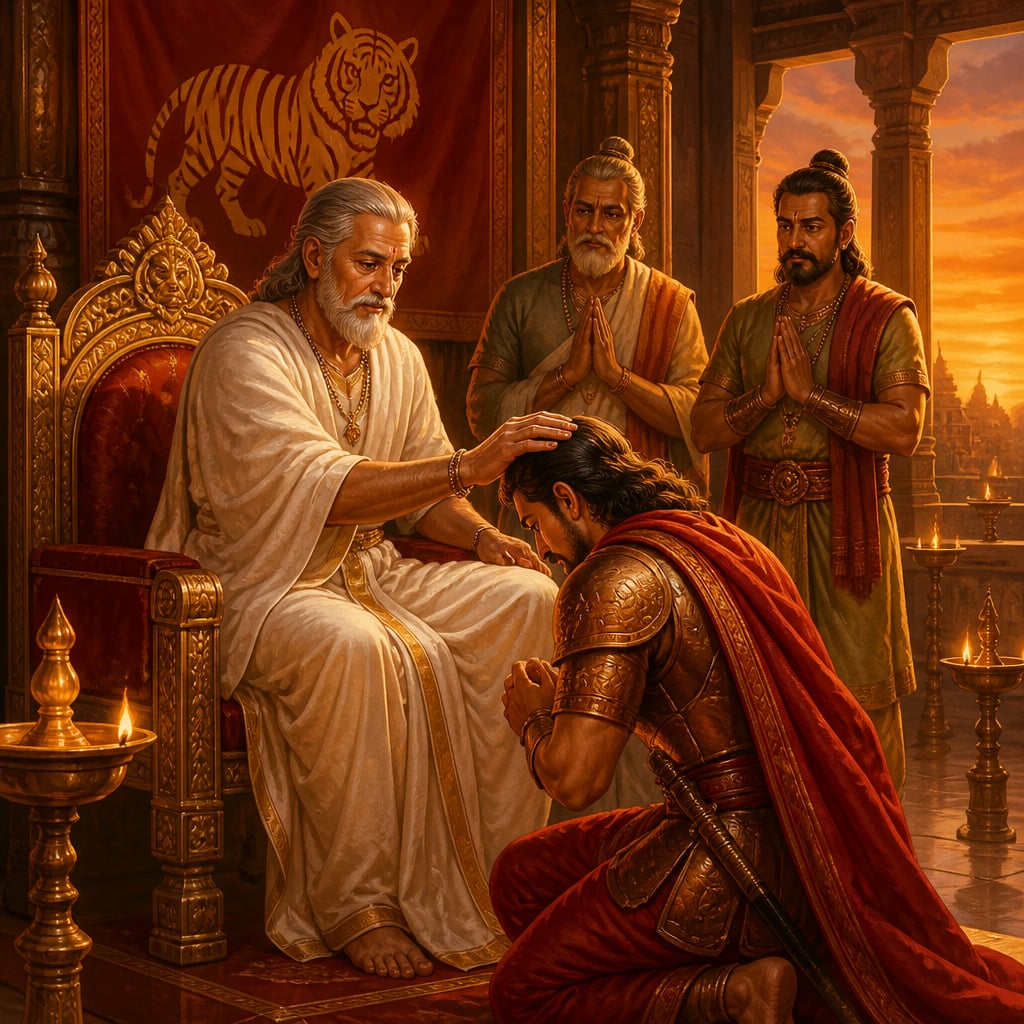
Raja Raja died in 1014 CE, probably in his early sixties. The exact circumstances are unknown, no dramatic battlefield death or palace intrigue, just the quiet passing of a man who had accomplished more than most emperors dream of. He was cremated according to Shaiva rites, and a memorial shrine was established in his honor.
But Raja Raja's true memorial was the empire he left behind: a navy that controlled the Indian Ocean, an administration that functioned with clockwork precision, a temple that still stands after a millennium, and arts traditions that continue to define Tamil culture.
The Son Who Exceeded the Father
Rajendra Chola I, who succeeded his father, would prove that Raja Raja's greatest achievement was not conquest but the creation of systems that could produce further conquest. Rajendra launched the audacious naval expedition to Southeast Asia that his father had prepared for, sweeping through the Malay Peninsula and reaching as far as Sumatra.
More remarkably, Rajendra marched north, not just to Karnataka but all the way to the Ganges, defeating the Pala dynasty of Bengal. He took the title Gangaikonda Chola, "the Chola who conquered the Ganges", and brought sacred Ganga water back to his capital.
This achievement was built entirely on Raja Raja's foundations: the professional army his father had created, the naval capabilities his father had developed, the administrative systems his father had perfected, and the ideology of expansive kingship his father had articulated. A son who surpasses his father is the ultimate testament to good parenting, and good governance.
Tamil Identity Forged
Raja Raja's reign was formative for Tamil identity in ways that persist today. Before him, Tamil speakers were subjects of various competing kingdoms, Pandyas, Cheras, minor Chola chiefs. After him, there was a unified Tamil political identity, a sense of being part of a great civilization that had conquered seas and built wonders.
The Brihadeeswarar Temple became a symbol of what Tamils could achieve, the largest temple of its era, with engineering that still impresses modern architects. The Chola bronzes became markers of Tamil aesthetic excellence, recognized worldwide. The Tevaram hymns, systematized under Raja Raja's patronage, became the soundtrack of Tamil religiosity.
This identity formation was neither accidental nor merely cultural. Raja Raja consciously promoted Tamil alongside Sanskrit, ensuring that inscriptions, administrative documents, and literature all gave dignity to the vernacular. The result was a Tamil high culture that didn't merely imitate Sanskrit models but created its own forms.
When Tamil nationalism emerged in the twentieth century, Raja Raja Chola became its founding hero. The 1,000th anniversary of the Brihadeeswarar Temple in 2010 was a major cultural event, drawing millions to Thanjavur. Statues of Raja Raja stand in public squares across Tamil Nadu. His image appears on everything from political posters to calendar art.
Southeast Asian Connections

Raja Raja's maritime reach planted seeds that flowered across Southeast Asia. Though he didn't conquer these lands directly (that would be Rajendra's achievement), his commercial and diplomatic networks laid the groundwork.
Chola influence is visible in the temple architecture of Angkor Wat in Cambodia, where the towers echo South Indian forms. The Prambanan temples in Java show Chola artistic influence. The very script used to write Javanese, Balinese, and Khmer derives from South Indian scripts that spread during the Chola maritime hegemony.
More subtly, Chola-era trade established the Indian Ocean as a connected zone where ideas, art forms, and religious practices flowed freely. The Hindu-Buddhist culture of Southeast Asia, today visible in Bali, in Thai royal ceremonies, in Cambodian dance, owes much to this era of intensive contact.
Raja Raja understood what later empires would learn: commercial connections often matter more than military conquest. The trader who visits annually influences culture more than the soldier who conquers once. The Chola trading networks, backed by naval power but driven by commerce, reshaped the Indian Ocean world.
Principles of Dharmic Leadership
What can Raja Raja Chola's life teach us about leadership? Not the superficial lessons of "be strong" or "build impressive buildings," but deeper principles that transcend his specific context.
First, inheritance is opportunity, not destiny. Raja Raja received a kingdom already reviving under his predecessors. He could have maintained the status quo. Instead, he saw inheritance as a platform for transformation, not a museum to preserve. He honored his ancestors by exceeding them.
Second, systems outlast individuals. Raja Raja built administrative systems, the ur and sabha village assemblies, the temple economic networks, the land survey methods, that continued functioning centuries after his death. His personal charisma mattered less than the institutions he created. Leaders who invest in systems multiply their impact beyond their lifespan.
Third, hard power and soft power reinforce each other. The navy that conquered Sri Lanka also protected the merchants who spread Tamil culture. The temple that glorified Shiva also employed hundreds of artists who created exportable art forms. Military strength enabled cultural projection; cultural prestige justified military investment.
Fourth, excellence requires concentration. By making Thanjavur the center for the best sculptors, dancers, and musicians, Raja Raja created an environment where talent fed on talent. Dispersed mediocrity cannot compete with concentrated excellence. The lesson applies to building teams, companies, and cities.
Fifth, document everything. Raja Raja's inscriptions recorded not just his conquests but the names of dancers, the details of land grants, the specifications of temple rituals. This obsessive documentation served practical purposes (preventing disputes, ensuring accountability) but also created the historical record that preserves his memory. What isn't recorded is eventually forgotten.
The Temple That Still Stands

Walk into the Brihadeeswarar Temple today and you walk into Raja Raja's vision made stone. The vimana still rises 216 feet, the same height it reached in 1010 CE. The 66-ton capstone still sits atop the tower, placed there by methods we can only partially reconstruct. The inscriptions still line the walls, recording a world of devadasis and generals, land grants and ritual procedures.
Priests still perform puja according to procedures Raja Raja established. The Tevaram hymns he ordered sung are still sung, in the same ragas, at the same times. The bronze images he commissioned are still carried in procession on festival days.
This continuity is not mere antiquarianism. The temple is a living institution, serving an active congregation, performing its function as Raja Raja intended. The permanence he sought was not the permanence of a museum but of an ongoing tradition.
What Remains
Raja Raja Chola I ruled for twenty-nine years in an age without photography, without audio recording, without video. Yet his memory remains vivid. We can visit his temple. We can read his inscriptions. We can watch dancers perform in styles he patronized. We can admire bronzes cast by techniques his sculptors perfected.
More importantly, we can learn from his example. He showed that a regional kingdom could become a maritime empire through naval investment and strategic vision. He demonstrated that material culture, temples, bronzes, music, could project power more durably than armies. He proved that administrative systems, properly designed, could outlast any individual ruler.
The Maritime Emperor left no autobiography, no philosophical treatise, no memoir. But he left something better: a temple that still stands, a culture that still thrives, and an example that still instructs. In the end, that may be the greatest legacy any leader can hope for, not to be remembered, but to have built something worth remembering.
Historical context
Medieval Chola Period (985-1014 CE)
As Raja Raja passed the throne to Rajendra, the Chola empire was at its zenith. To the north, Mahmud of Ghazni's raids had weakened the Pratiharas and Palas. The Cholas were the only major Indian power still expanding, their navy unchallenged in the Indian Ocean.
Living traditions
Raja Raja Chola I is today the preeminent symbol of Tamil imperial glory. His image appears on political party banners, in school textbooks, and as statue installations across Tamil Nadu. The 2010 millennial celebration of the Brihadeeswarar Temple drew millions and received global media coverage. Tamil diaspora communities from Singapore to Toronto organize Raja Raja commemoration events. His example is invoked in discussions of Tamil identity, naval power, and cultural preservation.
- Brihadeeswarar Temple Complex: Raja Raja's supreme monument, now a UNESCO World Heritage Site. The temple remains an active place of worship where rituals continue according to procedures he established. The inscriptions on the temple walls provide the most comprehensive record of his reign.
- Raja Raja Chola Memorial: Traditional site associated with Raja Raja's cremation. A small shrine marks the spot where the Maritime Emperor's mortal remains returned to the elements.
- Gangaikonda Cholapuram: The capital built by Rajendra Chola I to commemorate his northern conquests. The temple here, modeled on the Brihadeeswarar, demonstrates how Raja Raja's vision continued under his son.
Reflection
- What systems are you building that will function without you? What would happen to your work if you disappeared tomorrow?
- Raja Raja is remembered today partly because 20th-century Tamil nationalism chose to celebrate him. What does this suggest about how historical memory works?
- Raja Raja built a temple that still stands and arts traditions that still thrive. What is the relationship between physical monuments and living traditions in preserving a legacy?