Brihadeeswarar Temple

The Builder

Rising 216 feet above the Thanjavur plain, the Brihadeeswarar Temple was the largest and tallest temple the world had ever seen. Raja Raja Chola's masterpiece combined unprecedented engineering, a 66-ton capstone raised without modern machinery, with profound religious symbolism and political purpose. It remains standing after a millennium, a testament to Chola ambition and skill.

The Vision

In 1003 CE, Raja Raja Chola I conceived of something unprecedented: a temple so vast, so tall, so magnificent that it would proclaim Chola power to the ages. Not merely a place of worship but a statement in stone, that the Cholas had achieved what no Indian dynasty before them had accomplished.

The result was the Brihadeeswarar Temple (also called Peruvudaiyar Kovil, the Great Temple), completed in 1010 CE. For over a millennium, it has stood as one of humanity's greatest architectural achievements.
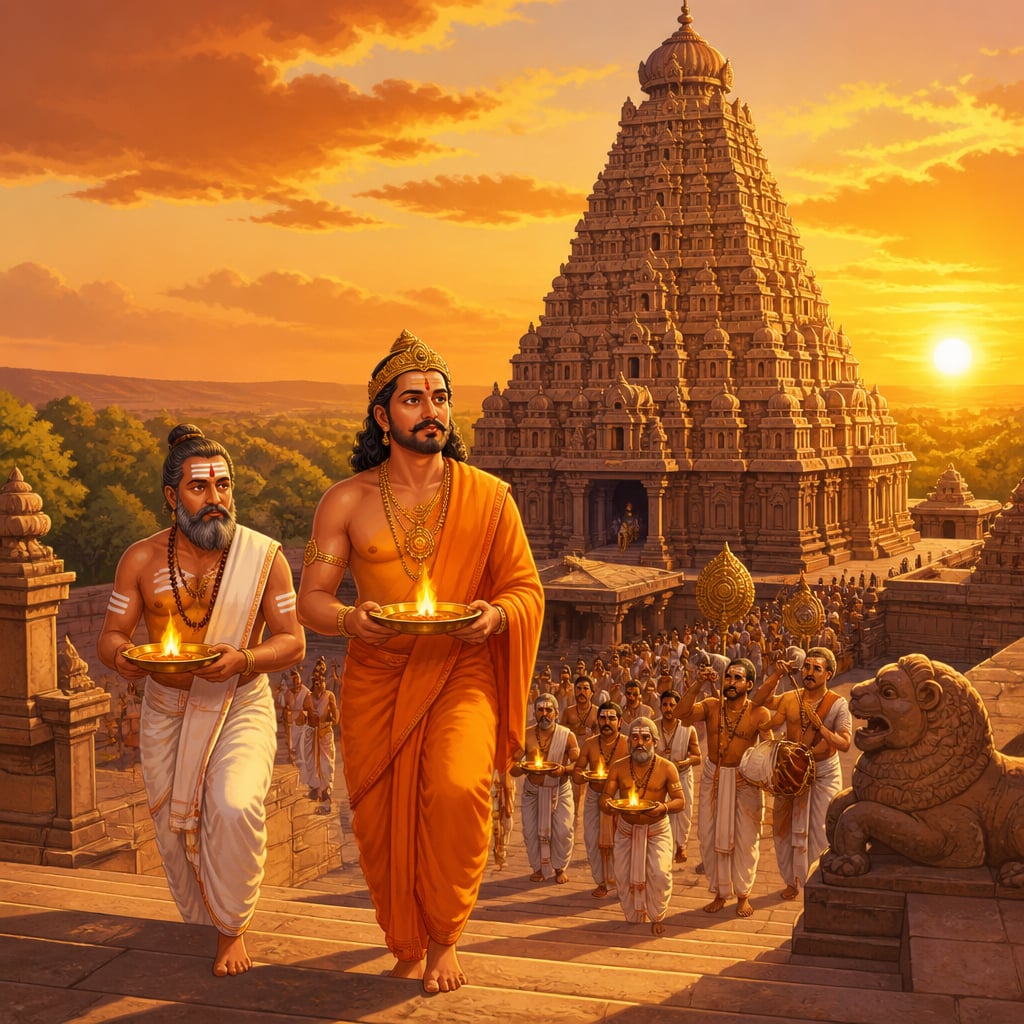
Brihadeeswarar Temple at sunrise in 1010 CE with Raja Raja Chola I leading the consecration procession

Engineering Marvel

The Brihadeeswarar Temple posed engineering challenges that would test modern construction methods. Raja Raja's architects solved them with ingenuity that still amazes engineers today.

The Vimana: Reaching for Heaven

The temple's central tower, the vimana, rises 216 feet (66 meters) above the ground. In an era when most buildings barely exceeded two stories, this was unprecedented.

Structural Challenges:

Challenge Solution
Foundation for massive weight Deep foundation reaching bedrock
Walls to support tower 13-foot thick granite walls at base
Vertical stability Stepped profile reducing weight at each level
Material strength Granite, the hardest building stone

The vimana comprises 13 diminishing stories (tiers), each smaller than the one below. This stepped profile reduces the weight borne by lower sections while creating the soaring vertical impression.

The 66-Ton Mystery

The crowning achievement, literally, is the shikhara (capstone) atop the vimana. This single granite block weighs approximately 66 tons (some estimates say 80 tons). How did Chola engineers raise such a massive stone 200 feet into the air?

The traditional explanation, supported by local geography, is the ramp theory:

Workers hauling 66-ton capstone up earthen ramp

Alternative theories propose lever systems or a combination of methods. Whatever the technique, it represents engineering sophistication matching or exceeding anything in the medieval world.

The Shadow That Never Falls

A remarkable feature: the vimana's shadow never falls on its own base at noon. This required precise calculation of:

Whether this was intentional (symbolic) or a happy consequence of the stepped design is debated, but it demonstrates the mathematical precision underlying the construction.

Materials and Logistics

The temple required approximately 130,000 tons of granite. The nearest granite quarries were 60 kilometers away. Moving this material required:

The logistics alone, coordinating quarrying, transport, construction, and carving, required administrative sophistication matching the engineering achievement.

Architectural Elements

The Nandi

Colossal granite Nandi at Brihadeeswarar entrance

Before the main entrance sits a colossal Nandi (Shiva's bull mount) carved from a single granite block. Measuring 16 feet long and 13 feet high, it weighs approximately 25 tons. The Nandi faces the inner sanctum, eternally gazing at Lord Shiva.

This Nandi is among the largest in India, its size proportionate to the temple it guards.

The Gopuram

The entrance gateway (gopuram) is deliberately smaller than the main vimana, an unusual choice, as later South Indian temples made gopurams the dominant feature. This design choice emphasizes the central shrine's importance.

The Prakaram

The temple sits within a walled prakaram (courtyard) measuring approximately 240 meters by 120 meters. Within this space:

The Lingam

The central shrine houses a massive Shiva Lingam called Peruvudaiyar ("The Great Lord"). Standing approximately 12 feet tall, it is among the largest lingams in South India. The sanctum's design allows light to fall on the lingam only at certain times, creating dramatic visual effects.

Religious Significance

The Brihadeeswarar Temple was not merely a building but a theological statement.

Shaiva Supremacy

Raja Raja was a devout Shaiva (worshipper of Shiva). The temple proclaimed Shaiva theology in stone:

The Nayanmars

The temple includes images of the 63 Nayanmars, the Tamil Shaiva poet-saints whose devotional hymns form the core of Tamil Shaivism. By honoring these saints, Raja Raja connected his temple to the living Tamil religious tradition.

Ritual Program

Raja Raja established an elaborate ritual schedule:

The inscriptions detail exactly how much rice, oil, ghee, and other materials were allocated for each ritual, a complete operational manual carved in stone.

Political Purpose

Great temples are never merely religious. The Brihadeeswarar Temple served multiple political functions:

Legitimacy

By building the largest temple ever constructed, Raja Raja demonstrated that the Cholas had surpassed all previous dynasties. The Pallavas, Pandyas, and Chalukyas had built great temples, but nothing approached this scale.

Royal Presence

The temple housed a massive bronze image of Raja Raja himself in a worshipping posture. Kings who came after would literally pray in the presence of the emperor who built this monument. His name, inscribed thousands of times, would be recited as long as the temple stood.

Economic Hub

The temple received enormous land grants producing substantial revenue. This wealth was distributed through:

The temple became an economic engine, redistributing royal wealth throughout the community.

Administrative Center

Temple walls served as bulletin boards for royal decrees. The thousands of inscriptions record not just donations but administrative orders, legal decisions, and organizational procedures. The temple was government as much as religion.

The Construction

Timeline

Construction began around 1003 CE and was completed in 1010 CE, approximately seven years for a project of unprecedented scale. By comparison:

The Chola achievement was not just building big but building fast.

Labor Force

No records specify the workforce size, but estimates suggest thousands of workers:

The Architect

Tradition credits an architect named Kunjaramallan Rajaraja Perunthachan ("the great architect named after the elephant and the king"). While details of his life are scarce, the temple's engineering excellence testifies to extraordinary skill.

Art and Sculpture

Every surface of the Brihadeeswarar Temple bears carved imagery:

Wall Sculptures

Paintings

The inner walls of the prakaram originally featured extensive frescoes depicting Shaiva mythology. Many have faded or been damaged, but conservation efforts have revealed remarkable medieval paintings.

Bronze Images

The temple housed numerous Chola bronzes, the finest examples of Indian metal sculpture. These include:

Legacy

The Brihadeeswarar Temple's influence extends far beyond its walls:

Architectural Standard

The temple established the model for all subsequent South Indian temple architecture. Its proportions, design principles, and engineering solutions were studied and emulated for centuries.

UNESCO Recognition

In 1987, UNESCO designated the temple a World Heritage Site as part of the "Great Living Chola Temples" (which also includes Gangaikondacholapuram and Darasuram temples). The citation recognizes both architectural achievement and continuing religious use.

Living Temple

Unlike many ancient monuments, Brihadeeswarar remains a functioning Hindu temple. Daily worship continues as it has for over 1,000 years. The rituals Raja Raja established still unfold within these walls.

Engineering Study

Modern engineers and architects continue to study the temple's construction techniques. How did medieval builders achieve such precision without modern surveying equipment? How did they calculate loads and stresses without computer modeling? The temple poses questions that fascinate technologists even today.

A Thousand Years

Consider what the Brihadeeswarar Temple has witnessed:

Through all this history, the temple has stood, damaged occasionally, repaired when needed, but never destroyed. Earthquakes, invasions, and the simple passage of time have not brought it down.

This durability was deliberate. Raja Raja built for eternity. The engineering conservatism, the massive foundations, the quality of materials, all reflect an intention to create something permanent.

A thousand years later, his intention has been fulfilled. The Brihadeeswarar Temple stands as India's greatest surviving monument to the ambition of a single ruler, and to the skill of the architects, engineers, and workers who turned that ambition into stone.

Historical context

Peak of Chola Power (1003-1010 CE)

The early 11th century saw contrasting fates across India. While Mahmud of Ghazni was destroying temples in the north (including Somnath), Raja Raja was building the largest temple ever constructed. The Chola south experienced peace and prosperity that funded unprecedented cultural achievement.

Living traditions

Brihadeeswarar Temple appears on Indian currency and in countless cultural references. Engineering schools study its construction techniques. Architects cite its proportions as exemplary. The UNESCO designation in 1987 recognized it as part of 'Great Living Chola Temples.' Modern laser scanning and 3D modeling continue to reveal new details about its construction. Every visitor to Thanjavur experiences what Raja Raja built over a millennium ago.

Reflection

More in Raja Raja Chola I

All lessons in Raja Raja Chola I · Great Emperors: Revival & Resistance course