Vākyapadīya: Philosophy of Language and Meaning
Bhartṛhari on meaning and cognition, Sphota theory and modern semantics
Explore Bhartṛhari's Vākyapadīya on meaning and cognition, the Sphota theory (the 'burst' of understanding), and connections to modern semantics and cognitive linguistics.
Vākyapadīya: Philosophy of Language and Meaning
How do we understand language? When you hear or read a sentence, what happens in your mind? Is meaning something that builds up word by word, or does it flash into awareness as a unified whole? These questions, central to modern cognitive science and linguistics, were explored with remarkable depth by Bhartṛhari (c. 450-510 CE) in his masterwork, the Vākyapadīya ("On Sentences and Words").
Bhartṛhari's philosophy offers nothing less than a complete theory of language, mind, and reality, one that anticipates and sometimes surpasses modern approaches to semantics, pragmatics, and the philosophy of language.
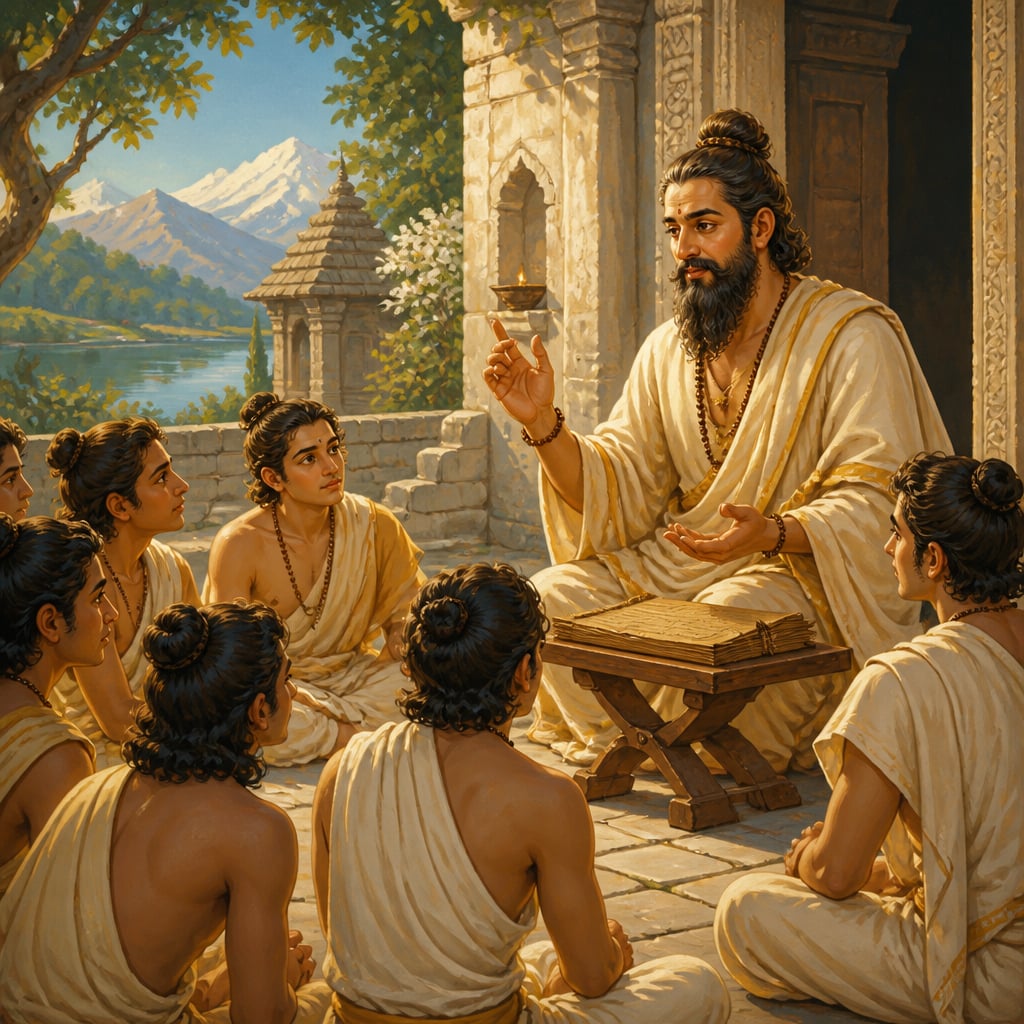
The Central Question: What Carries Meaning?
Consider the sentence: "The cat sat on the mat."
How do you understand it? One view says you first understand "the," then "cat," then "sat," and so on, finally combining these meanings into a whole. This is the building-block model of meaning, dominant in much of Western linguistics and philosophy.
Bhartṛhari challenges this fundamentally. He argues that you don't actually understand the sentence by understanding its parts first. Rather, understanding comes as an indivisible flash, what he calls pratibhā (intuitive insight). The meaning of the whole sentence is primary; the meanings of individual words are abstractions we derive afterward.
This might seem counterintuitive, but consider: Can you understand "the" without knowing what sentence it's in? Can you understand "cat" without context? Meanings aren't really independent atoms that combine mechanically, they're aspects of unified wholes that we analyze into parts only reflectively.
The Sphota Theory: The Burst of Meaning
At the heart of Bhartṛhari's philosophy is the concept of sphota (स्फोट), literally, "that which bursts forth" or "revelation."
When we hear a word, we hear a sequence of sounds: /k/ /æ/ /t/. These sounds are physical events, happening one after another. But the meaning isn't in the sounds themselves, meaning is something that "bursts forth" in consciousness, triggered by but not identical with the sounds.
Bhartṛhari distinguishes:
Dhvani (ध्वनि) - The physical sound, which is sequential, temporal, and perishes as soon as it's produced
Sphota (स्फोट) - The meaning-bearing linguistic unit, which is eternal, indivisible, and apprehended in a flash of understanding
The dhvani (sound) merely manifests the sphota; it doesn't create or constitute it. Just as a lamp reveals objects in a room but doesn't create them, sounds reveal meanings but don't generate them.
This has profound implications. If meanings were just built from sounds sequentially, learning language would be impossible, each sound would pass before the next arrives. Instead, sounds accumulate as saṃskāras (impressions) until, reaching completion, they trigger the sphota, the unified meaning that flashes into awareness.
Three Levels of Language

Bhartṛhari describes language operating at three levels:
Paśyantī (पश्यन्ती - "seeing" speech): The deepest level, where thought and word are completely unified. At this level, there is no distinction between the speaker's intention and its expression, they are one. This is pre-linguistic thought, the unverbalized intention before it takes any specific form.
Madhyamā (मध्यमा - "middle" speech): Thought taking linguistic form internally, before vocalization. Here, the speaker has formulated the thought in language but hasn't yet spoken. This is "inner speech", the voice in your head when you think in words.
Vaikharī (वैखरी - "corporeal" speech): Actual physical utterance, sounds produced by the speech organs and heard by the ear. This is what we ordinarily call "language."
Communication involves moving from paśyantī through madhyamā to vaikharī (for the speaker), and from vaikharī through madhyamā back toward paśyantī (for the listener). Perfect communication occurs when listener and speaker meet at the paśyantī level, achieving genuine understanding of intention.
Vākya-sphoṭa: The Sentence as Primary
Bhartṛhari argues for what we might call semantic holism, the primacy of the sentence over the word. The sentence (vākya) is the fundamental unit of meaning; words (pada) are analytical abstractions from sentences.
Consider how children learn language. Do they first learn isolated words and then combine them? Not really. They learn in context, hearing whole utterances and gradually learning to identify recurring patterns. "Mamma" isn't learned as an isolated word but as part of meaningful situations.
This aligns with modern usage-based linguistics, which emphasizes that language is learned through exposure to whole utterances in context, not through memorizing vocabulary and rules separately.
Bhartṛhari identifies four theories about the sentence-word relationship, arguing for the fourth:
- Saṃghāta-vākya - The sentence is a collection of words
- Krama-vākya - The sentence is words in sequence
- Pada-vākya - Each word is itself a sentence
- Akhaṇḍa-vākya - The sentence is an indivisible whole (Bhartṛhari's view)
Śabda-Brahman: Language as Ultimate Reality
Bhartṛhari makes an extraordinary metaphysical claim: language is not merely a tool for describing reality, language IS reality at its deepest level. The universe is, at its core, Śabda-Brahman (Word-Absolute).
This isn't mere mysticism. Bhartṛhari argues that all our knowledge, all our thought, all our experience is structured by language. We cannot think without language; we cannot know without concepts that are inherently linguistic. Even our perception of the world is shaped by the categories our language provides.
If this sounds similar to the Sapir-Whorf hypothesis or Wittgenstein's observations about language and thought, it should. Bhartṛhari was exploring this territory over a millennium before Western philosophers arrived at similar insights.
Kāla-Śakti: Language and Time
One of Bhartṛhari's subtlest contributions is his analysis of time and its relation to language. He argues that kāla (time) is a power (śakti) that enables differentiation and sequence, it's what allows the one to appear as many, the eternal to manifest as temporal.
Language perfectly exemplifies this. The sphota is eternal and indivisible, but it manifests through sounds that occur in sequence. Time is what makes this manifestation possible, it's the medium through which the timeless becomes temporal.
This has implications for understanding both language and reality. The sequential nature of speech doesn't mean meaning is sequential; it means eternal meaning takes temporal form to become communicable.
Pratibhā: Intuitive Understanding
When we understand a sentence, how does it happen? Bhartṛhari uses the term pratibhā (प्रतिभा), often translated as "intuition" but meaning something more specific: the flash of insight by which meaning becomes present to consciousness.
Pratibhā is:
- Non-inferential: We don't deduce meaning through logical steps
- Immediate: It happens in a flash, not gradually
- Holistic: We grasp the whole meaning, not parts that we combine
This accords with phenomenological observations about understanding. When you understand a sentence, you don't experience yourself assembling meaning from parts, meaning simply appears, whole and complete.
Āgama and the Authority of Language
Bhartṛhari takes seriously the āgama (authoritative linguistic tradition). Language isn't arbitrary, it embodies accumulated wisdom about how to categorize and communicate about reality. The grammatical tradition (especially Pāṇini's) represents not mere convention but deep insight into the structure of language and thought.
This doesn't mean language can't change or that all traditional usages are correct. Rather, it means that mastery of language, including its grammatical and semantic structure, is itself a form of knowledge, not merely a practical skill.
Modern Resonances

Bhartṛhari's ideas resonate remarkably with several modern developments:
Holistic Semantics (Quine, Davidson): The idea that meaning is determined at the level of whole language-systems, not individual words, echoes Bhartṛhari's vākya-sphoṭa doctrine.
Usage-Based Linguistics (Tomasello, Langacker): The emphasis on learning language through whole utterances in context parallels Bhartṛhari's view of sentences as primary.
Embodied Cognition: The three levels of speech (paśyantī → madhyamā → vaikharī) anticipate modern views about the embodied, multi-level nature of linguistic processing.
Linguistic Relativity: Śabda-Brahman, the view that thought is inherently linguistic, connects to debates about whether language shapes thought.
Gestalt Psychology: The sphota as a unified whole that isn't reducible to its parts parallels Gestalt principles about perception.
The Vākyapadīya's Structure
The Vākyapadīya is divided into three books (kāṇḍas):
Book I - Brahma-kāṇḍa (On Brahman): Establishes the metaphysical framework, Śabda-Brahman, the nature of language and reality, the authority of grammar.
Book II - Vākya-kāṇḍa (On the Sentence): Analyzes the sentence as the primary unit of meaning, discusses the sentence-word relationship, addresses how understanding occurs.
Book III - Pada-kāṇḍa or Prakīrṇaka (On Words/Miscellaneous): The longest book, analyzing specific linguistic categories: substance and quality, action, time, person, number, gender, and more.
Bhartṛhari wrote his own commentary (Vṛtti) on Books I and II, and the text attracted extensive commentary from later scholars.
Language Learning and Teaching
Bhartṛhari's views have implications for language pedagogy. If meaning is holistic and sentences are primary, then:
- Language should be taught in context, not as isolated vocabulary
- Grammar should emerge from meaningful communication, not precede it
- Understanding comes through exposure to whole utterances, not rule-memorization
These principles align with modern communicative approaches to language teaching.
The Challenge of Translation
Reading Bhartṛhari in translation raises a paradox he would appreciate. If meaning is bound up with specific linguistic forms, can his ideas truly transfer across languages? Sanskrit technical terms like sphota, pratibhā, and vākya carry networks of association that "burst," "intuition," and "sentence" don't capture.
This very difficulty illustrates one of his key points: language isn't a transparent medium for transmitting pre-linguistic thoughts. The language in which you think shapes what you can think.
Legacy and Influence
Bhartṛhari influenced virtually every subsequent Indian philosopher who dealt with language. The Nyāya, Mīmāṃsā, Vedānta, and Buddhist traditions all engaged with his ideas, sometimes accepting, sometimes challenging them.
In the modern period, scholars like K.A. Subramania Iyer, Harold Coward, and Bimal Krishna Matilal brought Bhartṛhari into conversation with Western philosophy of language. Today, researchers at institutions worldwide study the Vākyapadīya not merely as history but as a living contribution to philosophical understanding of meaning and mind.
Conclusion: Why Bhartṛhari Matters
Bhartṛhari matters because the questions he asked remain our questions: What is meaning? How does understanding happen? What is the relationship between language, thought, and reality?
His answers may not be final, but they offer alternatives to assumptions we might not have known we were making. The idea that sentences are primary, that meaning bursts forth whole, that language structures reality, these aren't self-evident truths, but neither are their opposites. Bhartṛhari shows us that fundamental questions about language have been asked with sophistication across cultures, and that the Western tradition has not exhausted the possibilities.
In a world increasingly shaped by language technologies, from machine translation to large language models, understanding the deepest questions about how language works matters more than ever. Bhartṛhari, writing fifteen centuries ago, remains a guide to these perennial questions.
Key figures
Bhartṛhari
Philosopher of Language
Patañjali (Grammarian)
Author of Mahābhāṣya
Maṇḍana Miśra
Synthesizer of Bhartṛhari and Vedānta
Case studies
The Sphota Controversy: A Millennium of Debate
Bhartṛhari's sphota theory sparked one of the longest philosophical debates in history - over a thousand years of rigorous argumentation. Buddhist philosophers like Dharmakīrti rejected sphota entirely. They argued that positing an eternal meaning-bearer beyond physical sounds was unnecessary metaphysical extravagance. Sounds, they claimed, suffice to explain meaning through their ability to eliminate misconceptions (apoha). Mīmāṃsā philosophers took a middle position. They accepted that sounds instantiate something beyond momentary particulars, but they identified this with the phoneme-type (varṇa), not Bhartṛhari's holistic sphota. Naiyāyikas (logicians) attacked the sphota from multiple angles: How can something eternal be manifested by temporal sounds? If the sphota is one, why do different pronunciations communicate it? How can what's already known (the eternal sphota) become known again? Defenders like Maṇḍana Miśra and later grammarians responded with increasingly sophisticated arguments. The debate refined everyone's understanding of meaning, reference, universals, and cognition - even those who rejected sphota developed their own theories more carefully because of it.
Productive disagreement advances understanding. Even theories that are ultimately rejected can be valuable for the responses they provoke.
The knowledge demonstrated in this case study contributed to the broader legacy of Indian linguistics and logic (Shabda Shastra), influencing developments across Asia and eventually the world.
Ancient Indian scientific traditions produced practical, empirically validated knowledge that remains relevant to modern practice.
Academic philosophy today still features century-long debates on consciousness, free will, and the nature of meaning. The sphota controversy shows that sustained, rigorous disagreement is productive, not wasteful. Each generation's critique sharpens the theory, creating intellectual infrastructure that future thinkers build upon.
Panini's Ashtadhyayi contains 3,959 rules that formalize Sanskrit grammar with a precision that anticipated modern formal language theory.
Bhartṛhari Meets Wittgenstein: Meaning and Use
In the mid-20th century, Ludwig Wittgenstein revolutionized Western philosophy of language with his observation that 'meaning is use' - words don't have fixed meanings but acquire meaning through their use in what he called 'language games.' When scholars began comparing Wittgenstein with Indian philosophy, striking parallels with Bhartṛhari emerged. Both philosophers: - Reject the idea that words name pre-existing mental 'ideas' - Emphasize the role of context in determining meaning - See language-use as a kind of practice or activity (vyavahāra) - Question the assumption that meaning can be atomized into components Yet there are differences. Bhartṛhari's Śabda-Brahman is a metaphysical thesis that Wittgenstein would likely reject. And Wittgenstein's anti-essentialism about meaning contrasts with Bhartṛhari's notion of eternal sphotas. These parallels and divergences have sparked a productive cross-cultural philosophical conversation that continues today, with scholars exploring what each tradition can learn from the other.
Cross-cultural philosophical comparison isn't about finding identical views but about illuminating what each tradition takes for granted.
The knowledge demonstrated in this case study contributed to the broader legacy of Indian linguistics and logic (Shabda Shastra), influencing developments across Asia and eventually the world.
Ancient Indian scientific traditions produced practical, empirically validated knowledge that remains relevant to modern practice.
Wittgenstein's 'meaning is use' philosophy directly influenced pragmatic approaches to AI and natural language processing. Modern chatbots and language models learn word meaning from usage patterns in training data, implementing computationally what both Bhartrhari and Wittgenstein described philosophically.
20th century - referenced in the context of Bhartṛhari Meets Wittgenstein: Meaning and Use.
Neural Binding and the Flash of Understanding
Cognitive neuroscience has uncovered what's called the 'binding problem': How does the brain unify separately processed features (color, shape, motion) into coherent perceptions of objects? And similarly for language: How do separately processed phonemes become unified word-meanings, and how do word-meanings become unified sentence-meanings? Recent research suggests that neural synchronization - the coordinated firing of neurons across different brain regions - may be the mechanism of binding. When we understand a sentence, there's a moment of neural synchronization that corresponds to the integrated comprehension. This is intriguingly reminiscent of Bhartṛhari's pratibhā - the flash of understanding in which meaning appears as a unified whole. The sphota, triggered by but not identical with the sequential sounds, might correspond to the integrated neural representation that emerges from binding. Researchers at labs studying language processing have begun explicitly drawing on Bhartṛhari's framework as a way of articulating what neural data might mean. The sphota provides a conceptual vocabulary for thinking about how distributed processing gives rise to unified understanding.
Ancient philosophical concepts can provide frameworks for interpreting modern scientific findings - conceptual tools don't have expiration dates.
The knowledge demonstrated in this case study contributed to the broader legacy of Indian linguistics and logic (Shabda Shastra), influencing developments across Asia and eventually the world.
Ancient Indian scientific traditions produced practical, empirically validated knowledge that remains relevant to modern practice.
The 'binding problem' in neuroscience, how the brain unifies separate sensory features into coherent perception, is one of consciousness research's deepest open questions. Bhartrhari's sphota theory, describing how discrete sounds unite into a flash of meaning, offers a philosophical framework that neuroscientists working on binding and integration continue to find relevant.
Panini's Ashtadhyayi contains 3,959 rules that formalize Sanskrit grammar with a precision that anticipated modern formal language theory.
Historical context
5th-6th century CE
Living traditions
Bhartṛhari's ideas continue to inspire research in linguistics, cognitive science, and philosophy. Annual conferences on Indian philosophy of language regularly feature papers on sphota theory. Sanskrit departments worldwide teach the Vākyapadīya. Most significantly, Bhartṛhari's questions about meaning, mind, and language remain at the cutting edge of contemporary inquiry.
- Sampurnanand Sanskrit University
- Deccan College Post-Graduate Research Institute
- University of Texas at Austin
- SOAS University of London
Reflection
- When you understand a sentence, does understanding feel like it builds up word by word, or does it come as a unified flash? What does your own experience suggest about Bhartṛhari's claim?
- Can you think without language? Bhartṛhari claims all cognition is 'shot through with language.' Do you agree? What would non-linguistic thought even be like?
- The sphota is said to be eternal, though sounds are momentary. Does it make sense to speak of meanings as eternal? What would that mean?