Pāṇini's Machine: The World's First Formal Grammar
4,000 sūtras as a 'program' for generating Sanskrit, why computer scientists study Pāṇini
Explore Pāṇini's Aṣṭādhyāyī, 4,000 sūtras that function as a 'program' for generating all valid Sanskrit words, his meta-rules (paribhāṣā) and recursion, and why computer scientists study this 2,400-year-old work today.
Pāṇini's Machine: The World's First Formal Grammar
In the 4th century BCE, in the region of Gandhāra (modern northwestern Pakistan and eastern Afghanistan), a scholar named Pāṇini completed a work that would not be fully appreciated for over two millennia. The Aṣṭādhyāyī, "Eight Chapters", contained approximately 4,000 sūtras (rules) that together formed something unprecedented in human history: a complete, formal grammar capable of generating every valid Sanskrit word and sentence.
This wasn't a grammar book in the modern sense, a collection of usage examples and style guidelines. This was something far more precise: an algorithm. A set of rules so complete and so carefully ordered that they function like a computer program. Feed in a root word and a desired meaning, follow the rules in sequence, and out comes the correctly formed Sanskrit word.
When 20th-century computer scientists began developing formal language theory, they discovered that Pāṇini had anticipated their work by 2,400 years.
The Problem Pāṇini Solved
Sanskrit is an extraordinarily complex language. A single verb root can generate hundreds of forms through combinations of tense, mood, voice, person, and number. The root kṛ (to do/make) alone produces over 500 different verb forms. Add prefixes, suffixes, and compound words, and the possibilities become astronomical.
Before Pāṇini, Sanskrit grammar was taught through long lists of examples, exceptions, and memorized patterns. This approach worked but was inefficient, students had to memorize vast amounts of material, and even then might encounter unfamiliar forms.
Pāṇini's genius was recognizing that beneath this apparent chaos lay deep patterns. Rather than listing every possible word, he could describe the rules that generate words. This shift, from enumeration to generation, from data to algorithm, marks one of humanity's great intellectual leaps.
The Architecture of the Aṣṭādhyāyī
The Aṣṭādhyāyī is organized with engineering precision:
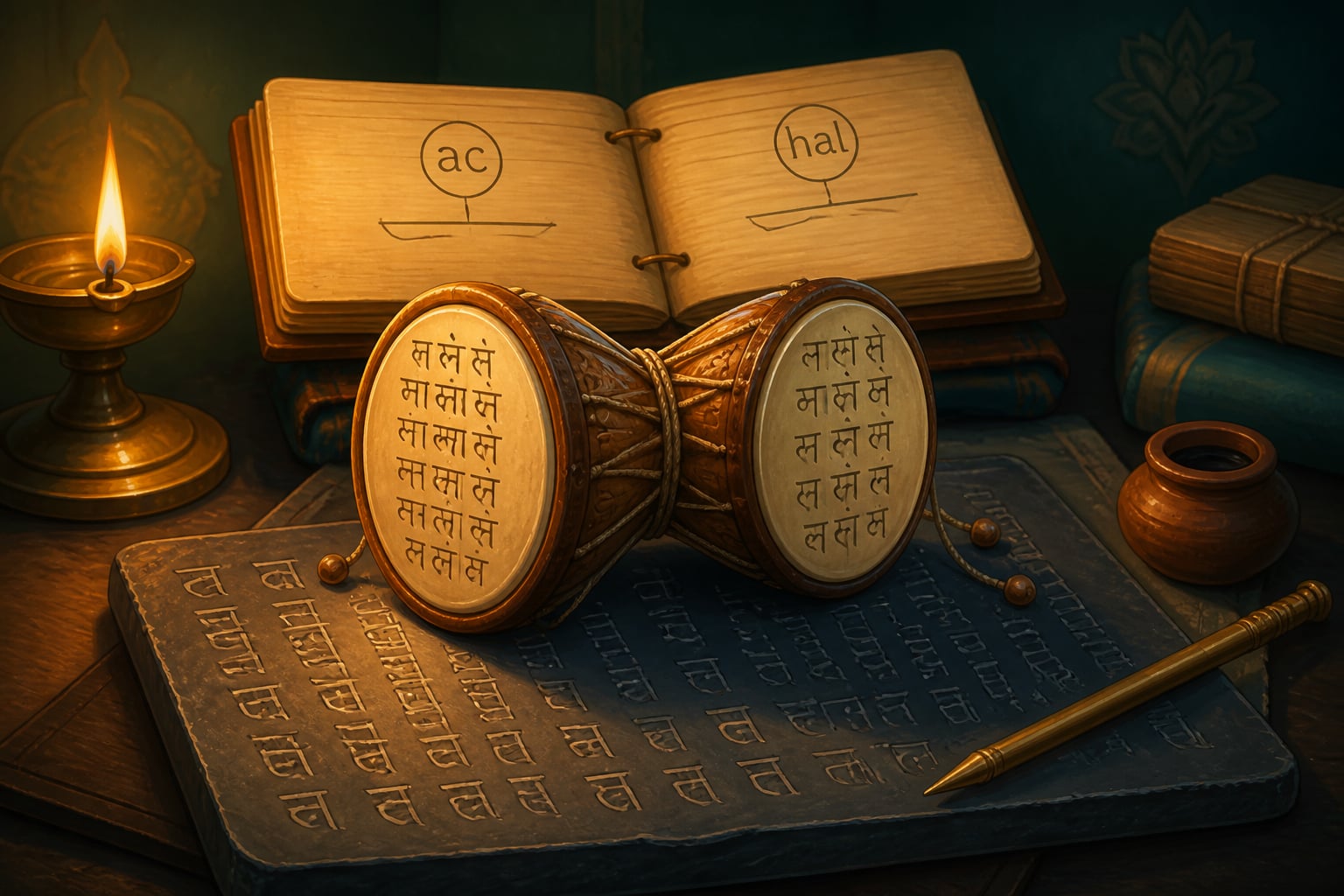
The Śivasūtras (Alphabet Arrangement) Before the grammar proper, Pāṇini arranges the Sanskrit sounds into 14 groups using the Śivasūtras (also called Māheśvara Sūtras). This isn't the familiar alphabetical order, it's a functional grouping that allows him to refer to classes of sounds efficiently. By combining the first sound of one sūtra with the final marker of another, he creates shorthand notations (pratyāhāras) that can specify any subset of sounds.
For example, ac refers to all vowels, hal refers to all consonants, and jhal refers to a specific subset of consonants. This is data compression, reducing hundreds of explicit references to compact codes.
The Sūtras (Rules) The 4,000 sūtras are divided into eight chapters (adhyāyas), each with four sections (pādas). The rules are organized so that each sūtra can inherit context from previous rules, a technique computer scientists call "scope" or "context inheritance."
Many sūtras are remarkably compact. The famous sūtra vṛddhir ādaic ("vṛddhi consists of ā, ai, and au") defines a technical term in just two words. The brevity is intentional: these rules were meant to be memorized, and every syllable saved reduced the burden on students.
Meta-Rules (Paribhāṣās) Pāṇini includes rules about how to apply rules. These paribhāṣās specify:
- When one rule takes precedence over another
- How to handle conflicts between rules
- Default assumptions that apply unless overridden
In modern programming, we call these "meta-rules" or "operator precedence." Pāṇini invented them.
The Dhātupāṭha (Root List) Supporting the Aṣṭādhyāyī is the Dhātupāṭha, a list of approximately 2,000 verb roots with their meanings. This functions like a database: the grammar rules operate on these roots to produce actual words.
How the Grammar Works: An Example
Let's trace how Pāṇini's system generates a simple word: pacati ("he/she cooks").
Step 1: Root Selection From the Dhātupāṭha, select the root pac (to cook).
Step 2: Apply Verbal Suffixes For present tense, third person singular, active voice, the rules specify the suffix -ti.
Step 3: Apply Connecting Rules Additional rules specify that a connecting vowel a (called vikaraṇa) is inserted between root and suffix for this verb class.
Step 4: Apply Sandhi Rules Rules for sound combination ensure the pieces fit together smoothly: pac + a + ti = pacati.
The beauty is that this same process, with different parameters, generates pacāmi (I cook), pakṣyati (will cook), apacata (cooked), and hundreds of other forms, all from the same root, all following the same rules.

Recursion and Self-Reference
Pāṇini's grammar includes recursive rules, rules that can apply to their own output. This allows for the generation of compound words of arbitrary length. In Sanskrit, you can theoretically create compounds that string together dozens of elements, each addition following the same formation rules.
This is precisely what computer scientists mean by "recursive grammar." Noam Chomsky's work on generative grammar in the 1950s, foundational to modern linguistics and computer science, follows principles Pāṇini had already codified.
The Zero Element: Lopa
Pāṇini introduced the concept of lopa, a morpheme that is "present" but realized as zero (silence). When a rule calls for deleting a sound, Pāṇini doesn't just say "delete it." He says it's replaced by lopa, a null element that occupies a position without producing sound.
This might seem like philosophical hair-splitting, but it's computationally profound. By treating deletion as replacement-with-nothing, Pāṇini maintains structural consistency in his rules. Modern linguists and computer scientists use the same concept: the "null string" or "empty element" that allows uniform rule application.
Why Computer Scientists Study Pāṇini

In 1959, the computer scientist John Backus developed a notation for describing programming language syntax, later refined by Peter Naur. The "Backus-Naur Form" (BNF) became the standard for defining programming languages.
Scholars quickly noticed that BNF bore striking resemblance to Pāṇini's system. Both use:
- A finite set of rewrite rules
- Recursive definitions
- Context-free generation of strings
- Meta-rules for rule application
Some researchers have argued that Pāṇini's grammar is actually more sophisticated than BNF, incorporating context-sensitive features that BNF cannot express.
Today, Pāṇini's work is studied at Stanford, MIT, and universities worldwide, not as historical curiosity but as a living contribution to computational linguistics. His techniques inform:
- Compiler design: Programs that translate code follow Pāṇinian principles
- Natural Language Processing: AI systems that parse human language use similar rule hierarchies
- Formal verification: Proving that programs are correct uses logic Pāṇini pioneered
The Oral Tradition: Memorization and Transmission
The Aṣṭādhyāyī was composed for oral transmission. Students memorized all 4,000 sūtras along with extensive commentaries. This wasn't mere rote learning, students had to understand the rules well enough to apply them correctly to any word.
The compression Pāṇini achieved was essential. Every unnecessary syllable in a rule meant additional burden on memory. The famous saying ardhamātrālāghavena putrotsavaṃ manyante vaiyākaraṇāḥ, "Grammarians celebrate like at a son's birth when they can save half a syllable", captures this drive for economy.
This constraint forced elegance. Like a poet working within strict meter, Pāṇini had to find the most efficient possible formulation for each rule. The result is a grammar that is simultaneously minimal and complete.
The Tradition After Pāṇini
Pāṇini's work inspired a tradition spanning millennia:
Kātyāyana (3rd century BCE) wrote Vārttikas, critical annotations pointing out gaps and ambiguities in the Aṣṭādhyāyī. His work represents early peer review: systematic criticism that improved the original.
Patañjali (2nd century BCE) composed the Mahābhāṣya, "Great Commentary", a massive work that defended Pāṇini against Kātyāyana's criticisms while acknowledging valid points. This three-way dialogue (Pāṇini, Kātyāyana, Patañjali) became the foundation of Sanskrit grammatical study.
Later Commentators, Bhartṛhari, Jinendrabuddhi, Kaiyaṭa, and dozens of others, continued elaborating the tradition for over a thousand years. Each generation found new implications in Pāṇini's compact sūtras.
The Algorithm of Preservation
Pāṇini's grammar served a practical purpose: preserving Vedic Sanskrit in its pure form. By the 4th century BCE, spoken Sanskrit was evolving. Without a fixed standard, the sacred Vedic texts might become incomprehensible.
The Aṣṭādhyāyī froze classical Sanskrit in place. Any word could be checked against the grammar; any deviation identified. This gave Sanskrit stability unmatched by other ancient languages, texts written in Pāṇinian Sanskrit remain accessible to modern readers in a way that Homeric Greek or Biblical Hebrew do not.
This preservation function continues today. Traditional scholars still learn Pāṇini's grammar, still generate and analyze Sanskrit using his rules. The algorithm keeps running, 2,400 years after its creation.
Key figures
Pāṇini
c. 4th century BCE
Patañjali (Grammarian)
c. 2nd century BCE
Kātyāyana
c. 3rd century BCE
Case studies
The Oral Tradition: How Compression Enabled Preservation
[4th century BCE - Present] Before writing became widespread, all knowledge had to be memorized. A student learning Pāṇini's grammar would need to store 4,000 sūtras plus extensive commentaries entirely in memory. Yet the tradition survived intact for over two millennia, transmitted from teacher to student without significant degradation. How was this possible?
The key was compression. Pāṇini's extreme brevity - removing every unnecessary syllable - reduced the memory burden dramatically. A verbose grammar might require 100,000 words; Pāṇini achieved the same coverage in perhaps 4,000. But compression alone wasn't enough. The rules also had internal logic: understanding why a rule works made it easier to remember than arbitrary memorization. Students didn't just memorize; they internalized a system.
Modern software engineers face similar constraints: code must be maintainable, memory-efficient, and elegant. The best code, like Pāṇini's sūtras, achieves maximum function with minimum redundancy. The saying 'less is more' has deep computational roots.
Constraints drive innovation. The 'limitation' of oral transmission forced Pāṇini to achieve unprecedented compression and systematization. What seemed like a handicap produced a superior result.
Data compression algorithms used in ZIP files, video streaming, and database storage apply the same principle: eliminate redundancy to minimize storage while preserving all information. Panini's grammar was, in essence, a compression algorithm for an entire language, optimized for the 'storage medium' of human memory.
Panini's Ashtadhyayi contains 3,959 rules that formalize Sanskrit grammar with a precision that anticipated modern formal language theory.
When Computer Science Met Ancient Grammar
In the 1950s and 1960s, computer scientists were developing formal notations for programming language syntax. John Backus and Peter Naur created 'Backus-Naur Form' (BNF), a notation for specifying formal grammars. Meanwhile, linguist Noam Chomsky was developing his hierarchy of formal grammars. When scholars examined these modern formalisms alongside Pāṇini's ancient work, they found striking parallels.
Both Pāṇini and modern formal language theorists discovered the same fundamental structures: rewrite rules, recursion, context-sensitivity, and hierarchy of complexity. Pāṇini's pratyāhāras function like regular expressions; his sūtras like production rules; his anuvṛtti like scope inheritance. The convergence suggests these structures are inherent to the nature of language itself - Pāṇini discovered them empirically, modern theorists axiomatically, but the destination was the same.
Every compiler that translates programming code, every parser that processes web pages, every autocomplete that suggests words - all use techniques Pāṇini pioneered. The smartphone in your pocket runs on Pāṇinian principles.
Deep truths can be discovered through different paths. Rigorous empirical observation (Pāṇini studying Sanskrit) and axiomatic mathematical reasoning (Chomsky, Backus, Naur) converged on the same formal structures.
Every programming language compiler uses formal grammars to parse code, directly inheriting the tradition of rule-based language description. Python, JavaScript, and Rust all have formal specifications that follow patterns Panini would recognize: a finite set of rules generating an infinite set of valid expressions.
Panini's Ashtadhyayi contains 3,959 rules that formalize Sanskrit grammar with a precision that anticipated modern formal language theory.
The Grammar That Settled Philosophical Debates
[8th-12th century CE] During the medieval period, Indian philosophers engaged in intense debates about reality, knowledge, and liberation. Buddhist, Jain, and Hindu thinkers competed to establish their views. Remarkably, all sides agreed on one thing: Pāṇini's grammar was authoritative. Philosophical arguments regularly turned on precise grammatical analysis - what exactly does this sentence mean? What are its components? Pāṇini's grammar provided the shared analytical framework.
The Aṣṭādhyāyī became infrastructure - a neutral tool that all intellectual traditions used. Buddhist logicians analyzed Sanskrit using Pāṇini's categories even while rejecting Hindu theology. This shows how a rigorous formal system can transcend its origins, becoming a shared resource for diverse purposes.
Modern science works similarly: scientists may disagree on theories but share mathematical notation, statistical methods, and experimental protocols. These shared tools enable productive debate rather than mere assertion.
Technical rigor creates common ground. When a system is precise and complete enough, it becomes a neutral tool that even opponents can share. Pāṇini's grammar enabled productive disagreement because all parties used the same analytical vocabulary.
Shared technical standards enable productive disagreement in modern contexts too. Scientists who disagree about climate policy can still share data formats, statistical methods, and peer review processes. Neutral infrastructure for communication, whether grammatical or digital, allows substantive debate to happen.
Panini's Ashtadhyayi contains 3,959 rules that formalize Sanskrit grammar with a precision that anticipated modern formal language theory.
Historical context
Late Vedic to Early Classical Period (5th-2nd century BCE)
Living traditions
Every time a compiler translates your code into machine instructions, every time autocomplete suggests a word, every time a search engine parses your query, Pāṇinian principles are at work. His formal rule systems anticipated modern computer science by over two millennia. The Aṣṭādhyāyī is studied at major universities worldwide not as ancient history but as living contribution to computational linguistics, formal language theory, and artificial intelligence. In India, traditional grammar schools continue unbroken chains of teaching stretching back to Pāṇini's own students.
- Śālātura (Lahur), Pakistan: Traditional birthplace of Pāṇini. Though ancient ruins are sparse, the village maintains awareness of its connection to the great grammarian. Archaeological surveys have identified mounds that may date to Pāṇini's era.
- Varanasi Sanskrit Pathshalas: Traditional Sanskrit schools (pathshalas) in Varanasi continue to teach Pāṇini's grammar using oral methods little changed from ancient times. Students memorize sūtras and learn to generate words using Pāṇini's rules.
- MIT Computer Science and Artificial Intelligence Laboratory: MIT researchers have studied Pāṇini's grammar in relation to computational linguistics, formal language theory, and AI. The library holds significant collections on Sanskrit computational linguistics.
- Oxford University Sanskrit Library: Houses important manuscripts and early printed editions of the Aṣṭādhyāyī. The Boden Professor of Sanskrit position, established in 1832, has maintained continuous study of Pāṇini's grammar.
Reflection
- Pāṇini achieved compression by inventing technical vocabulary and shorthand notations. Modern programming uses similar techniques. What are the trade-offs between using specialized terminology (efficient but requires training) versus plain language (accessible but verbose)?
- The constraint of oral transmission forced Pāṇini toward extreme elegance. Can constraints in general lead to better outcomes? Think of examples from your own experience where limitations produced unexpected benefits.
- Pāṇini's grammar was designed to preserve Sanskrit unchanged. Is linguistic preservation valuable, or should languages evolve freely? What do we lose when languages change, and what do we gain?