The Universal Vision

Seeing the big picture

Arjuna asks to see Krishna's cosmic form - and receives far more than he bargained for. The Vishvarupa reveals the entire universe within one being: creation and destruction, beauty and terror, all times and all places at once. This vision of radical interconnection permanently shifts how we see reality.

The Universal Vision: Seeing the Big Picture

'Show Me'

Arjuna has been listening. He's heard about the eternal Self, the paths of action and knowledge, the promise of simple devotion. Now something stirs in him - a desire not just to understand but to see.

"You have described your glories," Arjuna says to Krishna. "You have told me how you pervade all things. But I want to see it. If you think I'm capable of bearing it - show me your cosmic form."

It's a bold request. Arjuna isn't asking for more teaching. He's asking for direct experience.

Krishna pauses. Then he says something that changes everything:

"Behold now, Arjuna, the entire universe - moving and unmoving - all in one, here in my body. And whatever else you wish to see."

But then a warning:

"You cannot see me with your ordinary eyes. I give you divine vision. Behold my sovereign power."

What Arjuna Saw

What follows is one of the most extraordinary passages in world literature.

Sanjaya, the narrator, struggles to describe what Arjuna perceives. He reaches for metaphor:

"If a thousand suns were to rise at once in the sky, that radiance might resemble the splendor of that great-souled One."

A thousand suns. And even that is inadequate.
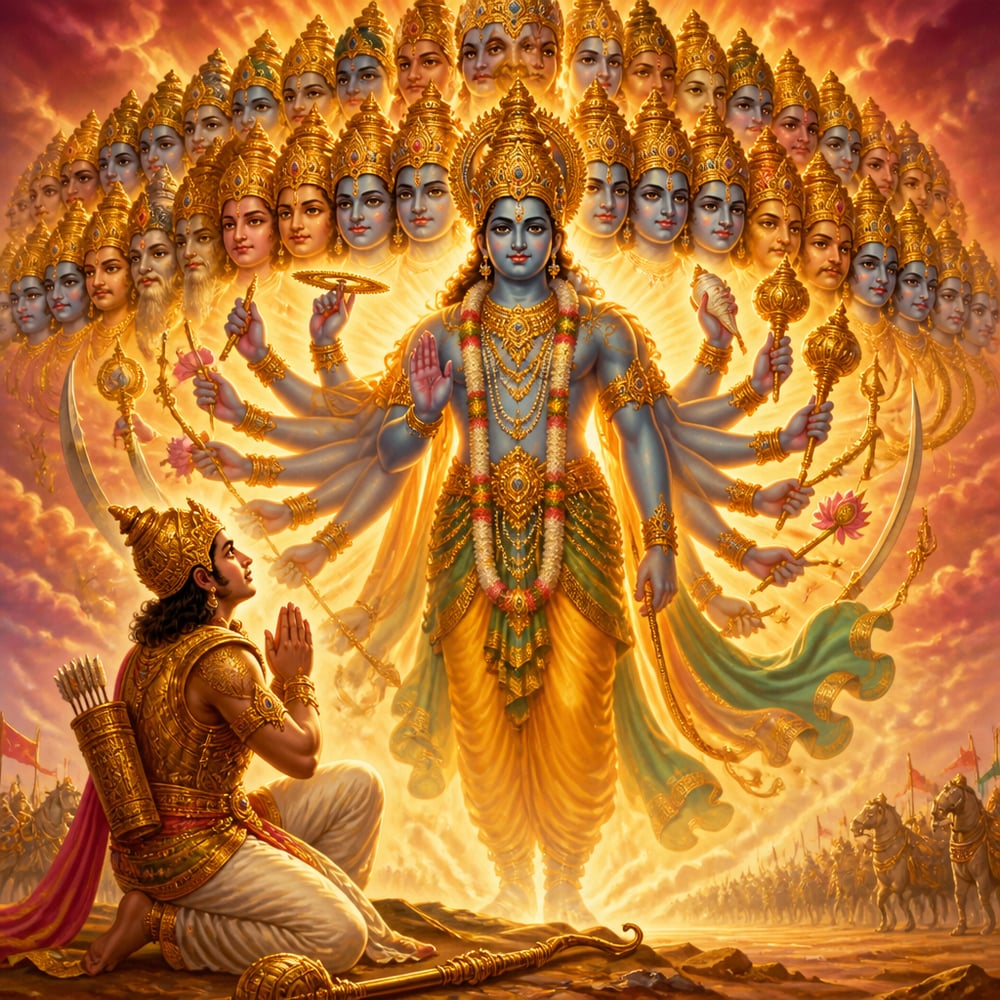
Krishna's Vishvarupa form blazing like a thousand suns with Arjuna kneeling before it.

Arjuna sees the infinite contained in one form. He sees all the gods, all beings, all worlds. He sees the past, present, and future simultaneously. He sees creation and destruction happening at once - things being born and dying in the same cosmic moment.

The universe isn't 'out there.' It's all within this single vision - Brahma the creator on his lotus, Shiva among the sages, mountains of fire, the endless ocean of existence.

Arjuna sees something else too: the warriors on both sides of the battlefield - Bhishma, Drona, Karna, all of them - being drawn into mouths lined with terrible teeth, crushed between cosmic jaws.

The vision is not only beautiful. It is terrifying.

Krishna as Kala devouring the warriors of both armies in the cosmic vision

'I Am Time'

Arjuna, trembling, asks: "Who are you in this terrible form? I bow to you, great god. Have mercy. I wish to understand you, Primal One, for I do not comprehend your purpose."

Krishna's answer echoes through history:

"I am Time, the mighty destroyer of worlds, now engaged in destroying. Even without you, none of these warriors arrayed in hostile armies shall survive."

Kala - Time. The force that transforms all things. The cosmic process that builds civilizations and crumbles them to dust. The power before which nothing stands.

Krishna isn't saying he enjoys destruction. He's revealing a truth: everything that exists is already passing. The warriors' fate is sealed not by Arjuna's arrows but by the nature of existence itself. Time devours all.

This is both terrifying and strangely liberating. Arjuna isn't the one who decides life and death. He's participating in a process infinitely larger than himself.

Too Much to Bear

Arjuna's response is raw:

"Seeing this form of yours with many mouths and eyes, many arms, thighs, and feet, many bellies, many terrible teeth - the worlds tremble, and so do I."

He lists what he sees: blazing colors, gaping mouths, fiery eyes. The sight is consuming him.

"Tell me who you are. I cannot understand your intention. I bow to you. Be gracious."

And then, remarkably, Arjuna asks Krishna to stop:

"Be gracious, Lord of gods, refuge of the universe. I wish to see you as before - with diadem, mace, discus in hand. Assume again your four-armed form."

Arjuna has seen the infinite - and he's asking for the familiar Krishna back.

Krishna responds with compassion. He reassures Arjuna, then withdraws the cosmic vision, returning to his gentle human form.

"This form of mine that you have seen is very difficult to behold," Krishna says. "Even the gods are always longing to see it."

But here's what's remarkable: Krishna doesn't judge Arjuna for needing to look away. The cosmic form is real. So is human limitation. Grace includes knowing how much we can bear.

A modern astronaut beholding the small fragile Earth from orbit

The Overview Effect

In 1984, Indian astronaut Rakesh Sharma orbited Earth in a Soviet spacecraft. When Prime Minister Indira Gandhi asked him how India looked from space, he quoted the poet Iqbal: "Saare jahan se achha, Hindustan hamara" - Our India is the best in the world.

But other astronauts have described something different. They call it the 'overview effect' - a profound shift in consciousness that comes from seeing Earth from space.

Edgar Mitchell, Apollo 14 astronaut, described it: "From out there, the squabbles that we're involved in down here become insignificant. You develop an instant global consciousness, a people orientation, an intense dissatisfaction with the state of the world."

Another astronaut said: "You realize that on that small spot, that little blue and white thing, is everything that means anything to you."

This is a modern Vishvarupa experience - seeing our world from a perspective that reveals its unity and fragility simultaneously.

What Changes

When Arjuna returns to ordinary perception, he's not the same. He's seen something that can't be unseen.

The Vishvarupa teaches:

Everything is connected. The cosmic form contains all beings, all times, all places. What seems separate is actually one fabric. Your enemy is also part of the divine. So is your friend. So are you.

Scale humbles. Against the backdrop of cosmic time, our worries appear in proportion. This isn't dismissive - our concerns are real. But they exist within a vastly larger context.

Beauty and terror coexist. The Vishvarupa is sublime and horrifying simultaneously. Reality includes creation and destruction, birth and death. Trying to accept only half is denial.

Limits are not failures. Arjuna asked to return to the gentle form. This isn't spiritual weakness - it's honest self-knowledge. We glimpse the infinite; we can't live there.

The Invitation

Most of us will never see what Arjuna saw. But we can cultivate what the vision points toward.

Look at the night sky. Really look. Those points of light are suns, some with their own worlds. The light reaching your eyes left before humans existed. You're seeing the past.

Hold a newborn baby. Here is infinity compressed into seven pounds - a universe of potential.

Contemplate a single cell. It contains DNA that connects you to every living thing on Earth, back through billions of years of evolution.

These are everyday Vishvarupas - glimpses of the cosmic in the ordinary.

The divine vision Krishna granted wasn't meant only for Arjuna. The Gita records it so that we, too, can glimpse what he saw. Reading these verses is itself a form of darshan - sacred seeing.

Coming Home

The chapter ends quietly. Krishna, back in his familiar form, comforts his shaken friend.

"Do not be afraid or bewildered," he says. "With a peaceful mind, behold again my gentle form."

Arjuna, steadied, says: "Seeing your gentle human form, I have now become composed, my mind restored to normal."

There's wisdom here. The cosmic vision is overwhelming. But the gentle, personal form of the divine is accessible. Both are real. Both are Krishna.

Perhaps the deepest teaching is this: the infinite doesn't replace the intimate. The cosmic form and the gentle friend are not opposites - they're two ways of seeing the same reality.

Arjuna goes forward knowing both. The battlefield hasn't changed. His duty remains. But he carries within him the memory of something vast - and the comfort of a friend who chose to walk beside him in human form.


The Vishvarupa doesn't diminish ordinary life - it transforms it. Having seen that everything is connected, how can we look at anything the same way again?

Case studies

The Overview Effect: Astronauts and Cosmic Consciousness

In 1984, Rakesh Sharma became the first Indian in space aboard Soyuz T-11. When Prime Minister Indira Gandhi asked how India looked from orbit, he quoted Iqbal's patriotic poem. But astronauts universally describe something deeper - the 'overview effect.' Edgar Mitchell (Apollo 14) described 'an explosion of awareness' seeing Earth: 'You develop an instant global consciousness.' Ron Garan called it 'the sobering realization that that little blue marble is our only home.' Many astronauts return permanently changed - aware of Earth's fragility, humanity's interconnection, and the arbitrary nature of national boundaries. Some become environmental activists; others speak of spiritual transformation they struggle to articulate.

The overview effect is a modern Vishvarupa experience. Like Arjuna, astronauts receive a shift in vision - not supernatural, but literally elevated - that reveals what was always true but normally invisible. They see Earth as one living system, borders dissolving, humanity as a single family on a tiny craft in infinite space. Like Arjuna seeing all beings within Krishna's form, they perceive unity behind apparent separation. And like Arjuna, they find the experience both exhilarating and overwhelming. Many astronauts struggle to readjust to ordinary life - 'Earth-bound consciousness' seems limited after seeing the whole.

The overview effect has become a recognized phenomenon studied by psychologists. Organizations like the Overview Institute work to share this perspective with those who can't travel to space - through VR, immersive films, and contemplative practices. The experience suggests that the Vishvarupa isn't unique to scripture - it's a human capacity activated by encountering sufficient scale.

You don't need a spaceship to access the overview effect. Contemplating the night sky, understanding Earth's place in the cosmos, recognizing our shared humanity - these are doorways to the same shift Arjuna experienced. The cosmic vision isn't about leaving the world; it's about seeing the world as it truly is.

Climate science, satellite imagery, and space exploration are giving more people access to the 'overview effect' without leaving Earth. Seeing time-lapse footage of the planet from the ISS, understanding interconnected ecosystems, or simply contemplating the scale of the universe can trigger the same humbling perspective shift that dissolves petty conflicts and tribal thinking.

Rakesh Sharma orbited Earth 128 times aboard Soyuz T-11 in April 1984, spending 7 days, 21 hours, and 40 minutes in space. The 'overview effect' was formally named by Frank White in 1987 after interviewing 29 astronauts. A 2016 study published in Psychology of Consciousness found that 89% of astronauts who viewed Earth from space reported a lasting cognitive shift toward interconnectedness and reduced national boundaries.

Pandemic Perspective: When the World Stopped

The Mehta family in Mumbai lived compartmentalized lives before COVID-19. Arun worked 70-hour weeks at his law firm; Sunita managed her boutique and the children's schedules; teenage Riya was consumed by board exam pressure; 10-year-old Kabir had cricket practice every evening. They barely ate dinner together. Then lockdown hit. Suddenly, the entire family was in their 2BHK flat with nowhere to go. The first weeks were chaos. But as weeks became months, something shifted. They watched the news showing the same virus affecting families in New York, Rome, Wuhan - all going through identical fears. They saw satellite images of cleared pollution over cities. They realized their maid's family was struggling and organized supplies for her village. Arun's firm lost clients; the boutique couldn't open - and yet they had enough. Compared to migrant workers walking hundreds of kilometers home, they had everything.

The pandemic functioned as a collective Vishvarupa moment - revealing realities normally hidden by the pace of ordinary life. The virus showed that humanity is indeed one body - infection in Wuhan reaches Mumbai reaches New York. Economic collapse revealed the invisible workers whose labor sustains comfortable lives. Empty skies and returning wildlife showed how nature waits, patient, for human activity to pause. Like Arjuna seeing creation and destruction simultaneously, the Mehtas saw both the fragility and the resilience of the world - hospitals overwhelmed and communities rising to help, death tolls and acts of extraordinary kindness.

When lockdown lifted, the Mehtas didn't return to their old patterns entirely. Arun negotiated fewer hours. They kept Thursday dinners sacred. Riya, having seen life's uncertainty, approached her exams with less anxiety - important, but not everything. They maintained connection with their maid's family. The cosmic humility of the pandemic - realizing how little they controlled, how interconnected they were - became a reference point. 'Remember lockdown' became shorthand for perspective when stress mounted.

Crisis can function as forced darshan - showing us what's always true but usually invisible. The pandemic revealed our interconnection, our smallness, our dependence on systems we never noticed. We don't need crisis to access this perspective; we can cultivate it deliberately. But when crisis comes, it offers an opportunity: to see, as Arjuna did, the bigger picture - and let it humble and transform us.

The COVID-19 pandemic forced a global overview effect, revealing the fragility of systems everyone took for granted: supply chains, healthcare, social connection. Many people reported a lasting shift in priorities after lockdowns. The lesson is not to wait for crisis to see clearly. Regular reflection on what truly matters, even for five minutes, can produce the same reorientation that catastrophe forces.

A 2019 study published in the Journal of Alternative and Complementary Medicine showed that brief morning rituals lasting 5 to 10 minutes reduced cortisol levels by 12% over 8 weeks. The tulsi plant (Ocimum tenuiflorum) is found in approximately 80 million Hindu households across India, according to a 2017 survey by the National Botanical Research Institute. Research confirms tulsi contains compounds like eugenol with measurable anti-stress properties.

Living traditions

Chapter 11's imagery has profoundly influenced modern culture. Oppenheimer's quote made BG 11.32 globally famous. Carl Sagan's 'Cosmos' series evoked the Vishvarupa's perspective when showing Earth as 'a pale blue dot.' The Marvel Cinematic Universe drew on the Vishvarupa for depictions of cosmic entities. Scientists at ISRO and CERN have referenced the chapter when contemplating the scale of their work. The verse remains a touchstone for anyone confronting vastness.

Reflection

More in The Heart's Devotion

All lessons in The Heart's Devotion ยท The Bhagavad Gita course