Beyond the Ordinary

The supreme person/principle

Krishna describes himself as the Purushottama - the Supreme Being beyond both the changing and unchanging. Using the powerful metaphor of an upside-down tree, Chapter 15 teaches that true fulfillment comes from discovering what lies beyond the perishable world we know.

The Upside-Down Tree

Chapter 15 begins with one of the Gita's most striking images: an enormous tree growing upside-down, with its roots in the sky and its branches spreading downward into the world.
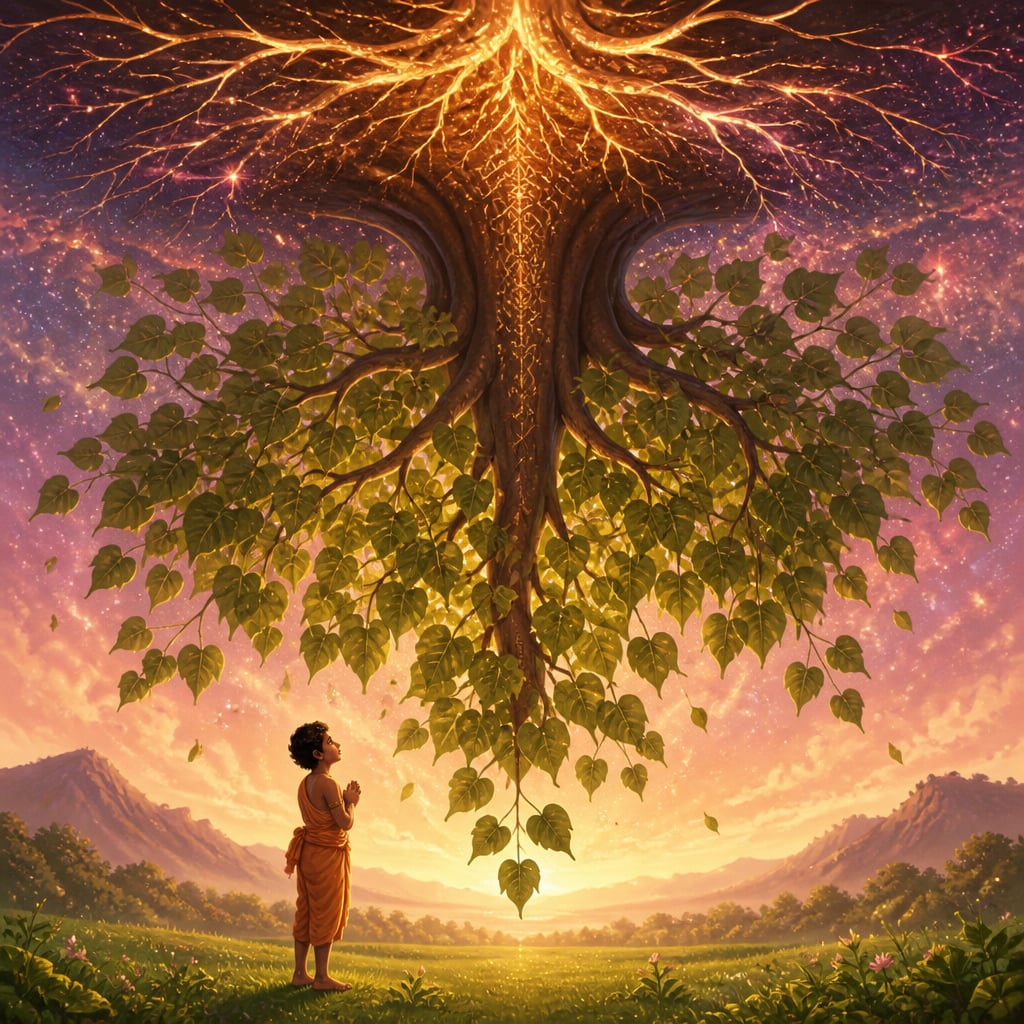
The cosmic upside-down Ashvattha tree with roots in the sky and branches reaching toward the earth.

This is the Ashvattha - the sacred fig tree - and it represents the world as we experience it. Its roots are "above" in the eternal, transcendent reality. Its branches spread "below" into the manifest world of names, forms, careers, relationships, achievements, and losses.

Why upside-down? Because our ordinary way of seeing is inverted. We think the world of things is the fundamental reality and wonder if something "higher" exists. Krishna says it's the other way around: the eternal is the root; the changing world is secondary.

The Two Purushas

Krishna then introduces a profound teaching. There are, he says, two kinds of beings in the universe:

Kshara - the perishable. This includes everything that changes: bodies, minds, empires, mountains, stars. Everything that comes into existence will one day cease. Even the longest-lived phenomena are ultimately temporary.

Akshara - the imperishable. This is the unchanging principle that underlies all change. While forms come and go, something eternal remains. The wave is temporary; the ocean is permanent.

Most spiritual teachings stop here: there's the changing world (ignore it) and the changeless absolute (seek it). But Krishna goes further.

The Purushottama

Beyond both the perishable and the imperishable, Krishna says, there is a third reality: the Purushottama - the "Supreme Person" or "Ultimate Principle."

This is where Chapter 15 gets philosophically bold. It's not enough to distinguish temporary from eternal. The Purushottama encompasses both while transcending both. It is the source of both the changing world and the changeless ground.

Think of it this way: the ocean (changeless) gives rise to waves (changing), but what is the ocean itself? Where did it come from? The Purushottama is that ultimate source - not just the unchanging backdrop but the very power of existence itself.

Why This Matters

This might sound abstract, but it has immediate practical implications.

If only the "perishable" is real, life is ultimately meaningless - everything you love will disappear.

If only the "imperishable" is real, life is ultimately an illusion to escape - why bother with the world at all?

But if Purushottama encompasses both, then the changing world is real (not illusion) while also being grounded in something eternal. Your life matters. Your relationships matter. Your work matters. AND there's something that doesn't end when these temporary forms dissolve.

The Sacred Within the Ordinary

Krishna makes clear that Purushottama isn't somewhere far away:

"I am seated in the hearts of all beings. From Me come memory, knowledge, and their loss. I am what is to be known by all the Vedas. I am the author of Vedanta and the knower of the Vedas."

The transcendent isn't transcendent in the sense of being elsewhere. It's right here, in the heart of every being. Every moment of awareness, every flash of insight, every experience of love - these are expressions of Purushottama operating through finite forms.

The extraordinary isn't above the clouds or after death. It's present in the ordinary, if we learn to see.

A seeker raising the axe of non-attachment to cut the tangled roots of the worldly tree

Cutting the Tree

But there's a catch. The beautiful, spreading Ashvattha tree - this world of experience - can become a trap. We get so absorbed in chasing pleasures and avoiding pains, accumulating achievements and nursing grievances, that we forget the roots. We think the branches ARE all there is.

Krishna's remedy: "This tree, with its strong roots, must be cut down with the powerful axe of non-attachment."

Non-attachment doesn't mean not caring. It means not being stuck. You can love your family, pursue your work, enjoy life's pleasures - while remembering that none of these are ultimate. They're branches, not roots. When you hold them lightly, you can appreciate them more fully.

Young Ramana Maharshi at sixteen undergoing the death-inquiry that awakened him

The Invitation to Go Beyond

The chapter ends with an invitation. Having understood this teaching - that there's something beyond even our highest concepts - seek refuge in that ultimate source.

This isn't about leaving the world. It's about being in the world with different eyes. The person who knows Purushottama doesn't become passive or indifferent. They become free - free to engage fully without being enslaved by outcomes, free to love without possessing, free to work without anxiety.

As Krishna says: "One who knows Me as Purushottama, knowing all, worships Me with their whole being."

This wholeness - engaging life completely while rooted in the eternal - is the fruit of Chapter 15's teaching.

Case studies

Ramana Maharshi's 'Death' at Sixteen

In 1896, a sixteen-year-old boy named Venkataraman sat in his uncle's house in Madurai, India, when suddenly he was seized by a violent fear of death. Instead of fleeing the fear, he lay down, made his body rigid like a corpse, and held his breath. He asked himself: 'Now death has come. What does it mean? What is it that is dying? This body dies.' He discovered that while the body could 'die,' the awareness watching the body remained untouched. Something that was not the body, not the mind, not the personality - was aware. It was akshara (imperishable) while the body was kshara (perishable). But even more - that awareness was not 'his' private possession but the universal awareness itself - Purushottama.

Ramana's experience directly demonstrates Chapter 15's teaching. He discovered that the body-mind (kshara) is not the true self. The unchanging awareness (akshara) underlies all experience. And finally, that awareness is not separate from the Supreme - it IS the Purushottama looking through this particular form. His question 'Who am I?' became his teaching method: cut through identification with the perishable to discover what remains.

Venkataraman left home six weeks later for the sacred mountain Arunachala and became Ramana Maharshi, one of the most respected sages of the 20th century. His teaching - simply asking 'Who am I?' - has guided countless seekers to discover what lies beyond the perishable personality. He never asked people to believe anything, only to investigate their own direct experience.

The teaching of Chapter 15 isn't abstract philosophy - it describes something that can be directly discovered. When we stop identifying with what changes (body, thoughts, circumstances), we can notice what doesn't change. This isn't about having a dramatic experience but about asking the right question: What in me is perishable, and what is not?

The self-inquiry question 'Who am I beyond my roles and achievements?' is gaining traction in executive coaching, therapy, and personal development circles. Burnout, midlife crises, and identity confusion after retirement all stem from the same root: over-identification with what changes. Ramana's approach offers a direct method for anyone willing to sit with the question honestly.

Ramana Maharshi's spontaneous self-inquiry experience occurred in July 1896 at age 16 in Madurai. He arrived at Arunachala on September 1, 1896, and remained there for 54 years until his death in 1950. Sri Ramanasramam, his ashram in Tiruvannamalai, now receives over 1 million visitors annually. His core teaching of 'Who am I?' (Nan Yar) has been translated into over 30 languages.

The CEO Who Stepped Back

Vikram built a tech company from his apartment to a billion-dollar valuation. He had achieved everything he'd dreamed of as a young man: wealth, recognition, influence, a beautiful family. At 52, he should have been deeply fulfilled. Instead, he found himself at 3 AM staring at the ceiling, asking: 'Is this all there is?' The achievements felt hollow. Every goal he reached just created new goals. He began reading philosophy, then started meditating. One day, during a silent retreat, something shifted. He realized that everything he'd built - all of it - was kshara, perishable. Not bad, just temporary. And his whole life had been spent chasing the temporary while ignoring the question of what might be akshara.

Vikram's crisis perfectly illustrates the Ashvattha tree metaphor. He had climbed high into the branches - successful career, family, status - but had mistaken the branches for the roots. His 3 AM despair was the recognition that no branch, however high, provides ultimate security. The Gita doesn't condemn his achievements but puts them in perspective: they're real, they matter, but they're not the foundation. True peace requires discovering what lies beneath all the branches - what Krishna calls Purushottama.

Vikram didn't abandon his company or family. He continued his responsibilities, but something had changed. He held his achievements more lightly. He no longer needed the next milestone to feel worthwhile. His colleagues noticed he was more present, less anxious, more generous. He had discovered that you can climb the tree while knowing it's not the ground.

Success and achievement aren't the problem - mistaking them for ultimate fulfillment is. The Gita's teaching doesn't require abandoning the world but recognizing that all worldly attainments are branches, not roots. This recognition, paradoxically, allows us to engage MORE fully because we're not desperate for outcomes to make us complete.

Founder burnout and post-exit depression are well-documented in the startup world. Entrepreneurs who build companies as extensions of their identity often find that even spectacular success leaves them feeling hollow. The Gita's framework explains why: branches, no matter how magnificent, cannot substitute for roots. Recognizing this before the crisis hits allows leaders to build lives with multiple sources of meaning.

A 2020 Harvard Business Review study found that 58% of CEOs reported feeling lonely in their role, and 70% of those who underwent a personal crisis reported fundamental changes in their leadership approach. Research by McKinsey (2021) showed that executives who practiced reflective self-inquiry scored 34% higher on leadership effectiveness measures and reported 26% higher personal fulfillment compared to peers who did not.

Living traditions

Ramana Maharshi's self-inquiry method ('Who am I?'), rooted in discovering what is akshara within ourselves, has influenced Western psychology, neuroscience of consciousness research, and contemporary non-dual teachings. The Gita's Chapter 15 philosophy shapes how millions understand the relationship between change and permanence.

Reflection

More in The Heart's Devotion

All lessons in The Heart's Devotion ยท The Bhagavad Gita course