Dhyana: The Art of Meditation

Taming the restless mind

Arjuna complains that the mind is harder to control than the wind. Krishna agrees - but offers practical methods. Meditation isn't about stopping thoughts; it's about changing your relationship with them. This lesson introduces the Gita's approach to training attention.

The Art of Meditation: Taming the Restless Mind

The Honest Complaint

Arjuna has been listening carefully to Krishna's teachings about inner peace and mental steadiness. But now he raises his hand with a question that millions of people across centuries have asked:

"Krishna, you make it sound so simple. But you don't know my mind! It's restless. It's turbulent. It's stubborn. It's as hard to control as the wind. How can anyone master such a force?"

This is not the complaint of a weak person. This is Arjuna, the greatest archer of his age, a warrior who has mastered weapons that most people cannot even lift. If anyone should have mental discipline, it's him. Yet here he stands, admitting that his own mind defeats him.

And Krishna's response is surprising. He doesn't scold Arjuna or tell him he's not trying hard enough. Instead, he says something extraordinary:

"You're absolutely right. The mind IS restless, turbulent, strong, and obstinate. It IS as hard to control as the wind. But it CAN be done, through practice and detachment."
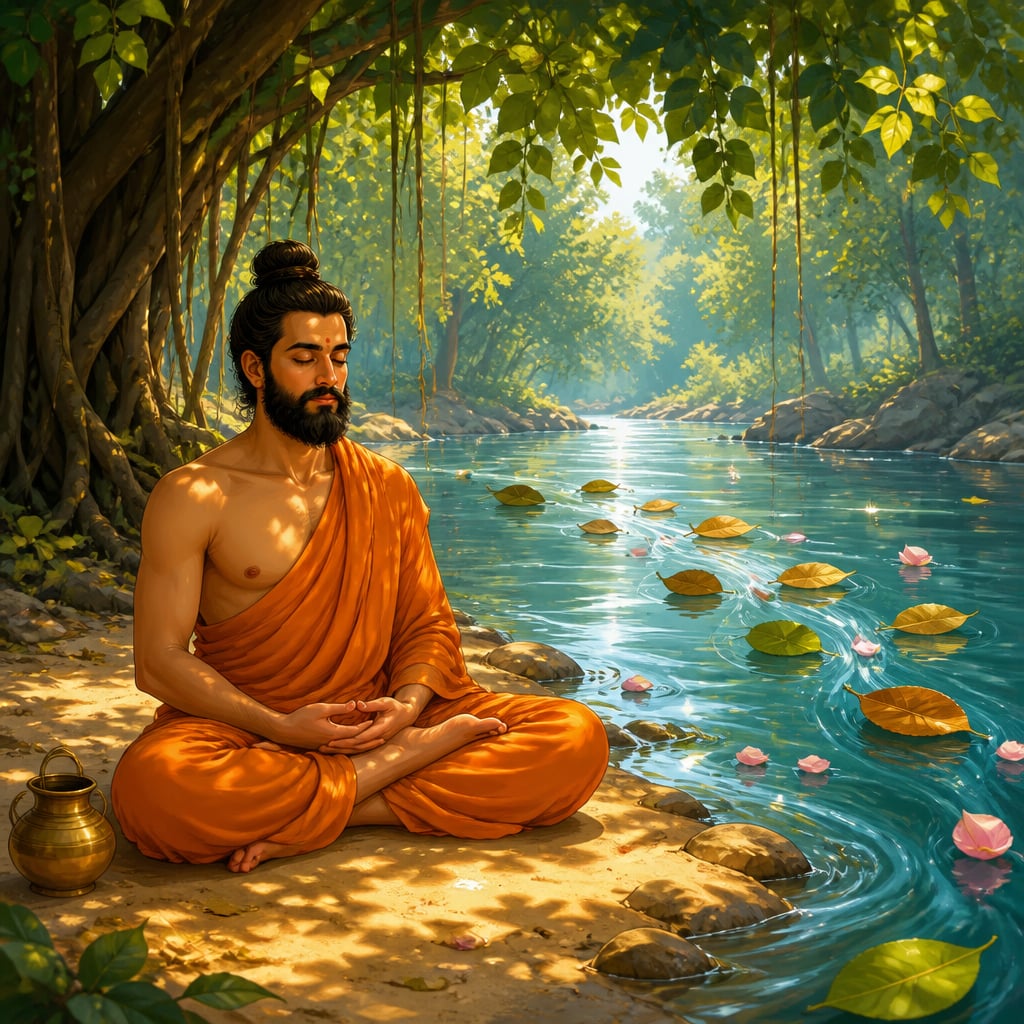
A yogi seated by a quiet forest river in midday meditation

Why the Mind Wanders

Before learning how to train the mind, we need to understand why it wanders in the first place.

A student's mind wanders away from his exam books

Imagine you're trying to study for an important exam. You sit down with your book. Within thirty seconds, you're thinking about something a friend said yesterday. You pull your attention back. Now you're wondering what's for dinner. You refocus. Now you're replaying a scene from a movie. This happens to everyone, from students to CEOs to monks.

The Gita explains that the mind has its own momentum. It has been wandering for so long that wandering has become its habit. Like a river that has carved its own channel over thousands of years, the mind flows toward whatever is familiar, pleasant, or stimulating.

This isn't a defect, it's just how minds work. The mind evolved to notice changes, spot dangers, and seek rewards. Sitting still and focusing on one thing goes against its nature.

But here's the good news: what has been trained in one direction can be trained in another.

The Gita's Practical Instructions

Krishna doesn't just talk philosophy. He gives Arjuna specific, practical guidance for meditation.

The prescribed meditation seat ready in a forest clearing

Find a clean, quiet place. The Gita suggests a spot that is neither too high nor too low, covered with cloth, a deerskin, and kusha grass. Today, this might simply mean a comfortable corner of your room, free from distractions.

Sit with a steady posture. Keep your head, neck, and spine aligned and still. This isn't about suffering in an uncomfortable position, it's about finding a posture where your body can be forgotten so your mind can settle.

Settle your gaze. Krishna suggests focusing on the tip of the nose or the space between the eyebrows. The point isn't the specific location but giving your eyes somewhere to rest so they stop pulling your attention around the room.

Start with the breath. Though the Gita doesn't elaborate as much as later yoga texts, the principle is clear: use something simple and rhythmic as an anchor. Your breath is always with you, always available.

What Meditation Is (And Isn't)

Many people think meditation means stopping thoughts. They try to empty their mind, fail within seconds, and conclude they "can't meditate."

The Gita offers a different understanding. Meditation isn't about having no thoughts. It's about not being pulled around by thoughts.

Imagine you're sitting by a river. Leaves float by, thoughts, memories, plans, worries. You don't have to chase every leaf. You don't have to stop the river. You just watch the leaves float past.

The goal isn't an empty mind but a mind that has choice. Instead of being kidnapped by every thought that appears, you learn to notice thoughts and let them pass. Gradually, the gaps between thoughts grow longer. The noise quiets. Something underneath becomes perceptible.

The Two Keys: Abhyasa and Vairagya

Krishna gives Arjuna two tools for training the mind:

Abhyasa, Practice: Regular, repeated effort. Not once a week when you remember, but daily, consistently, over time. The mind is trained by repetition, not by intensity. Five minutes every day beats one hour once a week.

Vairagya, Letting Go: Non-attachment. When the mind wanders (and it will), don't get frustrated. Don't judge yourself as a failure. Simply notice where the mind went and gently bring it back. This gentle returning, done hundreds of times, is the actual practice.

The combination is powerful. Practice without letting go becomes grim determination, exhausting and unsustainable. Letting go without practice becomes passivity, nothing changes. Together, they create a sustainable path.

The Promise of Progress

Arjuna asks a worried question: "What if I try and fail? What if I can't do this perfectly? Is all the effort wasted?"

Krishna's answer is one of the most reassuring passages in all of spiritual literature:

"Neither in this life nor the next is there destruction for one who does good. No one who strives for self-improvement ever comes to a bad end."

In other words, no sincere effort is ever wasted. Even if you meditate for years without achieving "enlightenment," every moment of practice has shaped you. Every time you noticed your mind wandering and brought it back, you strengthened the muscle of attention. Every session, even the frustrating ones, moved you forward.

Starting Where You Are

The Gita's approach is remarkably non-judgmental. Krishna doesn't demand that Arjuna become a monk, move to a cave, or give up everything. He meets Arjuna exactly where he is, on a battlefield, in crisis, with responsibilities and fears.

The same is true for us. You don't need perfect conditions to begin. You don't need hours of free time. You don't need to already be calm. You can start with three breaths. You can start in your bedroom, on the school bus, in the five minutes before a test.

The journey of a thousand miles begins with a single step. The mastery of the restless mind begins with a single moment of awareness.


The mind may be as hard to control as the wind. But even the wind shapes mountains over time. So too, patient practice shapes the mind.

Case studies

The Flying Sikh's Inner Race: Milkha Singh's Mental Training

The 1960 Rome Olympics. 400 meters. Milkha Singh is running the race of his life. He's in the lead with 100 meters to go. Then, fatally, he looks back to check on his competitors. That split-second break in focus costs him the race, he finishes fourth by 0.1 seconds. The memory haunted him. But it also transformed him. Milkha realized that his legs were fast enough, it was his mind that had betrayed him. He began training not just his body but his focus. Every morning, he would run in complete mental silence, practicing the art of staying present, not looking back, not projecting forward. He visualized perfect races. He rehearsed the feeling of the final stretch without the urge to look back.

Milkha's journey mirrors Arjuna's question perfectly. His body was strong, like Arjuna, he was a master of his physical craft. But the mind remained restless, pulling his attention away at the crucial moment. His solution was abhyasa, not just physical practice but mental practice, repeated daily until presence became habit. The Gita teaches that the mind can be trained like any other instrument. Milkha discovered this through bitter experience and then applied it systematically.

Though he never won Olympic gold, Milkha became a legend. He broke world records, won Commonwealth gold, and more importantly, became known for his unshakeable mental focus in later races. He never looked back again. His story is now taught in sports psychology programs worldwide. The 'Flying Sikh' flew not just because of his legs but because he learned to harness his mind.

Physical skill is not enough without mental discipline. The moment we let our focus scatter, looking back at competitors, worrying about outcomes, we lose our edge. Dhyana isn't just for sitting meditation; it's for every moment that requires full presence.

Athletes, traders, and performers in any high-stakes field describe the same phenomenon: the moment your attention splits between doing and monitoring results, performance drops. Modern sports psychology, flow state research, and mindfulness-based performance training all converge on the same principle the Gita taught millennia ago. Full presence is not a luxury; it is the prerequisite for excellence.

Milkha Singh finished fourth in the 400m at the 1960 Rome Olympics with a time of 45.73 seconds, missing bronze by 0.1 seconds. He set a national record of 45.6 seconds at the 1960 Olympics that stood for 38 years until 1998. He won gold at the 1958 Cardiff Commonwealth Games with a time of 46.6 seconds, and his 1960 record remained the best by an Indian for nearly four decades.

Anika and the Attention Thieves

Anika is 13 years old, and her mind feels like a browser with 47 tabs open. She sits down to do homework, and within two minutes she's checking Instagram. She closes Instagram, returns to her math problem, and ten minutes later realizes she's watching YouTube shorts. She's not lazy, she genuinely wants to focus. But her phone buzzes, notifications ping, and every app is designed by teams of engineers to capture and hold attention. At night, she lies in bed with a racing mind, jumping between worries about school, social media comparisons, and fragments of videos. She feels like her attention doesn't belong to her anymore.

The Gita describes the restless mind as 'chanchala', always moving, jumping from thing to thing. In Arjuna's time, the distractions were internal thoughts and external sense objects. In Anika's time, the same restless tendency meets technology specifically designed to exploit it. But the solution Krishna offers is still relevant: abhyasa (practice) and vairagya (letting go). Anika needs to practice directing her attention consciously, and she needs to let go of the anxiety that comes when she misses a notification.

Anika's parents suggest a simple experiment: ten minutes each morning, before touching any device, she sits quietly and notices her breath. Not to achieve anything special, just to practice choosing where attention goes. The first week is frustrating. Her mind screams for stimulation. But by week three, something shifts. She notices the urge to check her phone without automatically acting on it. She starts creating 'phone-free zones' during homework. Her focus improves. More importantly, she feels like her attention is hers again.

In a world of infinite digital distractions, the ancient skill of dhyana is more relevant than ever. Technology isn't evil, but it trains our minds toward distraction. Meditation is counter-training, practicing the choice of where attention goes, rather than letting attention be pulled by whatever is most stimulating.

The average teenager now switches between apps every 19 seconds, and attention spans are declining measurably across age groups. Schools, workplaces, and families are all grappling with the same challenge: how to cultivate sustained focus in an environment designed to fragment it. Meditation is increasingly prescribed not as spiritual practice but as cognitive training for an attention-scarce world.

A 2022 Common Sense Media report found that American teens spend an average of 8 hours and 39 minutes per day on screen media. Research by Microsoft (2015) measured average human attention span at 8 seconds, down from 12 seconds in 2000. A study published in JAMA Pediatrics (2019) showed that children who practiced 10 minutes of daily mindfulness for 8 weeks improved sustained attention scores by 16%.

Living traditions

The Gita's meditation teachings have influenced global wellness culture. Apps like Headspace and Calm, used by over 100 million people, teach techniques rooted in the dhyana tradition. Corporate mindfulness programs at Google, Apple, and Nike draw from these ancient practices. The Indian government has established AYUSH ministry to promote yoga and meditation as preventive healthcare. What was once Arjuna's personal struggle with the restless mind has become a worldwide movement for mental wellness.

Reflection

More in Mastering the Mind

All lessons in Mastering the Mind ยท The Bhagavad Gita course