Abhyasa: Building Daily Practice

Making meditation accessible

How do you actually start? This practical lesson brings together the Gita's teachings on meditation into something you can do today - even for just three minutes. Small, consistent steps lead to big changes. The secret isn't intensity but regularity.

The Gap Between Knowing and Doing

You've learned that meditation can train the mind. You've understood that the mind can be friend or enemy. You've seen how what you focus on shapes who you become.

But knowing isn't doing. And this is where most people get stuck.

They read about meditation and think, "That sounds great." They might even try it once or twice. But then life happens. Days become weeks, weeks become months, and the practice that was supposed to change their life never actually begins.

This lesson is about crossing that gap. From understanding to doing. From intention to habit. From "I should" to "I do."
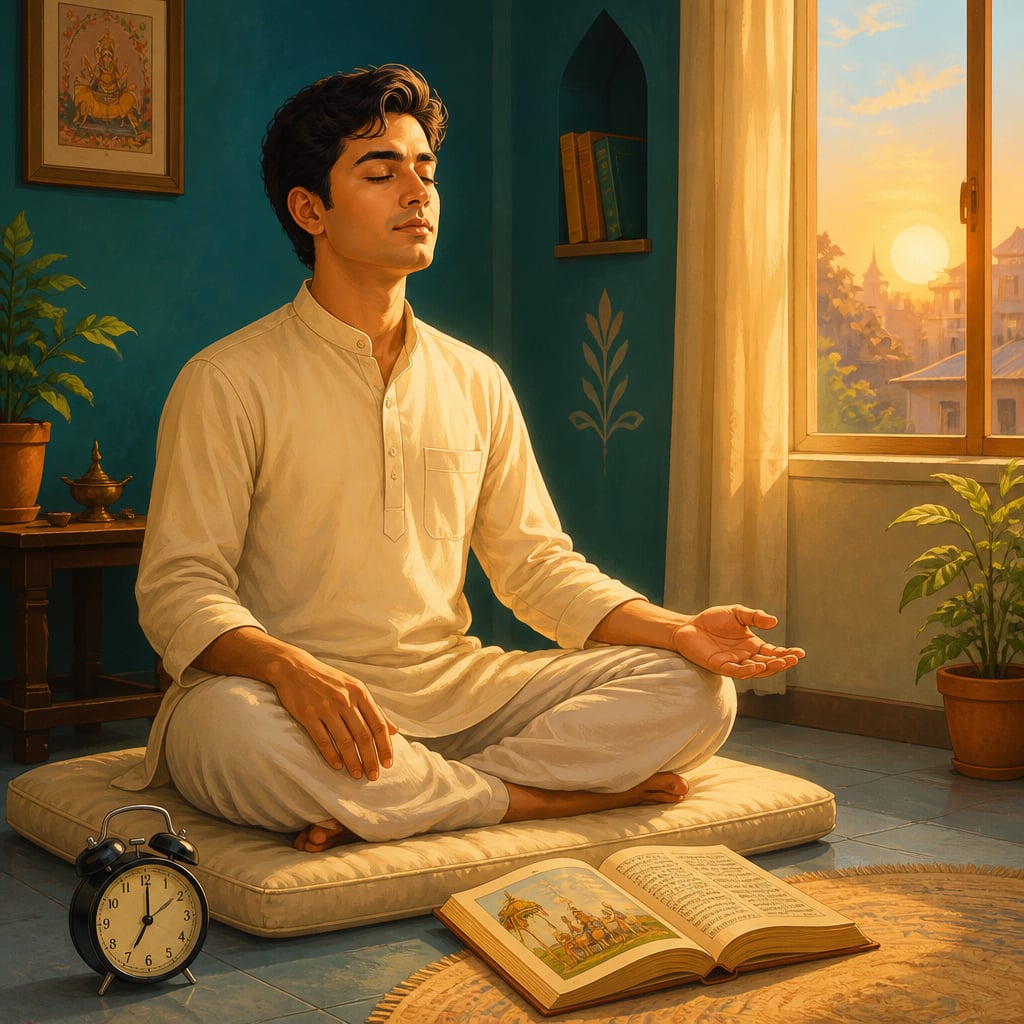
A young practitioner beginning meditation at sunrise in a small home

Why Practice Fails

Let's be honest about why meditation practice fails for most people.

They start too big. Inspired by a book or video, they commit to 30 minutes daily. Day one is fine. Day two is hard. By day three, they quit, feel guilty, and abandon the whole thing.

They wait for perfect conditions. "I'll start when I have a quiet room." "After exams." "When things are less stressful." Perfect conditions never arrive.

They expect immediate results. After three sessions without achieving enlightenment, they conclude it doesn't work for them.

They make it a solo struggle. Without guidance, accountability, or community, practice dies in isolation.

They fight their own nature. They force themselves into a style that doesn't fit. Sitting still when they need movement. Silence when they need sound.

The Gita's Approach: Patient Repetition

Krishna's key word is "abhyasa." Practice. Repetition. Consistent effort applied over time. Not once. Not intensely. But again and again, patiently, without attachment to quick results.

"Through abhyasa and vairagya," Krishna says, "the restless mind is gradually brought under control."

Notice "gradually." This is the opposite of crash diets, New Year's resolutions, and heroic one-time efforts. The Gita's approach is more like farming than conquest. You plant seeds. You water them. You wait. Growth happens in its own time.

Start Shamefully Small

The most important practical advice: start smaller than you think you should.

If you think you can do 15 minutes, start with 5. If you think you can do 5 minutes, start with 2. If 2 minutes feels like a stretch, start with 3 breaths.

Yes, 3 breaths. About 15 seconds. It sounds ridiculous. But consider:

The enemy of practice isn't laziness. It's ambition. People fail because they try to do too much, not too little.

The Power of Environment

Willpower is unreliable. Environment is powerful.

The home meditation corner prepared the evening before

If you want to practice in the morning, put your cushion or chair in a visible spot the night before. Remove friction from the desired behavior. Add friction to competing behaviors. This isn't cheating. It's wisdom.

The Gita itself says to find a clean, quiet spot. Not because the universe demands it, but because your environment shapes your behavior. A designated practice spot sends a signal to your brain: this is where I settle.

Same Time, Same Place

Habits anchor to context. The easiest practice to maintain is one that happens at the same time, in the same place, every day.

Pick a time. Morning works well because the mind is fresh and the day hasn't yet filled with demands. But any consistent time beats the "perfect" time that keeps shifting. Link it to something you already do: after brushing teeth, after morning tea, before opening your phone.

The trigger should be so automatic that practice becomes the natural next step, not a decision you have to make each day.

When You Don't Feel Like It

Here's a secret: nobody feels like practicing every day. Even people who've meditated for decades have days when they'd rather not.

The question isn't "Do I feel like it?" The question is "Am I the kind of person who practices?"

When resistance comes, and it will, notice it without obeying it. "I notice I don't feel like practicing today. I'll do my 3 breaths anyway."

This is exactly what Krishna describes in verse 6.26: wherever the restless mind wanders, bring it back. The wandering is expected. The return is the practice. This applies not just during meditation but to the habit of meditating itself. You'll wander away from practice. Bring yourself back. That's the whole game.

What to Actually Do

The 3-Minute Anchor Practice:

  1. Sit comfortably. A chair is fine. The floor is fine. Don't make this complicated.
  2. Set a timer for 3 minutes.
  3. Close your eyes or lower your gaze.
  4. Pay attention to your breathing. You don't need to change it or control it. Just notice it.
  5. When your mind wanders, notice where it went, and gently bring attention back to the breath. This return IS the practice.
  6. When the timer sounds, sit for one more moment before jumping up.

That's it. No special techniques. No apps required. No equipment. Just you, your breath, and 3 minutes.

If your mind wandered 50 times in 3 minutes, congratulations. You practiced returning 50 times. That's a successful session.

The Long Game

Finally, remember: this is a long game.

You're not trying to have one good meditation session. You're trying to build a relationship with your own mind that lasts decades. A relationship that supports you through challenges, that gives you a home in chaos, that slowly and quietly transforms you.

This takes time. Years. Maybe a lifetime. And that's fine. You're not behind. You're not in a race. Every moment of practice matters, whether it felt "good" or not.

Start today. Start small. Start where you are. The practice is waiting.


The mind is trained not by one heroic session but by a thousand small returns. Start today. Start again tomorrow. That is the path.

Case studies

B.K.S. Iyengar: 75 Years of Daily Practice

Bellur Krishnamachar Sundararaja Iyengar was born in 1918 in Bellur, Karnataka, a sickly child who contracted tuberculosis, typhoid, and malaria before age 15. Doctors predicted he wouldn't live long. At 15, he went to live with his sister, whose husband was the famous yogi T. Krishnamacharya. Krishnamacharya began teaching him yoga, not gently, but rigorously. The sickly boy struggled. But he didn't stop. Day after day, year after year, he practiced. Not always perfectly. Not always easily. But consistently. By his 20s, he was teaching. By his 40s, he was known internationally. At age 95, in 2014, he was still practicing daily, bending, stretching, holding postures that people a third his age couldn't manage.

Iyengar lived the Gita's teaching: 'śanaiḥ śanaiḥ', gradually, step by step. He didn't become a master overnight. He became a master through 75 years of daily practice. His famous quote captures the essence: 'Practice, and all is coming.' He didn't wait for perfect conditions. He practiced sick, he practiced tired, he practiced through injuries. His abhyasa (consistent practice) was legendary. But so was his intelligence, he constantly refined his technique, invented props to help students, and remained a learner until his death.

Iyengar transformed yoga worldwide. His book 'Light on Yoga' has sold over three million copies. His method, now called 'Iyengar Yoga,' is taught in studios around the world. More importantly, he personally demonstrated that consistent daily practice, not talent, not perfect health, not special conditions, creates mastery. The sickly child who wasn't expected to survive became one of the 100 most influential people of the 20th century according to Time magazine.

Long-term consistency trumps short-term intensity. Iyengar didn't have natural advantages, he had daily practice. Over 75 years, those daily practices compounded into something extraordinary. The same principle applies to meditation: it's not about how long you practice today but whether you practice tomorrow, and the day after, and the day after that.

The fitness and wellness industries are built on the same insight: consistency compounds. People who exercise moderately every day outperform those who train intensely but sporadically. The same applies to meditation, journaling, language learning, or any skill. Showing up daily for a small amount beats waiting for the perfect long session that never comes.

B.K.S. Iyengar (1918-2014) practiced yoga daily for over 75 years. His book 'Light on Yoga,' published in 1966, has been translated into 23 languages and sold over 3 million copies worldwide. Iyengar Yoga is now taught in over 40 countries with more than 10,000 certified teachers. In 2004, Time magazine named him one of the 100 most influential people in the world.

Kavya's Fifth Attempt: When Practice Finally Sticks

Kavya is 16 and has tried meditation four times. Attempt one: downloaded an app, did it for 3 days, forgot about it. Attempt two: joined a school mindfulness club, attended twice, felt awkward, stopped. Attempt three: New Year's resolution to meditate 20 minutes daily, lasted until January 4th. Attempt four: read a book about meditation, did a 10-minute practice once, never opened the book again. Each failed attempt left her feeling worse: 'I'm just not the kind of person who can meditate.' She's about to give up entirely. Then her grandmother, who has practiced for 40 years, says something that changes everything: 'Stop trying to be good at it. Just do it badly, every day.'

Kavya's previous attempts failed because she was trying to 'succeed' at meditation, to do it right, to be good at it, to achieve the results promised by apps and books. Her grandmother's advice aligns perfectly with Krishna's: 'abhyāsena tu kaunteya vairāgyeṇa ca gṛhyate', through practice AND detachment. Kavya had practice without detachment. She was attached to being good, to feeling calm, to measurable results. When those didn't come, she quit. What her grandmother offered was vairagya, doing the practice without attachment to outcomes. Just sit. Just breathe. Don't try to be good. Just do it.

Kavya's fifth attempt is different. She commits to 3 minutes, every day, no matter what. She doesn't try to quiet her mind. She doesn't judge the sessions as good or bad. She just sits, breathes, and gets up. Day one: mind races the whole time. Day seven: mind races most of the time. Day thirty: some moments of quiet. Day sixty: she notices she's less reactive in arguments with her brother. Day one hundred: meditation is just something she does, like brushing teeth. Nothing dramatic happened. But everything changed. She became someone who practices.

The difference between failed attempts and successful practice often isn't the technique, it's the attitude. Lower the bar dramatically. Remove the pressure to be good. Make it so small and so daily that failure becomes almost impossible. The practice builds itself once you stop demanding results from it.

Habit formation research confirms that the biggest predictor of long-term practice is not motivation but friction reduction. Making the habit small enough to be nearly effortless gets you through the first 30 days, after which neural pathways begin reinforcing the behavior automatically. This is why '2 minutes of meditation' works better than '30 minutes of meditation' for beginners. Start absurdly small. Let the practice grow on its own.

A 2018 study in the journal Behaviour Research and Therapy found that participants who committed to just 3 minutes of daily meditation maintained the habit at 90% adherence after 8 weeks, compared to 40% adherence for those who committed to 20 minutes. Research at University College London (2009) established that forming a new habit takes an average of 66 days, with simpler behaviors becoming automatic faster.

Living traditions

The Gita's emphasis on gradual, consistent practice has been validated and popularized by modern habit science. James Clear's 'Atomic Habits' (20+ million copies sold) essentially restates Krishna's teaching: small improvements compound, consistency beats intensity, and identity change drives behavior change. Apps like Headspace and Calm have brought meditation to millions by emphasizing short, daily practice over long, occasional sessions. The ancient teaching has become mainstream: start small, show up daily, trust the process.

Reflection

More in Mastering the Mind

All lessons in Mastering the Mind · The Bhagavad Gita course