Shah Jog and Nam Jog: Specialized Hundis

Custom Instruments for Every Commercial Need

Beyond the basic Darshani and Muddati types, Indian merchants developed specialized Hundis for specific purposes. Shah Jog Hundis paid to any respectable merchant regardless of who carried them. Nam Jog Hundis paid only to the named individual. This lesson explores how the Hundi system evolved into a sophisticated menu of financial instruments tailored to different risks and needs.

The Diamond Merchant's Dilemma
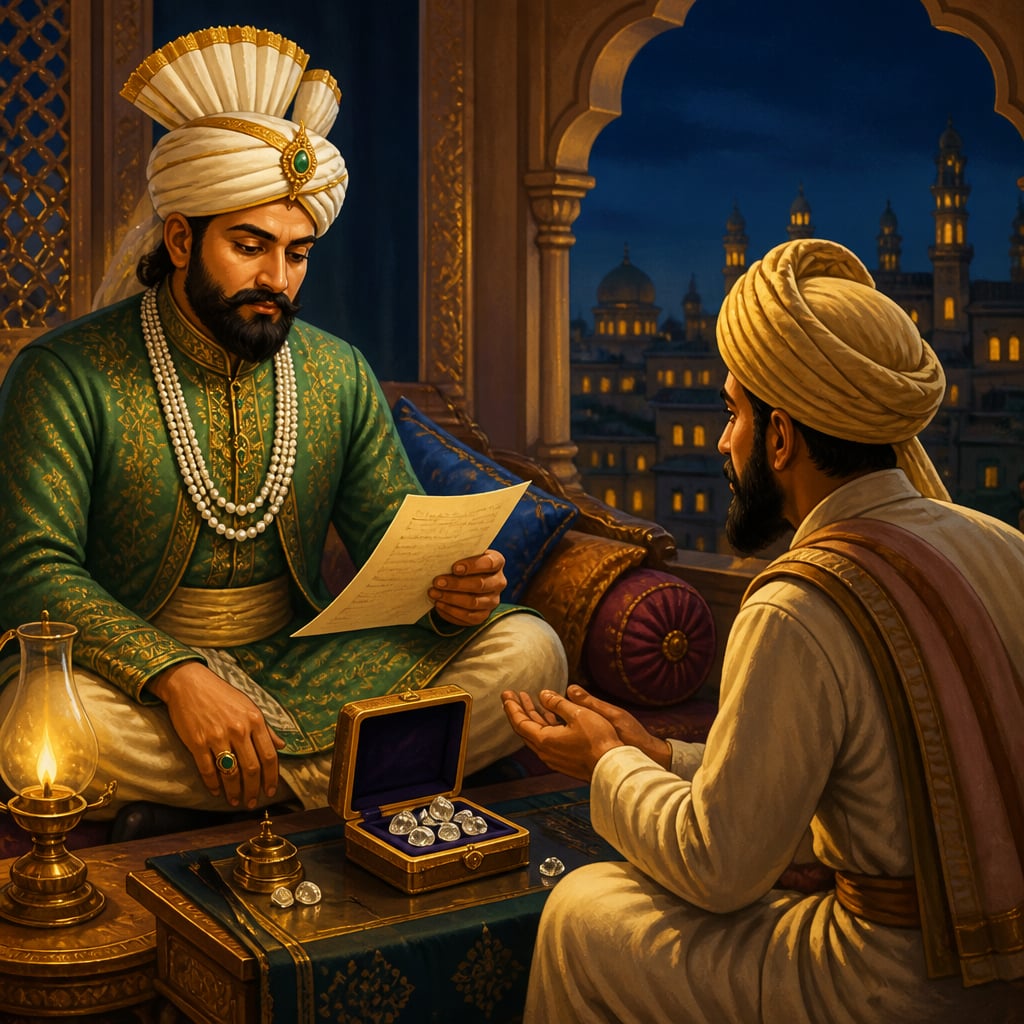
Mir Jumla II examining a Nam Jog hundi at his Hyderabad gaddi

Hyderabad, 1735. Mir Jumla, a diamond merchant dealing in Golconda's legendary stones, faced a security nightmare. He needed to pay 2 lakh rupees to a supplier in Surat, a fortune in gems. But the roads between Hyderabad and Surat crawled with dacoits who specifically targeted diamond merchants.

A Darshani Hundi presented risk: if stolen, any bearer could present it for payment. A Muddati Hundi had the same problem, thieves could simply wait for the maturity date.

Mir Jumla's Shroff offered a solution: a Nam Jog Hundi, payable only to "Mir Jumla, son of Mir Ahmed, of the diamond merchant family of Hyderabad." Even if bandits seized the paper, they couldn't present it. Only Mir Jumla himself, identified by name, lineage, and profession, could collect.

This innovation represented a fundamental advance: the Hundi had evolved from bearer instrument to identified-payee instrument, dramatically reducing theft risk.

The Hundi Family Tree

By the 18th century, the Hundi system had evolved into a sophisticated family of instruments, each designed for specific purposes:

Type Payable To Best For Risk Level
Darshani Bearer, on demand Quick transfers, trusted couriers Higher (theft risk)
Muddati Bearer, at term Trade finance, cash flow matching Higher (theft + time risk)
Shah Jog Any respectable merchant Large transactions, flexible routing Medium
Nam Jog Named individual only High-value, high-security transfers Lower
Dhani Jog Original payee or their agent Moderate security needs Medium
Jawabi Respondentia, linked to cargo Maritime trade finance Variable
Khaka Prototype for large transactions Confirming terms before final issue N/A

This wasn't random evolution, each type emerged to solve specific commercial problems.

Shah Jog: The Respectable Merchant's Hundi

A drawee Shroff verifying a Shah Jog hundi presented by a travelling merchant

The Shah Jog Hundi introduced a middle ground between open bearer instruments and restrictive named-payee documents. "Shah" meant a respectable merchant; "Jog" meant worthy or fit. A Shah Jog Hundi was payable to any person of known merchant standing.

"शाहजोग, श्रेष्ठिजनार्हम्।"

"Shah Jog, fit for respectable traders."

How did this work in practice?

Scenario: A merchant sends his servant with a Shah Jog Hundi to collect payment in another city. The servant arrives, but the designated recipient (his master's correspondent) is traveling. Another established merchant offers to accept the Hundi and forward funds.

With a Nam Jog Hundi, this flexibility would be impossible, only the named person could collect. With a bearer Hundi, anyone (including a thief) could collect. The Shah Jog Hundi allowed collection by any known, reputable merchant, solving the flexibility problem while maintaining security.

Verification: How did drawees confirm someone was a "Shah" (respectable merchant)? The same reputation networks that made all Hundis work:

A stranger claiming Shah status would face questions. Known merchants were processed immediately.

Nam Jog: Security Through Identity

The Nam Jog Hundi took security further: payment only to the named individual. "Nam" meant name; the Hundi was literally "name-worthy", worthless to anyone but the named payee.

Nam Jog Hundis included extensive identification:

Payable to: Lala Hukumchand, son of Lala Premchand,
of the Mathura cloth merchants,
recognizable by his scar above the left eye,
at his premises in Surat's Mahidharpura.

This level of detail made impersonation nearly impossible. The drawee would verify:

Use Cases for Nam Jog:

The Nam Jog Hundi's security came at a cost: reduced flexibility. If the named person died, fell ill, or was unavailable, the Hundi couldn't be collected by anyone else. The security-flexibility tradeoff was explicit.

Dhani Jog: The Assignable Option

Between Shah Jog's openness and Nam Jog's restriction lay Dhani Jog, payable to the original payee OR anyone they formally assigned it to.

"Dhani" meant owner or master; a Dhani Jog Hundi acknowledged that the named person "owned" the right to payment but could transfer that ownership.

Assignment Process:

  1. Original payee writes endorsement on Hundi reverse
  2. Names the new beneficiary
  3. Signs with their seal or mark
  4. New holder presents with original Hundi

This created flexibility while maintaining documentation. The chain of ownership was visible, each endorsement added to the paper trail.

Modern Parallel: Dhani Jog Hundis operated exactly like modern checks with "Pay to the order of" language. The payee can endorse to another party, creating negotiability with documented transfer.

Jawabi Hundi: Cargo-Linked Credit

A Shroff matching a Jawabi hundi against shipping documents at Surat port

The Jawabi Hundi represented sophisticated trade finance: payment linked to the arrival of specific cargo. "Jawab" meant response or return; the Hundi "responded" when goods arrived.

How Jawabi Worked:

  1. Exporter ships goods from Surat to Basra
  2. Issues Jawabi Hundi to the ship captain
  3. Captain presents Hundi in Basra along with cargo
  4. Drawee verifies cargo arrival, then pays
  5. Payment goes to exporter's account (via Hundi correspondent)

The Jawabi Hundi was essentially a documentary credit, payment triggered by evidence of shipment. If cargo was lost at sea, the Hundi wasn't payable. The exporter bore cargo risk; the Hundi holder bore payment risk only if cargo arrived.

Risk Distribution:

Risk Who Bears It
Sea voyage Exporter/shipper
Payment default Hundi holder
Cargo damage Insurer (if insured)
Piracy/loss Exporter

This risk distribution made maritime trade financeable. A Shroff issuing Jawabi Hundis knew their exposure was limited to situations where cargo actually arrived, they weren't guaranteeing the sea.

Khaka Hundi: The Prototype

For very large transactions, merchants used Khaka Hundis, draft or prototype versions that confirmed terms before final execution.

"Khaka" meant outline or sketch. A Khaka Hundi was the sketch of the final instrument.

Process:

  1. Parties negotiate terms: amount, drawee, batta, conditions
  2. Shroff issues Khaka Hundi with all details
  3. Parties review, any objections?
  4. If approved, Shroff issues final (pakka) Hundi
  5. Khaka is destroyed or marked void

This prevented errors in large transactions. A 5 lakh rupee Hundi with wrong terms could cause catastrophic problems. The Khaka stage allowed verification before commitment.

Modern Parallel: The Khaka Hundi anticipated what banks now call "draft" or "pro forma" documents, preliminary versions reviewed before final execution.

The Economics of Choice

Why did merchants choose different Hundi types? The decision involved balancing multiple factors:

Factor Favors Bearer/Shah Jog Favors Nam Jog
Flexibility Need routing options Specific recipient
Security Lower-value transactions High-value, theft-sensitive
Speed Quick collection needed Time available for verification
Cost Lower batta typically Higher batta for security
Trust level High trust in system Limited trust, need restriction

Shroffs charged different batta (fees) based on instrument type:

The pricing reflected risk and service levels, a functioning market in financial instrument types.

The System's Sophistication

By 1750, the Hundi system offered a complete menu of credit instruments:

This sophistication developed organically, merchant innovation responding to commercial needs, without legislation, regulation, or formal financial theory. The market created solutions; reputation enforced contracts.

European observers were often puzzled by the variety. They sought simple categories; the Hundi system offered nuanced options. This wasn't confusion, it was customer-centric financial engineering.

Your Choice of Instruments

Today, when you choose between wire transfer, check, or UPI payment, you're making the same choice Hundi merchants made: selecting an instrument based on speed, security, cost, and flexibility.

The principles remain identical:

Modern finance has standardized these instruments, but the underlying logic the Hundi system discovered centuries ago persists: different needs require different tools.

Global Perspectives on Specialized Credit Instruments

The challenge of designing instruments for specific commercial needs occupied financial innovators across civilizations. How did others approach this problem?

Raymond de Roover (1904-1972), the Belgian-American historian who documented medieval banking, showed how Italian merchant houses developed specialized instruments: cambium for currency exchange, lettere di pagamento for remittances, and bills with various endorsement rules. But de Roover noted that European instruments remained relatively standardized, the legal system demanded uniformity. The Hundi system's organic diversity puzzled European observers precisely because it evolved through practice rather than legislation.

Avner Greif (born 1955), the Stanford economist who studied medieval Mediterranean trade, documented how Maghribi traders developed identity-restricted instruments for high-value goods. Like Nam Jog Hundis, these paid only to named individuals within trusted networks. Greif's key insight: such instruments emerged where formal legal enforcement was weak, exactly the condition that produced India's Hundi variety.

Philip Curtin (1922-2009), historian of cross-cultural trade, noted that specialized credit instruments appeared wherever merchants needed to balance security against flexibility. His comparative work showed that the Indian system achieved greater instrument diversity than any other pre-modern trading network, a sophistication invisible to scholars who looked only at European archives.

Thinker Finding Hundi Parallel
de Roover European instruments were legally standardized Hundis evolved organically to match actual needs
Greif Identity-restricted instruments emerged where law was weak Nam Jog achieved security through social enforcement
Curtin India had greatest instrument diversity Market-driven innovation beat legislative design

The Western scholars documented what Indian merchants already knew: one size never fits all in trade finance. The Hundi system's variety wasn't disorder, it was customer-centric financial engineering.

In our next lesson, we'll explore the infrastructure that made all Hundi types work: Vishwasa-Tantra, the trust networks that transformed paper promises into continental payment systems.

Financial economists prize 'complete markets', where diverse instruments exist for diverse needs. The Hundi system achieved completeness organically, through merchant innovation responding to actual requirements.

European instruments were often standardized by regulation. Indian instruments evolved through practice, creating options that formal systems wouldn't have designed but merchants actually needed.

Colonial records identify at least 12 distinct Hundi varieties in common use by 1800, more differentiation than formal European banking systems offered for comparable functions.

Economics recognizes that most choices involve trade-offs, you can't maximize all dimensions simultaneously. The Hundi system made these trade-offs explicit and priced them accordingly.

Rather than pretending one instrument could serve all needs, the Hundi system honestly presented options with their trade-offs. Merchants made informed choices rather than accepting one-size-fits-all solutions.

Nam Jog Hundis typically carried 0.5-1% higher batta than equivalent Shah Jog Hundis, the explicit price of additional security.

Key terms

Shāh Jog Huṇḍī
A Hundi payable to any respectable merchant of known standing, not restricted to a named individual but not open to any bearer. The drawee verifies the presenter's merchant status before payment.
Nām Jog Huṇḍī
A Hundi payable only to the specifically named individual, including identifying details (name, lineage, profession, sometimes physical description). No other person can collect payment.
Jawābī Huṇḍī
A Hundi payable upon confirmation of cargo arrival, a documentary credit instrument where payment is triggered by evidence that specific goods have been delivered or shipped.
Dhānī Jog Huṇḍī
A Hundi payable to the original payee or anyone they formally assign it to through endorsement. Creates transferability while maintaining documentation of ownership changes.

Verses

यथा रोगं तथा भेषजं यथा कार्यं तथा साधनम्। एकेनैव न सर्वाणि सिध्यन्ति व्यवहारिणाम्॥

yathā rogaṃ tathā bheṣajaṃ yathā kāryaṃ tathā sādhanam | ekenaiva na sarvāṇi sidhyanti vyavahāriṇām ||

As the disease, so the medicine. As the task, so the tool. Not everything can be accomplished with one instrument by those in business.

Modern finance recognizes 'completeness', markets are more efficient when diverse instruments exist for diverse needs. The Hundi system achieved completeness organically, through merchant innovation rather than regulatory design.

Merchant Tradition, Recorded in Shroff family manuals (Practical wisdom transmitted through apprenticeship)

नाम्ना जानाति विश्वासं नाम्ना रक्षति सम्पदम्। अनाम्नो नास्ति बन्धनं नाम एव प्रमाणकम्॥

nāmnā jānāti viśvāsaṃ nāmnā rakṣati sampadam | anāmno nāsti bandhanam nāma eva pramāṇakam ||

By name one knows trust; by name one protects wealth. Without a name, there is no binding. The name itself is the proof.

Modern finance rediscovered this in the shift from bearer bonds to registered securities. Named instruments create audit trails and reduce fraud, exactly what the Nam Jog achieved centuries earlier.

Traditional Proverb, Common in Gujarati and Marwari trading communities (Oral tradition)

Key figures

Mir Jumla II

Diamond merchant and statesman of Golconda and Mughal Empire; major user of sophisticated Hundi instruments · 17th century (active 1630s-1663)

Karen Leonard

Historian at UC Irvine; specialist in Indian banking history and the Hyderabad State · Contemporary (born 1939)

Raymond de Roover

Belgian-American economic historian; leading authority on medieval European banking and credit instruments · 20th century (1904-1972)

Case studies

Surat's Diamond Trade: Where Nam Jog Principles Still Rule

Surat processes over 90% of the world's diamonds by volume, $24 billion annually. This massive trade operates on payment systems that would be instantly recognizable to the Hundi merchants who financed Golconda's gem trade three centuries ago. The principle of identity-verified, relationship-based payments remains foundational.

Modern diamond trading demonstrates that identity-based payment systems, the Nam Jog principle, remain optimal for high-value, high-risk goods. Formal banking's standardized instruments cannot replicate the security that community-verified identity provides.

The diamond industry's identity-based payment system is structurally identical to how high-value NFT and art transactions operate today. When goods are unique and high-value, standardized payment instruments remain inferior to relationship-based trust systems.

Surat's diamond industry processes over 90% of the world's diamonds by volume, handling $24 billion in annual trade. Despite dealing in goods that are easily stolen and nearly impossible to trace, the industry maintains fraud rates well below 1%, sustained entirely by community-verified identity and reputation networks.

Historical context

Medieval to Colonial India (1500 CE - 1900 CE)

India's diverse commercial needs, from local grain trade to international diamond commerce, required diverse financial instruments. The Hundi system's variety emerged from this diversity, creating specialized tools for specialized purposes.

European commercial law recognized fewer instrument varieties, often mandated by regulation. Indian Hundi diversity emerged from merchant practice, bottom-up innovation rather than top-down standardization. The result was greater flexibility for actual commercial needs.

A comprehensive British survey in 1870 documented at least 12 distinct Hundi types in active use across India, with regional variations adding further complexity. European banking offered perhaps 4-5 comparable categories.

The Hundi system's instrument variety demonstrates that Indian merchants engaged in sophisticated financial engineering, designing products for specific needs rather than accepting one-size-fits-all solutions. This challenges narratives that present indigenous finance as primitive.

Living traditions

While specific Hundi varieties have been replaced by standardized banking products, the principle they embodied, matching instrument type to transaction need, remains fundamental to trade finance. India's export sector today uses documentary credits exactly as 18th-century merchants used Jawabi Hundis.

Reflection

More in The Hundi System: World's First Credit Transfer

All lessons in The Hundi System: World's First Credit Transfer · Banking & Finance Heritage of Bharat course