Darshani Hundi: Demand Payment Instruments
Payment on Sight, India's Original Demand Draft
The Darshani Hundi, payable the moment it was presented, solved a problem that still challenges modern finance: how do you guarantee immediate payment across distances? This lesson explores how Indian merchants invented demand drafts centuries before Western banks, creating an instrument so efficient that colonial banks eventually copied it.
The Merchant Who Couldn't Wait
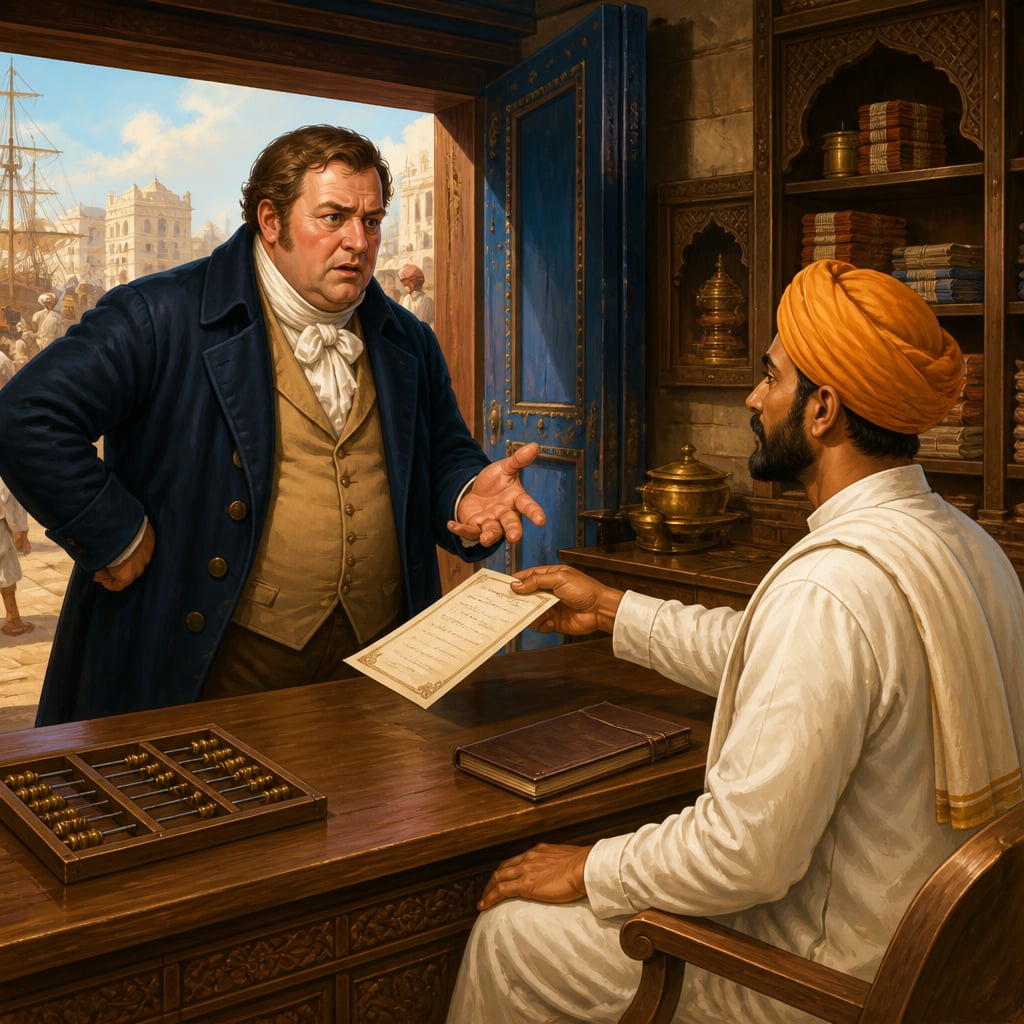
Bombay, 1780. Captain James Forbes of the East India Company had a crisis. His ship, the Britannia, needed urgent repairs before the monsoon made the harbor impassable. The ship's carpenter demanded 3,000 rupees, cash, immediately, for timber and labor. But Forbes's treasury was in Madras, 1,300 kilometers away.
A British bill of exchange would take 60 days to clear. The monsoon would arrive in 30. The Britannia would rot at anchor.
Forbes's solution came from an unlikely source: a Gujarati Shroff named Narsidas who offered him a Darshani Hundi. "Present this to my cousin Madhavdas in the timber market," Narsidas said. "He will pay you within the hour."
Forbes was skeptical. A piece of paper, honored instantly, by a stranger, for 3,000 rupees? It seemed impossible. But he had no choice.
Two hours later, Forbes had his timber. The Britannia sailed before the monsoon. And the captain had learned something that would transform British banking: Indians had solved the immediate payment problem centuries ago.
What Makes a Darshani Hundi Special?
The word Darshani (दर्शनी) comes from darshan, to see or to present. A Darshani Hundi is payable at sight, the moment the drawee sees it. No waiting period. No verification delays. Present the paper, receive the money.
"दृष्ट्वा देयम्।"
"Payable upon seeing."
This simple phrase, written on traditional Darshani Hundis, created a financial revolution. It meant that properly authenticated paper was as good as gold, sometimes better, because paper was lighter and safer.
The mechanics were elegant:
| Step | Action | Time |
|---|---|---|
| 1 | Drawer deposits funds with issuer | Immediate |
| 2 | Issuer writes Darshani Hundi | Minutes |
| 3 | Bearer travels to destination | Days/weeks |
| 4 | Bearer presents Hundi to drawee | Immediate |
| 5 | Drawee verifies and pays | Minutes to hours |
Total time from issue to payment: as fast as the bearer could travel. Compare this to European bills that required 30-90 days for "acceptance" before payment.
The Verification Challenge
If Darshani Hundis paid instantly, how did drawees verify authenticity? Without telephones or internet, how could Madhavdas in Bombay confirm that Narsidas in Surat had actually issued the paper?
The answer lay in multiple layers of security:
1. Distinctive Scripts (Boli) Each trading community developed proprietary scripts. Marwari Mahajani, Gujarati Vaniya, and Multani scripts were deliberately difficult for outsiders to master. A forger would need years to learn the precise strokes.
2. Personal Codes (Sanket) Merchant families used coded phrases and symbols. A Hundi from the Jagat Seth house might include a specific pattern of dots or a phrase like "remembering our grandfather's blessing", meaningless to outsiders, instantly recognizable to correspondents.
3. Seal Impressions (Mudra) Metal seals pressed into wax or ink created distinctive marks. Some families used seals passed down for generations, making them impossible to replicate without the original.
4. Paper Quality Premium Hundis used specific paper from known mills. The Jagat Seths reportedly used paper from a single supplier in Kashmir, texture and watermarks serving as authentication.
5. Courier Knowledge Trusted couriers (harkara) were known to both parties. A Hundi carried by an unknown person triggered extra verification.
The Economics of Instant Payment
Why would a drawee honor a Hundi instantly when the issuer was hundreds of miles away? Three economic principles made it rational:
Reciprocity: Narsidas and Madhavdas continuously exchanged Hundis. If Madhavdas paid 3,000 rupees today, Narsidas would pay a similar amount for Madhavdas's client tomorrow. Over time, flows balanced.
Commission Sharing: The batta (fee) was split. If Narsidas charged 1% to issue, he might share 0.3% with Madhavdas for honoring. The drawee earned from every transaction.
Reputation Stakes: Refusing to honor a valid Hundi meant breaking vishwasa. Word spread instantly through the merchant network. One refusal could cost a lifetime of business.
Economist R. Vaidyanathan calculates that the reputation cost of default exceeded the face value of most Hundis. Dishonor a 3,000-rupee Hundi, lose 30,000 rupees in future business.
Darshani vs. European Sight Bills
European banking eventually developed "sight bills", instruments payable on demand. But key differences remained:
| Feature | European Sight Bill | Indian Darshani Hundi |
|---|---|---|
| Acceptance period | 3-7 days typical | None, immediate payment |
| Legal formalities | Notary endorsement required | Community verification sufficient |
| Dispute resolution | Court proceedings (months) | Community arbitration (days) |
| Operating hours | Banking hours only | Anytime (merchant homes open late) |
| Geographic coverage | Limited correspondent banks | Any town with community members |
The Darshani Hundi's true innovation was eliminating the "acceptance" step. European sight bills technically paid "on demand" but actually required days of verification. The Darshani paid in minutes because trust infrastructure replaced bureaucratic process.
Real-Time Information Networks
For instant payment to work, drawees needed real-time information about issuers' creditworthiness. How did 18th-century merchants achieve this without telecommunications?
The answer: patrika, regular correspondence bulletins that circulated through merchant networks.
Weekly Bulletins: Major Shroffs issued weekly reports to correspondents listing their outstanding Hundis, recent defaults they'd heard of, and changes in their financial position.

Courier Networks: Professional couriers (harkara) ran regular routes. A letter from Surat reached Bombay in 3 days, Calcutta in 14. Information moved faster than goods.
Market Gossip: Every major bazaar had informal information exchanges. Merchants gathered at specific times to share news. A default in Patna was known in Benares by sunset.
Community Assemblies: Monthly mahajan sabha (merchant assemblies) reviewed creditworthiness, issued warnings, and formally expelled defaulters. Minutes were circulated to other cities.
Historian Lakshmi Subramanian describes this as "a proto-credit bureau operated without formal organization", exactly the function that Experian and CIBIL now perform through databases.
The Speed Advantage in Trade
Darshani Hundis gave Indian merchants a decisive competitive advantage: speed of capital deployment.

Consider a typical scenario: A pepper shipment arrives in Calicut from Kerala's interior. A European factor (trader) sees the opportunity but must request funds from his London principals, a 6-month round trip. The pepper will be sold and gone.
A Gujarati merchant presents a Darshani Hundi drawn on his correspondent in Surat. Within hours, he has capital. He buys the pepper, ships it to the Red Sea, and begins the next trade cycle while the European is still writing letters.
The Dutch traveler Francisco Pelsaert, writing in 1626, noted with frustration: "The Banyans trade with borrowed money which they obtain in a moment through their bills. We cannot compete with their speed."
This speed advantage explains how Indian merchants dominated Indian Ocean trade despite lacking European military power. Financial technology substituted for naval technology.
The Darshani's Evolution
Over centuries, Darshani Hundis became increasingly sophisticated:
Bearer vs. Order Hundis: Some Darshani Hundis paid "to bearer", whoever presented them. Others paid "to order", only the named person. Order Hundis provided security if papers were stolen.
Endorsable Hundis: A merchant could endorse a Darshani Hundi to another party, creating negotiability. A Hundi might change hands 3-4 times before presentation.
Split Hundis: Large amounts could be split across multiple smaller Hundis, reducing risk if one was lost.
Conditional Hundis: Some Darshani Hundis included conditions, "payable upon delivery of the attached goods invoice", combining payment with trade documentation.
This evolution happened organically, through merchant innovation, without legislation or banking regulation.
Global Perspectives on Instant Payment
The challenge of instant payment across distances preoccupied financial thinkers worldwide. How did other civilizations approach this problem?
Walter Bagehot (1826-1877), editor of The Economist and author of the foundational Lombard Street, analyzed how bills of exchange worked in Victorian England. He noted that even 'sight bills' required acceptance periods, the drawee needed time to verify. Bagehot couldn't conceive of truly instant payment; the trust infrastructure didn't exist. He wrote: 'Credit is a power which may grow, but cannot be constructed.' Indian merchants had constructed precisely what Bagehot thought impossible.
Josiah Stamp (1880-1941), Bank of England director who studied Indian banking for colonial administration, was astonished by Hundi efficiency. In his reports, he noted that Shroffs processed payments faster than British banks despite having no formal organization. Stamp's observation: 'The native banker has solved problems of credit verification that our banking system approaches only clumsily.' He recommended (unsuccessfully) that colonial banks study indigenous methods.
John Maynard Keynes (1883-1946), in his early work Indian Currency and Finance (1913), documented how indigenous financial instruments operated parallel to, and often more efficiently than, colonial banking. Keynes noted the Hundi's 'remarkable velocity' compared to formal banking channels.
| Thinker | Observation | Darshani Innovation |
|---|---|---|
| Bagehot | Trust 'cannot be constructed' | Hundi networks constructed trust systematically |
| Stamp | Colonial banks were 'clumsy' | Shroffs achieved instant verification |
| Keynes | Indigenous finance had 'remarkable velocity' | Darshani eliminated acceptance delays |
The Western thinkers diagnosed the problem, instant payment requires instant trust verification, but assumed technology would solve it. Indian merchants solved it through social architecture: community bonds that made verification instantaneous because reputation was always known.
Your Darshani Moment
Today, when you use UPI for instant payment, you're experiencing the Darshani Hundi's descendant. The principles are identical: immediate payment, trust-based verification, minimal intermediation.
But there's a difference. UPI relies on institutional trust, RBI, NPCI, your bank. The Darshani Hundi relied on personal trust, the specific reputation of the issuer and drawee.
Ask yourself: Which system is more resilient? Which survives if institutions fail? The Hundi network operated through the collapse of the Mughal Empire, the chaos of the 18th century, and the disruptions of colonial rule. Could our digital systems survive equivalent shocks?
In our next lesson, we'll explore the Darshani Hundi's counterpart: the Muddati Hundi, payable not on sight but at a specified future date, India's invention of time-based credit instruments.
Modern finance recognizes the time value of money, a rupee today is worth more than a rupee tomorrow. The Darshani Hundi operationalized this principle, enabling merchants to capture time-sensitive opportunities.
While European traders waited for London's approval, Indian merchants acted instantly. This speed advantage allowed smaller Indian firms to outcompete larger, better-capitalized European companies in trade negotiations.
Dutch records from 1650-1700 repeatedly complain that 'Banyans' captured the best merchandise by paying immediately while VOC factors awaited authorization. Speed compensated for scale.
Economics distinguishes between screening (costly verification) and signaling (costly demonstration of quality). The Darshani Hundi used ongoing relationship as signal, cheaper and more reliable than transaction-by-transaction screening.
Bureaucratic verification adds cost and time. Relationship-based verification is nearly free for established parties. The Darshani Hundi's low transaction cost came from substituting relationship knowledge for document verification.
British banks in 19th-century India employed armies of clerks for document verification. Shroff houses with similar transaction volumes operated with far smaller staffs, relationships replaced bureaucracy.
Key terms
- Darśanī Huṇḍī
- A sight bill or demand payment instrument payable immediately upon presentation. The drawee must honor the Hundi the moment it is presented, with no acceptance period or delay.
- Bolī
- The specialized language, script, or coded dialect used by merchant communities to write Hundis. Each trading community had its own boli, serving both communication and security functions.
- Patrikā
- Regular correspondence bulletins circulated among merchant networks containing creditworthiness information, outstanding Hundi volumes, default warnings, and general commercial intelligence.
- Mudrā
- A seal or stamp used to authenticate Hundis and other commercial documents. The mudra was typically a metal seal bearing the merchant's name, family symbol, or distinctive mark, pressed into wax or ink to create an impression that was nearly impossible to forge.
Verses
ऋणादानं च दानं च याचितं च प्रतिश्रुतम्। अविलम्बेन कर्तव्यं धर्मस्य न विलम्बनम्॥
ṛṇādānaṃ ca dānaṃ ca yācitaṃ ca pratiśrutam | avilambena kartavyaṃ dharmasya na vilambanam ||
Lending, giving charity, fulfilling requests, and honoring promises, all must be done without delay. In dharma, there is no room for delay.
By framing immediate payment as dharmic duty, merchant communities created internal pressure for honoring Hundis instantly. The religious dimension reduced default rates below what economic incentives alone could achieve.
Yajnavalkya Smriti, Vyavahara Adhyaya, Rina-Prakarana (From traditional Sanskrit jurisprudence)
दृष्ट्वा देयं न वक्तव्यं प्रतीक्षा कारणं वृथा। विश्वासघाती मूर्खः स्यात् व्यापारे मृतवत् सदा॥
dṛṣṭvā deyaṃ na vaktavyaṃ pratīkṣā kāraṇaṃ vṛthā | viśvāsaghātī mūrkhaḥ syāt vyāpāre mṛtavat sadā ||
Pay upon seeing, do not argue. Excuses for delay are worthless. He who breaks trust is a fool; in business, he becomes as if dead forever.
The irreversibility of reputation damage ('forever') created extreme caution about default. Unlike modern bankruptcy that allows fresh starts, the traditional system offered no rehabilitation, making the expected cost of default catastrophic.
Merchant Tradition, Recorded in Marwari trading literature (Traditional saying preserved in business families)
Key figures
Narsidas Jhaveri
Prominent Shroff of Surat; specialist in Darshani Hundis for maritime trade · 18th century (active 1750s-1790s)
Amiya Kumar Bagchi
Economic historian; founding Director of the Institute of Development Studies Kolkata · Contemporary (1936-2017)
Josiah Stamp
British economist; Bank of England director; studied Indian banking for colonial administration · 1880-1941
Case studies
IMPS: India Rebuilds Instant Payment for the Digital Age
In 2010, NPCI launched IMPS (Immediate Payment Service), India's first 24/7 instant interbank transfer system. At the time, NEFT transfers took hours and weren't available on weekends. The challenge was identical to what Darshani Hundi solved: how do you enable instant payment when the payer and payee use different institutions? NPCI's solution mirrored the Hundi architecture: create a trusted intermediary network (like Shroff correspondents) that could verify and settle instantly. By 2024, IMPS processes over 500 million transactions monthly, with average settlement time under 10 seconds.
The Darshani Hundi's core principle, that delay is adharmic ('dharmasya na vilambanam'), drove IMPS's design philosophy. When banks proposed 'T+1' settlement (next day), NPCI insisted on real-time. The Darshani principle that 'payable upon seeing' must mean immediate, not 'soon,' shaped technical decisions. IMPS rejected the Western model of batch processing (which introduces delays) in favor of real-time gross settlement for retail payments, exactly what Shroffs achieved through correspondent trust.
IMPS proved that instant interbank payment was technically feasible at scale, something Western banking systems hadn't achieved. This success laid the groundwork for UPI (2016), which expanded the model to include smartphones and QR codes. India now processes more real-time payments than the US, UK, and EU combined. The World Bank and IMF regularly cite India's payment systems as global best practice.
IMPS succeeded because its designers, consciously or not, followed Darshani Hundi principles: eliminate acceptance periods, trust the network, settle immediately. The technology was modern (digital infrastructure), but the philosophy was ancient (delay violates dharma). India's payment revolution came from returning to indigenous principles, not copying Western models.
The US launched FedNow in July 2023, thirteen years after India's IMPS. American consumers still wait hours for bank transfers that Indians complete in seconds. The Darshani principle of instant settlement is now a competitive differentiator for national economies.
IMPS average transaction time: 10 seconds. US ACH 'same-day' settlement: 4-6 hours. The Darshani principle of instant payment is now India's competitive advantage in global fintech.
Historical context
Medieval to Colonial India (1400 CE - 1900 CE)
The Darshani Hundi emerged from India's commercial intensity. Markets moved fast; goods spoiled; ships sailed on schedule. Merchants who couldn't pay immediately lost opportunities to those who could. The Darshani Hundi was economic necessity, not leisurely innovation.
European sight bills existed but required 'acceptance' periods, days or weeks for the drawee to verify and accept obligation. The Indian Darshani Hundi eliminated this step entirely. Trust-based verification was faster than document-based verification.
East India Company records from 1780 note that their formal banking took 21 days average for payment authorization while Indian merchants using Darshani Hundis completed equivalent transactions in under 3 days.
The Darshani Hundi proves that instant payment is not a modern innovation. Indians solved this problem centuries ago using social technology, trust networks, rather than physical technology, telecommunications. Understanding this history reveals that financial innovation requires institutional imagination, not just technical capability.
Living traditions
India's UPI is now being exported globally, Singapore, UAE, and others have adopted or plan to adopt UPI-like systems. The Darshani Hundi's insight, that trust infrastructure enables instant payment, has become India's 21st-century technology export.
- UPI Instant Settlement: India's UPI system processes over 12 billion transactions monthly with instant settlement, directly embodying the Darshani principle. Payment happens the moment you scan. The infrastructure is digital, but the philosophy is ancient: trust enables instant transfer.
- Community Trading Networks: In wholesale markets like Azadpur Mandi (Delhi) or Crawford Market (Mumbai), established traders still extend instant credit to known buyers. A phone call confirms identity; goods change hands immediately. Settlement happens through ongoing relationship, Darshani principles in modern dress.
- Cloth Market (Mangaldas Market), Mumbai
- Chandni Chowk, Delhi
- NPCI Office, Mumbai
- NPCI Digital Innovation Hub: While not a traditional temple, NPCI, creator of UPI, represents the modern institution that has digitized Darshani Hundi principles, making instant payment available to 500 million Indians.
- Siddhivinayak Temple: One of India's wealthiest temples, Siddhivinayak processes thousands of donations daily using UPI, demonstrating how ancient principles of instant, trust-based payment now serve dharmic institutions through digital infrastructure.
Reflection
- The Darshani Hundi worked because delay was considered adharmic, a moral failure, not just inconvenience. In your own life, what commitments have you delayed fulfilling? If immediate action were a dharmic requirement, how would your behavior change? What might you accomplish if you eliminated unnecessary delays in honoring your promises?
- The Darshani Hundi's verification worked through relationship knowledge, not documentation. Identify one professional or personal relationship where trust has built to the point that verification is unnecessary, you simply believe each other's word. How did that trust develop? How can you build similar trust-based verification in other relationships to reduce transaction friction?