Types of Spies
Nine Categories of Agents
Different agents for different purposes. The nine types of spies in Kautilya's system, from wandering ascetics to poisoned maidens, each designed for specific intelligence missions and environments.
The Face You Never Suspect
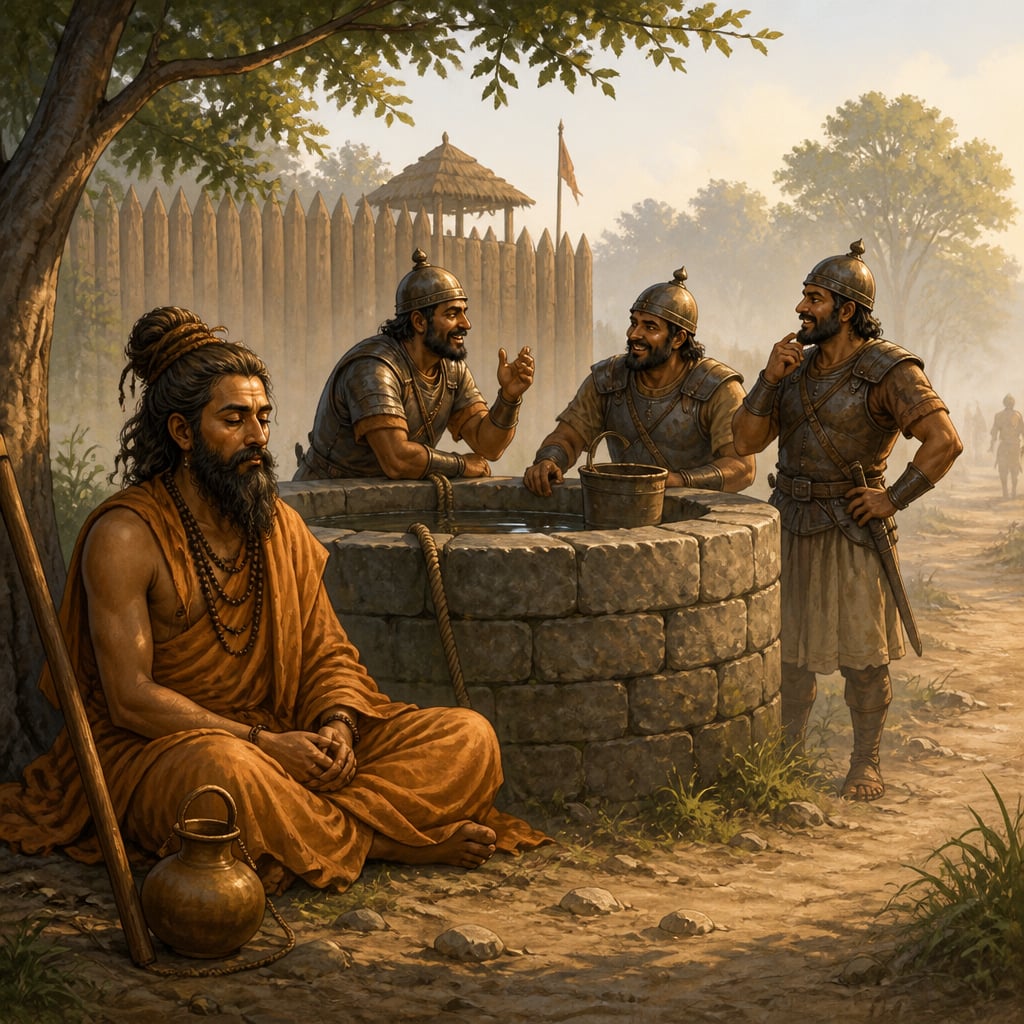
Madhava looked exactly like what he was supposed to be, a wandering ascetic in ochre robes, carrying nothing but a water pot and walking staff. He had arrived in the border city three months ago, begging alms at the marketplace, sleeping under trees, offering blessings to merchants and farmers alike. Everyone knew him. No one suspected him.
This morning, like every morning, he stopped at the well near the garrison. As soldiers drew water, they joked about their new commander's strict discipline, complained about delayed pay, gossiped about which units were being rotated to the northern frontier. Madhava listened while appearing to meditate. He blessed a young soldier who gave him rice. He moved on.
By evening, everything the soldiers had said would reach Kautilya's intelligence officers in Pataliputra, not because Madhava was a spy pretending to be an ascetic, but because he was an ascetic who also happened to serve the kingdom. This distinction mattered.
"The best cover," Kautilya once explained to Chandragupta, "isn't a disguise. It's a genuine life that serves dual purposes. Cāra-bhedāḥ nava-vidhāḥ, the nine types of agents each operate through authentic roles, not mere pretense. A false merchant is always discovered. A real merchant who also observes? Invisible."
Nine Paths to Knowledge
Kautilya understood something most intelligence theorists miss: different missions require different types of people. You don't send the same agent to infiltrate a merchant guild and a royal court. You don't use the same approach for long-term embedded intelligence and urgent tactical information.
So he created a systematic typology, nine distinct categories of agents, each optimized for specific environments and objectives:
1. Kapatika Sanyasi (The Fraudulent Ascetic) These weren't genuine monks but trained agents adopting ascetic cover. They could move freely across borders, enter any social circle from palace to slum, and their poverty meant they aroused no suspicion of ulterior motives. The spiritual authority gave them access to confessions and secrets.
2. Udasthita (The Recluse) Former officials, disgraced courtiers, or merchants who had "retired" from public life. Their bitterness seemed authentic, often it was authentic, but channeled to serve the state. People spoke freely around those presumed to have withdrawn from affairs.
3. Grihapaitika (The Householder) Respectable farmers, traders, or professionals maintaining their ordinary lives while observing local conditions. These formed the backbone of domestic intelligence, thousands of ordinary citizens noting unusual activities, newcomers, and changes in local sentiment.
4. Vaidehaka (The Merchant) Actual merchants whose trading activity took them across borders and into foreign territories. They gathered economic intelligence, crop yields, military preparations visible in increased arms purchases, political stability reflected in market confidence.
5. Tapasa (The Genuine Ascetic) Unlike the Kapatika, these were real spiritual seekers who served the kingdom from devotion rather than payment. Their intelligence was both reliable and guilt-free, they weren't lying about who they were.
6. Sattri (The Classmate Agent) Agents placed in childhood, educated alongside princes and nobles, building relationships that would last decades. When these childhood friends reached positions of power, the agent had perfect access based on authentic long-term relationships.
7. Tikshna (The Sharp One/Assassin) Operatives trained for dangerous missions requiring violence or extreme risk. These weren't everyday observers but specialists deployed for critical operations, eliminating threats, conducting sabotage, operating in hostile territory.
8. Rasada (The Poison Giver) Experts in toxicology capable of elimination missions that left no obvious trace. More importantly, they could detect poisoning attempts against their own rulers, making them defensive as well as offensive assets.
9. Vishakanya (The Poisoned Maiden) Women raised from childhood with gradual exposure to poisons, building immunity while their bodies became toxic. Sent as gifts or planted as lovers, they could eliminate targets through intimate contact. The most controversial and ruthless category.
The Logic Behind Diversity
Why nine types instead of generic "spies"? Because intelligence gathering isn't one activity, it's many.
Long-term strategic intelligence requires embedded agents who live their cover for years. The Grihapaitika farmer watching a border region provides early warning of military buildups. The Sattri childhood friend reports on palace politics from inside knowledge. These missions demand patience and authenticity.
Short-term tactical intelligence needs mobile observers who can deploy quickly. The Vaidehaka merchant travels on legitimate business, gathering information across multiple locations. The Kapatika ascetic moves wherever needed, arousing no suspicion about sudden arrivals or departures.
Special operations demand specialists. The Tikshna assassin and Vishakanya poisoned maiden handle missions that ordinary observers cannot, eliminating threats that normal intelligence merely identifies.
Defensive intelligence requires trusted, motivated agents. The Tapasa genuine ascetic serves from devotion, minimizing risk of double-agency. The Sattri's long-cultivated relationships provide warning of plots.
Modern intelligence services rediscovered this typology independently. The CIA distinguishes between NOCs (non-official cover, like Kautilya's merchants), official cover (embassy staff, his courtiers), and assets (recruited locals, his householders). The KGB's "illegals" matched his Sattri, deep-cover agents embedded for decades. SEAL teams and special forces mirror his Tikshna. Every serious intelligence service eventually recreates Kautilya's categories because the underlying logic is universal.
The Ethics of Espionage

The Vishakanya, poisoned maiden, disturbs modern readers. Girls raised as weapons, their bodies made toxic, sent to seduce and kill. This seems monstrous.
Kautilya would respond with a question: compared to what? A siege that starves thousands? A battle that kills armies? The alternative to targeted elimination isn't peace, it's cruder violence affecting more people.
This is the libertarian calculus embedded in Kautilya's intelligence doctrine. The goal isn't perfect morality, it's minimum necessary force. If one Vishakanya can eliminate a tyrant bent on conquest, isn't that preferable to the war that tyrant would launch? If intelligence prevents a rebellion by identifying its leaders early, isn't that better than the bloodshed of putting down a full revolt?
The ethical question isn't whether espionage is inherently wrong. It's whether the alternative, blind governance, reactive violence, mass casualties, is better. Kautilya's answer was clear: information enables precision, and precision reduces harm.
Modern targeted strikes via drones reflect the same logic. A missile eliminating a terrorist leader kills fewer than the ground invasion that alternative would require. The moral question becomes: does the precision of intelligence-enabled action justify its use? Or should we reject all such methods and accept the greater violence that follows?
Kautilya chose precision. His nine types of agents enabled rulers to act surgically rather than broadly, to prevent wars rather than fight them, to eliminate specific threats rather than punishing whole populations.
Matching Agent to Mission
The merchant Vishaka from our previous lesson was a Vaidehaka, a genuine trader whose business took him across borders naturally. His cover was perfect because it wasn't a cover. When he reported on military movements near the border, he did so while actually buying and selling silk. The intelligence was a byproduct of legitimate activity.
But when Chandragupta needed to know what was happening inside the Nanda palace, which nobles were loyal, which disgruntled, where the treasury kept its gold, he needed a Sattri. Someone who had grown up with Nanda princes, who had authentic relationships built over decades, who could walk into restricted areas without question.
When a regional governor showed signs of rebellion, raising private armies, hoarding grain, meeting secretly with foreign envoys, that was a job for an Udasthita. A "disgraced" former official, bitter about his dismissal from court, who approached the governor offering his services. The governor, thinking he'd found a useful traitor, shared his plans freely. Every word flowed back to Pataliputra.

And when intelligence revealed a genuine threat, an assassin sent by an enemy kingdom, a conspiracy that couldn't be exposed without revealing sources, that's when the Tikshna deployed. Not for routine work, but for critical missions where normal channels had failed.
The key was matching the agent type to the mission requirements. Ask yourself:
- Access requirements: Who can naturally be where you need information from?
- Timeline: Is this long-term observation or urgent collection?
- Risk tolerance: Can you afford exposure if the agent is caught?
- Information type: Are you gathering gossip, official secrets, or technical intelligence?
Different answers demanded different agent types.
The Modern Parallel
Consider how Sheryl Sandberg described Facebook's approach to understanding users. They didn't just survey people, surveys produce what respondents think they should say. Instead, they observed actual behavior: what people clicked, shared, time spent, reaction patterns. Different types of data required different collection methods.
Or look at how venture capitalists evaluate startups. They don't rely only on the pitch deck the founders present (Kapatika, possibly deceptive). They also: talk to customers (Grihapaitika, ground truth), analyze market data (Vaidehaka, economic intelligence), speak with former employees who left on good terms (Udasthita, disaffected but informed), and place their own people on boards (Sattri, long-term embedded observers).
The categories change; the principle doesn't. Different information sources provide different perspectives. Triangulation requires diversity. And matching your information-gathering method to your question determines whether you get signal or noise.
Your Turn
You probably don't need assassins or poisoned maidens. But Kautilya's principle applies to every information challenge you face: match your source to your question.
Seeking career advice? The Kapatika (recruiter telling you what you want to hear) gives different information than the Grihapaitika (someone actually doing the job) or the Udasthita (someone who left the role). You need all three perspectives to see clearly.
Evaluating a potential business partner? Don't just trust their pitch (Kapatika). Talk to their current customers (Grihapaitika), their former partners (Udasthita), and their long-term associates (Sattri). Each type reveals different truth.
Kautilya's nine categories of agents represent a deeper insight: reality has many faces, and you need eyes in many places to see it whole.
Deep Cover Through Authentic Identity - Operating through genuine roles rather than adopted disguises, making detection nearly impossible.
Modern intelligence distinguishes between 'official cover' (agents operating as declared diplomats) and 'non-official cover' (NOCs who build genuine civilian careers). NOCs spend years establishing real businesses, academic positions, or professional identities. The CIA's Valerie Plame was a NOC operating as an energy consultant, a real career that also provided intelligence access. This matches Kautilya's Vaidehaka merchants perfectly.
Kautilya systematized authentic cover across society's entire structure, every legitimate profession could harbor intelligence function. This created a network that couldn't be dismantled by arresting any category. You can expel diplomats; you cannot expel all merchants, monks, and farmers without destroying your economy and society. The comprehensiveness of Kautilya's system remains impressive even by modern standards.
The Soviet 'illegals' program, immortalized in the TV series 'The Americans', embedded KGB officers in Western societies for decades under deep cover. They built real lives: marriages, children, careers, community involvement. Their covers were authentic because they lived them fully. Donald Heathfield and Tracey Foley (actually Andrei Bezrukov and Elena Vavilova) operated for years as ordinary Americans, exactly as Kautilya's Grihapaitika householders operated as ordinary citizens.
Source Specialization and Mission Matching - Different information requirements demand different collection methods and agent types.
Modern intelligence distinguishes HUMINT (human intelligence), SIGINT (signals intelligence), OSINT (open source), GEOINT (geospatial), and more. Each category requires different capabilities, training, and deployment. Similarly, venture capital uses different information sources: market research (Vaidehaka), customer interviews (Grihapaitika), founder background checks (Udasthita, former colleagues), and board representation (Sattri, long-term embedded observers). The principle is universal: match collection method to question type.
Verses
चारभेदाः नववृत्तयः।
cāra-bhedāḥ nava-vṛttayaḥ |
There are nine types of spies with different occupations.
Kautilya establishes that intelligence work cannot be one-size-fits-all. Different missions, environments, and information types require specialized agent categories.
Book 1, Chapter 11, Verse 2 (R.P. Kangle)
स्वधर्मेण प्रविष्टाः चाराः न संशयं जनयन्ति।
sva-dharmeṇa praviṣṭāḥ cārāḥ na saṃśayaṃ janayanti |
Spies established in their natural roles do not create suspicion.
The most effective cover is authenticity. Agents operating through genuine occupations, real merchants, actual monks, legitimate farmers, arouse no suspicion because they ARE what they appear to be.
Book 1, Chapter 12, Verse 5 (R. Shamasastry)
तीक्ष्णाः गूढार्थसाधकाः।
tīkṣṇāḥ gūḍha-artha-sādhakāḥ |
The sharp ones (assassins) are the accomplishers of secret objectives.
Some missions cannot be accomplished through observation and reporting alone. When intelligence reveals a threat that cannot be countered through normal means, specialized operatives must act.
Book 1, Chapter 12, Verse 18 (Patrick Olivelle)
Case studies
CIA's NOC Program - Modern Vaidehaka
The CIA's Non-Official Cover (NOC) program embeds intelligence officers in genuine civilian careers for years or decades. NOCs build real businesses, work for actual corporations, establish academic credentials, living authentic lives that happen to include intelligence collection. Unlike official cover officers (operating from embassies), NOCs have no diplomatic protection if caught. Their only protection is the authenticity of their cover.
NOCs are Kautilya's Vaidehaka merchants perfected, actual professionals whose genuine work provides intelligence access. An energy consultant really does consult on energy projects; they also observe which countries are developing what capabilities. A journalist really does report news; they also gather political intelligence. The cover is sustainable because it's authentic.
When Valerie Plame's NOC status was exposed (2003), it demonstrated both the system's power and fragility. Her energy consulting work had provided years of intelligence on WMD proliferation. The exposure ended her operational career but validated the approach, she had operated successfully for years because her cover was genuine.
Authentic cover beats false identity because it's sustainable and undetectable. Whether in intelligence, business intelligence, or personal information gathering, the principle holds: genuine roles provide better access than pretense. Build real relationships and authentic expertise; intelligence flows naturally from authentic positioning.
Corporate espionage today operates through the same principles of authentic cover. Competitors hire away employees, consultants embed in client organizations, and market researchers build genuine relationships to gather strategic intelligence. The most effective business intelligence comes from people with real roles and real access, not from outsiders trying to peek in.
The CIA's NOC program requires an average of 7-10 years to develop a single deep-cover agent. When Valerie Plame was exposed in 2003, the entire network she had built over nearly two decades was compromised overnight.
Operation Anthropoid - The Tikshna Dilemma
In 1942, Czech resistance agents assassinated Reinhard Heydrich, architect of the Holocaust and Protector of Bohemia and Moravia. The operation succeeded, Heydrich died of his wounds. But Nazi reprisals were brutal: the villages of Lidice and Ležáky were destroyed, every male resident murdered, women sent to concentration camps, children killed or germanized.
This represents the Tikshna dilemma Kautilya recognized: targeted elimination can prevent future harm (Heydrich's continued organization of genocide) but can also trigger broader violence. The calculation is grim: how many would Heydrich have killed if allowed to continue vs. how many died in reprisals? The moral mathematics of precision targeting.
Historians debate whether Anthropoid was justified. Heydrich's death may have disrupted Holocaust logistics temporarily. The reprisals killed hundreds immediately and terrorized thousands. But Heydrich's continued work might have killed tens of thousands more. The counterfactual is unprovable but necessary to consider.
Precision action based on intelligence isn't automatically moral, consequences must be anticipated and weighed. Kautilya's Tikshna category wasn't employed casually but only when the alternative was worse. The principle for modern application: precision requires not just capability but careful assessment of total consequences, including second-order effects. Intelligence enables precision; wisdom requires asking whether precision is proportional to the goal.
Targeted sanctions, drone strikes, and cyberattacks all face the same dilemma: precision action can achieve immediate objectives but may trigger consequences far exceeding the original problem. Companies that aggressively litigate against small competitors or publicly attack critics often win the battle but lose the war of public perception. The second-order effects of any forceful action deserve as much analysis as the action itself.
The Nazi reprisals for Heydrich's assassination killed an estimated 5,000 Czech civilians. The village of Lidice was completely destroyed, with all men executed and women and children sent to concentration camps.
Historical context
c. 4th century BCE
Ancient India's political fragmentation made intelligence essential. Multiple kingdoms, republics, tribal confederations, and foreign powers created a complex strategic environment. Survival required knowing who was plotting with whom, where armies were gathering, which alliances were forming. The nine agent types emerged from operational necessity in this complex landscape.
The nine agent types weren't theoretical abstractions, they were operational categories that enabled the Mauryan empire's intelligence superiority. When Chandragupta's forces met larger Nanda armies, they won partly through better intelligence about enemy positions, capabilities, morale, and internal divisions. The system worked, which is why it survived in the Arthashastra for millennia.
Reflection
- Kautilya argued that authentic cover (spies operating through genuine roles) is more effective than false identity. In your own information gathering, about careers, opportunities, or decisions, do you rely more on 'official' sources (like marketing materials) or authentic ground truth (like talking to people actually doing the work)?
- The nine agent types served different purposes, long-term strategic intelligence, tactical information, special operations. When you need to make important decisions, do you use multiple information source types, or do you rely primarily on one category (like internet research, or friend recommendations, or expert analysis)?