Gathering Information

Collection Methods

From observation to interrogation, methods of gathering strategic intelligence. Kautilya's techniques for collection, verification, and counter-deception that separate reliable intelligence from noise.

The Art of Listening Without Asking
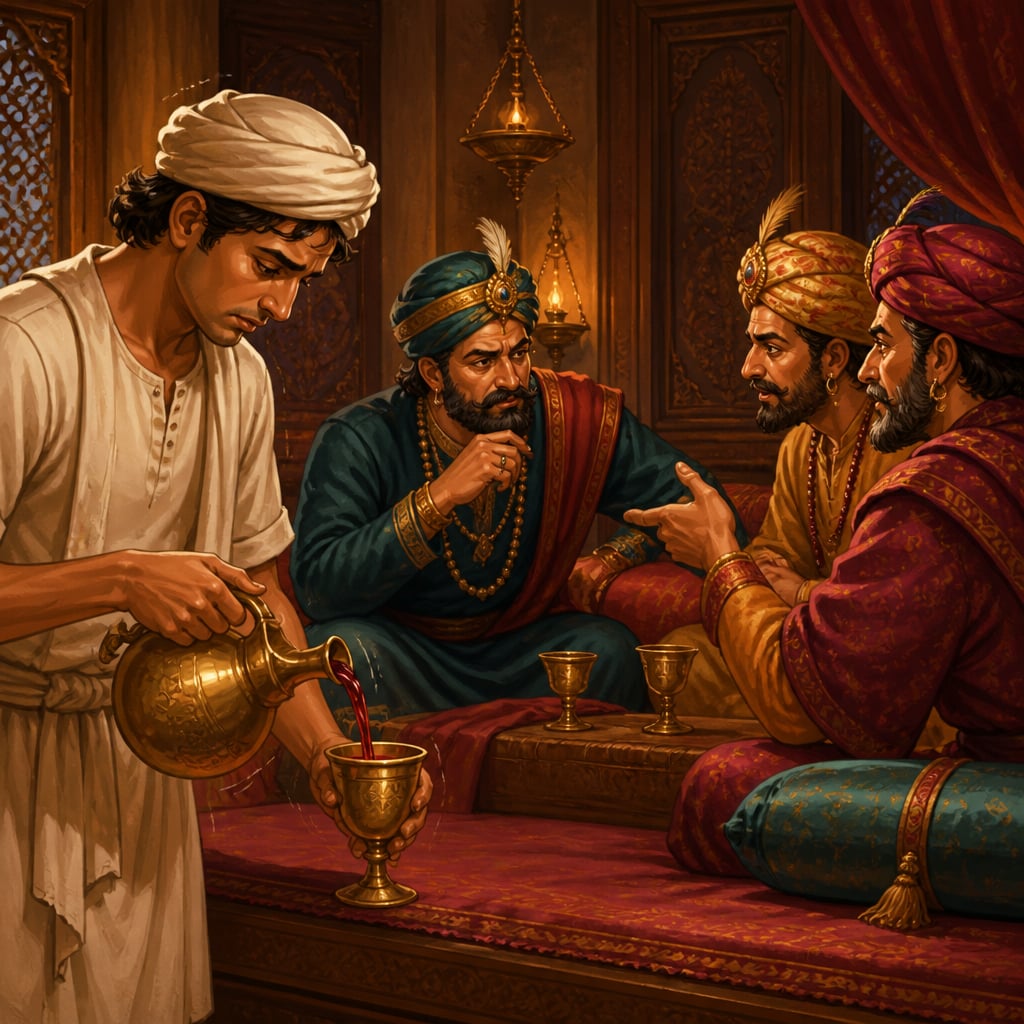
Palace servant Ratnakara eavesdropping on Nanda ministers

Ratnakara had been working in the Nanda palace kitchens for eight years. Nobody questioned his presence anymore, he was part of the furniture, as invisible as the stone walls. This invisibility made him invaluable.

This evening, as he carried wine to the private chamber where the treasury minister met with two northern governors, he moved slowly. Not suspiciously slowly, just the unhurried pace of an old servant whose joints ached. He poured the wine carefully, taking time to ensure each cup was filled precisely. The governors barely glanced at him.

"The new taxes are bleeding the northern provinces," one governor said, accepting his cup. "My people won't tolerate another harvest seized for Pataliputra's granaries."

"Nor mine," the second agreed. "If Chandragupta were to guarantee lower tributes..."

The treasury minister raised a hand. "Careful. Even walls have ears."

They glanced at Ratnakara, who was gathering the wine pitcher with trembling hands. Just an old man, deaf probably, certainly no threat. They waited until he shuffled out, then continued their conspiracy.

What they didn't know: Ratnakara wasn't deaf. He wasn't even particularly old, the tremor was theater. And everything they'd said would reach Kautilya before morning, carefully verified against what other agents had reported from those same provinces.

"Pratyakṣa-anumāna-upamāna-śabdaiḥ pramāṇaiḥ," Kautilya had taught his intelligence officers. "Through direct observation, inference, comparison, and testimony, these four means of valid knowledge. Never trust one alone. Truth emerges from convergence."

The Five Methods of Collection

Kautilya recognized that intelligence gathering isn't a single skill but a constellation of techniques, each suited to different circumstances. He codified five primary methods:

1. Direct Observation (Pratyakṣa)

The most reliable but also most limited. What you see with your own eyes, you know, but you can only see so much. Direct observation works for:

The Grihapaitika householder watching the border, the Vaidehaka merchant noting prices in foreign markets, the Tapasa ascetic observing activity at temples, all practice direct observation. Its strength is certainty about what was witnessed. Its weakness is limited scope, you can only be in one place at a time.

2. Interrogation and Conversation (Śabda)

What people tell you, voluntarily or otherwise. This includes:

The art lies in making people talk without realizing what they're revealing. The Udasthita "bitter exile" attracts confidences from conspirators. The Kapatika ascetic receives confessions. The merchant exchanges gossip with fellow traders. Each creates contexts where information flows naturally.

Interrogation can be subtle (conversation) or overt (questioning prisoners). Kautilya advocated both but emphasized that forced interrogation often produces what the subject thinks you want to hear rather than truth. Better to create conditions where people want to talk.

3. Document Analysis (Lekhya-parīkṣā)

Written records reveal what conversations conceal. Kautilya's agents sought:

The challenge with documents: they can be forged or planted. Verification requires checking against known authentic documents, analyzing writing styles, examining seals and materials, and, most importantly, cross-referencing against information from other sources.

A Sattri with access to palace archives could copy documents. A merchant might glimpse customs records. A disgraced official (Udasthita) might still have access to administrative papers. Each document told a story, but only when verified against the larger pattern.

4. Signal Analysis (Cihna-darśana)

Reading meaning from indirect indicators, what we'd now call "signals intelligence" though Kautilya's version was human rather than electronic:

The principle: actions reveal intentions more reliably than words. A king who claims peace while stockpiling weapons is preparing for war. A merchant who insists business is normal while quietly liquidating inventory knows something others don't.

Signal analysis requires baseline knowledge, you must know what's normal to recognize what's abnormal. This is why long-term embedded agents (Sattri, Grihapaitika) are invaluable. They know the patterns; they spot the deviations.

5. Inference and Pattern Analysis (Anumāna)

Drawing conclusions from partial information by applying logic and understanding human behavior:

Inference fills gaps between direct observations. But it's also where mistakes happen, the same signal can have multiple causes. Rising grain prices might indicate famine, military preparation, or simply hoarding by merchants. Inference must be tested against additional evidence.

Kautilya warned against over-reliance on inference. It's a necessary tool when direct knowledge is unavailable, but it should always be marked as probabilistic, not certain. The intelligence officer's job was to say: "Based on these signals, we infer this conclusion with this level of confidence."

The Verification Problem

Gathering information is easier than verifying it. Every method of collection can be compromised:

Kautilya cross-checking three spy reports by lamplight

This is why Kautilya mandated triangulation, the principle we saw earlier of requiring multiple independent sources. But he went further, specifying verification procedures:

Cross-Source Verification: Information from a Kapatika ascetic should be checked against a Vaidehaka merchant's report from the same region. If both report similar intelligence independently, confidence increases.

Temporal Verification: Track whether earlier predictions proved accurate. An agent who previously reported reliable intelligence earns higher credibility. One whose reports repeatedly fail verification loses credibility.

Logical Verification: Does the intelligence make sense given what else is known? A report of massive troop movements in a region where logistics couldn't support such forces deserves skepticism.

Motive Assessment: Does the source have incentive to deceive? The Udasthita "disgraced official" who genuinely resents his former employer is more credible than one who seems too eager to betray. Real bitterness has a texture fake bitterness lacks.

Counter-Deception

Kautilya knew that enemies practice deception deliberately, planting false information, running double agents, staging events to mislead observers. He developed counter-deception techniques:

Test Intelligence: Occasionally give different agents slightly different information and see which version leaks. This identifies compromised sources.

Controlled Disclosure: Feed suspected double agents false information and observe whether the enemy acts on it. If they do, you've confirmed the agent is compromised, and can now use them to deceive the enemy.

Pattern Disruption: Change your own patterns unpredictably so enemies can't establish reliable baselines for their signal analysis. Irregular troop rotations, random diplomatic missions, varied palace routines, all complicate enemy intelligence gathering.

Layered Verification: Never act on single-source intelligence for critical decisions. Always require multiple independent confirmations, especially for intelligence that seems "too good to be true", because it probably is.

Modern Echoes

When Nate Silver revolutionized political forecasting, he applied Kautilyaancient principles without knowing it. Silver didn't trust single polls (single sources). He aggregated multiple polls (triangulation), weighted them by historical accuracy (temporal verification), and adjusted for known biases (motive assessment). His success in predicting elections came from systematic verification procedures, exactly what Kautilya prescribed for evaluating spy reports.

Colin Powell raising the vial at the UN Security Council

Or consider how intelligence agencies responded to the Iraq WMD failure. The problem wasn't lack of information, it was verification failure. Analysts relied too heavily on single sources ("Curveball"), didn't cross-check adequately, let political pressure override logical verification, and failed to test intelligence through alternative collection methods. The exact failures Kautilya warned against 2,300 years earlier.

In business, the principle applies constantly. Jeff Bezos famously rejected PowerPoint presentations at Amazon in favor of narrative memos because PowerPoint makes it easy to hide weak logic. Reading a full narrative, Kautilya's "document analysis", forces logical verification. Does the argument actually hold together?

Venture capitalists learned the same lesson painfully during the Theranos fraud. Elizabeth Holmes presented compelling direct observations (staged demos), passionate testimony (conversations), and impressive documents (partnership agreements). But investors who failed to verify independently, talk to actual users, consult independent experts, test the technology objectively, lost billions. Those who practiced Kautilyan triangulation avoided the trap.

The Libertarian Principle

Why does verification matter beyond avoiding mistakes? Because it protects against the greatest threat to freedom: action based on false information.

When rulers act on unverified intelligence, they often act oppressively. The wrong person gets arrested. The innocent village gets raided. The loyal official gets executed. Bad intelligence leads to bad governance, which destroys trust and freedom.

Kautilya's verification procedures weren't just about accuracy, they were about justice. Before you punish someone based on intelligence reports, verify. Before you invade based on threat assessments, triangulate. Before you restrict freedoms based on danger claims, test the evidence.

This connects to the broader libertarian premise: government power should be constrained by evidence requirements. Don't let the state act on mere assertion. Demand proof. Require multiple sources. Insist on verification.

Modern civil liberties law embodies this: warrants require probable cause, convictions require proof beyond reasonable doubt, surveillance requires court orders. These are verification requirements, forcing the state to triangulate before it acts.

Kautilya would recognize these as applications of his intelligence doctrine: power must be evidence-based, not assertion-based.

Your Turn

You may not run a spy network, but you face verification challenges constantly:

Career decisions: Don't trust just the recruiter's pitch (possibly deceptive) or company website (marketing). Talk to current employees (direct observation), former employees (unbiased testimony), customers (external perspective), and industry analysts (inference from patterns). Triangulate.

Investment decisions: Don't rely on single analysts or official statements. Check multiple independent research sources, examine actual financial documents, talk to customers and competitors, analyze patterns over time. Verify before committing capital.

Personal relationships: When someone tells you about another person, consider the source's motives and biases. Seek multiple perspectives. Observe directly rather than trusting all testimony. People's actions (signal analysis) often contradict their words.

News and information: In an era of misinformation, Kautilya's methods are more relevant than ever. Before accepting claims: check multiple independent sources, assess source credibility and motives, look for direct evidence rather than assertions, apply logical verification, watch for temporal consistency.

The ancient strategist's wisdom applies to the modern citizen: verify before you trust, triangulate before you act, and never accept single-source claims about important matters.

Information is power only when it's accurate. Everything else is noise, or worse, deception that leads you astray.

Multi-Method Verification - Using multiple independent means of knowledge acquisition to triangulate toward truth.

Scientific method embodies this principle: hypotheses require multiple types of evidence (observation, experiment, mathematical proof, peer review) before acceptance. Journalism's standards require multiple independent sources for major claims. Legal systems demand different types of evidence (witness testimony, physical evidence, documentary evidence, expert analysis). The principle is universal even if terminology differs.

Kautilya explicitly integrated epistemological theory with practical intelligence work 2,000+ years before Western intelligence agencies formalized similar requirements. His framework is both philosophically grounded (drawing on legitimate epistemology) and operationally practical (specifying which methods for which situations). This integration of theory and practice remains rare.

The Iraq WMD intelligence failure (2003) occurred partly through violating Kautilyan principles. Analysts relied heavily on single-source testimony ('Curveball'), didn't adequately cross-check with other methods (satellite imagery showed no supporting evidence), failed logical verification (claimed production levels were logistically implausible), and didn't test temporal consistency (predictions didn't match observations). When George Tenet declared intelligence 'slam dunk,' he was asserting single-source certainty that Kautilya would have rejected.

Recursive Verification - Testing information sources through other independent sources in continuous process.

Modern intelligence uses 'compartmentalization', giving different agents different pieces of information to prevent comprehensive compromise and enable leak detection. Journalism uses 'confirmation', requiring second source verification for major claims. Science uses 'reproducibility', demanding independent researchers replicate findings. Corporate audit uses 'control testing', checking that control systems themselves work properly. All embody Kautilya's recursive verification.

Verses

प्रत्यक्षानुमानोपमानशब्दैः प्रमाणैः।

pratyakṣa-anumāna-upamāna-śabdaiḥ pramāṇaiḥ |

By the valid means of knowledge: direct perception, inference, comparison, and testimony.

Kautilya adopts classical Indian epistemology's four sources of valid knowledge (pramāṇa) for intelligence work. Truth isn't found through single means but through multiple methods that verify each other.

Book 1, Chapter 15, Verse 47 (R.P. Kangle)

चारैः चारान् परीक्षेत।

cāraiḥ cārān parīkṣeta |

One should test spies with other spies.

This elegant sutra captures the verification problem: how do you verify your verifiers? Kautilya's answer: cross-check intelligence sources against each other.

Book 1, Chapter 12, Verse 23 (R. Shamasastry)

मिथ्यावादिनो दण्ड्याः।

mithyā-vādino daṇḍyāḥ |

Those who report falsely should be punished.

Kautilya recognized that intelligence systems live or die by accuracy. Agents who fabricate reports, whether from laziness, fear, or malice, poison the entire system.

Book 1, Chapter 15, Verse 53 (Patrick Olivelle)

Case studies

FiveThirtyEight and the Art of Verification

Nate Silver's FiveThirtyEight revolutionized election forecasting by treating polls like intelligence reports, never trusting single sources, always aggregating multiple polls (triangulation), weighting by historical accuracy (temporal verification), adjusting for known biases (motive assessment), and tracking predictions against outcomes (accountability). While pundits confidently predicted outcomes based on gut feelings, Silver used systematic verification.

Silver independently rediscovered Kautilyan verification principles: (1) Multiple sources (never single polls), (2) Cross-verification (comparing polls of same race), (3) Source credibility tracking (weighting by past accuracy), (4) Logical verification (adjusting for known biases), (5) Temporal testing (comparing predictions to outcomes). This is pratyakṣa-anumāna-upamāna-śabda applied to modern data.

Silver correctly predicted 49 of 50 states in 2008 and 50 of 50 in 2012, unprecedented accuracy. His success wasn't magic but method: systematic verification procedures that Kautilya would recognize. When Silver's predictions differed from pundit consensus, Silver was usually right, because his verification was more rigorous.

Systematic verification beats intuition and single sources. Whether forecasting elections or making business decisions, the principle applies: gather multiple independent sources, cross-check them, weight by historical accuracy, test predictions against outcomes, and adjust methods based on results. Kautilya's 2,300-year-old framework still produces superior results.

Data-driven decision making in business follows the same verification principles. Companies like Google run hundreds of A/B tests simultaneously, never trusting a single data source. Investment firms cross-reference multiple signals before making trades. The organizations that consistently outperform are those that have built systematic verification into their decision processes rather than relying on any single expert's intuition.

Nate Silver's model correctly predicted 49 of 50 states in 2008 and all 50 in 2012. His approach used weighted aggregation of roughly 20 different polls per state, applying source reliability adjustments to each.

Iraq WMD Intelligence Failure

In 2003, the United States invaded Iraq based on intelligence claiming Iraq possessed weapons of mass destruction (WMD). CIA Director George Tenet declared the case 'slam dunk.' But post-invasion, no WMDs were found. The intelligence was wrong. How did this happen?

The failure violated every Kautilyan verification principle: (1) Over-reliance on single source ('Curveball'), (2) Failure to cross-check (defector testimony contradicted by satellite imagery), (3) No logical verification (claimed production levels were logistically implausible), (4) Political pressure overrode verification procedures, (5) No consequences for sources providing false intelligence. Each violation Kautilya specifically warned against.

The invasion proceeded based on false intelligence, costing thousands of lives, trillions of dollars, and destabilizing a region for decades. Post-mortems identified verification failures as root cause. The lesson was expensive: Kautilyan principles exist for reasons, ignoring them courts catastrophe.

Verification procedures aren't bureaucratic obstacles, they're safeguards against catastrophic errors. When political pressure, confirmation bias, or overconfidence bypasses systematic verification, disaster often follows. Kautilya's methods seem cautious, even slow. But caution based on false intelligence is far more dangerous than patience seeking accurate truth. The Iraq case validates ancient wisdom painfully.

The Iraq WMD failure is repeated in miniature every time a company launches a product based on unverified market research, or an investor backs a startup based on founder charisma instead of diligence. Confirmation bias and political pressure corrupt information systems in corporations just as they do in governments. Building verification procedures that resist pressure is not bureaucracy. It is survival.

The Iraq WMD intelligence failure led to a war costing over $2 trillion and hundreds of thousands of lives. A 2005 Senate investigation found that every major prewar claim about Iraqi WMD was either overstated or wrong.

Historical context

c. 4th century BCE

The complex multi-state system of ancient India made intelligence gathering essential but also made deception common. Every kingdom ran spies; every kingdom faced enemy agents. Success required not just gathering information but verifying it, distinguishing accurate intelligence from deliberate deception. Kautilya's verification methods emerged from this intensely competitive environment.

The verification methods Kautilya established weren't academic exercises, they were operational necessities. The Mauryan empire's intelligence advantage came partly from better verification. While enemies acted on single-source intelligence and often fell into deception traps, Mauryan decision-makers demanded triangulation. This systematic approach to truth-finding provided competitive advantage that helped build subcontinental empire.

Reflection

More in Gudhapurusha: The Nine Spies

All lessons in Gudhapurusha: The Nine Spies · Arthashastra: Art of Strategy course