Treaties and Agreements

Sandhi-Vigraha Documents

How to structure agreements that protect your interests and stand the test of time. Kautilya's framework for drafting treaties reveals principles for creating enforceable commitments in environments where trust is limited and interests diverge - wisdom applicable to any binding agreement.

In 305 BCE, Chandragupta Maurya sat across from Seleucus Nicator in a pavilion erected at the boundary between their empires. The air was thick with tension. Two years of war had proven costly to both sides, and neither could deliver a knockout blow. Now they had to negotiate peace.
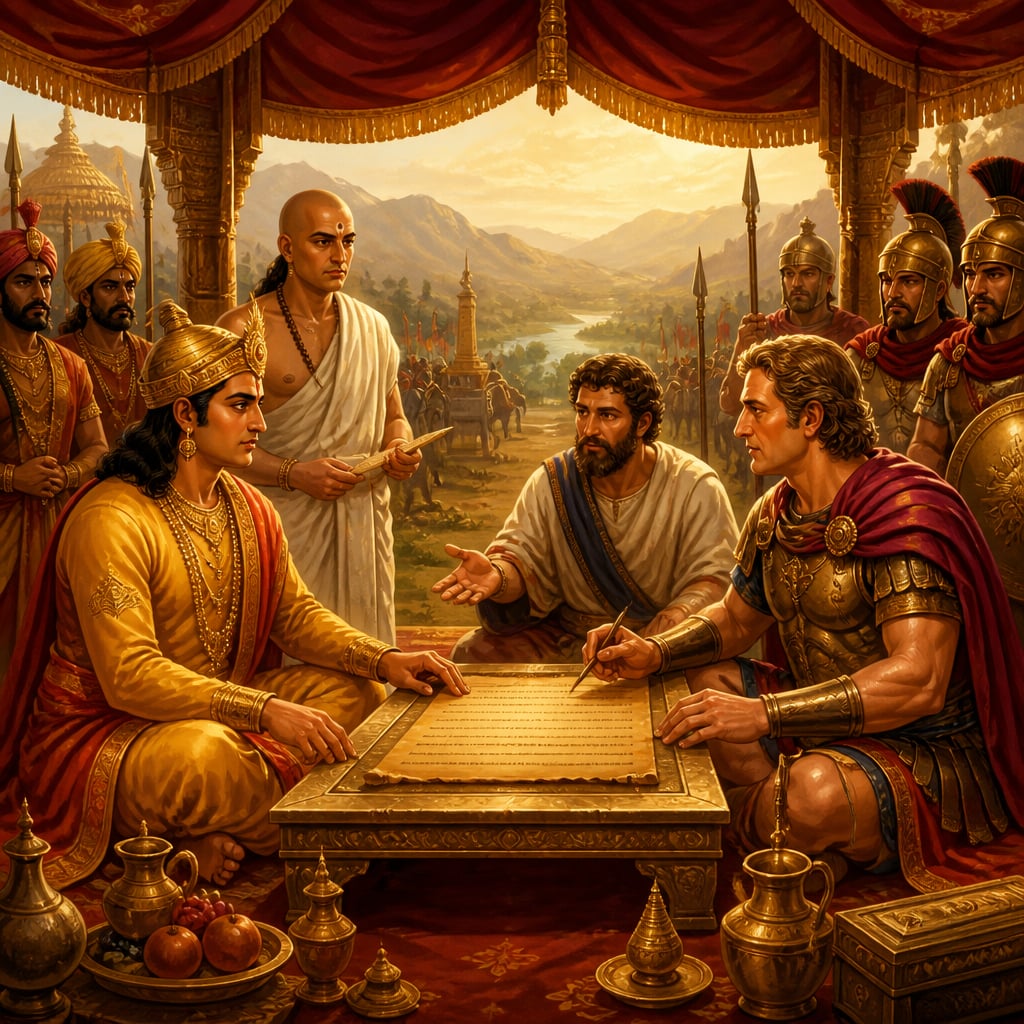
Chandragupta and Seleucus at the treaty pavilion in 305 BCE

Kautilya stood behind Chandragupta, observing the Greek general who had once commanded under Alexander himself. Seleucus wanted to reclaim Alexander's lost territories. Chandragupta needed to secure his western frontier to consolidate his new empire. Both men knew that whatever they agreed to today could be broken tomorrow.

"Words are wind," Seleucus said through his translator, gesturing at the draft treaty between them. "How do I know you will honor this agreement when I march east to deal with Antigonus?"

Kautilya leaned forward and spoke for the first time. "You don't," he said quietly. "Which is precisely why this treaty must be structured so that neither of us benefits from breaking it." He tapped the parchment. "The agreement itself must create the incentives for compliance. Sandhi sādhana-upahitaḥ sthāna-kāla-pramāṇaiḥ - a treaty should be furnished with means of enforcement, specifying place, time, and methods of verification."

This moment captures the essence of Kautilyan treaty-making. In a world without international courts, without binding arbitration, without any power above sovereign rulers, how do you create agreements that stick? Kautilya's answer, refined through decades of diplomatic practice, was revolutionary: structure the treaty so that self-interest demands compliance.

The Architecture of Binding Agreements

Kautilya understood what modern game theorists would later formalize - that treaties succeed not through moral obligation but through incentive alignment. The Mauryan-Seleucid treaty exemplified this principle. It included territorial exchanges (Seleucus ceded Afghan territories), a royal marriage (Chandragupta married Seleucus's daughter), mutual military guarantees, and the exchange of ambassadors who would live at each other's courts - essentially high-status hostages ensuring good behavior.

Each element created mutual vulnerability. If Seleucus violated the treaty, he lost access to Indian war elephants crucial for his campaigns against rivals. If Chandragupta broke faith, his wife's father became his enemy, the ambassadors could be imprisoned, and the legitimacy gained from the marriage evaporated. The treaty worked not because both men were honorable - though they may have been - but because violation cost more than compliance.

Consider how different this is from naive treaty-making. An inexperienced diplomat might draft a document saying "Both parties agree to maintain peace and friendship." Kautilya would dismiss this as worse than useless - it creates the illusion of security without substance. What does "peace" mean? What constitutes "friendship"? When has it been violated? How is violation detected? What are the consequences?

Instead, Kautilya insisted on specificity that bordered on obsessive. The treaty must state exactly what each party will and will not do, when, where, verified how, with what penalties for breach. This isn't legalistic pedantry - it's survival. Vague agreements invite violation disguised as interpretation.

The Seven Types of Sandhi

Kautilya categorized treaties into seven types based on the power dynamics between parties. Understanding which type you're negotiating is crucial because each requires different safeguards.

When Airbnb negotiated with New York City in 2016 over home-sharing regulations, they entered what Kautilya would call an Upahita Sandhi - a treaty under pressure. The city held regulatory power and threatened to fine Airbnb thousands of dollars per illegal listing. Airbnb, facing potential prohibition from its largest market, had to accept unfavorable terms while building political support to change the rules later. Like Kautilya advised for such treaties, they minimized immediate commitments, built in review periods, and immediately began lobbying for legislative change. The agreement bought time.

Contrast this with the 2015 Paris Climate Accords - a Sankshita Sandhi, or doubtful treaty. Nearly 200 nations signed an agreement to reduce emissions, but nobody trusted anybody else to actually do it. The treaty succeeded precisely because it assumed bad faith. It built in extensive reporting requirements, public disclosure of emissions data, five-year review cycles, and peer pressure mechanisms. Countries couldn't secretly violate because violation would be detected and publicized. The enforcement wasn't through penalties but through reputation and domestic political cost.

Apple and Samsung counsel teams negotiating patent cross-licensing

Or consider Apple and Samsung's complex patent cross-licensing agreements - a Dvidhabhara Sandhi, treaty of dual obligation. Both companies are bitter competitors in smartphones while simultaneously being each other's suppliers and licensees. Samsung makes critical components for iPhones; Apple licenses design patents to Samsung. Each depends on the other while competing fiercely. As Kautilya warned, this is inherently unstable, requiring constant renegotiation and occasional eruptions of litigation.

The Mauryan-Seleucid treaty was a Samam Sandhi - equal treaty between roughly matched powers. Neither could dominate the other militarily, making balanced exchange both possible and necessary. The equality was real, making the treaty stable for decades.

What Makes Treaties Stick

Kautilya identified seven elements that transform words into enforceable commitments.

First, clarity. When Jeff Bezos makes acquisition offers, the term sheets specify exactly what's being purchased, at what price, under what conditions, with what representations and warranties, backed by what escrows and indemnifications. This isn't because lawyers enjoy complexity - it's because ambiguity creates disputes. "We'll work together" means nothing. "You'll deliver 10,000 units by March 15 meeting specifications detailed in Appendix A, verified by third-party testing, with $50,000 penalty for each week of delay" is enforceable.

Second, verification. The Reagan administration's approach to arms control treaties with the Soviet Union embodied the Russian proverb Reagan loved to quote: "Trust, but verify." Actually, Kautilya would correct this to "Don't trust, just verify." The INF Treaty included on-site inspections, data exchanges, satellite monitoring, and tagged missiles. Verification wasn't about catching cheaters - it was about making compliance transparent and violation obvious.

Third, graduated enforcement. A treaty that makes every breach equivalent to complete violation can't be enforced. If the only response to minor technical non-compliance is war or total breakdown, you can't respond proportionally to small violations, encouraging larger ones. Modern contracts include cure periods, warnings, mediation, arbitration, then litigation - escalating responses to escalating breaches.

Fourth, collateral or hostages. Traditional Indian treaties often included royal marriages, creating kinship ties that made betrayal literally fratricidal. Modern equivalents include performance bonds, escrow accounts, and interlinked agreements. When a construction company posts a performance bond, they've given hostages to fortune - violating the contract means forfeiting the bond.

Fifth, time limits and adaptation. The worst treaty is a perpetual one that can't respond to changed circumstances. Kṛta-sandhir viśvāso bhavati na cira-kālam - trust created by a treaty does not last long, as Kautilya observed. Circumstances change, interests shift, capabilities evolve. Treaties that can't adapt get broken. Build in renewal points, review clauses, and renegotiation procedures.

Sixth, witnesses. Medieval European treaties often included the Pope as witness, not because he could enforce anything but because violation had reputational costs. Modern equivalents include public announcements, signing ceremonies, and media coverage. When company executives shake hands in front of cameras announcing a partnership, they've created witnesses who'll remember if the deal fails.

Seventh, mutual vulnerability. Don't structure a deal where one side gives everything upfront while the other promises future performance. That's asking for betrayal. Structure exchanges to occur simultaneously or incrementally, so both sides always have something at risk.

When Treaties Must Be Broken

Kautilya was no idealist. He recognized that sometimes breaking a treaty is strategically necessary. But even then, he insisted on procedure.

Sandhi-bhede nimittaṃ prakāśayet - when breaking a treaty, publicly declare the reason. This isn't about moral justification; it's about preserving your reputation for future agreements. If you break treaties arbitrarily, nobody will trust your future commitments. But if you break them only when the other side violated first, or when circumstances changed fundamentally, or when survival demanded it, and you explain why publicly, you maintain credibility.

When Germany violated the Treaty of Versailles in the 1930s, Hitler offered justifications - the treaty was imposed, not negotiated; it was unfair; Germany had complied while others hadn't. Whether these justifications were valid is debatable, but the strategic logic is pure Kautilya: don't just violate, explain the violation publicly to shape how others interpret it.

Conversely, when Britain and France declared war after Germany invaded Poland, they framed it as enforcing treaty obligations, not starting a war. The London Agreement had guaranteed Polish independence; Germany violated it; Britain and France responded as the treaty demanded. This preserved their reputation for honoring agreements even as they went to war.

Modern Applications

Every important agreement you make involves the same principles Kautilya identified 2,300 years ago.

When Elon Musk tried to back out of his $44 billion agreement to buy Twitter in 2022, the Delaware courts enforced it because the merger agreement included specific performance clauses, limited due diligence periods, and tight definitions of what constituted a valid termination reason. The agreement was structured, like Kautilya advised, to be self-enforcing through clear terms and specified consequences.

When labor unions negotiate collective bargaining agreements, successful contracts include precise definitions of working conditions, explicit grievance procedures, neutral arbitrators for disputes, and graduated discipline processes. Vague agreements about "fair treatment" lead to constant conflict; specific agreements about "maximum 8-hour shifts with time-and-a-half overtime pay verified by time cards reviewed monthly by joint labor-management committee" actually work.

When divorcing couples negotiate settlements, experienced attorneys build in verification (financial disclosures), enforcement (court orders), flexibility (review clauses for child support as circumstances change), and mutual vulnerability (both sides give concessions). The agreement has to work without love or trust - only structure and incentives.

The Human Element

Kautilya recognized that treaties aren't purely mechanical. Psychology matters.

Public commitments create stronger obligations than private ones - people want to appear consistent. That's why corporate partnerships are announced via press release, why treaties are signed in elaborate ceremonies, why marriage vows are public. The ceremony isn't decoration; it's strategic. It raises the reputational cost of violation.

Reciprocity creates obligation. When you've received benefits under a treaty, you feel pressure to provide benefits in return. Structure agreements so exchanges are continuous, not one-time, creating ongoing reciprocal obligation.

Loss aversion is more powerful than gain-seeking. People fear losing what they have more than they desire getting something new. Frame treaty compliance as preserving existing benefits rather than gaining future ones.

The Ultimate Test

The Mauryan-Seleucid treaty lasted for decades and both sides honored it. Why? Not because both men were saints, but because Kautilya designed it to align incentives with compliance. Seleucus got war elephants he desperately needed, recognition of his legitimacy through royal marriage, and a secure eastern frontier. Chandragupta got international recognition, territorial gains, and peace to consolidate his empire. Both got ambassadors who served as high-status hostages. Neither could improve their position by violation.

This is the test of any treaty: Does compliance serve both sides' interests better than violation? If yes, the treaty will hold. If no, no amount of moral language will save it.

Whether you're negotiating international peace, business partnerships, employment contracts, or prenuptial agreements, the principle remains the same. Structure, verify, enforce through incentives, build in adaptation, create mutual vulnerability. Don't rely on trust - create alignment of interests that makes trust unnecessary.

That's what Kautilya understood in that pavilion in 305 BCE, and what Seleucus came to appreciate. The treaty they signed that day wasn't just words. It was architecture - a structure of incentives that made peace more profitable than war.

Mechanism design and self-enforcing agreements - structuring commitments so compliance serves each party's self-interest independent of trust or external enforcement.

Game theory formalizes subgame perfect equilibrium for self-enforcing agreements. Contract law emphasizes specific performance clauses and liquidated damages. Thomas Hobbes argued for sovereign enforcement; Kautilya shows how to create enforcement without sovereigns through structure.

Kautilya provides concrete structural mechanisms rather than abstract principles: incremental performance (not lump-sum exchanges), mutual vulnerability (both sides equally exposed), collateral or hostages (immediate cost for violation), third-party witnesses (reputational enforcement), and graduated penalties (proportional responses). His framework is operational - directly implementable - anticipating modern mechanism design theory by 2,000 years.

European diplomats signing the Treaty of Westphalia at Münster in 1648

The Treaty of Westphalia (1648) ended Europe's Thirty Years' War through Kautilyan structure: specific territorial assignments, mutual recognition creating balanced vulnerability, interlinked agreements where violating one endangered all, and great power guarantees providing third-party enforcement. It worked not through moral transformation but structural design - making compliance more beneficial than violation, creating the modern state system that persists today.

Dynamic instability of agreements and the necessity of continuous renegotiation - recognizing that all commitments exist in changing contexts requiring adaptation.

Relational contract theory acknowledges that long-term agreements require ongoing adjustment. Evolutionary game theory models how cooperation erodes as circumstances change. Modern treaty theory includes sunset clauses and review provisions, but often treats stability as the default rather than erosion.

Verses

संधिः साधनोपहितः स्थानकालप्रमाणैः

sandhiḥ sādhana-upahitaḥ sthāna-kāla-pramāṇaiḥ

A treaty should be furnished with means of enforcement, specifying place, time, and methods of verification.

This sutra encapsulates the principle of self-enforcing agreements. A treaty isn't just a statement of intentions - it must specify concrete mechanisms: where performance occurs (jurisdiction), when it occurs (deadlines), and how compliance is verified (measurement).

Book 7, Chapter 3, Verse 12-14 (R.P. Kangle)

कृतसन्धिर्विश्वासो भवति न चिरकालम्

kṛta-sandhir viśvāso bhavati na cira-kālam

Trust created by a treaty does not last for a long time.

A devastatingly realistic observation: treaties create temporary alignment of interests, not permanent friendship. The trust that emerges from a successful treaty is contingent and time-limited.

Book 7, Chapter 8, Verse 27-29 (L.N. Rangarajan)

संधिभेदे निमित्तं प्रकाशयेत्

sandhi-bhede nimittaṃ prakāśayet

When breaking a treaty, one should publicly declare the reason.

Even Kautilya, the arch-realist, recognizes that reputation matters. If you must break a treaty, explain why publicly.

Book 7, Chapter 9, Verse 16-18 (R. Shamasastry)

Case studies

The Treaty of Westphalia (1648)

After thirty years of devastating religious war in Europe, Catholic and Protestant powers negotiated the Peace of Westphalia. The treaty had to reconcile irreconcilable religious differences while creating a stable political order. It established the principle of state sovereignty and religious tolerance through carefully structured agreements.

Westphalia exemplifies Kautilyan treaty principles brilliantly: (1) Specific territorial assignments rather than vague promises, (2) Mutual recognition of sovereignty creating balanced vulnerability, (3) Multiple interlinked agreements so violating one endangered all, (4) Great power guarantees providing third-party enforcement, (5) Religious tolerance as pragmatic necessity, not moral ideal - neither side could eliminate the other, so structured coexistence became rational choice.

The treaty worked remarkably well, creating the modern state system that persists today. It succeeded not through moral transformation but through structural design - making compliance more beneficial than violation. The system of sovereign states with mutual recognition created stable expectations and predictable behavior.

Even parties with fundamental, irreconcilable differences can create stable agreements through proper structure. Westphalia didn't resolve Catholic-Protestant theological disputes; it made them irrelevant to state relations. The lesson: don't wait for mutual trust or shared values. Design agreements that work even with continued deep disagreement by creating shared interests in compliance.

International trade agreements like the WTO framework operate on the same principle: parties with deep disagreements can coexist under structural rules that make compliance automatic. Modern open-source software licenses work similarly, creating cooperation frameworks between competing companies without requiring them to agree on anything beyond the rules themselves.

The Peace of Westphalia involved 109 delegations negotiating for over four years. The resulting framework of sovereign nation-states still forms the foundation of international law nearly 400 years later.

Bitcoin and Smart Contracts

Blockchain technology enables 'smart contracts' - agreements encoded in software that execute automatically when conditions are met. No human enforcement needed; the code itself ensures compliance. If you meet the conditions, you automatically receive the benefit; if you don't, you automatically don't. Trust is replaced by cryptographic verification.

Smart contracts are the ultimate realization of Kautilyan treaty principles: (1) Perfectly specific terms - code requires precision, (2) Automatic verification - blockchain records all transactions, (3) Immediate enforcement - benefits are released automatically when conditions are met, (4) No third-party needed - the system itself enforces, (5) Mutual vulnerability - both parties lock up assets that are released only upon performance. It's Kautilya's vision of self-enforcing agreements implemented in code.

Smart contracts work for simple, verifiable exchanges but struggle with complex agreements requiring judgment, adaptation, or interpretation. They excel at replacing trust with verification but can't handle ambiguity or changing circumstances. The technology reveals both the power and limits of pure structural enforcement.

Structural enforcement has limits. Kautilya's principles work brilliantly for agreements with verifiable performance and clear terms. But human relationships often require flexibility, judgment, and adaptation that pure mechanism design can't capture. The ideal combines structural safeguards (Kautilyan realism) with human judgment (dharmic wisdom). Neither alone suffices for complex, long-term agreements.

Smart contracts are transforming supply chain management, insurance claims, and real estate transactions by removing trust from the equation. Yet their limitations mirror Kautilya's insight: structural enforcement works for measurable deliverables but struggles with complex, relationship-dependent agreements. The future likely combines automated enforcement for routine terms with human judgment for nuanced obligations.

Smart contracts on Ethereum processed over $3 trillion in transactions in 2023 alone. Yet an estimated $1.7 billion was lost to smart contract exploits that same year, revealing the limits of purely code-based enforcement.

Historical context

c. 4th century BCE

Ancient Indian political culture developed sophisticated treaty practices over centuries. The constant shifting of alliances in the Mahajanapada period created practical wisdom about what makes agreements stick. Mechanisms like hostage exchange, royal marriages, ritual oaths, third-party witnesses, and graduated penalties were refined through trial and error. Kautilya systematized this accumulated practice into explicit principles.

Understanding the historical context reveals that Kautilya's principles emerged from real-world necessity. The Mahajanapada period was a laboratory for testing what treaty designs work and which fail. His framework represents distilled wisdom from centuries of diplomatic practice, not abstract theorizing.

Reflection

More in Duta: The Art of Diplomacy

All lessons in Duta: The Art of Diplomacy · Arthashastra: Art of Strategy course