The Ambassador

Duta - Eyes and Ears of the King

The ambassador is far more than a messenger. In Kautilya's system, the duta is an intelligence operative, negotiator, and strategic instrument who can make or break a kingdom's foreign policy. Understanding the critical role of diplomatic representatives in a world of competing powers.

The Spy Who Carried No Weapons
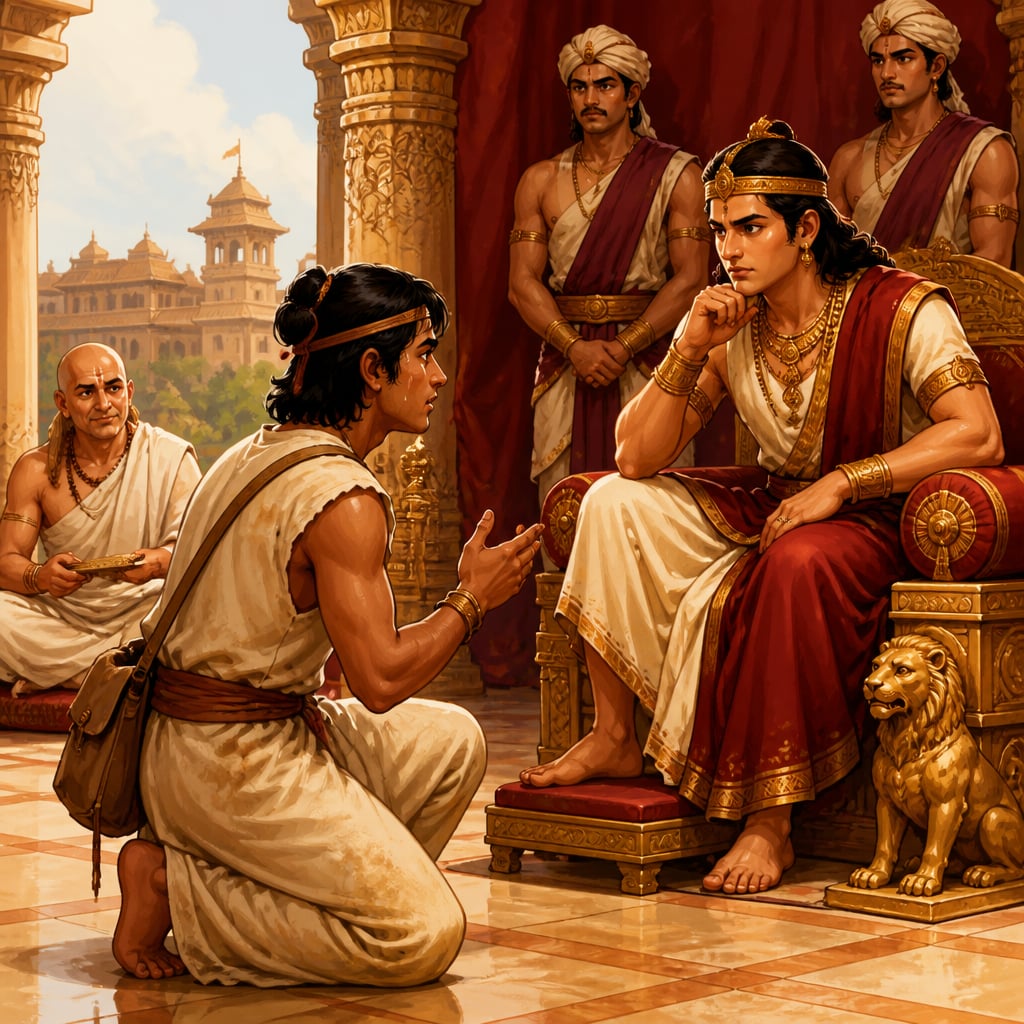
Young Mauryan messenger reporting enemy intelligence to Chandragupta

The young man knelt before Chandragupta Maurya, sweat beading on his forehead. He had just returned from the Seleucid court, a journey of three months through hostile territory. Kautilya stood beside the throne, watching intently.

"They have sixty war elephants," the messenger reported, "not the two hundred they claim. Their treasury is depleted from the campaigns in Babylon. And Seleucus himself, " the man paused, choosing words carefully, ", he fears a two-front war more than anything."

Kautilya nodded slowly. This single report was worth more than ten thousand soldiers. The dūta, the ambassador, had done his work.

"Dūtaḥ sarva-sandhi-vigrahāṇāṃ yoniḥ," Kautilya murmured. "The ambassador is the source of all peace and war." He turned to Chandragupta. "Now we know: negotiate from strength. They need peace more than we do."

More Than a Messenger

In Kautilya's system, the dūta was never merely a courier. He was intelligence operative, psychologist, and strategic weapon wrapped in diplomatic robes. Every ambassador carried two missions: the official one everyone could see, and the shadow mission only the king knew.

Kautilya classified ambassadors into three types based on their authority:

The Nisrishta-Artha (full-power ambassador) could negotiate treaties, make commitments, and bind the kingdom. Sending such an envoy signaled serious intent, and serious trust. Get the wrong person, and they might give away the kingdom.

The Parimitartha (limited ambassador) delivered specific messages without authority to deviate. "Say exactly this," Kautilya would instruct. "Not one word more." Perfect for ultimatums or opening positions where flexibility must be hidden.

The Sasanaharana (courier) simply carried sealed documents. They knew nothing, could reveal nothing, and existed only for secure transmission.

The choice of ambassador type was itself a strategic signal. Sending a full-power envoy meant you were ready to deal. Sending a courier meant you weren't ready to talk seriously, yet.

The Five Qualities That Matter

Kautilya was precise about what made an effective dūta. "Prakṛti-parīkṣito buddhimān pāṇḍityavān smṛtimān pratyutpanna-matiḥ," he wrote, the ambassador should be tested in character, intelligent, learned, possessed of excellent memory, and quick-witted.

Why memory? Because written messages could be intercepted. The best intelligence traveled only in the ambassador's mind. A single misremembered detail about enemy troop positions could mean catastrophe.

Why quick wit? Because foreign courts would probe, test, and try to extract information through seemingly innocent questions. "How long did your journey take?" might really mean "How strong are your border defenses?" The dūta needed to recognize traps instantly.

Above all, absolute loyalty. Enemy kings would offer gold, women, and power to turn an ambassador. "Gūḍha-mantrasya sarvaṃ parijñānam alpa-śrutasya," Kautilya warned, one who cannot keep secrets reveals everything about confidential plans.

The Shadow Mission

While publicly negotiating trade agreements, the skilled dūta was simultaneously counting soldiers in the garrison, noting which ministers argued with the king, observing whether the treasury seemed full or strained, and identifying potential allies within the enemy court.

This wasn't betrayal of diplomatic norms, it was the dūta's true purpose. Kautilya saw clearly that information determined outcomes. The kingdom that understood its rivals' true capabilities and intentions held decisive advantage.

Modern intelligence agencies continue this ancient practice. Embassy staff worldwide gather information under diplomatic cover. The principle Kautilya articulated 2,300 years ago remains operational doctrine today.

When Henry Kissinger Played Dūta

Kissinger and Zhou Enlai meeting in Beijing in July 1971

In July 1971, National Security Advisor Henry Kissinger faked stomach illness in Pakistan and secretly flew to Beijing. No American official had visited China in over two decades. Kissinger carried full authority from President Nixon to negotiate, a true Nisrishta-Artha ambassador.

His mission embodied Kautilyan principles perfectly: assess Chinese intentions, probe for common ground against the Soviet Union, and report back what no satellite or spy could reveal, whether Mao and Zhou Enlai genuinely wanted rapprochement.

Kissinger returned with intelligence that reshaped global politics. China would welcome Nixon. The Soviet Union could be outmaneuvered. A new strategic alignment was possible.

One man, properly chosen and empowered, achieved what armies could not.

The Dūta in Your Life

The principle extends far beyond statecraft. When you send a colleague to negotiate with a client, they become your dūta. When a friend mediates a family dispute on your behalf, they carry your reputation. When your lawyer speaks in court, their words are your words.

The question Kautilya would ask: Did you choose wisely? Does your representative understand not just what to say, but what to observe? Can they read the room, recognize opportunities, and protect your interests when you're not present?

"The ambassador is the source of all peace and war." In business, this means your negotiator can make or break deals worth millions. In relationships, the wrong intermediary can deepen conflicts instead of resolving them.

Choose your ambassadors as carefully as you choose your strategies. In a world where you cannot be everywhere, they are your eyes, ears, and voice, and their quality determines your outcomes.

Representation and agency theory - how effectively delegates act on behalf of principals in high-stakes negotiations.

Machiavelli emphasized choosing ambassadors who understood power dynamics, while modern diplomatic theory focuses on training and protocol. Henry Kissinger advocated for full-power envoys with strategic autonomy to make real-time decisions.

Kautilya provides a comprehensive checklist of five essential qualities rather than relying on general competence. His framework integrates loyalty, intellect, and practical skills - recognizing that brilliance without integrity leads to betrayal, and loyalty without intelligence leads to failure. The holistic assessment prevents partial evaluation.

Megasthenes presenting credentials at the Mauryan court at Pataliputra

When Chandragupta sent ambassadors to negotiate with Seleucus Nicator in 305 BCE, the carefully selected representatives successfully converted a potential military confrontation into a beneficial alliance through territorial exchanges and royal marriage - demonstrating how the right messenger can reshape strategic outcomes.

Intelligence gathering under diplomatic cover - the integration of information operations with official communications.

Sun Tzu emphasized spies and intelligence networks as separate from diplomacy. Modern intelligence agencies use diplomatic cover for officers, but maintain formal separation. Kissinger understood the intelligence value of direct observation during negotiations.

Verses

दूतः सर्वसन्धिविग्रहाणां योनिः

dūtaḥ sarva-sandhi-vigrahāṇāṃ yoniḥ

The ambassador is the source of all peace and war.

This profound sutra places the ambassador at the center of statecraft. Wars and alliances don't just happen - they emerge from communication or its failure.

Book 1, Chapter 16, Verse 1-3 (R.P. Kangle)

प्रकृतिपरीक्षितो बुद्धिमान् पाण्डित्यवान् स्मृतिमान् प्रत्युत्पन्नमतिः

prakṛti-parīkṣito buddhimān pāṇḍityavān smṛtimān pratyutpanna-matiḥ

An ambassador should be tested in character, intelligent, learned, possessed of good memory, and having ready wit.

Kautilya lists five essential qualities, each critical for different aspects of the role. Character ensures loyalty under temptation.

Book 1, Chapter 16, Verse 8-10 (L.N. Rangarajan)

गूढमन्त्रस्य सर्वं परिज्ञानमल्पश्रुतस्य

gūḍha-mantrasya sarvaṃ parijñānam alpa-śrutasya

One who cannot keep secrets reveals everything about confidential plans.

A harsh truth about representation: an indiscreet ambassador is worse than no ambassador. They will inadvertently reveal strategic information through careless words, nervous behavior, or susceptibility to clever questioning.

Book 1, Chapter 16, Verse 14-15 (R. Shamasastry)

Case studies

Megasthenes: The Foreign Duta in Chandragupta's Court

Around 305 BCE, after making peace with Chandragupta Maurya, the Greek king Seleucus Nicator sent Megasthenes as ambassador to the Mauryan court in Pataliputra. Megasthenes spent years in India, observing the government, society, and military. He wrote detailed accounts (Indica) that became the primary Greek source on ancient India.

Megasthenes functioned exactly as Kautilya's ideal duta: he maintained diplomatic relations (official mission) while systematically gathering intelligence about Mauryan power (strategic mission). His reports gave the Greek world detailed knowledge of Indian military strength, administrative systems, and resources. From Chandragupta's perspective, hosting Megasthenes was also strategic - it demonstrated Mauryan power and sophistication to the Greek world, potentially deterring future conflicts.

Megasthenes' mission achieved multiple objectives: it normalized relations between the Mauryan and Seleucid empires, provided valuable intelligence to both sides, and created channels for future communication. The exchange of ambassadors became a stabilizing factor in relations between India and the Hellenistic world.

Even 'enemy' ambassadors serve a purpose. By hosting Megasthenes openly, Chandragupta controlled what he observed (likely showing strength while hiding weaknesses) and gained a channel to the Greek world. Transparency can be strategic - showing selected truths to create desired impressions. The duta sees what you want them to see.

Foreign correspondents, think tank researchers, and diplomatic staff serve the same dual function today: gathering intelligence while projecting influence. When companies host journalists for factory tours or product demos, they control the narrative. The lesson for any organization: managed access is a strategic tool, not a vulnerability.

Megasthenes' account, the Indica, remained Europe's primary source of information about India for nearly 1,500 years. His observations about Mauryan administration influenced Western political thought well into the medieval period.

Kissinger's Secret Mission to China

In July 1971, Henry Kissinger secretly flew to Beijing while officially on a diplomatic tour of Asia. The U.S. and China had no diplomatic relations and were technically enemies (Chinese forces were fighting Americans in Vietnam). Kissinger's mission was to open communications and prepare for President Nixon's historic visit. The entire operation was conducted in secrecy.

Kissinger functioned as a nisrishta-artha duta - a full-power ambassador with authority to make commitments. His mission demonstrates Kautiyan principles: (1) Timing - choosing the moment when both sides were ready, (2) Secrecy - preventing opposition before success, (3) Strategic purpose - using diplomacy to reshape the global balance of power against the Soviet Union, (4) Intelligence - gathering insights about Chinese leadership and intentions.

The mission succeeded brilliantly. Nixon visited China in 1972, diplomatic relations were established, and the global balance of power shifted. The opening to China is considered one of the greatest diplomatic achievements of the 20th century.

The right ambassador with the right authority at the right moment can change history. Kissinger succeeded because he combined the personal qualities Kautilya identifies (intelligence, composure, discretion) with full governmental backing. Half-measures in representation often fail; fully empowered representation can achieve the seemingly impossible.

Backchannel negotiations remain critical in modern diplomacy and business alike. Tim Cook's personal meetings with Chinese officials helped Apple navigate regulatory challenges. Elon Musk's direct calls with world leaders shaped Tesla's global expansion. The right person with the right authority, deployed at the right moment, can unlock doors that formal channels cannot.

Kissinger's secret trip to Beijing was disguised as a stomach illness during a visit to Pakistan. The 48-hour mission reshaped global geopolitics and was kept secret from the State Department itself.

Historical context

c. 4th century BCE

In ancient India, ambassadors were protected by dharma and practical necessity, but operated in dangerous conditions. A duta to an enemy kingdom could be imprisoned as leverage, subjected to psychological pressure, or even executed if caught spying. Yet the system worked because all kingdoms needed diplomatic communication. Kautilya's detailed treatment of the ambassador's role reflects how critical this function was.

Understanding the ancient duta system helps us appreciate that diplomacy has always been more than polite conversation. It's a sophisticated craft requiring psychological insight, strategic thinking, and personal courage. The ambassador operates at the dangerous intersection of peace and war, where words can prevent catastrophe or provoke it.

Reflection

More in Duta: The Art of Diplomacy

All lessons in Duta: The Art of Diplomacy · Arthashastra: Art of Strategy course