Evidence and Procedure
Rules of Fair Trial
Justice requires proper process. Kautilya established detailed rules for evidence, witnesses, documentation, and trial procedures - the mechanics that transform law from theory into practice.
The Mechanics of Justice

Good laws and honest judges are necessary but not sufficient. You also need reliable ways to determine what actually happened.
"Justice without evidence is tyranny. Evidence without procedure is chaos."
Types of Evidence
Kautilya recognized multiple forms of evidence:
1. Documentary Evidence (Likhita) - Written records were the gold standard: contracts, receipts, official records, letters. Why preferred? Because memory fades but writing persists.
"The wise man writes; the fool relies on memory."
2. Witness Testimony (Sakshi) - Eyewitnesses, character witnesses, expert witnesses, circumstantial witnesses. Required careful evaluation as people lie, misremember, and have biases.
3. Circumstantial Evidence (Yukti) - Logical inference from circumstances: physical evidence, patterns of behavior, possession of stolen goods, unexplained wealth.
4. Confessions (Prativacana) - The accused's own admission, but with limits. Confessions under torture required corroboration. Confessions under duress could be recanted. Even confessions didn't end investigation entirely.
Rules for Witnesses
Competent witnesses:
- Of sound mind
- Present during relevant events
- Able to perceive what happened
- Willing to testify truthfully
Incompetent witnesses:
- Children too young to understand
- Mentally incapable persons
- Those with obvious bias
- Previously convicted liars
Evaluating Credibility:
- Character: Known for honesty?
- Interest: Benefit from outcome?
- Consistency: Story holds together?
- Corroboration: Other witnesses agree?
- Demeanor: Seems truthful?
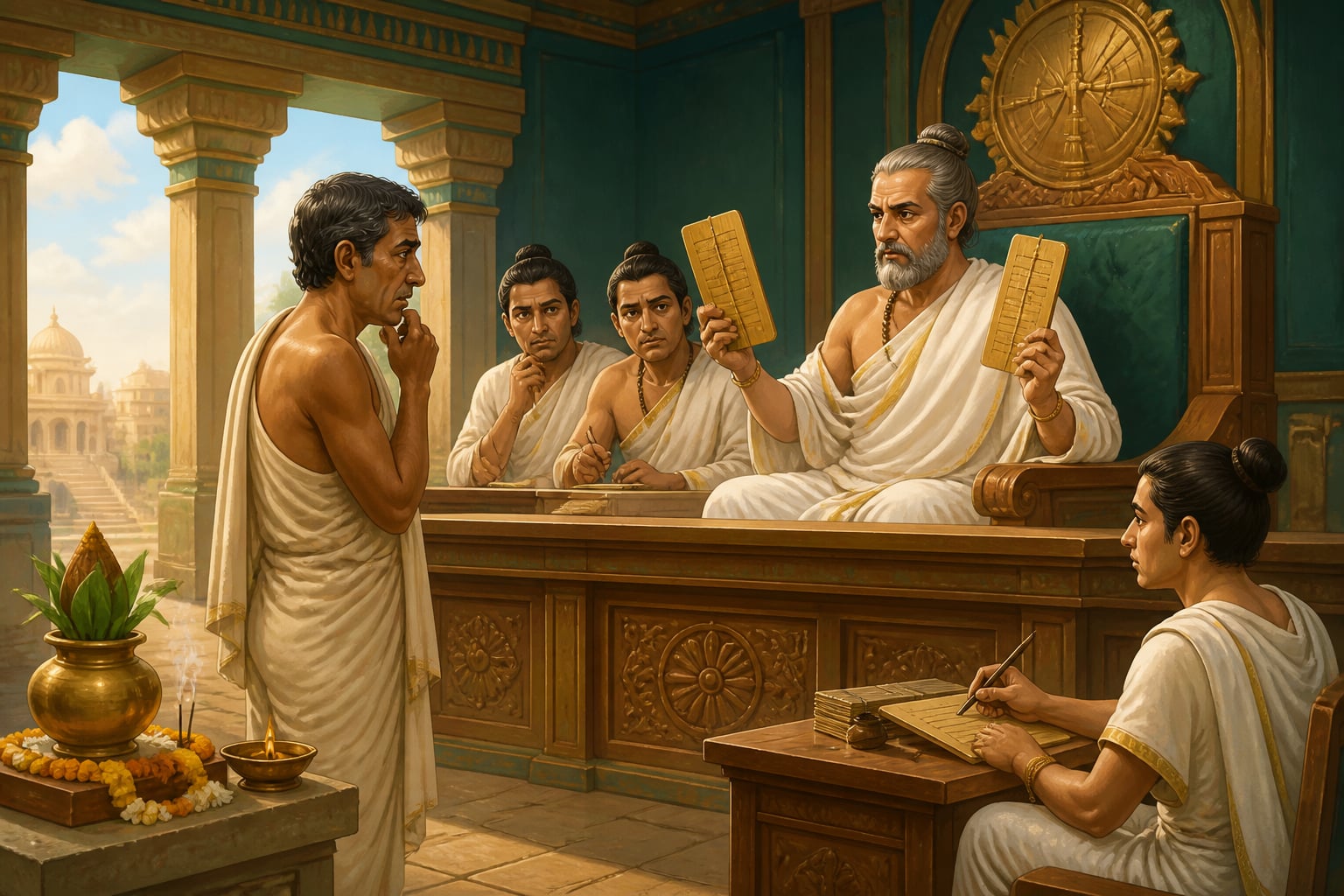
Punishment for Perjury:
"The witness who speaks falsely shall suffer the punishment that would have fallen on the accused."
This created powerful incentives for truthful testimony. Falsely accuse someone of murder, face the murderer's penalty.
Trial Procedure
Kautilya established systematic procedures:
1. Filing - Plaintiff states claim clearly, identifies defendant, provides initial evidence, pays court fees.
2. Summoning - Accused formally notified and required to appear. Failure results in default judgment, fines, or arrest in serious matters.
3. Defense Response - Defendant can deny allegations, admit with justification, challenge jurisdiction, or request time to prepare.
4. Evidence Presentation - Both sides present documents, witnesses, physical evidence. Experts consulted.
5. Examination - Witnesses face questioning from presenting party, cross-examination from opposing party, and questions from judges.
6. Deliberation - Judges (often panels) review evidence, apply law, deliberate, and decide.
7. Announcement - Judgment announced publicly, explained with reasoning, recorded, and enforced.
Protections for the Accused
Right to Know Accusations - No one tried without knowing specific charges.

Right to Respond - The accused always had opportunity to present defense before judgment.
Right to Witnesses - Defendants could call witnesses on their behalf.
Right to Appeal - Judgments could be appealed to higher courts.
Protection Against Harassment - Repeated prosecution for the same offense limited. Frivolous lawsuits could result in penalties for plaintiff.
Time Limits
Statute of Limitations - Claims brought within reasonable time. Stale claims where evidence deteriorated and memories faded were disfavored.
Speedy Resolution - Courts required to decide cases promptly. Delays in justice were considered a form of injustice.
"The king who allows cases to linger while parties suffer has failed in his duty."
Extensions - Limited extensions granted for good cause (illness, absent witnesses, gathering evidence) but not indefinitely.
Documentary Requirements
Valid Documents Must Include:
- Date and place
- Names of parties
- Terms clearly stated
- Witnesses present
- Signatures or marks
Storage and Authentication:
- Kept in safe places
- Copied for backup
- Authenticated by officials when needed
- Protected from tampering
Special Procedures
Cases Involving the State - Additional safeguards against abuse of state power.
Cases Involving the Vulnerable - Women, children, elderly, disabled received accommodations like testifying in private or having representatives.
Criminal Cases - Required higher standards of proof than civil disputes.
Commercial Cases - Could be decided according to trade customs, with merchants as expert advisors.
The Purpose of Procedure
Why all these rules? Because procedure protects freedom.
Without procedural requirements:
- The powerful could crush the weak through mere accusation
- Mistakes would become permanent
- Bribes and bias would rule
- Citizens would live in fear
Procedure slows things down, yes. But that slowness protects everyone from arbitrary power.
"The form of justice is not merely formality - it is the substance of liberty."
The Libertarian Insight
Kautilya's evidentiary and procedural rules embody a crucial principle: the burden of proof lies on those who would punish.
The state cannot simply assert guilt and demand the citizen prove innocence. The accuser must prove the case. The defendant is protected until proven wrong.
This principle - that power must justify itself, not demand that weakness justify itself - is the foundation of free society. In any system where the accused must prove their innocence, tyranny is already present.
Human memory is unreliable - genuinely honest people can remember the same event differently years later. Disputes often hinge on proving what was agreed, not just claiming what was intended. Documentation created at the time of agreement preserves truth before memory distorts it. The strategic advantage: writing creates objective evidence that doesn't change with self-interest or time.
The first story you hear is rarely the complete story. What seems obvious from one perspective may look entirely different from another. Premature judgment based on one side's account leads to errors that damage credibility and create injustice. Hearing all sides improves decision quality and legitimacy. The strategic insight: better information comes from adversarial presentation than from accepting initial claims.
Without cost to accusation, the justice system becomes a weapon against the innocent. False accusations are cheap when only the accused faces risk. Symmetrical punishment creates powerful incentives for truth by making false accusation as risky as the alleged crime. The strategic design: align incentives so that accusers carefully verify claims before weaponizing state power against others.
Verses
लिखितं साक्षिणश्चैव प्रमाणं द्विविधं स्मृतम्
likhitaṃ sākṣiṇaścaiva pramāṇaṃ dvividhaṃ smṛtam
Evidence is considered to be of two kinds: documentary and testimonial.
Truth can be established through different means. Written records and human testimony both serve justice, but each has strengths and weaknesses that must be understood.
Book 3, Chapter 11, Verse 1 (R.P. Kangle)
मिथ्याभियोगी तद्दण्डं प्राप्नुयात्
mithyābhiyogī tad-daṇḍaṃ prāpnuyāt
The false accuser shall receive the punishment that would have fallen on the accused.
False accusations are not free. The person who weaponizes the justice system against the innocent will face the very consequences they sought to impose.
Book 3, Chapter 11, Verse 25 (L.N. Rangarajan)
उत्तरं प्रथमं दद्यात् ततः प्रमाणम्
uttaraṃ prathamaṃ dadyāt tataḥ pramāṇam
The defendant shall first give their response, then evidence shall be examined.
The accused has the right to respond before judgment. Justice requires hearing all sides.
Book 3, Chapter 1, Verse 15 (R. Shamasastry)
Case studies
The Disputed Contract
Two merchants dispute the terms of a contract for silk delivery. One claims the agreed price was 100 panas; the other claims 80 panas. No written contract exists. Each produces witnesses who support their version.
Kautilya's framework would: (1) Examine why no written contract exists - this itself suggests carelessness by both parties. (2) Evaluate witnesses for credibility, interest, and consistency. (3) Look for corroborating evidence - receipts, other transactions, market prices. (4) Apply default rules if evidence is truly equal.
With conflicting testimony and no documents, the court might split the difference or apply trade custom. But both parties learn the value of written agreements.
Document agreements in writing with witnesses. The cost of paperwork is far less than the cost of disputed memory.
This is exactly why modern contract law requires written agreements for transactions above certain thresholds (the Statute of Frauds in common law). Digital contracts, e-signatures, and blockchain-based smart contracts all solve the same problem Kautilya identified: memory is unreliable, so agreements must be documented in a form that survives dispute.
The Arthashastra specifies that contracts without witnesses are unenforceable, and that written documents override oral testimony. Book 3 identifies 18 categories of civil law (vyavahara), covering property, debt, wages, sales, and boundary disputes.
Historical context
c. 4th century BCE
Various legal traditions existed in pre-Mauryan India, but procedures varied widely. Kautilya systematized and standardized these, creating predictable processes across the empire.
The procedural protections Kautilya established influenced Indian legal thought for centuries, and anticipate principles later developed in other traditions.
Living traditions
- Documentary Evidence Preference: The Indian Evidence Act distinguishes documentary and oral evidence, giving preference to documents as Kautilya prescribed.
- Right to Be Heard (Audi Alteram Partem): The principle that both sides must be heard is foundational to modern procedure, continuing Kautilya's emphasis on fair hearing.
- Cross-Examination Rights: The right to cross-examine witnesses protects defendants, continuing Kautilya's skepticism of unchallenged testimony.
- National Judicial Academy: Training institution for judges
- District Courts: District courts are the primary venues for civil and criminal trials, where evidentiary rules are applied daily. Here, Kautilya's principles of documentary preference, witness examination, and procedural fairness are implemented in routine justice.
- National Law Universities: Legal education institutions train future lawyers and judges in evidence law, continuing the tradition of systematic legal learning. Students study the same questions Kautilya addressed: What proves a case? How do we find truth?
Reflection
- Why did Kautilya prefer documentary evidence over witness testimony? What does this reveal about his understanding of human nature?
- The rule that false accusers face the accused's punishment creates symmetry. But might this deter legitimate accusations where proof is uncertain?
- Think of a dispute you've witnessed or experienced. What evidence existed? What was missing? How did the available evidence affect the outcome?