Dharmasthiya
Civil Law and Disputes
How disputes between citizens were resolved - contracts, property, marriage, inheritance, and more. Kautilya created one of history's most sophisticated civil law frameworks.
The Merchant's Dilemma
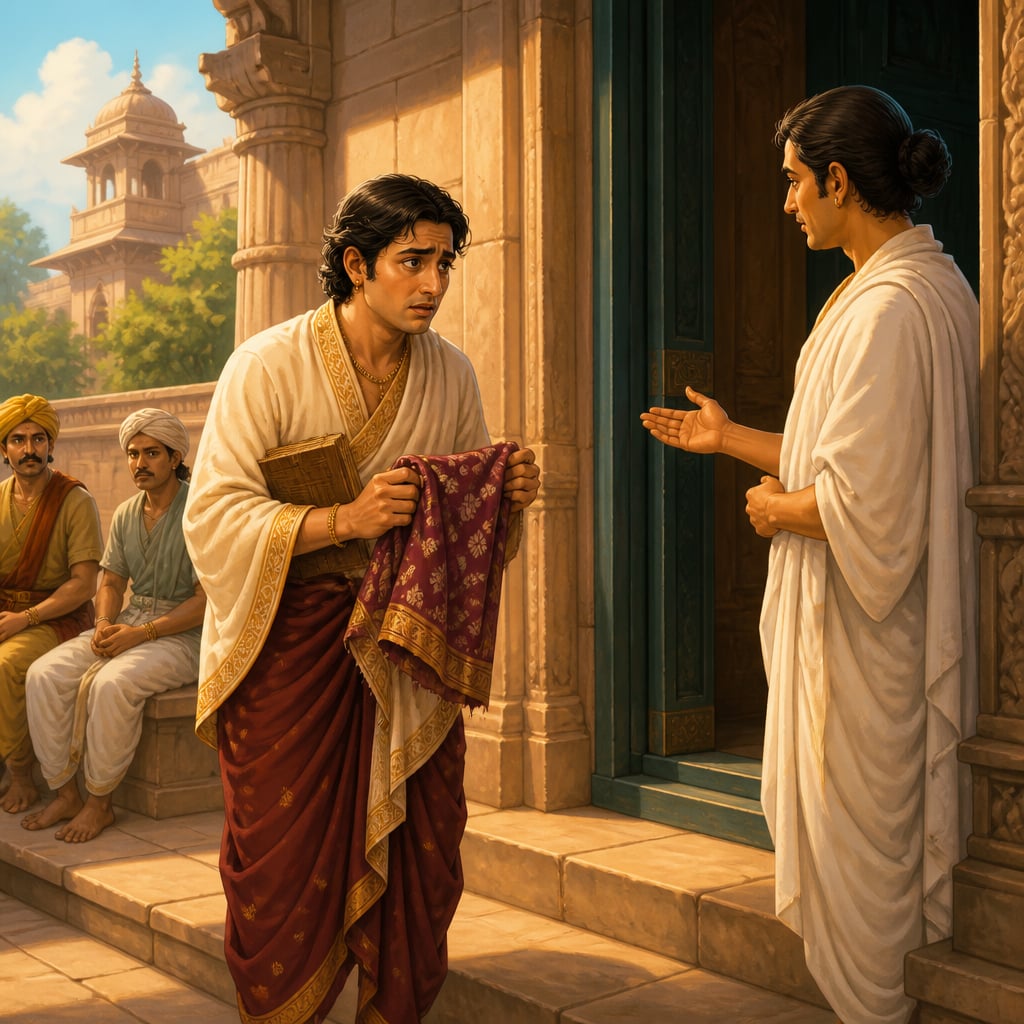
A silk merchant named Devadatta stood outside the court in Pataliputra, clutching a worn piece of cloth. His business partner had vanished with three months of profits. No written contract existed - just a handshake and mutual trust, now broken.
"How do I prove what we agreed?" he asked the court scribe.
The scribe smiled. "That's precisely why Dharmasthiya exists."
Kautilya understood a fundamental truth: before there can be prosperity, there must be predictability. Citizens cannot trade, invest, or build if they don't know that agreements will be honored and disputes fairly resolved.
The Eighteen Titles of Law
Kautilya organized civil disputes into eighteen categories called vyavahara-padas:
- Rinadana - Non-payment of debts
- Niksepa - Disputes over deposits
- Asvami-vikraya - Sale by non-owners
- Sambhuya-samutthana - Partnership disputes
- Dattapradanika - Non-delivery of gifts
- Vetana-adana - Non-payment of wages
- Samvidah-vyatikrama - Breach of contract
- Vikraya-asampradana - Cancellation of sale
- Sima-vivada - Boundary disputes
- Vastu-pasuvikrosa - Damage by cattle
Plus eight more covering verbal injury, assault, gambling, theft, violence, and inheritance.
This systematic approach was revolutionary. By categorizing disputes, Kautilya made law predictable and accessible. Citizens could understand which rules would apply to their case.
Contracts: The Foundation of Freedom
"समयक्रिया व्यवहारः" - Legal transactions are based on agreements and their proper execution.
Kautilya devoted extensive attention to contracts because he understood: free people make agreements; slaves are commanded.
A society of contracts is a society of equals. A society without enforceable contracts becomes one of raw power, where the strong simply take from the weak.
What Made a Contract Valid?
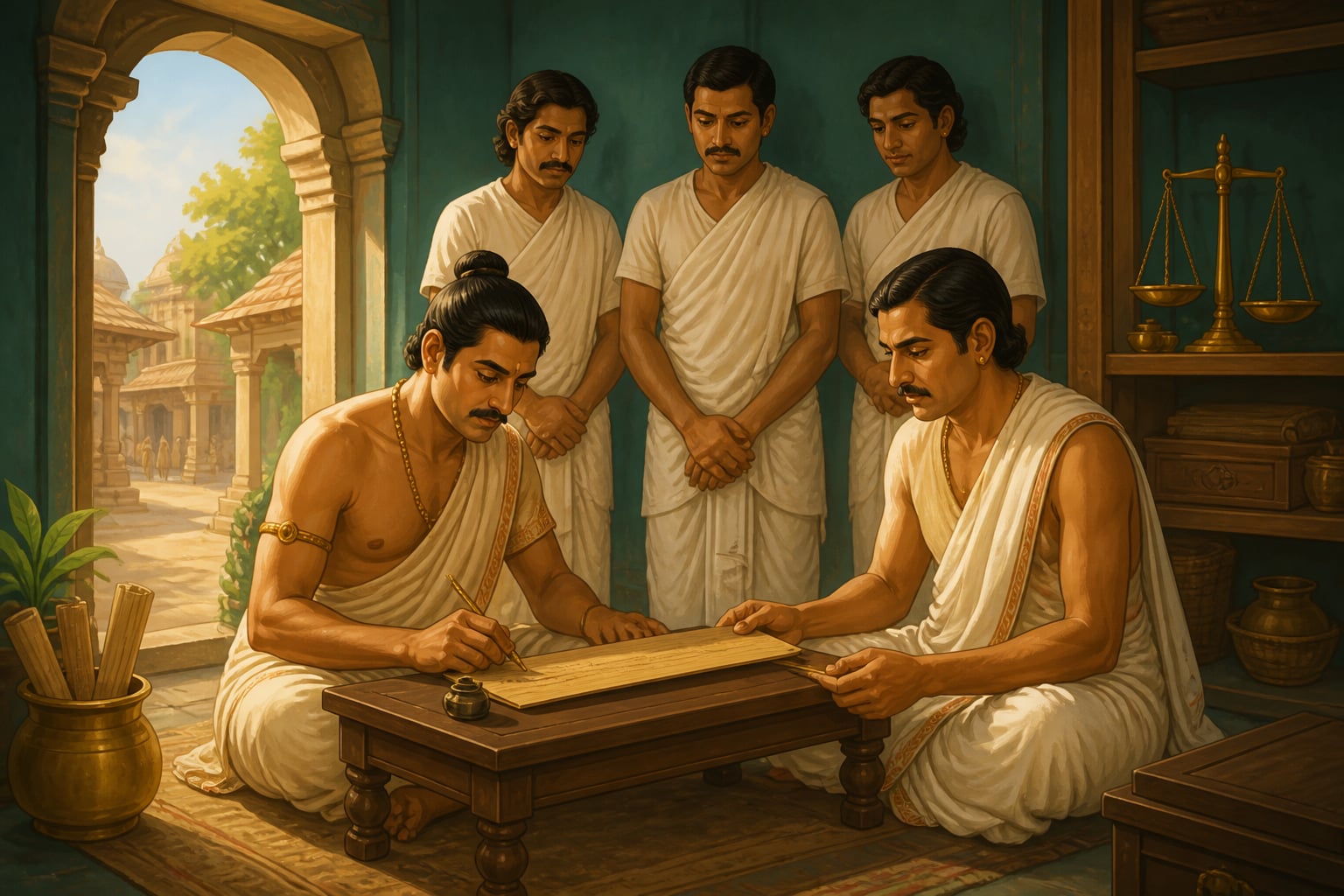
- Capacity: Both parties must be of sound mind and legal age
- Consent: Agreement must be genuine, not coerced
- Witnesses: Proper documentation for significant agreements
- Legality: Cannot be for illegal purposes
What Made a Contract Void?
"बलात्कृतं भयकृतं च कर्म न प्रमाणम्" - Acts done under force or fear are not legally valid.
This principle protected the vulnerable. Contracts made under duress, by minors, or by those in distress were automatically void. True consent cannot be coerced.
Property Rights
Kautilya was a fierce defender of property rights:
"The acquisition of wealth is the foundation of dharma."
Without secure property, people cannot plan, invest, or accumulate capital. The Arthashastra distinguished between:
- Immovable property: Land, buildings, wells
- Movable property: Goods, livestock, money
- Inherited property: From ancestors
- Acquired property: Earned through one's own efforts
Remarkably, Kautilya was explicit that the state itself could not arbitrarily seize property. Land could only be taken for public purposes and with compensation - a radical limitation on royal power.
Debt and Credit
Credit enables economic growth. Kautilya created balanced rules:
For creditors:
- Clear procedures for debt recovery
- Criminal penalties for fraud
- Rights to collateral clearly defined
For debtors:
- Interest could not exceed the principal
- Certain property exempt from seizure
- Debtors could not be enslaved for ordinary debts
- Courts could restructure debts in hardship cases
Maximum interest rates were fixed: 15% annually for commercial transactions, lower for secured loans, higher for risky ventures.
Justice for All
Perhaps most remarkable was Kautilya's concern for accessibility. Justice that only the wealthy can access isn't justice.
He mandated:
- Courts in every major town
- Speedy resolution of cases
- Limits on court fees
- Free assistance for the poor in certain cases
The principle "justice delayed is justice denied" runs throughout Dharmasthiya.
Why This Matters Today

Devadatta's case was heard. Witnesses testified to his character and the partnership's existence. The court examined the partner's sudden wealth. Justice, though imperfect without written terms, was attempted.
Kautilya's civil law reflects a libertarian insight: the state's primary job is to protect voluntary arrangements between free people.
The Dharmasthiya doesn't tell people how to live. It creates a framework where free people can pursue their goals, make their own agreements, and resolve disputes fairly. This is governance at its best - not as control, but as a foundation for freedom.
The Statute of Frauds in English law similarly requires certain contracts to be in writing to be enforceable.
Kautilya balanced documentation requirements with practical reality - not every small transaction needed writing, but significant ones did.
The East India Company's meticulous record-keeping enabled it to enforce contracts across continents and centuries.
Contract law universally recognizes duress as a defense. But Kautilya went further - even economic desperation could void agreements.
He understood that formal consent without real choice is meaningless. Protection extended to those in distress, not just physical threats.
Predatory lending that exploits desperation ultimately harms the lender too - defaults rise, communities destabilize.
Verses
धर्मस्थीयं व्यवहारसिद्धये
dharmasthīyaṃ vyavahāra-siddhaye
The civil law section exists for the resolution of legal proceedings and disputes.
Justice exists to resolve disputes between free people, not to control them. The purpose is practical: enabling society to function through peaceful resolution of conflicts.
Book 3, Chapter 1, Verse 1 (R.P. Kangle)
समयक्रिया व्यवहारः
samaya-kriyā vyavahāraḥ
Legal transactions are based on agreements and their proper execution.
The foundation of civil law is voluntary agreement. Contracts between consenting parties, not government commands, form the basis of economic life.
Book 3, Chapter 1, Verse 5 (L.N. Rangarajan)
बलात्कृतं भयकृतं च कर्म न प्रमाणम्
balātkṛtaṃ bhayakṛtaṃ ca karma na pramāṇam
Acts done under force or fear are not legally valid.
True consent cannot be coerced. This protects the weak from exploitation and ensures agreements reflect genuine choice.
Book 3, Chapter 1, Verse 38 (R. Shamasastry)
Case studies
The Partnership Dispute
Two merchants form a partnership to trade silk. After a profitable year, one claims the other skimmed profits. No written agreement exists about profit-sharing.
Kautilya's partnership rules (Sambhuya-samutthana) would first seek witnesses. Without written terms, default rules apply: equal sharing unless different contributions can be proven. Character witnesses and account examination would follow.
The case would likely result in a default equal split, with both required to maintain proper accounts going forward.
Verbal agreements between friends seem sufficient until disputes arise. Document partnerships from the start.
Startup co-founder disputes are the modern version of this case. Y Combinator reports that co-founder conflict is the number one killer of early-stage companies. Their standard advice matches Kautilya's: sign a written co-founder agreement covering equity splits, roles, and exit terms before writing a single line of code.
Kautilya's Arthashastra (Book 3, Chapters 1-16) details over 40 specific types of commercial contracts and disputes. Partnership law in the text prescribes default profit-sharing proportional to capital invested, with written documentation required for agreements exceeding 100 panas.
Historical context
c. 4th century BCE
Before Mauryan unification, different kingdoms had varying legal traditions. Merchants trading across regions faced uncertainty. Kautilya's systematic approach created predictable, unified legal frameworks.
Kautilya's civil law framework enabled the trade networks that made the Maurya Empire prosperous. Predictable rules allowed strangers to do business with confidence.
Living traditions
- Indian Contract Law: The Indian Contract Act of 1872 reflects principles from traditional contract law, including requirements for free consent and valid consideration.
- Alternative Dispute Resolution: Mediation and arbitration continue Kautilya's emphasis on settlement over litigation for civil disputes.
- Commercial Courts System: Specialized commercial courts for speedy resolution reflect Kautilya's timeliness emphasis in civil matters.
- National Law School of India University: Premier law school with programs on Indian legal history
- Supreme Court of India: India's apex court adjudicates contract disputes and property rights at the highest level, continuing the tradition of authoritative civil justice. The inscription 'Yato Dharmas Tato Jayah' reflects the connection between righteousness and legal victory that Kautilya emphasized.
- Lok Adalat (People's Court): Lok Adalats provide free, speedy settlement of disputes through conciliation, continuing Kautilya's emphasis on accessible justice and settlement over litigation. The courts embody dharmic justice - resolution that serves truth and harmony rather than procedural victory.
Reflection
- Why does Kautilya place such emphasis on contracts and property rights? What would society look like without enforceable agreements?
- Kautilya voided contracts made under duress. But how do we distinguish between duress and simply driving a hard bargain?
- Think of a dispute you've experienced. What would Kautilya's framework suggest about handling it better?