The Emotional Hijacker

When Volume Replaces Argument

The Emotional Hijacker replaces logical discourse with raw emotion. Level 1 (Obvious) archetype in the Manipulators cluster of the Chatur-Vadin Framework. Volume substitutes for argument. The room loses its capacity to think within thirty seconds. The Vaadin's counter is a single sentence: I acknowledge your feeling. Now let us return to the mechanism.

The Sage Who Came In Shouting

The wedding party of Sita and Rama was on its way home from Mithila. The road back to Ayodhya passed through open country. Dasharatha was in the lead palanquin. The four brothers and their new wives followed. Sage Vasishta and the household priests rode behind. The afternoon was bright. The mood was the lightest the old king had felt in years.

Then the sky darkened.

The ground shook. A tall figure with matted hair, an axe across one shoulder and a great bow across the other, walked out of the trees and onto the road. Birds in nearby branches stopped singing. The horses pulling Dasharatha's chariot reared. The sage was Parashurama, the warrior-brahmin who had emptied the earth of unjust kshatriya kings twenty-one times for an old wrong his father had suffered. He was, by reputation, the most dangerous living being on the subcontinent. He had heard from somewhere that a young prince of the Ikshvaku line had broken the bow of his master, Lord Shiva, at a marriage contest in Mithila.

He was not pleased.

"Where is this Rama who has destroyed Shiva's bow?" he shouted across the assembled wedding party. "I have come to test his strength against the bow of Vishnu, which I have carried since my own youth. Let him string it. If he cannot, I will end his life on this road, and the stain on Shiva's honour will be answered."

Dasharatha fell at the sage's feet. The court priests began stuti, prayers of pacification. Lakshmana, sixteen years old and watching his brother be threatened on his own wedding day, took one step forward with his hand at his sword. Rama placed a hand on Lakshmana's shoulder without looking at him. Lakshmana stopped.
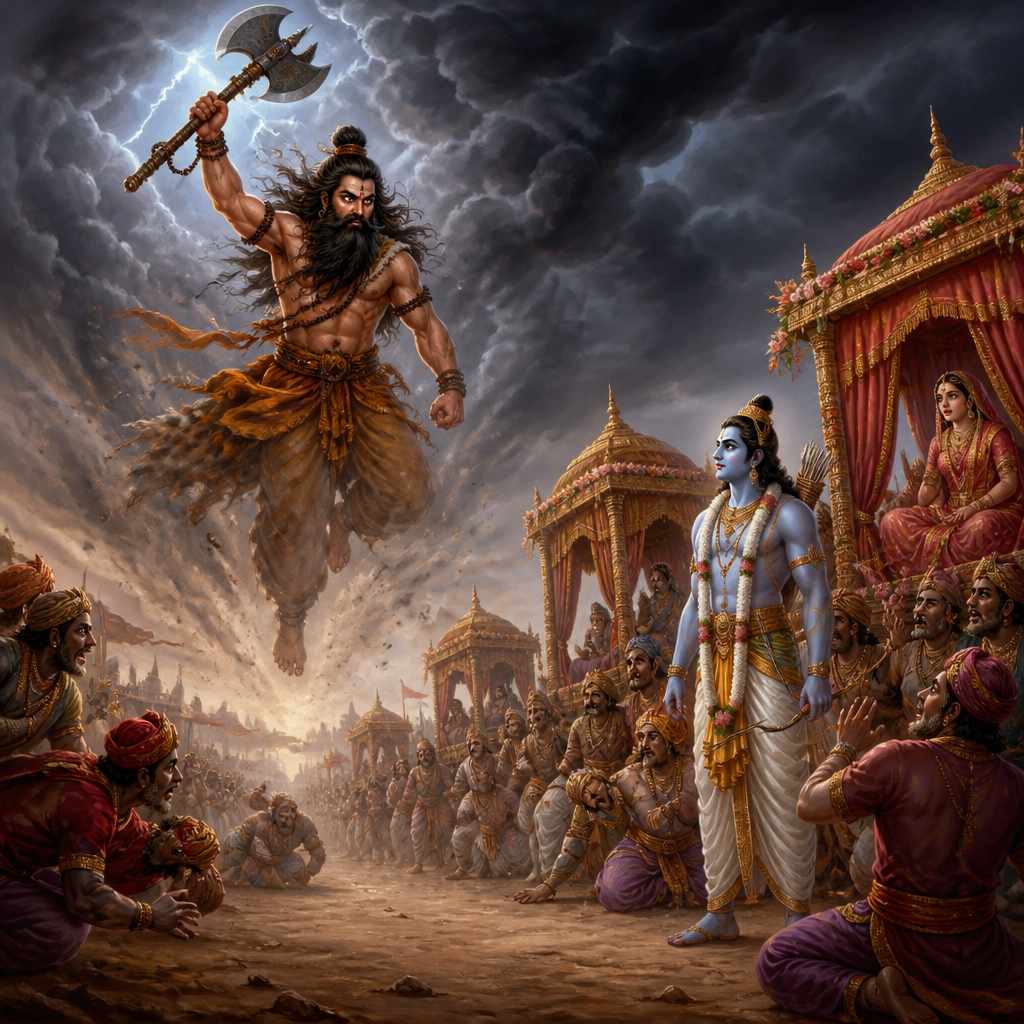
Parashurama descends in storm and dust as Rama stands serene before the wedding party.

Rama then spoke. He did not raise his voice. He did not match the sage's volume. He acknowledged the sage's anger as real. He acknowledged the bow of Shiva as sacred. He pointed out, calmly, that he had not destroyed the bow as a sport but had been asked to string it as part of a king's contest. He offered to receive the bow of Vishnu and to attempt it. The voice across the road was still shouting. Rama's voice was the steady centre of the scene.

Rama strings the bow of Vishnu and Parashurama's anger leaves him

When Rama strung the bow of Vishnu and drew it back, Parashurama's anger left him in a single moment. The bow had answered the question the shouting had not. The sage bowed, asked Rama to release the arrow into the sage's own meditative tapas rather than into him, and walked back into the trees. The wedding party continued.

This is the archetype the lesson is about. The shouter. The one who arrives at speaking volume eleven and stays there until the room either matches or breaks. The counter is what Rama did, and that is the only counter that works.

Difficulty Level: ⬜ Obvious

This is a Level 1 (Obvious) archetype. It is the loudest of all twenty-two archetypes in the Chatur-Vadin Framework, and the easiest to spot. The shouting itself is the tell. There is no subtle definition shift to detect, no hidden assumption to surface, no twenty-minute frame to peel back. The Emotional Hijacker is operating in plain sight from the first thirty seconds.

The Level 1 marking is not a comment on how hard the archetype is to defeat. It is a comment on how easy it is to recognize. The defeat is harder. Volume operates faster than reasoning. By the time you have noticed the hijack, the room is already noisy. The counter has to be deployed in the first sixty seconds or the room is gone for the night.

The Emotional Hijacker sits in the Chhala Vadin (Manipulators) cluster of the Chatur-Vadin Framework. The cluster shares a common engine: each archetype substitutes some emotional pressure for substantive engagement.

Archetype Pressure deployed Surface tell
Emotional Hijacker Raw volume, anger Voice rises within thirty seconds
Moral Shamer Guilt and disgust 'You should be ashamed for even asking'
Victim Card Player Inverted aggression (DARVO) 'I am the one being attacked here'
Guilt Tripper Historical or relational debt 'After all we have suffered, how can you'
Social Pressure Wielder Manufactured consensus 'Every responsible person agrees with me'

Where the Moral Shamer uses guilt and the Victim Card Player inverts who-did-what-to-whom, the Emotional Hijacker simply makes the original question impossible to hear.

The Archetype's Move

The move has three predictable beats.

  1. The trigger. A substantive question is asked, an argument is made, or a proposal is put on the table. The Emotional Hijacker either does not have a counter-argument or has one but does not want the substantive ground tested.
  2. The volume jump. Within ten to thirty seconds, the response shifts register. Voice rises. Pace accelerates. Vocabulary becomes intensifier-heavy: outrageous, unbelievable, how dare you, shame on you. The shift is visible to anyone watching from outside. It is invisible to the people inside the room because their own systems have already started to mirror the volume.
  3. The room captures. Other speakers either match the volume (the room descends into shouting) or fall silent (the Hijacker becomes the only audible voice). Either outcome ends the substantive discussion. The original question is not answered. The Hijacker has won the only victory that was on offer: the suppression of the discussion they did not want to have.

Krishna names the deeper mechanism in the Bhagavad Gita.

त्रिविधं नरकस्येदं द्वारं नाशनमात्मनः। कामः क्रोधस्तथा लोभस्तस्मादेतत्त्रयं त्यजेत्॥

tri-vidhaṃ narakasyedaṃ dvāraṃ nāśanam ātmanaḥ kāmaḥ krodhas tathā lobhas tasmād etat trayaṃ tyajet

Three are the gates of self-destruction: desire, anger, and greed. Therefore one should abandon all three.

Bhagavad Gita 16.21

Krodha (anger) is the engine of this archetype. The Hijacker is not in control of the krodha. The krodha is in control of the Hijacker. By the time the volume reaches the audience, the speaker's own buddhi (reasoning faculty) has already been compromised by their own anger. The person doing the hijacking is themselves the first hijacked.

The Counter, In One Sentence

The Vaadin's counter to the Emotional Hijacker is one sentence delivered in one breath, in a voice deliberately quieter than the room.

"I hear that you feel strongly about this. Let us still return to the specific question on the table."

The sentence does three things at once. It acknowledges the feeling out loud, which removes the Hijacker's ability to escalate by claiming they have not been heard. It does not match the volume, which deprives the room of the second voice that the descent into shouting requires. It returns to the mechanism, which makes the original question audible again for any listener who is still capable of hearing it.

The Hijacker has two responses available. They can drop the volume and engage the substantive question, in which case the Vaadin has won the only victory that mattered: the discussion is back on. Or they can escalate further, which makes the asymmetry between Vaadin and Hijacker visible to the audience and shifts the audience's sympathy to the Vaadin. Either response is acceptable. The Vaadin does not need the Hijacker to choose the first.

Krishna names the inner state required in Bhagavad Gita 5.23. The yogi who can endure the surge of desire and anger before the body is liberated, that yogi is happy. The Vaadin facing the Emotional Hijacker does not need to be a fully liberated yogi. The Vaadin needs only enough endurance to ride out the first ninety seconds of the hijack without matching it. The match is the only thing the Hijacker actually needed.

Modern Echoes

An Indian primetime news panel as architecture of the emotional hijack

In Indian primetime television, the Emotional Hijacker is the standard nightly format. Six to nine boxes on the screen. An anchor in the centre. Within thirty seconds of the first substantive question, two panellists are already shouting. By minute three, the anchor's mute button is the only thing keeping any single voice audible at a time. By minute ten, the substantive question of the night has not been touched. The format has not evolved by accident. Volume produces watch-time, which produces ad revenue. The architecture of the show is designed to reward the Hijacker. The substantive question is the production cost the show has decided not to pay.

On social media, the same mechanism operates at scale through outrage cycles. A celebrity, brand, or film says or does something contested. Within hours, a hashtag is trending: #BoycottX. Tens of thousands of posts express pure outrage. Almost none engage the underlying substantive question. The cycle peaks within forty-eight hours, fades within a week, and has demonstrated almost no correlation with actual sales or career impact across multiple studies. The mechanism is the emotional outburst at scale, with the substantive engagement compressed to zero. The platform's algorithm rewards the volume and ignores the substance, in exactly the same way the news show's incentives do.

Back on the road outside Mithila, Parashurama walked into the trees and the wedding party continued home. Rama said almost nothing for the rest of the journey. Lakshmana asked, that night at camp, why his brother had not answered the threats with threats of his own. Rama only smiled. The reply, though it was not given in words that the bards preserved, was visible in what had happened on the road: volume had been the sage's whole speech, and the bow had been the whole answer. The kingdom that received them at Ayodhya the next morning had no idea how close the wedding had come to ending in a sage's funeral pyre on the road. The Vaadin's quietness, when it lands, looks like nothing happened at all.

Case studies

Parashurama On The Road Outside Mithila

In the Bala Kanda of the Valmiki Ramayana, the wedding party of Sita and Rama is on its way back from Mithila to Ayodhya. The road passes through open country. The mood is light. The sky darkens, the ground shakes, and Parashurama, the warrior-brahmin avatara who had emptied the earth of unjust kshatriya kings twenty-one times, walks out of the trees onto the road in a towering rage. He has heard that a young Ikshvaku prince has broken the bow of his master, Lord Shiva, at a marriage contest in Mithila. He arrives shouting. He demands that Rama prove his strength by stringing the bow of Vishnu, which Parashurama has carried since youth. He threatens annihilation if Rama fails. Dasharatha falls at his feet. The court priests begin pacification mantras. Lakshmana, sixteen and watching his brother be threatened on his wedding day, takes one step forward with his hand at his sword. Rama places a hand on Lakshmana's shoulder without looking, and Lakshmana stops. Rama then speaks at lower volume than the sage, acknowledges the anger as real, acknowledges the bow of Shiva as sacred, and offers to receive the bow of Vishnu and attempt it.

The scene is the textbook three-part counter to the Emotional Hijacker, performed by an avatara on a sage. Rama acknowledges (the anger is real, the bow of Shiva is sacred), does not match (his voice stays below Parashurama's), and returns to the mechanism (the bow of Vishnu, the actual question of strength on which the threat depended). The deeper teaching is that the inner capacity required is kshamā, not technique. Without the kshamā, the counter sentence is just words and the Vaadin's voice will rise to match within the first sixty seconds. With the kshamā, the same words are operational and the room reorganizes around them.

When Rama strings the bow of Vishnu and draws it back, Parashurama's krodha leaves him in a single moment. The bow has answered the question the shouting was meant to settle. The sage bows, asks Rama to release the arrow into the sage's own meditative tapas rather than into him, and walks back into the trees. The wedding party continues home. Lakshmana asks that night why Rama did not answer threats with threats. Rama replies, in the traditional account: volume answers volume, and the bow answers the question.

The Emotional Hijacker can be a small person or an avatara. The mechanism is the same. Acknowledge, do not match, return to the underlying question. If that question can be settled (the bow strung, the proposal tested, the data shown), settle it. The settlement is the actual end of the scene, not the shouting.

In the Valmiki Ramayana, the Parashurama encounter spans Bala Kanda chapters 74-76, roughly 75 verses total. Parashurama speaks for approximately 30 of those verses, mostly in raised voice. Rama speaks for approximately 8 verses, mostly in measured tone. The asymmetry of word count is itself part of the teaching: the quieter speaker had less to say because he had nothing to escalate.

Ravana And The Burning Of Hanuman's Tail

In the Sundara Kanda, Hanuman is brought before Ravana in the court of Lanka after his initial reconnaissance has been discovered. Hanuman delivers Rama's message in measured form: return Sita, accept the wrong, end the conflict before it begins. He cites dharma. He cites the consequences of refusal. He addresses the assembled court with the precision of a trained envoy. Ravana does not engage a single one of his arguments. He orders Hanuman killed. Vibhishana intervenes to remind the court that envoys are protected by custom from execution. Ravana accepts the lesser option of burning Hanuman's tail as humiliation. The court watches the punishment with satisfaction. The substantive case Hanuman has just made has been answered by an emotional outburst that is itself treated as the reply. The volume is the reply.

The scene shows the Emotional Hijacker operating not as a single panellist but as the dominant culture of an entire room. Ravana is the loudest voice but the court echoes him. Hanuman has nowhere to deploy a Rama-style counter because no individual speaker is the target; the room itself has decided that volume substitutes for engagement. The traditional lens names this as the special pathology of a court (or a network, or a platform) that rewards the Hijacker structurally. In such a room the Vaadin's only remaining option is to take the punishment, mark the absence of substantive reply for the audience, and let the world deliver the verdict the room would not.

Hanuman uses the burning tail to set Lanka on fire, leaping from rooftop to rooftop until much of the city is ablaze. The emotional outburst that was meant as the answer becomes the cause of the answer the court did not give. The dharma argument Hanuman had made is then vindicated by the world rather than by the court: the very burning that was supposed to humiliate the messenger becomes the demonstration of the consequence the messenger had warned of. The court that chose volume over engagement watched its own city pay the bill within hours.

When the Hijacker is not a person but the room itself, the individual counter loses much of its power. Still worth deploying, for the audience and the record. The deeper lesson is institutional: rooms that reward the Hijacker pay the cost themselves, often within a single news cycle.

The Indian Primetime News Panel As Architecture

Through the post-2010 period, the dominant format of Indian primetime news debate has converged on a recognizable architecture. Six to nine boxes appear on screen at once. An anchor sits at the centre. Within thirty seconds of the first substantive question, two panellists are already shouting. By minute three, the anchor's mute button is the only thing keeping any single voice audible at a time. By minute ten, the substantive question of the night has not been touched. The pattern has been documented across English, Hindi, and regional-language news channels and has remained stable for more than a decade. Several anchors who attempted lower-volume formats found themselves losing time slots to higher-volume competitors. The architecture rewards the Hijacker because the audience metric the show is being judged on is total watch-time, and watch-time is responsive to volume more than to substance.

The format is Ravana's court at industrial scale. The Hijacker is not a single panellist; the entire studio architecture has been engineered around the Hijacker's incentives. The traditional Vaadin response (acknowledge, do not match, return to mechanism) does not scale inside this architecture, because any individual Vaadin who tries it is shouted over within seconds and the time-slot's editorial choices then minimize their airtime. The deeper diagnosis is that the system itself is in āveśa: not a single speaker has been taken over by anger, but the platform's incentive structure has handed the speaker's seat to whichever voice can produce the most volume the fastest.

More than a decade into this format, the public discourse it shapes has measurably degraded across multiple dimensions. Viewer trust scores in news media are at historical lows in major surveys. Substantive policy literacy has not increased even as news consumption has. Political polarization has tracked the rise of the format closely. Several Indian observers from Sridhar Vembu to Pratap Bhanu Mehta have publicly called for boycotts of the format. The format has survived these calls because the underlying revenue architecture has not changed.

When the Hijacker is an architecture rather than a speaker, the most useful response is often to refuse the architecture entirely. Choose long-form podcasts, written essays, controlled-format conversations where acknowledge-and-return can operate. The refusal is itself a teaching: audiences that want substance learn where to find it.

The Twitter #BoycottX Outrage Cycle

A recurring 2018-2024 pattern on Indian Twitter and global X. A celebrity, brand, film, or public figure says or does something contested. Within hours, a hashtag is trending: #BoycottX. Tens of thousands of posts express pure emotional outrage. The mechanism is consistent across cycles. Almost no posts engage the underlying substantive question. The cycle peaks within forty-eight hours, fades within seven days, and has demonstrated almost no measurable correlation with actual sales, box-office numbers, or career trajectory across multiple data studies. The volume itself is the entire phenomenon. The platform's algorithmic architecture rewards the outburst with reach, the outburst rewards the platform with engagement, and the substantive question that triggered the cycle is rarely revisited once the trending peak has passed.

This is the Emotional Hijacker scaled by algorithm. No individual user is performing the full hijack. The platform's incentive structure converts millions of small individual surges of krodha into one mass-coordinated emotional outburst that looks like a debate but contains almost no debate-content. Krishna's Bhagavad Gita 5.23 prescription (endure the surge of desire and anger before it becomes action) operates here at the individual level: the user who can endure the urge to add to the trending hashtag, even for ten minutes, has refused the algorithm's pull. The discipline scales. If enough users practice the endurance, the cycle loses fuel.

Multiple post-cycle studies, including work in the Reuters Institute Digital News Reports across 2020-2023, have shown that #Boycott cycles correlate poorly with the outcomes they appear to demand. Films that trended as boycott targets often went on to commercial success. Brands that survived a 48-hour outrage cycle returned to normal sales within weeks. The cycles produce the appearance of a verdict without the substance of one. The cumulative effect, across years, has been to train audiences to discount the outrage and the substantive concerns that underlay it together.

The individual response to the algorithmic Hijacker is endurance. Do not add to the trending tag in the first hour. Do not retweet outrage you have not personally examined. Do not let the platform turn your krodha-vega into engagement on someone else's revenue line. At scale, refusal is the only counter the architecture cannot route around.

Reflection

More in Chhala Vadin: The Manipulators

All lessons in Chhala Vadin: The Manipulators · Vaada Shastra: The Dharmic Art of Debate course