Ardhanarishvara: Divine Wholeness

Shiva-Parvati as One Being

In the cosmic dance of creation, Shiva and Shakti unite as one being, Ardhanarishvara, the Lord who is half-woman. This divine form, depicted in temples across India for over 1,500 years, reveals a profound truth: masculine and feminine are not opposites to be reconciled but complementary forces within a single whole. Unlike Western frameworks that treat gender as either rigid biology or infinitely malleable construct, the dharmic tradition recognizes gender diversity as part of the cosmic order itself, present at the highest level of divine reality.

The Divine Union

High in the Himalayas, in the eternal realm of Kailasa, dwells a form that defies simple categories. Ardhanarishvara, literally "the Lord who is half-woman", stands as perhaps the most profound statement on gender in any world tradition.

The right half is Shiva: ash-smeared, tiger-skinned, bearing the trident, with matted locks piled high and the crescent moon adorning his brow. The left half is Parvati: golden-skinned, adorned with flowers and jewels, graceful and radiant. Yet this is not two beings standing together, it is one being, one consciousness, one divine reality.

What Ardhanarishvara Teaches

The message is revolutionary: masculine and feminine are not opposites requiring reconciliation, but complementary aspects of a single whole.

Every being contains both Shiva (consciousness, purusha) and Shakti (energy, prakriti). The proportions may vary, in some, the Shiva aspect predominates; in others, the Shakti aspect; in still others, the two exist in balanced measure. But neither can exist without the other.

"Without Shakti, Shiva is shava (corpse). Without Shiva, Shakti has no witness." , Traditional teaching

This is why the dharmic tradition has always recognized tritiya prakriti, the "third nature", as a natural expression of divine reality, not an aberration to be corrected.
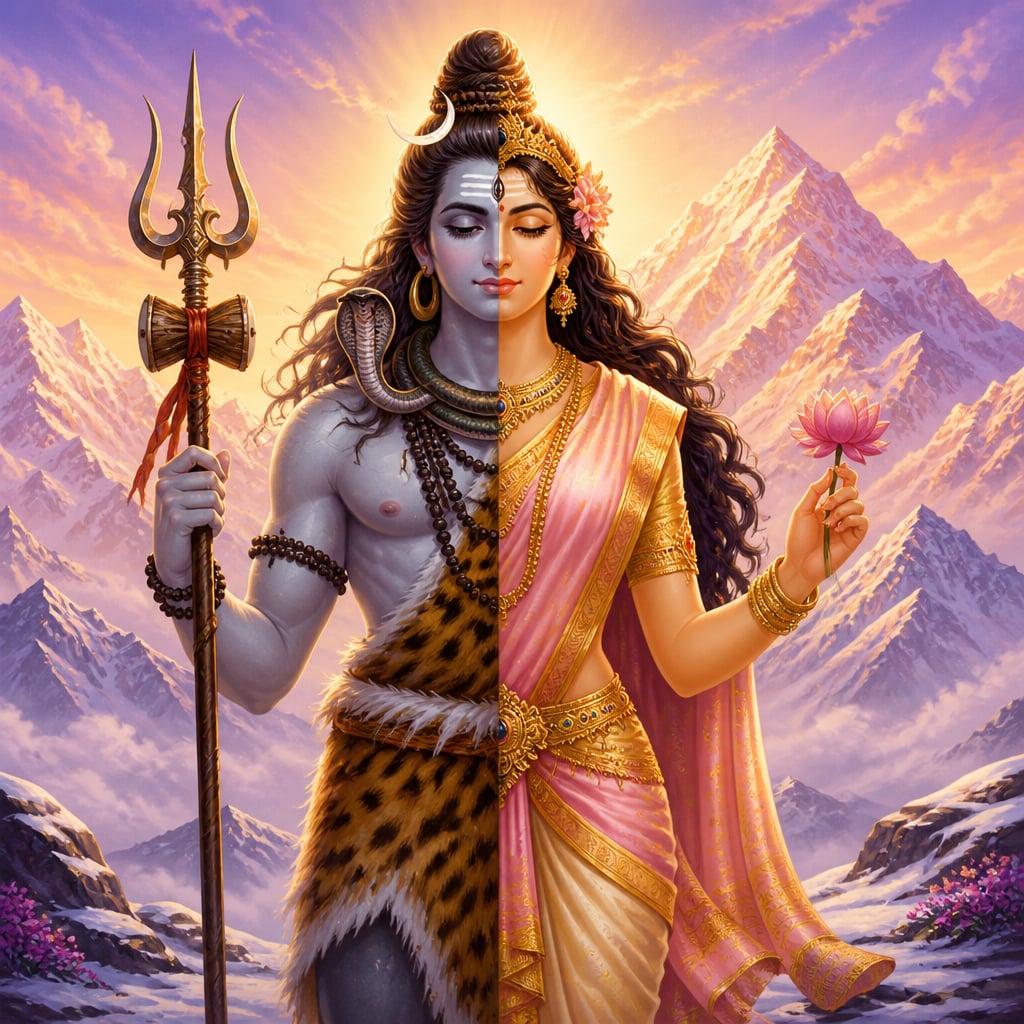
Ardhanarishvara stands on Mount Kailasa, Shiva on the right and Parvati on the left as a single divine form.

The Cosmic Origin Story

The Shiva Purana tells how this form came to be:
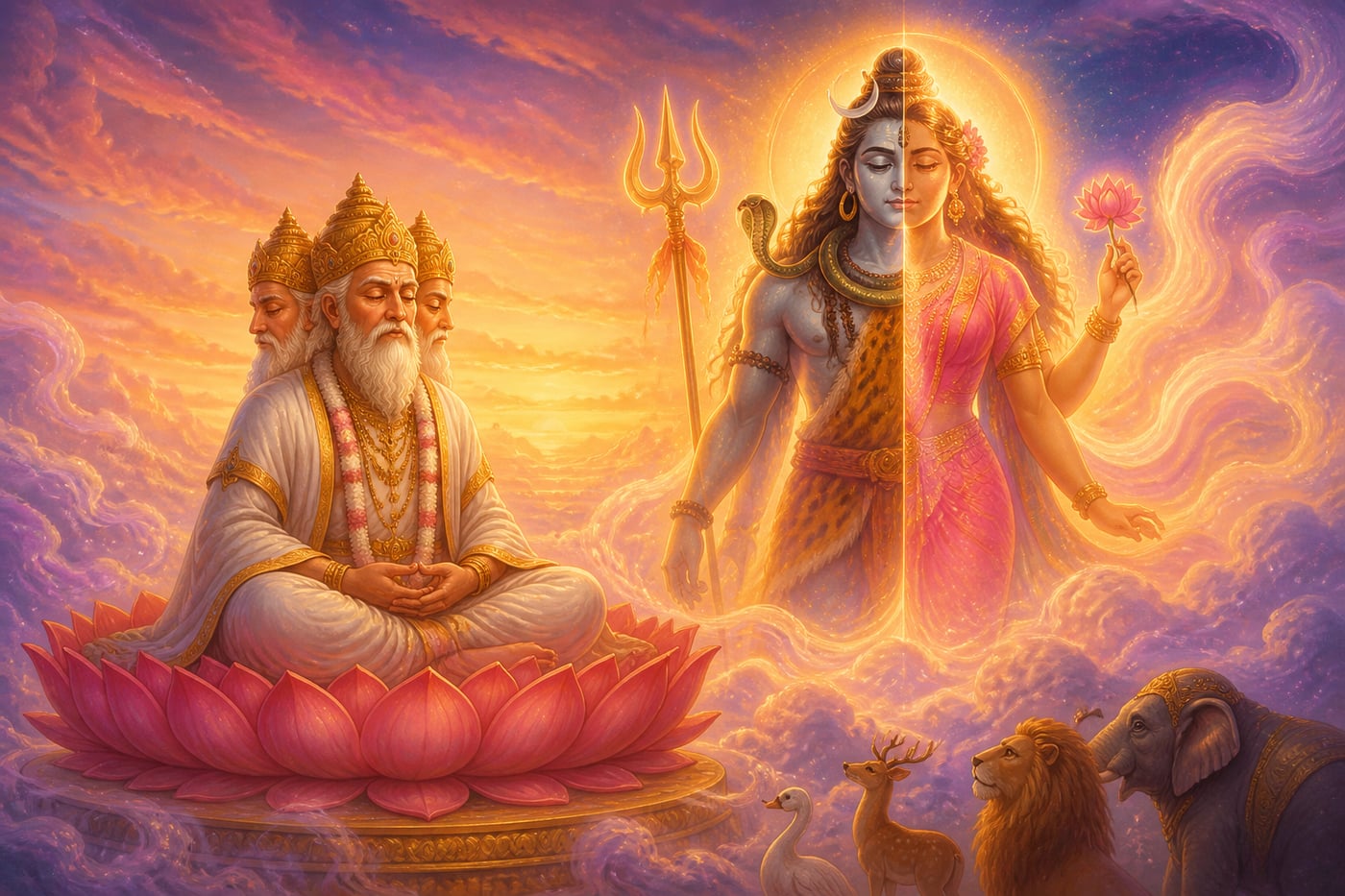
Brahma receiving the vision of Ardhanarishvara

Brahma, the creator, had made many beings, but creation was not flourishing. He meditated upon Shiva for guidance. In response, Shiva appeared in the Ardhanarishvara form, revealing that creation requires both the masculine and feminine principles working as one.

From the Shakti half of this form emerged the goddess, and through her creative power, coupled with the consciousness of the Shiva half, the universe began to thrive with diverse life.

The teaching is clear: diversity itself is built into creation's very foundation. The divine chose to manifest not as pure masculinity nor pure femininity, but as their eternal union, and from this union comes all variety of forms.

Prakriti: Nature, Not Construction

A crucial distinction separates the dharmic understanding from modern Western gender theory:

Western Theory Dharmic Understanding
Gender is a "social construct", invented, arbitrary, infinitely malleable Gender is prakriti, nature observed, not invented
Identity is self-declared and can change at will Svabhava (inherent nature) reveals itself over time
External validation and affirmation are essential Recognition comes through alignment with one's true nature
Categories are oppressive and should be abolished Categories reflect natural diversity within cosmic order

The dharmic tradition never claimed gender was merely biological, as some Western conservatives argue. But nor did it claim gender was purely a social construct, as Western progressives insist. Instead, it recognized a third way: prakriti, the inherent nature of beings that expresses itself through bodies but is not limited to bodies.

Ardhanarishvara embodies this truth. The divine form shows that masculine and feminine exist at the level of consciousness itself, prior to biology, yet also manifest through material forms. Those whose prakriti expresses gender diversity are not "confused", they are expressing an aspect of cosmic reality that the divine itself demonstrates.

Why This Matters Today

In an age of confusion about gender, Ardhanarishvara offers clarity without rigidity.

Western societies have oscillated between two extremes:

Both extremes miss what the dharmic tradition has understood for millennia: gender diversity is real and natural (not arbitrary social construction), but also exists within recognizable patterns (not infinite fragmentation).

The tritiya prakriti individual in the dharmic framework is not:

Instead, they are an expression of the same cosmic principle embodied by Ardhanarishvara, the reality that masculine and feminine can exist in proportions and combinations beyond the typical binary.

The Temple Evidence

Devotee before the Elephanta Ardhanarishvara sculpture

Ardhanarishvara has been worshipped across India for over 1,500 years. The Elephanta Caves (6th century), the Chola bronzes (10th-11th century), the Khajuraho temples (10th-11th century), and countless other sites testify to continuous devotion.

This is not reluctant tolerance. This is not "accepting" something problematic. This is worship, recognizing gender transcendence at the highest divine level.

When Western societies were executing people for "sodomy" and pathologizing any gender variance as mental illness, Indian civilization was carving Ardhanarishvara in stone, casting the form in bronze, and composing hymns to the Lord who is half-woman.

Integration, Not Activism

The dharmic approach to gender diversity differs fundamentally from Western LGBTQ activism:

Western Approach Dharmic Approach
Identity defined through struggle against oppression Identity grounded in cosmic order
Dignity comes from political recognition Dignity inherent in one's prakriti
Community formed through shared grievance Community formed through shared dharmic roles
Success = changing society's attitudes Success = aligning with one's svabhava

A tritiya prakriti person in the dharmic framework does not need society to change for them to be whole. They are already whole, just as Ardhanarishvara is complete, not half a deity waiting for the other half.

This is the gift of Ardhanarishvara: not mere tolerance of difference, but recognition that difference itself is divine.

Living the Teaching

What does Ardhanarishvara mean for us today?

For tritiya prakriti individuals: Your nature is not a disorder, not a social construct, and not an identity requiring external validation. It is prakriti, natural expression of the same divine principle that Ardhanarishvara embodies. You do not need activism to be whole. You need alignment with your svabhava and integration into dharmic community.

For families: When a family member shows signs of gender diversity, the dharmic response is neither panic nor immediate affirmation of any claimed identity. It is patient observation of svabhava over time, guided by the understanding that the divine itself transcends binary categories.

For communities: Tritiya prakriti individuals have had defined roles in dharmic society for millennia, offering blessings at weddings and births, serving in temples, providing counsel. Integration comes through contribution, not through demands for acceptance.

The Wisdom of Wholeness

Ardhanarishvara does not ask us to choose between masculine and feminine, or to pretend the categories don't exist. The divine form shows us that both are real, both are sacred, and both can exist within a single being in various proportions.

This is neither the rigid binary of traditional Western thought nor the formless fluidity of modern gender theory. It is something older and wiser: recognition of diversity within natural order, grounded in the highest spiritual reality.

As we explore tritiya prakriti through this course, let Ardhanarishvara be our guide, the half-woman Lord who shows that wholeness transcends categories while honoring the reality those categories reflect.

Case studies

The Elephanta Artisan: Divine Calling Through Svabhava

In 6th century CE, during the Kalachuri period, a master sculptor was commissioned to carve the magnificent Ardhanarishvara panel at the Elephanta Caves near Mumbai. Historical tradition records that among the artisan guild working on this cave complex was a sculptor whose own prakriti expressed both masculine and feminine qualities, what would today be called gender non-conforming. When guild elders debated whether such a person should carve the sacred image, the chief priest offered guidance: 'Who better to render the half-woman Lord than one who knows both natures within themselves? This is not deficiency but divine qualification.'

The dharmic framework understood that svabhava (inherent nature) is not chosen but revealed. The sculptor's gender-diverse prakriti was seen not as disqualifying but as uniquely qualifying them for this sacred task. The Shilpa Shastras (texts on sacred art) emphasize that the artisan must enter the bhava (mood/feeling) of what they create, one who naturally embodies both masculine and feminine principles could most authentically render Ardhanarishvara. This is dharmic integration through defined contribution, not acceptance despite difference.

The Elephanta Ardhanarishvara remains one of the most celebrated sculptures in Indian art, UNESCO World Heritage listed, studied by art historians worldwide. The figure captures a quality that purely masculine or feminine artists might struggle to achieve: the perfect balance point where neither aspect dominates. The sculptor found purpose not despite their svabhava but through it, their nature became their gift to civilization.

The dharmic tradition did not merely 'tolerate' gender diversity, it recognized that certain sacred roles were uniquely suited to those whose nature transcended binary categories. Integration came through contribution and defined role, not through activism or demands for acceptance.

Today's workplace diversity programs often reduce people to demographic checkboxes, but the Elephanta artisan model shows a more effective path. Organizations like Pixar and IDEO have found that teams with cognitively diverse members produce more creative output, not because diversity was mandated, but because unique perspectives were channeled into defined contributions.

The Elephanta Caves complex contains over 7 rock-cut cave temples dating to the 5th-6th century CE. The Ardhanarishvara panel, standing approximately 5 feet tall, was designated a UNESCO World Heritage Site in 1987 and remains one of the finest examples of composite gender imagery in Indian sculpture.

The Gender Clinic Assembly Line: When Ideology Replaces Observation

In 2016, a 14-year-old British girl named Emma (composite based on documented patterns) arrived at a gender clinic after declaring she was 'really a boy.' She had discovered trans content online six months earlier, had a history of autism spectrum traits, struggled socially at school, and experienced depression. Within three appointments totaling less than five hours, she was diagnosed with gender dysphoria and referred for puberty blockers. No exploration of her autism. No investigation of the recent social media consumption. No examination of whether her gender distress might relate to her social difficulties. The clinic operated on an 'affirmative' model: the patient declares identity, the clinician affirms and refers for medical intervention.

The dharmic approach could not be more different. Svabhava reveals itself over years, not months. Patient observation, by family, by elders, by those who know the person across contexts, allows genuine nature to be distinguished from temporary confusion, social influence, or expressions of other underlying issues. The Cass Review (UK, 2024) found exactly what dharmic wisdom would predict: the 'affirmative' model rushed children into irreversible interventions without adequate assessment, with 98% of those given puberty blockers proceeding to cross-sex hormones. This is not observation of prakriti, it is ideological imposition.

Emma underwent social transition, then blockers at 14, then testosterone at 16, then mastectomy at 17. At 21, she detransitioned, realizing her gender distress had been a manifestation of autism-related difficulty with her developing body and social isolation. She now lives with a permanently deepened voice, no breasts, and possible fertility complications. The UK closed its main pediatric gender clinic (Tavistock GIDS) in 2024 following the Cass Review. Sweden, Finland, and Norway have severely restricted pediatric gender interventions. The Western medical establishment is beginning to acknowledge what dharmic wisdom always knew: true nature reveals itself through patient observation, not clinical affirmation of momentary declarations.

Western gender ideology's rush to 'affirm' and medicalize replaced the patient observation that could distinguish genuine svabhava from social contagion, autism-related distress, or other underlying factors. The dharmic approach of observing prakriti over time, rather than affirming any claimed identity, protects both those with genuine tritiya prakriti and those whose distress has other causes.

The rapid closure of pediatric gender clinics across Europe between 2022 and 2024 mirrors the Elephanta lesson in reverse. Countries like Sweden, Finland, and the UK discovered that replacing careful assessment with ideological affirmation harmed the very people it claimed to help. The emerging global consensus now favors extended evaluation periods, echoing the dharmic principle that true nature reveals itself through patient observation, not clinical speed.

The UK's Cass Review found that 98% of children who began puberty blockers at the Tavistock GIDS proceeded to cross-sex hormones, suggesting the pathway was effectively one-way rather than a 'pause' for exploration as claimed.

Living traditions

Ardhanarishvara imagery appears throughout contemporary Indian culture, in wedding invitations symbolizing the union of bride and groom, in philosophical discussions of consciousness and energy, and increasingly in conversations about gender diversity. Unlike Western approaches that treat gender variance as new discovery, the dharmic tradition can point to continuous worship of gender transcendence for over 1,500 years.

Reflection

More in What Our Stories Tell Us

All lessons in What Our Stories Tell Us · Tritiya Prakriti: A Family's Dharmic Guide course