Finding Your Sangha

Building meaningful community connections

Beyond family, every person needs sangha, community that provides belonging, purpose, and support. For tritiya prakriti individuals, dharmic tradition offers multiple pathways to sangha: temple communities, guru-chela relationships, professional networks, and spiritual practices. This lesson explores how to build community through contribution and shared purpose rather than through identity politics and grievance. The Western model creates identity groups defined by struggle; the dharmic model creates communities defined by service, practice, and mutual support.

What is Sangha?

The Dharmic Understanding of Community

Sangha is one of the three jewels of Buddhist tradition, Buddha, Dharma, Sangha, but the concept exists throughout dharmic culture. Sangha means a community of people practicing together, supporting each other's growth, and sharing a common purpose.

For tritiya prakriti individuals, sangha answers a fundamental human need: belonging beyond the self, connection with others who understand, and a context for contribution.

But what kind of sangha? This is where dharmic tradition offers something fundamentally different from Western approaches.

Two Models of Community

The Western Model: Identity Groups

Western LGBTQ culture organizes community around identity, who you ARE defines the group. This creates:

The focus is on what you are and what you're fighting against.

The Dharmic Model: Practice Communities

Dharmic tradition organizes community around shared practice and purpose, what you DO and what you're building together. This creates:

The focus is on what you contribute and what you're building together.


Traditional Sanghas for Tritiya Prakriti

The Hijra Community Structure
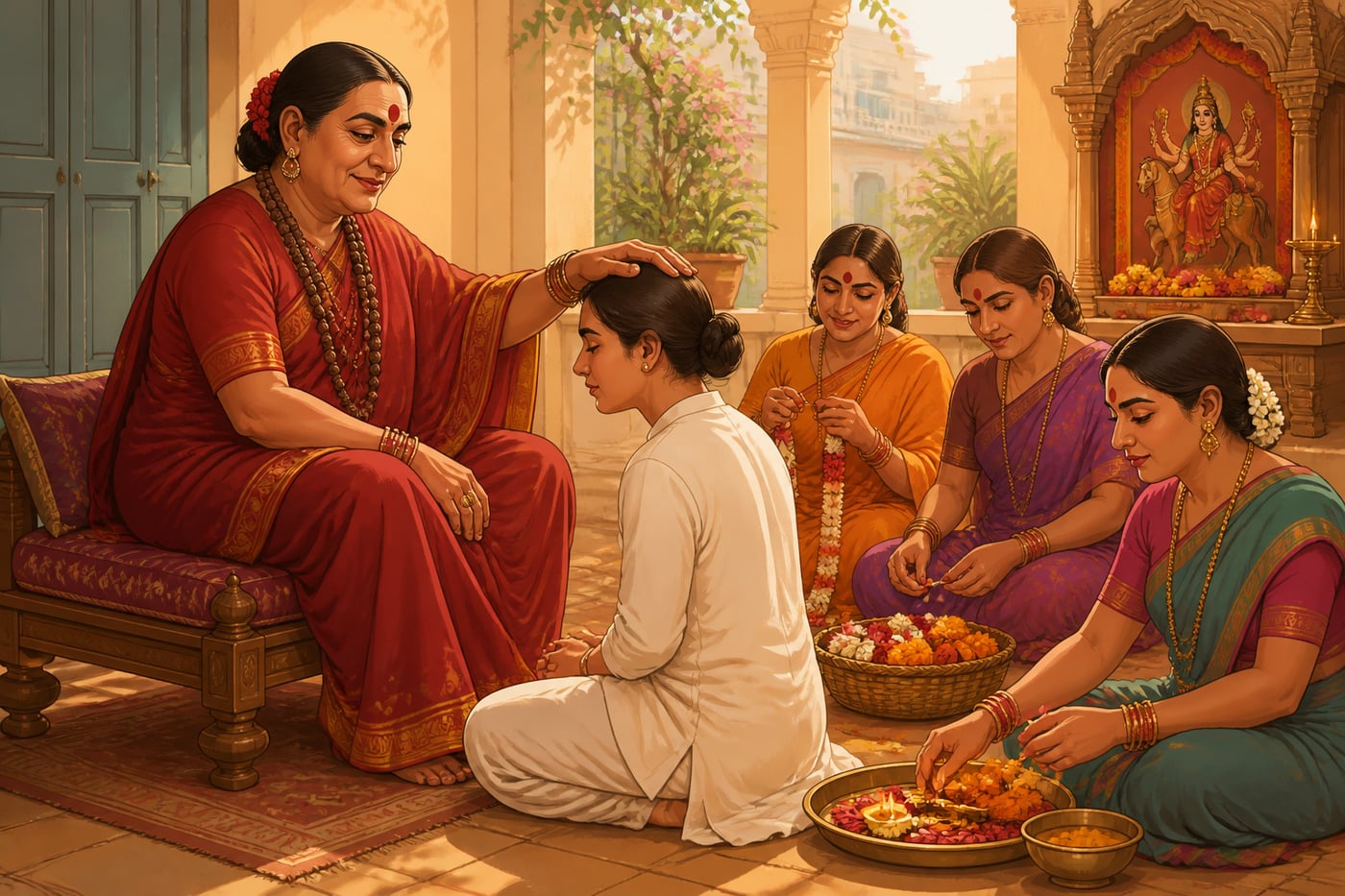
An elder hijra guru blessing a kneeling young chela in a Mumbai courtyard

The hijra community offers a traditional model of sangha that has existed for centuries:

Guru-Chela System: Each hijra household is led by a guru (teacher/leader) with chelas (disciples). The guru provides:

This is fundamentally different from Western support groups. The guru-chela relationship is about growth and transmission of wisdom, not just emotional support.

Household (Gharana): Hijras traditionally live in households with defined roles, responsibilities, and mutual support. These function as extended families, providing:

Wider Community: Multiple households connect through shared traditions, festivals, and networks. This provides:

Temple Communities

Templates offer sangha that isn't defined by gender identity at all:

Bahuchara Mata: The temple in Gujarat is specifically associated with the hijra community, but all devotees are welcome. The temple provides:

Ardhanarishvara Temples: Temples dedicated to Shiva's half-male, half-female form offer theological grounding for gender diversity within the divine itself.

General Temple Communities: Any temple can be sangha. The community of devotees, gathering for aarti, festivals, and service, provides belonging that transcends individual identity categories.

Spiritual Practice Communities

Beyond specific temples, spiritual practice itself creates community:

Satsang: Gathering for spiritual discourse and practice. The focus is on truth (sat) and companionship (sanga), not on identity categories.

Bhajan Groups: Singing devotional songs together creates community through shared practice.

Meera Bai dancing in bhakti at the heart of a circle of bhaktas in a temple courtyard at dusk

Meditation Groups: Sitting in silence together, regardless of individual nature.

Scriptural Study: Learning together creates bonds of shared understanding.


Building Sangha Through Contribution

The Key Insight: Contribution, Not Category

The dharmic secret to sangha is this: Community forms through shared contribution, not through shared category.

Western identity groups gather people who share a label. But labels don't create deep bonds, contribution does.

When you work alongside others toward a shared goal, community naturally forms. When you serve together, bonds develop. When you create together, belonging emerges.

Practical Pathways to Sangha

1. Seva (Service) Communities

Find opportunities for seva, selfless service. This might be:

In seva, you become valued for what you give, not for what category you belong to. Bonds form through working together.

2. Professional Communities

Your work can be sangha:

Excellence in work creates respect. Contribution to your field creates belonging. Focus on what you build, not on identity politics.

3. Creative Communities

Arts have always provided community for gender-diverse individuals:

Artistic practice creates community through shared dedication and creation.

4. Learning Communities

Study and growth create bonds:

Learning together creates sangha through shared growth.


What Western Community Gets Wrong

Identity Politics Creates Division

Western LGBTQ community is organized around identity, and identity politics creates problems:

Constant Subdivision: As new identity categories proliferate (70+), communities fragment. Arguments about who belongs and who doesn't consume energy.

Defined by Opposition: When community is about fighting oppression, there's always need for enemies. This creates adversarial relationships with the wider world.

Grievance Focus: Gatherings often center on what's wrong, discrimination faced, rights denied, struggles endured. This is exhausting and doesn't build toward anything positive.

Temporary Bonds: Identity groups often lack the depth of communities built on shared practice. When the political moment passes, bonds may fade.

Pride Events vs. Temple Gatherings

Pride Model Temple Model
Organized around identity category Organized around devotion and practice
Focus on visibility and rights Focus on worship and community
Often politically charged Spiritually grounded
Annual events Ongoing practice
Defined by struggle Defined by devotion
Creates insider/outsider dynamics Open to all devotees

The Loneliness Paradox

Despite more visibility and more LGBTQ organizations than ever, loneliness and mental health struggles in Western LGBTQ communities remain high. Why?

Identity groups provide temporary connection but may not provide:

Dharmic sangha offers what identity politics cannot: community through practice, purpose through contribution, belonging through shared devotion.


Finding Your Place

Questions to Ask

When seeking sangha, ask:

  1. What do I want to contribute? Not "who understands my identity?" but "where can I give my gifts?"

  2. What do I want to practice? What spiritual, creative, or service practices draw me?

  3. What do I want to build? What positive vision am I working toward?

  4. Who are my natural companions? Not necessarily those who share my label, but those who share my values and purposes.

Multiple Sanghas

Most people have multiple sanghas:

No single community needs to meet all needs. Having multiple sanghas creates resilience and richness.

The Guru Relationship

For those who feel drawn, a relationship with a guru offers a specific kind of sangha:

Personal Guidance: A guru knows you and your situation, offering tailored wisdom.

Lineage Connection: Through a guru, you connect to a tradition stretching back centuries.

Spiritual Community: Fellow disciples of the same guru form a natural sangha.

Growth Path: The guru-disciple relationship is about transformation, not just support.

This is available whether you're tritiya prakriti or not. The guru sees the Atman, not the body's category.


Case Study: Building Sangha the Dharmic Way

Priya's Path: From Identity Group to Temple Community

Priya serving prasad at a Hindu temple during Navratri

Priya was raised in an Indian immigrant family in the UK. When she came to understand her tritiya prakriti nature as a young adult, she first sought community in local LGBTQ groups.

She found temporary connection but also problems:

A visit to a Hindu temple during Navratri changed her perspective. She felt something she hadn't felt in activist spaces: peace, devotion, belonging that didn't require explaining or defending her identity.

She began attending temple regularly. She volunteered for seva, helping with prasad distribution, assisting with festivals. She joined a bhajan group. She found a meditation teacher.

Over time, she realized she had found sangha, not through identity politics but through practice and contribution. Her temple community knows her as a devoted volunteer and sincere practitioner. Her nature is simply one aspect of who she is, not her defining characteristic.

"In activist spaces, I was constantly explaining and defending who I am," she reflects. "In temple, I just AM. I contribute, I worship, I belong. My prakriti is known but not the center of everything. I'm a devotee first."

The Hijra Guru: Traditional Sangha in Modern Times

Rama joined a hijra household in Mumbai after connecting with a guru through the Bahuchara Mata temple network. The guru provided what Western support groups couldn't:

The guru-chela relationship demands discipline and respect. It's not just emotional support, it's a path of growth. Rama learned traditions, took on responsibilities, and eventually became qualified to guide others.

"Western support groups felt like everyone talking about their problems," Rama says. "The guru system is different. Yes, we support each other, but we're also building something. We're maintaining a tradition. We have a purpose beyond ourselves."


Cautionary Tale: When Identity Becomes Everything

Alex's Fragmentation: The Limits of Identity Community

Alex grew up in progressive California, identifying as non-binary from age 16. They found community in LGBTQ youth groups, then college organizations, then adult activism.

But over time, problems emerged:

Constant Conflict: Arguments about who was "really" trans, whether non-binary people belonged, debates about race and privilege within the community. Energy went to infighting, not support.

Exhaustion: The activist community demanded constant engagement, protests, social media battles, calling out "problematic" behavior. There was no rest.

Shallow Bonds: When Alex stepped back from activism due to burnout, many "friends" disappeared. The connections were political, not personal.

No Spiritual Grounding: Everything was political. There was no transcendent purpose, no practice, no tradition to draw on.

Identity Consuming Everything: Alex's non-binary identity had become their entire personality. They had no other sources of meaning or community.

At 28, after a mental health crisis, Alex began therapy and eventually discovered meditation. Through a mindfulness community, they found what had been missing: practice-based sangha that wasn't about identity at all.

"I spent a decade in identity communities and ended up more isolated than ever," Alex reflects. "The meditation group doesn't care about my gender. They care whether I show up and practice. That's actually more accepting than all the 'acceptance' I found in activist spaces."


Building Sangha: Practical Steps

Step 1: Identify Your Gifts and Interests

Before seeking community, know what you bring:

Sangha forms through contribution. Know what you'll contribute.

Step 2: Explore Multiple Possibilities

Don't limit yourself to identity-defined groups:

Step 3: Show Up Consistently

Sangha develops over time, through consistent presence:

Step 4: Contribute Before Expecting

Give before asking:

Step 5: Maintain Multiple Sanghas

Don't put all belonging in one basket:

Multiple communities provide resilience.


The Sangha of the Atman

Beyond All Categories

The deepest teaching: at the level of Atman, there are no categories at all.

When you sit in meditation with others, there is no male, female, or tritiya prakriti. There is awareness, together.

When you sing bhajans with devotees, the divine doesn't sort by gender. There is devotion, shared.

When you serve prasad at temple, you serve the Atman in all, and the Atman in you serves.

This is the ultimate sangha: community at the level of what we truly are, beyond all bodily categories.

Integration, Not Separation

The dharmic path is integration:

You can find specific communities that understand your nature (like hijra households or specific guru lineages). But you can also find sangha anywhere there is sincere practice and open hearts.


Dharmic vs. Western Community

Dharmic Sangha Western Identity Community
Defined by practice and purpose Defined by identity category
Focus on contribution Focus on recognition
Spiritual grounding Political grounding
Builds toward positive vision Fights against oppression
Deep bonds through shared practice Connections through shared label
Guru guidance available Peer support only
Integrates with wider society Creates separate space
Time-tested structures Recently invented forms
Purpose beyond identity Identity as purpose

Conclusion: Sangha Through Practice, Not Politics

Every human needs belonging. The question is: what kind of belonging?

The Western model offers identity community, gathering with those who share your label, fighting for recognition together, finding temporary support in shared struggle.

The dharmic model offers something deeper: sangha through practice, contribution, and shared purpose. Community that transcends identity categories. Belonging through what you give, not what you are.

For tritiya prakriti individuals, both paths are available. But the dharmic path offers what the Western path often lacks:

Find your temple. Find your guru. Find your seva. Find your practice community.

Build sangha through contribution. Find belonging through service. Create community through shared purpose.

This is the dharmic way: not isolation in identity groups, but integration through practice. Not defined by struggle, but defined by devotion.

Your sangha awaits. Not because of what category you belong to, but because of what you have to offer.

The Buddha taught: "The sangha is like a great ocean, all rivers flow into it and become one."

Flow into the ocean. Find your sangha. And become one.

Case studies

Rama Devi: Finding Sangha in Temple Service

Rama Devi grew up in a village in Andhra Pradesh, recognizing her tritiya prakriti nature from childhood. Her family, following dharmic tradition, observed patiently and eventually connected her with a respected hijra guru in Hyderabad. But Rama Devi's true sangha emerged through the Yellamma temple network. She began as a helper at local Yellamma shrines, eventually becoming recognized as a devotee-server at larger gatherings. At temple festivals, she found community: other devotees from all backgrounds who gathered for worship, not for identity politics. The temple sangha provided what identity groups couldn't: spiritual grounding, purpose through service, community that transcended categories. Now in her 50s, Rama Devi is a respected figure in multiple temple communities. She's known not primarily as 'a hijra' but as 'Rama Devi who organizes the prasad distribution' and 'Rama Devi who knows all the old songs.' Her identity is integrated into her contribution, not separate from it.

Rama Devi's path exemplifies dharmic sangha building. She found community through practice (temple devotion), through contribution (seva), and through shared purpose (worship of the divine). Her tritiya prakriti nature is known but not the defining characteristic. The temple sangha includes people of many backgrounds united by devotion. This is integration, not separation, belonging through what you give and practice, not through what category you represent.

Rama Devi has deep, lasting relationships built over decades of shared practice. She has purpose beyond identity: preserving temple traditions, serving devotees, transmitting songs and stories to younger people. She has spiritual grounding through devotion. Her mental health is stable, her belonging is secure, her life has meaning. This is what sangha through practice provides.

Sangha forms through contribution and practice, not through identity politics. Rama Devi didn't find belonging by joining identity groups and fighting for recognition. She found belonging by showing up, serving, and practicing alongside others. Her lesson: focus on what you can give, not on what category you belong to. Community follows contribution.

The distinction between identity-based and practice-based community explains why many gender-diverse individuals in India report higher life satisfaction than their Western counterparts despite having fewer legal protections. Temple communities, craft guilds, and neighborhood networks that accept people based on participation and contribution create a more durable form of belonging than groups organized around shared identity categories.

Studies of traditional temple communities in India show that devotees from marginalized backgrounds who integrate through service and practice report higher well-being than those who organize primarily around identity politics, suggesting that contribution-based belonging offers something that category-based belonging cannot.

Jordan's Isolation: The Limits of Identity Community

Jordan grew up in a progressive American city, identifying as non-binary from age 15. They threw themselves into LGBTQ community: youth groups, college organizations, activism, online communities. By 25, Jordan had thousands of social media followers, had spoken at pride events, and was deeply embedded in queer activist networks. But Jordan was also increasingly anxious, isolated, and exhausted. The identity community they'd built had problems: constant arguments about who was 'really' queer enough, exhausting demands for political engagement, relationships that seemed to evaporate when Jordan stopped being politically active. When Jordan went through a difficult period and pulled back from activism, most 'friends' disappeared. The community had been political, not personal. At 28, following therapy, Jordan began exploring meditation and volunteer work unrelated to identity. Through a Buddhist sangha and environmental volunteering, they found something different: community based on practice and contribution, not on identity. These relationships lasted because they were about what people did together, not what categories they belonged to.

Jordan's experience illustrates what Western identity community often lacks: depth, permanence, purpose beyond identity itself. Community organized around 'who you are' can provide temporary connection but may not provide lasting bonds. Community organized around 'what you practice together' creates deeper relationships. Jordan eventually found sangha through practice (meditation) and contribution (environmental volunteering), exactly what dharmic tradition teaches. Identity became one aspect of their life, not the whole of it.

Jordan now has multiple sanghas: a meditation group, a volunteer community, a few lasting friends from earlier periods. Their mental health improved when community wasn't entirely about identity. They still participate in some LGBTQ activities but no longer make it their whole world. 'I needed something to DO together with people, not just to BE together,' Jordan reflects. 'Practice-based community is more real than identity-based community.'

Identity-based community has limits. When all your relationships are based on shared category rather than shared practice, they may not survive when political engagement fades. The dharmic alternative, sangha through practice, contribution, and shared purpose, creates deeper bonds. Jordan's trajectory from identity community to practice community mirrors what dharmic tradition teaches: belonging comes through what you do together, not just what you are.

Activist burnout is now recognized as a clinical pattern, with organizations like the Movement Strategy Center documenting high rates of depression, anxiety, and relationship breakdown among long-term identity-based activists. The pivot toward 'healing justice' and 'contemplative activism' in Western social movements represents a groping toward what dharmic tradition already provides: community centered on practice, service, and spiritual growth rather than opposition and grievance.

Research on LGBTQ mental health in Western countries shows that despite unprecedented visibility and community organization, rates of anxiety, depression, and loneliness remain high. This suggests that identity-based community may not provide what humans need as effectively as practice-based community, a finding consistent with dharmic emphasis on sangha through shared practice.

Living traditions

Many dharmic communities continue to welcome all sincere practitioners regardless of gender category. Temple seva programs, ashrams, and pilgrimage traditions create sangha through practice, offering an alternative to Western identity-based community organizing.

Reflection

More in Mental Health & Acceptance

All lessons in Mental Health & Acceptance · Tritiya Prakriti: A Family's Dharmic Guide course