Vakchaturya: Clever Speech
The power of words to solve problems
Two tales showcasing the power of clever speech. The Mirror shows how Tenali finds the precise gap in the king's words to turn a royal ban into a moment of laughter, while The Three Questions demonstrates how wise answers can satisfy even impossible demands.
The Mirror
One day, King Krishnadevaraya was in a foul mood. A court performance had gone wrong, a minister had irritated him, and small things kept going badly. By afternoon, his patience had snapped.
Tenali walked into the court at exactly the wrong moment.
"Out!" the king thundered. "I am tired of your jests and your face! I do not wish to see you again!"
The courtiers froze. The king's anger was real. Tenali bowed quietly and left.
The next morning, the king was calmer. He sat in court going through petitions when he noticed a figure standing just outside the main doorway. Something was held up between the figure's face and the king.
A mirror.
The figure stepped forward. It was Tenali - holding a large bronze mirror so that the king, looking toward him, could only see his own reflection staring back.
"What is the meaning of this?" the king demanded.
"Maharaja," Tenali said calmly from behind the mirror, "yesterday you said you did not wish to see me again. I have honored your command. You are not seeing me. You are seeing yourself."
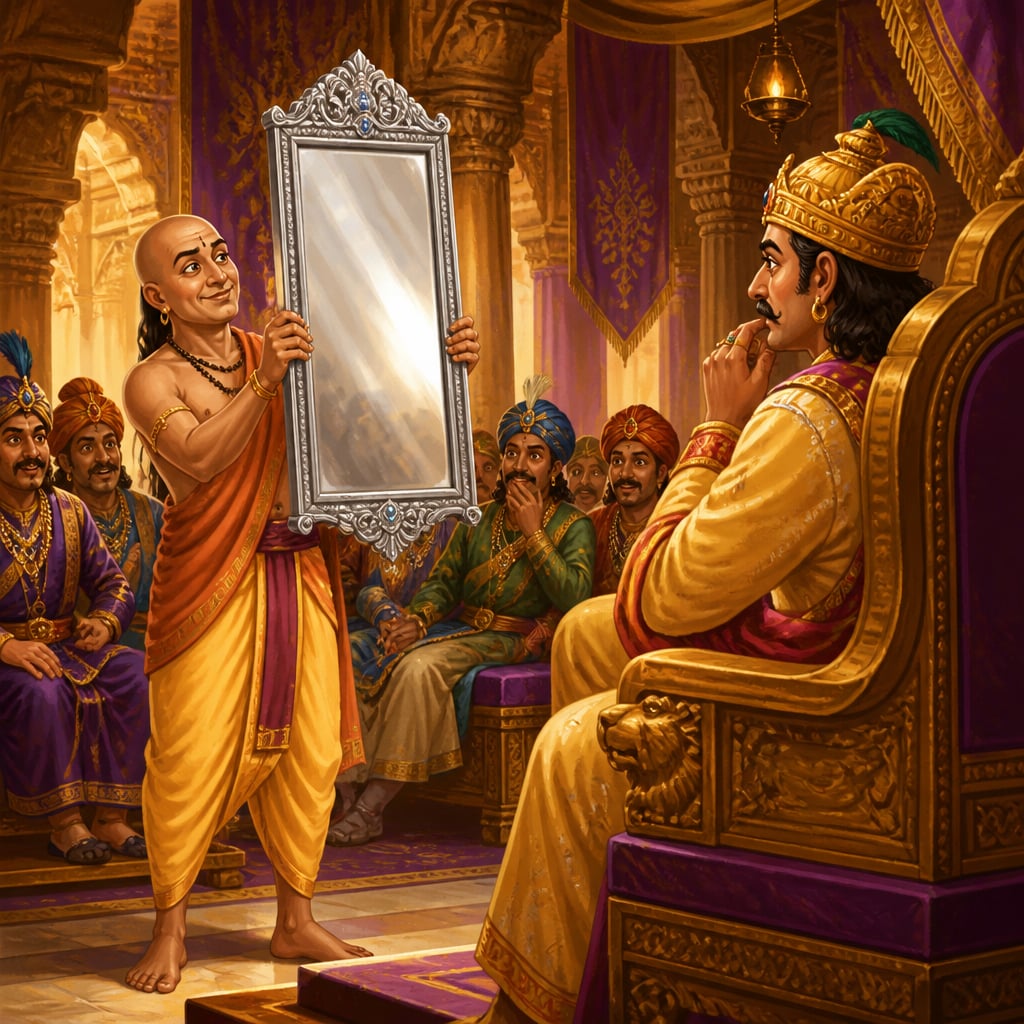
The court went utterly silent.
Then the king laughed - a real laugh, from deep in his chest.
"Tenali," he said, "you have found a way to be present without disobeying me. And you have held up a mirror so I can see my own face. Perhaps... I needed to."
He waved Tenali forward. "Put the mirror down. I have changed my mind."
Tenali lowered the mirror and bowed. "Maharaja, a wise king's anger, like a summer storm, passes quickly. I simply waited for the sun."
The trick, explained:
The king said: "I do not wish to see YOU again."
Tenali heard: "I do not wish to see your FACE."
By holding up a mirror, Tenali ensured the king could only see his own face - and technically obeyed the command completely. He did not argue. He did not apologize. He found the exact gap in the words and stepped through it with a smile.
The Three Questions
One day, a foreign scholar arrived at the court. He had traveled from a distant land to challenge the wisdom of Vijayanagara.
"I have three questions," he announced. "If anyone can answer them, I will admit that India has the wisest scholars. If not, I will spread word that this 'great kingdom' is full of fools."
The courtiers shifted nervously. The scholar's eyes were cold and his smile was arrogant.
"What are your questions?" the king asked.
"First: Where is the center of the Earth?"
"Second: How many stars are there in the sky?"
"Third: What am I thinking right now?"
The court fell silent. These were impossible questions! No one could answer them.
The scholars looked at each other helplessly. The Rajaguru studied his feet. Even the wisest ministers had nothing to say.
"Anyone?" the foreign scholar sneered. "No one in this famous court can answer?"
Tenali stepped forward.
"I will answer," he said.
The foreign scholar looked him up and down. "You? A court jester?"
"A jester who thinks," Tenali replied calmly. "Ask your questions again."
"Fine. Where is the center of the Earth?"

Tenali stamped his foot on the ground. "Right here. Exactly where I'm standing."
"What? That's absurd! How can you prove that?"
"How can YOU disprove it?" Tenali replied. "If you think the center is somewhere else, measure it. The Earth is round - every point on it is equally far from every other point. So the center is wherever you stand. Right now, it's where I'M standing."
The scholar's mouth opened, then closed. He had no counter-argument.
"Second question," he said, sounding less confident. "How many stars are in the sky?"

Tenali gestured to a goat outside the window. "Exactly as many stars as there are hairs on that goat's body."
"That's ridiculous! How do you know that?"
"Count the hairs on the goat. Count the stars in the sky. If the numbers don't match, come back and tell me."
The court burst into laughter. Of course no one could count either one!
The foreign scholar was red-faced now. "Last question. What am I thinking RIGHT NOW?"
"Easy," Tenali said. "You're thinking that I, Tenali, am answering your questions. But you're wrong."
"Wrong? How am I wrong? You ARE answering my questions!"
"No," Tenali smiled. "You THINK I'm answering. But actually, I'm QUESTIONING your questions. There's a difference."
The foreign scholar stared at him. Then, slowly, a genuine smile crossed his face.
"I underestimated you," he said. "I came looking for scholars who knew facts. Instead, I found a mind that understands wisdom. India's reputation is safe."
He bowed to Tenali - a bow of genuine respect.
The Wisdom
Words have exact meanings. Clever speech finds creative ways to use those meanings - not to deceive, but to shift perspective. Tenali didn't argue or plead with the king. He found the precise gap in the words and stepped through it with grace.
And when impossible questions came from the foreign scholar, he didn't try to give impossible answers. He showed that sometimes the question itself needs to be questioned.
In Your Life
Have you ever been asked a question that felt like a trap? "Do you like my haircut?" when you don't. "Which of your parents do you love more?" when you love them both. "Why are you so quiet?" when you're just thinking.
Like Tenali, you don't always have to answer the question as asked. You can:
- Question the question ("What do you mean by 'quiet'?")
- Find a middle path ("I like things about both!")
- Respond with a question ("Do YOU like your haircut?")
Clever speech isn't about lying or avoiding. It's about finding words that are true AND kind AND wise - all at the same time. That's an art worth practicing!
Reflection
- Can you think of a time when you said something that was understood differently by different people? Was this a problem or did it actually help?
- The foreign scholar's questions were designed to have no right answer. Why do people sometimes ask questions like this?
- Is there a difference between being 'clever with words' and being 'dishonest with words'? Where is the line?