Netritva: Can Women Lead?

Queens, scholars, and warriors

For thirty years, Ahilyabai Holkar ruled the kingdom of Malwa, and her reign became legendary for justice, prosperity, and dharma. She wasn't the exception. Indian history is filled with women who commanded armies, administered kingdoms, built temples, and transformed societies. The Dharmic answer to 'Can women lead?' is not just 'yes', it is that Shakti, the feminine divine power, is the SOURCE of all leadership. Without Shakti, even Shiva cannot act.

A Modern Dilemma

In the City

The office was buzzing with news. After twenty years, the company was getting its first woman Managing Director.

"Priya ma'am deserves it," said Arjun. "She turned around the Gujarat operations single-handedly."

"But can she handle the board? Those old uncles won't listen to a woman," another colleague wondered.

Priya's mother, watching the news at home, smiled. She remembered when Priya was just starting out, unsure if she could compete in a male-dominated industry. Her father had said: "Beta, remember Ahilyabai Holkar? She ruled a kingdom when queens weren't supposed to rule. You're just running a company."

Her grandmother, who had never worked outside the home, had added: "In our family, the women have always been the backbone. Your dadi managed this entire joint family for forty years. Leading is in your blood."

Today, Priya would lead not just a family but an organization of thousands. And she knew: the Shakti that guided Ahilyabai was the same Shakti flowing through her.

In the Village

Kamala was nervous. The gram sabha had elected her as sarpanch, the first woman to lead the village council in its history.

"What do I know about running a village?" she asked her husband.

He laughed. "You've run this house for thirty years. You know who needs help, who's fighting with whom, how to make one rupee do the work of ten. The village isn't that different."

Her mother-in-law, once skeptical, now supported her. "The village needs someone who listens. You listen. The village needs someone who solves problems without shouting. You do that. The men have tried for decades, look where we are. Now it's time for Shakti."
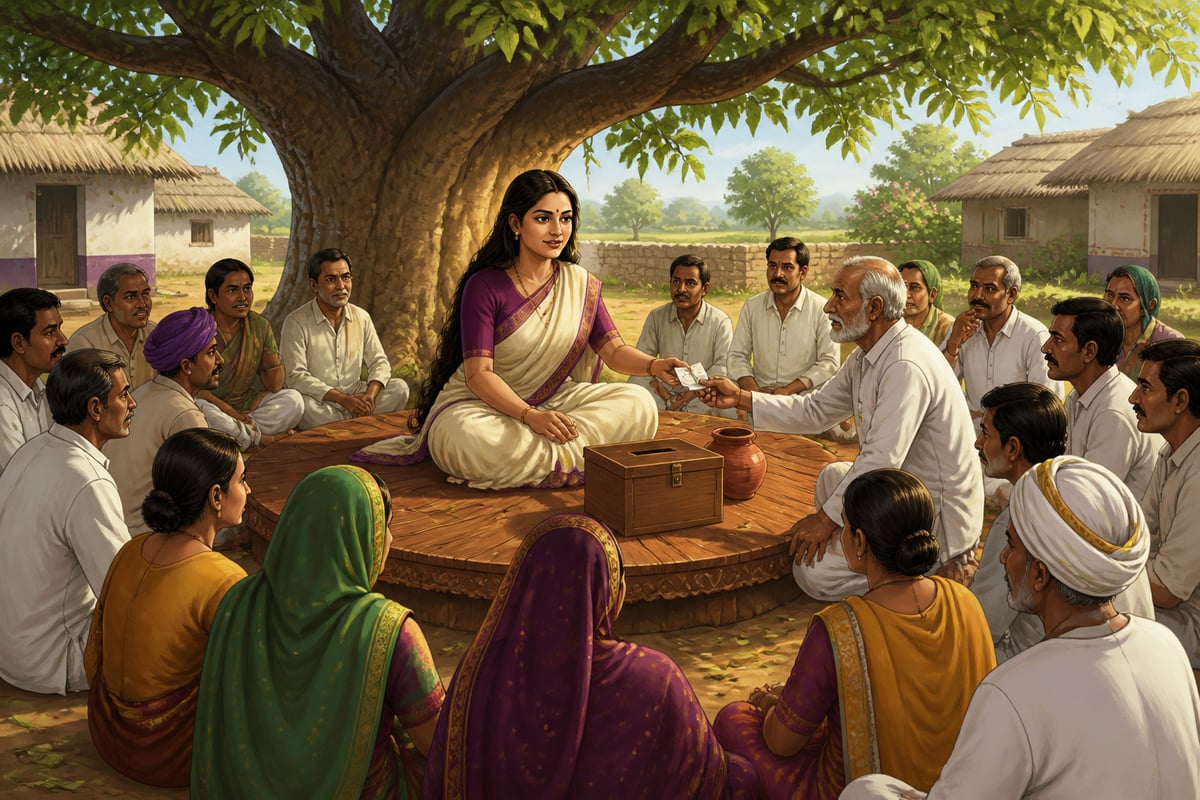
Kamala leads her first panchayat as the new sarpanch

At her first meeting, some men smirked. But Kamala thought of her grandmother's words: "When Durga rides into battle, the demons don't surrender because she asks nicely. They surrender because she's stronger." She spoke with clarity, made decisions, and by the end, the smirks had faded.

Leadership wasn't about being male or female. It was about Shakti, and Shakti flows through whoever is ready to receive it.


The Philosophy of Shakti

Before we look at history, let's understand the Dharmic foundation of leadership.

In Hindu philosophy, the universe operates through two principles:

Here's the critical insight: Without Shakti, Shiva cannot act.

The famous saying goes: "शिवः शक्त्या युक्तो यदि भवति शक्तः प्रभवितुम्", "Shiva united with Shakti becomes capable of action." Without her, he is शव (shava), a corpse.

This isn't metaphor. It's a statement about the nature of power itself.

All action, all leadership, all creation flows from Shakti. When a king rules well, it is Shakti flowing through him. When a queen rules, Shakti flows directly. The gender of the vessel doesn't matter, what matters is the presence of Shakti.

This is why India worships the goddess as Durga (protector), Lakshmi (prosperity), and Saraswati (wisdom). Leadership requires all three, the courage to protect, the ability to create prosperity, and the wisdom to guide. These are not masculine qualities being borrowed by women. They are feminine divine qualities that can manifest through anyone.


Ahilyabai Holkar: The Philosopher-Queen

In 1767, after her husband and father-in-law died in battle, Ahilyabai Holkar faced a choice. She could retire to a life of piety and let her kingdom be absorbed by rivals. Or she could rule.

She chose to rule.

For thirty years (1767-1795), Ahilyabai administered the kingdom of Malwa (in present-day Madhya Pradesh) with a wisdom that became legendary. What made her reign extraordinary?

Justice Without Favorites

Ahilyabai personally heard cases from common citizens. A peasant could bring a grievance against a noble, and Ahilyabai would judge impartially. She famously said: "The law knows no distinction between high and low." Crime rates dropped. Disputes were resolved. People felt heard.

Ahilyabai Holkar hears a village farmer's petition in her open-air court

Prosperity Through Good Governance

Under Ahilyabai:

Her treasury grew not through conquest but through the prosperity of her people.

Dharma in Action

Ahilyabai is remembered for rebuilding temples across India, not just in her own kingdom. She rebuilt the Kashi Vishwanath Temple in Varanasi, the Somnath Temple in Gujarat, and dozens of others that had been destroyed in invasions. She built dharamshalas (rest houses) for pilgrims, ghats on holy rivers, and water tanks for drought-prone regions.

But here's what set her apart: She didn't just build temples. She lived dharma. When her only son, Malerao, became corrupt and cruel, Ahilyabai, as his mother, had him removed from succession. Dharma came before bloodline.

The Legacy

When Ahilyabai died in 1795, her kingdom mourned a mother. The British, observing from nearby, noted that she had achieved what their best administrators couldn't: genuine popularity among her subjects.

John Malcolm, a British officer who studied her reign, wrote: "In the history of the world, whether ancient or modern, we find few such examples of pure and unambitious virtue."

Ahilyabai didn't lead despite being a woman. She led because Shakti flowed through her fully, the Shakti of Durga in protecting her people, of Lakshmi in creating prosperity, and of Saraswati in governing with wisdom.


The Clear Dharmic Position

WOMEN CAN LEAD, AND SHAKTI IS THE SOURCE OF ALL LEADERSHIP.

  1. Leadership is about Shakti, not gender. The power to lead, protect, and prosper comes from Shakti, the feminine divine force. When this force flows through a person fully, they become capable leaders. Gender is irrelevant.

  2. History proves it. Ahilyabai Holkar ruled for 30 years with legendary success. Rani Lakshmibai fought against empire. Rani Durgavati defended her kingdom to death. Razia Sultan ruled Delhi. Abbakka fought the Portuguese. The tradition of women leaders in India is ancient and deep.

  3. The tradition doesn't limit women to "soft" roles. Durga carries weapons and rides into battle. Kali destroys demons. The goddess isn't confined to nurturing, she also protects and fights. Women leaders can embody any aspect of Shakti.

  4. Family support enables leadership. Ahilyabai's father-in-law, Malhar Rao Holkar, recognized her abilities and trained her in administration. Great women leaders often have families who saw and supported their potential.

  5. Leadership is service. Ahilyabai didn't seek power for herself. She served her people for thirty years. The Dharmic model of leadership is not domination but service, and this is available to anyone.


Dharmic Guidelines

✅ DO ❌ DON'T
Recognize leadership potential regardless of gender Assume leadership is a "masculine" quality
Remember that Shakti is the source of all power Think women need to become "like men" to lead
Support women in leadership roles, at home, work, community Undermine women leaders with subtle sabotage
Study the examples of Ahilyabai, Lakshmibai, and others Forget that these traditions are YOUR traditions
Teach daughters leadership by giving responsibilities Shield daughters from decision-making "for their protection"
Seek Shakti's blessing before any leadership role Assume power comes from position alone

Why This Matters to YOU (The Karma Angle)

If you doubt women's capacity to lead:

If you support and nurture women's leadership:

If you're a woman hesitating to lead:


Messages for Different Ages

For Children (8-12 years)

Did you know that India was ruled by some of the best queens in history? One of them, Ahilyabai Holkar, ruled for 30 years. She built roads, schools, and temples. She made sure everyone was treated fairly, rich or poor. People loved her so much that they called her "Mother."

When people ask "Can girls be leaders?", remember Ahilyabai. She didn't just lead. She was one of the BEST leaders India ever had!

For Teenagers (13-17 years)

You might hear:

Here's what history says: Nonsense.

Ahilyabai led with wisdom and compassion, and crushed corruption firmly. Lakshmibai led cavalry charges. Durga Ma rides a tiger into battle. The feminine isn't weak, it's the SOURCE of all power.

If you feel the call to lead, at school, in your community, in your career, don't shrink. Shakti chose you.

For Adults (18+ and Parents)

If you're a woman in a leadership position: You're not an anomaly. You're part of a tradition that goes back millennia. When you face resistance, remember Ahilyabai, she faced skeptics too. She answered them with thirty years of excellent governance.

If you're raising daughters: Leadership skills are built through practice. Give her responsibilities. Let her make decisions and face consequences. Don't protect her from leadership, prepare her for it.

If you work with women leaders: Your support or sabotage makes a difference. The man who sees and supports a woman's leadership potential participates in dharma. The man who undermines it participates in adharma.


A Living Example: Nirmala Sitharaman

Nirmala Sitharaman at Parliament with the budget folder

In 2017, Nirmala Sitharaman became India's first full-time female Defence Minister, responsible for the world's second-largest military. In 2019, she became Finance Minister, managing one of the world's largest economies.

She wasn't born into political dynasty. Her father was a railway employee. But her family believed in education and capability.

When questioned about being a woman in traditionally male domains, Sitharaman has been direct: The job requires competence, not gender.

As Defence Minister, she authorized surgical strikes. As Finance Minister, she presented budgets during the COVID-19 pandemic, the most challenging economic period in decades. She has faced criticism and controversy, as all leaders do. But she has never asked for accommodation because of gender, nor been denied responsibility because of it.

From a railway employee's daughter to guiding India's defense and economy, this is Shakti in action. Not borrowed, not exceptional, not unusual, simply expressed through someone ready to receive it.


The Tradition Continues

Today, women lead:

Every one of them is part of Ahilyabai's lineage. Every one of them draws from the same Shakti.

The question "Can women lead?" has never been about capability. It has always been about whether society would recognize what was always there.

The Dharmic tradition recognized it thousands of years ago. When we worship Durga, Lakshmi, and Saraswati, we acknowledge that protection, prosperity, and wisdom flow from feminine power.

Now, finally, the world is catching up.

Case studies

Kamala's First Meeting: Shakti at the Panchayat

When Kamala was elected sarpanch of her village in Maharashtra, some men openly doubted her. At her first gram sabha, the agenda included a water dispute between two powerful families. The previous sarpanch, a man, had avoided the issue for years. Kamala listened to both sides carefully. Then she announced her decision: a shared water schedule, with fines for violations, and a community well to be dug using MGNREGA funds so no one would face scarcity. Some grumbled, but most saw the wisdom. Her husband supported her publicly: 'She manages our home's water for thirty years. The village is just bigger.' Her mother-in-law, who had initially hesitated about Kamala taking a public role, now told neighbors: 'When Shakti enters, problems leave.'

Ahilyabai was known for personally hearing disputes and deciding with wisdom rather than force. Kamala follows the same model, listening carefully, deciding fairly, and implementing firmly. The support of her family (husband and mother-in-law) parallels Malhar Rao Holkar's recognition of Ahilyabai's abilities. Great women leaders often emerge when families see and support their Shakti.

By the end of her first year, Kamala had resolved three long-standing disputes, improved the village school's attendance by working with mothers, and secured funds for road repair. The men who doubted her became her strongest supporters. The neighboring village elected a woman sarpanch the next year, inspired by Kamala's example.

Leadership success isn't about proving doubters wrong, it's about solving problems. When Shakti flows through a leader, results speak louder than skepticism. And success creates ripples: one woman's effective leadership inspires others.

India has 1.4 million elected women in local governance, yet many still face the same skepticism Kamala did at her first meeting. The 62% increase in drinking water investment under women-led panchayats is not coincidence. Women who have managed household resources for decades bring that practical expertise to governance. The pattern repeats in corporate boards, NGOs, and community organizations where women leaders consistently prioritize infrastructure and long-term well-being.

India has over 1.4 million elected women in local governance, the largest number of any country in the world. After the 73rd Amendment (1993) mandated 33% reservation for women in panchayats, studies found that women-led panchayats invested 62% more in drinking water infrastructure.

Ahilyabai's Hardest Decision: Dharma Over Bloodline

Ahilyabai's only surviving son, Malerao, grew to be cruel and incompetent. He threatened to undo everything his mother had built. Palace officials whispered: he was the rightful heir. A mother's love should transfer power to her son. But Ahilyabai saw clearly: Malerao would harm her people. She made the hardest decision of her life, she bypassed her son and continued to rule herself, training a nephew for eventual succession. When Malerao died young (some say from his own excesses), Ahilyabai mourned as a mother but continued her duty as queen.

The dharmashastra tradition places raja-dharma (duty of the ruler) above personal attachment. Ahilyabai's choice echoes the Bhishma's teaching in Mahabharata: a ruler's first duty is to the people. She loved her son, but she loved dharma more. This wasn't cruelty, it was the highest form of leadership.

Ahilyabai's decision preserved her kingdom's prosperity for another two decades. Her people never knew the corruption they might have suffered under Malerao. After her death, when her successor faced challenges, the people remembered: their queen had put their welfare above her own heart's desire.

True leadership sometimes requires personal sacrifice. Ahilyabai shows that women can make hard decisions, not because they lack emotion, but because dharma demands it. Leadership isn't about being 'tough' or 'soft'; it's about being true to duty.

Leaders today face the same tension Ahilyabai confronted: personal loyalty versus institutional duty. Corporate founders who hand businesses to incompetent sons instead of capable daughters or professional managers repeat the mistake Ahilyabai refused to make. Her willingness to put governance above bloodline is the standard every family business succession plan should be measured against.

Ahilyabai ruled for 30 years (1767-1795), one of the longest and most successful reigns of any Indian ruler in that era.

From 'Lean In' to Shakti: Deepa's Leadership Transformation

Deepa was promoted to regional head of a multinational company. She had read all the Western leadership books, Sheryl Sandberg's 'Lean In,' countless Harvard Business Review articles. She tried to lead 'like the men', aggressive in meetings, demanding in emails, competitive with peers. Her team's performance improved briefly, then crashed. Turnover spiked. Anonymous feedback was brutal: 'cold,' 'unapproachable,' 'doesn't listen.' Her mentor, a senior woman executive, observed her struggle. 'You're trying to be someone you're not,' she said. 'I made the same mistake. The Western playbook tells you to imitate men. But that's not how Indian women have led for millennia. Ahilyabai was firm but compassionate. She listened before deciding. She served rather than dominated.'

The Western 'Lean In' model tells women to adopt masculine leadership traits, aggression, competition, self-promotion. Camille Paglia critiques this as feminism 'trying to make women into interchangeable units with men.' But Shakti is not borrowed masculine power; it's the original source of all power. Durga is fierce AND nurturing. Lakshmi creates prosperity through generosity, not hoarding. Ahilyabai ruled with wisdom and compassion, not aggression. The dharmic model doesn't ask women to imitate men, it invites them to express the full range of feminine power.

Deepa stopped trying to be someone else. She led with her natural style, collaborative, empathetic, but clear on standards. She started team meetings with personal check-ins, something the 'Lean In' books would have called 'soft.' Within a year, her region had the lowest turnover and highest employee satisfaction scores. Her grandmother, visiting from Kerala, smiled when she heard the news: 'That's how we always did it. The books are new; the wisdom is old.'

Western leadership models often fail women because they ask women to imitate men. The dharmic model offers a better path: lead as yourself, drawing on the full range of Shakti. As Mary Harrington notes, 'corporate feminism serves capitalism, not women.' Family wisdom, rooted in centuries of women's leadership, offers a truer guide than recent business books.

The 'Lean In' generation of women leaders is increasingly burned out from performing masculinized leadership. Companies are now discovering that collaborative, empathetic leadership styles produce better retention and performance. Deepa's transformation from aggressive imitation to authentic leadership reflects a broader corporate shift. The data confirms what dharmic tradition always taught: Shakti expresses best through its own nature, not through borrowed forms.

A Harvard Business Review study of 7,280 leaders found that women scored higher than men in 84% of leadership competencies measured, including initiative, resilience, and collaboration. Companies in the top quartile for gender diversity were 25% more likely to achieve above-average profitability (McKinsey, 2020).

Living traditions

Ahilyabai Holkar's legacy is invoked whenever Indians discuss good governance. The Ahilyabai Holkar University in Indore, the Devi Ahilyabai Holkar Airport, and countless institutions bear her name. Her model of dharmic administration, just, compassionate, but firm, remains the ideal. Modern women leaders from politics to business are compared to her, continuing a lineage of Shakti in action.

Reflection

More in Can I Work? - Education, Career, Purpose

All lessons in Can I Work? - Education, Career, Purpose · Stri Shakti: A Woman's Dharma course