Mrityunjaya: Conquering the Fear of Death
Shukadeva counsels the dying king
King Parikshit, cursed to die in seven days, receives the greatest gift - the wisdom of immortality from the young sage Shukadeva. This second skanda opens with profound teachings on how the soul should prepare for the moment of death and what constitutes true liberation.
The Dying King's Supreme Fortune
As the second skanda of the Srimad Bhagavatam opens, we find ourselves on the banks of the Ganga at Sukartala, where an extraordinary scene unfolds. King Parikshit, the grandson of the great Arjuna and heir to the Pandava legacy, sits in meditation - but not by choice. He has been cursed to die within seven days by the bite of the serpent Takshaka.
Yet what appears to be the greatest tragedy becomes the greatest fortune. For in response to his impending death, the wisest sages from across the universe have gathered. And among them arrives Shukadeva Goswami, the sixteen-year-old son of Vyasa, who has come to deliver the nectar of the Bhagavatam.
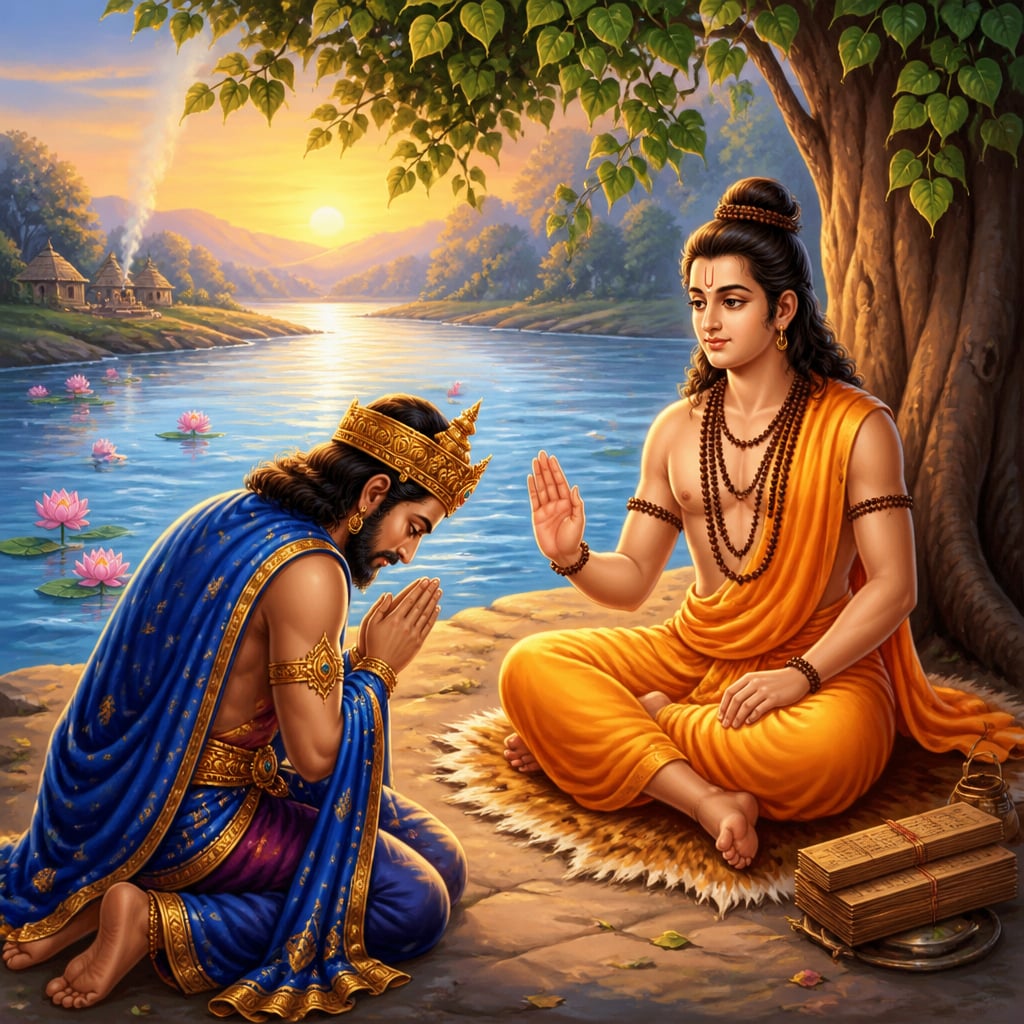
"O great sage, you have come at the perfect moment. I have only seven days to live. Tell me - what should a man do who is about to die? What should he hear, chant, remember, and worship? What should he avoid?"
Parikshit's question cuts to the heart of human existence. Every one of us is dying - some know the date, most do not. The king's situation simply makes explicit what is true for all: time is limited, and the question of how to use it is the most urgent question of life.
Shukadeva's Opening Counsel
Shukadeva Goswami was no ordinary sage. Born from Vyasa's mind rather than womb, he had emerged fully realized - a brahma-jnani from his first breath. He had wandered naked through forests, indifferent to the world, until the sweetness of Krishna's pastimes drew him back. Now this liberated soul, whose very presence purified the atmosphere, would speak for seven days.
Shukadeva began with a declaration that would frame the entire Bhagavatam:
"O King, the supreme duty of one about to die is to hear about, glorify, and remember the Supreme Lord. This alone liberates the soul from the cycle of birth and death."
But Shukadeva did not immediately launch into stories. First, he established the philosophical foundation. He would teach Parikshit about the nature of the cosmos, the universal form of the Lord, and the process of creation and dissolution - so that the stories of divine pastimes would be understood in their proper cosmic context.
The Three States of Consciousness
Shukadeva explained that the embodied soul experiences three states of consciousness:
| State | Sanskrit | Experience |
|---|---|---|
| Waking | Jagrat | Awareness of the physical world through senses |
| Dream | Svapna | Mind creates its own world from stored impressions |
| Deep Sleep | Sushupti | Neither external nor internal awareness; pure being |
In waking and dream states, the soul identifies with the body and mind. But in deep sleep, this identification temporarily ceases - offering a glimpse of the soul's true nature as pure consciousness.
"The wise understand that the Self is the witness of all three states," Shukadeva taught. "It is neither the waker, nor the dreamer, nor the sleeper - but the awareness in which all three appear and disappear."
This teaching was essential preparation. Parikshit needed to understand that the "I" about to die was not his true self. The body and mind would perish, but the witness consciousness - the atman - was eternal.
The Art of Dying
Shukadeva then taught the sacred art of leaving the body consciously - what later traditions would call yoga-mrityu or conscious death. The technique involved withdrawing the life force (prana) through the sushumna nadi (central energy channel) and exiting through the brahma-randhra (crown of the head).
But Shukadeva emphasized that such yogic techniques were secondary. The primary practice was simpler and more powerful:
"Fix your mind on the lotus feet of Lord Vishnu. Let every thought be of Him. Let His name be on your tongue. Let His form fill your vision. Then, whether death comes suddenly or gradually, you will be transported to His eternal abode."
This teaching democratized liberation. While advanced yogic techniques required years of practice, remembrance of the Lord was available to everyone - even a king with only seven days to live.
The Question of Time
Parikshit, ever the practical king, raised a concern:
"O sage, seven days is a short time. The Bhagavatam is vast - twelve cantos, eighteen thousand verses. How can I absorb it all before Takshaka's arrival?"
Shukadeva smiled. His answer contains one of the Bhagavatam's most encouraging teachings:
"O King, even a moment of hearing about the Lord is sufficient for liberation, if heard with pure heart and undivided attention. Many great souls attained perfection in a single moment of devotion. The demon Ajamila was saved by accidentally chanting the Lord's name. The elephant Gajendra was rescued by a single prayer. Time is not the measure - depth of devotion is."
This teaching liberates us from the anxiety of spiritual practice. We do not need decades in a cave. We need moments of genuine surrender. Quality, not quantity, is what matters.
The Framework for What Follows
Before diving into the narrative content of the Bhagavatam, Shukadeva established the philosophical framework that would make those narratives meaningful:
First, the nature of the Supreme - Brahman, Paramatma, and Bhagavan as three aspects of one reality.
Second, the nature of the soul - eternal, conscious, blissful, yet currently covered by material identifications.
Third, the nature of the material world - real but temporary, a school for the soul's evolution.
Fourth, the purpose of human life - to reawaken our eternal relationship with the Divine through bhakti.
With this framework established, Shukadeva would next teach Parikshit about the cosmic form of the Lord - the Virat Purusha - as the most accessible beginning point for meditation.

The Gathering of Sages
The scene at Sukartala was itself remarkable. Word had spread that Shukadeva would speak, and sages from every tradition, every ashram, every lineage had assembled. Devarishi Narada was present. So were Vyasa, Parashurama, and countless other luminaries.
They came not because Shukadeva would say something they did not already know. They came because hearing from a pure devotee has its own power. The same truth, spoken by a realized soul, carries a different potency than when read from a book or heard from a scholar.
"When a swan moves through water, the water is purified," the sages reflected. "When Shukadeva speaks, the very atmosphere becomes sanctified."
For seven days and seven nights, this assembly would sit without food or water, absorbed in the nectar flowing from Shukadeva's lips. They were demonstrating what the Bhagavatam teaches: nothing in this world compares to the bliss of hearing about the Lord.
What Death Teaches
The setting of Skanda Two offers a powerful teaching. Parikshit's curse became his liberation. Facing certain death, he was freed from all other concerns. He had no time for politics, wealth, pleasure-seeking, or distraction. He had only the essential question: How do I prepare my soul for what comes next?
In this, Parikshit represents us all. We may not have a specific date, but our death is equally certain. The question is whether we will use our time wisely or waste it on things that cannot accompany us beyond the threshold.

"The body is a guest house," Shukadeva taught. "We are travelers passing through. Wise travelers do not become attached to the inn; they prepare for the journey ahead."
This was the teaching that would unfold through Skanda Two: how to shift our identification from the temporary body to the eternal soul, from the material cosmos to the transcendent Lord who pervades it, from fear of death to freedom from death.
Living traditions
The hospice movement in India increasingly incorporates the Bhagavatam's teachings on conscious dying. Organizations like the Ramakrishna Mission and ISKCON provide spiritual support to the dying, ensuring they hear sacred sounds and have their minds directed toward the Divine in their final moments.
- Antima Samskara: The practice of chanting the Lord's names and reading sacred texts to a dying person, helping them fix their mind on the Divine at the moment of death
- Moksha Dwara Darshanam: The practice of taking the dying to sacred pilgrimage sites, particularly Varanasi, so that death occurs in a spiritually charged environment
- Sukartala (Shukadeva's Place): The traditional site where Shukadeva narrated the Bhagavatam to Parikshit. Though now in Pakistan, it remains an important site in Bhagavatam geography.
- Kashi (Varanasi): The city of liberation where many Hindus go to die consciously. Reflects the Bhagavatam's teaching on the importance of dying with divine remembrance.
- Manikarnika Ghat: The most sacred cremation ground in India, where death is welcomed as liberation. The continuous funeral pyres represent the Bhagavatam's teaching that death is a doorway, not an end.
Reflection
- If you knew you had only seven days to live, what would you want to hear about, think about, and remember? How does your answer compare to how you actually spend your time now?
- Shukadeva taught that the Self is the witness of waking, dream, and deep sleep. Have you ever noticed the difference between your thoughts and the awareness that observes your thoughts? What is it like to rest in that awareness?
- What would it mean for you to 'remember Narayana at the time of death'? Is this a literal practice, a metaphor, or both? How might you prepare for such remembrance?