Mahakaleshwar and Omkareshwar: Rescue of the Devotee
Shiva arrives in the worst moment
Two Jyotirlingas, two devotees at their worst hour. At Ujjain the king Chandrasena and a five-year-old boy named Shrikhar are about to be overwhelmed by the asura Dushana. At Omkareshwar the sage Mandhata performs a long tapas on the island of Om in the Narmada. Shiva rises for both.
A Boy With Three Stones In Ujjain
The city of Ujjain sits on the bank of the Shipra river in central India, in what is today the western Madhya Pradesh district of Ujjain. In the era the Shiva Purana describes, the city is the seat of King Chandrasena, a Shaiva householder ruler who has spent his reign making the city the most ardent worshipper of Shiva on the subcontinent. Every street has a Shivalinga at one end. Every household begins the day with abhisheka. The temple at the centre, built around an old swayambhu linga, is the busiest in the kingdom. The wealth of the realm has not made the king proud. It has made him quieter. He spends his evenings on the temple steps, after the last devotee has gone home, with his eyes closed.
On one such evening, at the far edge of the city, a five-year-old boy named Shrikhar is walking home from the cattle pen. He is the son of a cowherd. He has spent the day in the field. He is barefoot, his feet caked with dust, his hair sun-bleached at the ends. He is humming something to himself.
He stops at the temple gate. He has seen the king inside many evenings in a row. Today he wants to do what the king does. He looks around. The temple is closed for the evening. The priests have gone home. The boy walks down to the riverbank, picks up three small smooth stones, comes back, and arranges them in a small triangle at the foot of a tree just outside the temple wall. He places one larger stone in the middle. He calls the larger one Shivalinga.
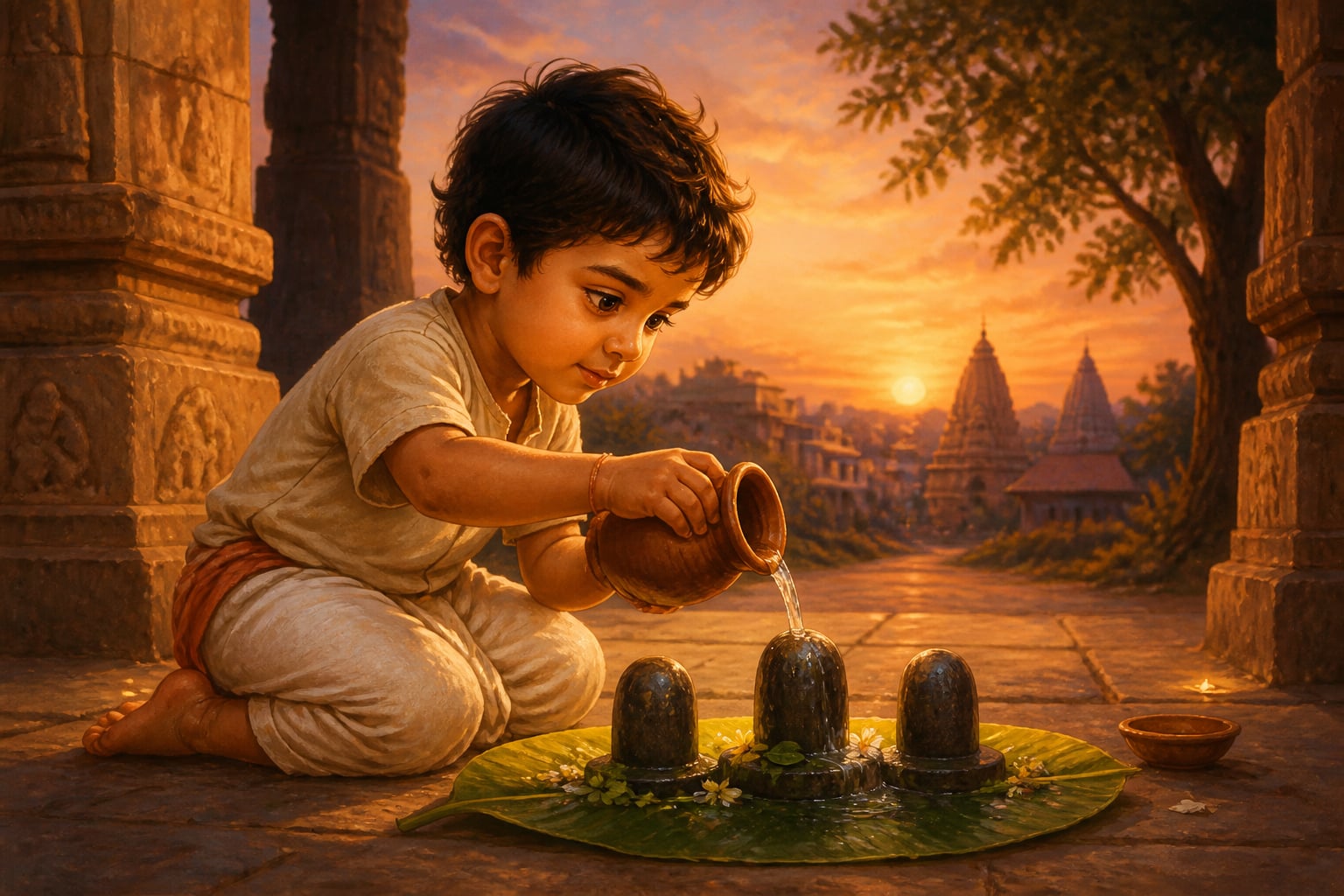
Then he begins. He has watched the king's abhisheka many times. He pours a small handful of river water on the stone. He places a yellow flower on top. He sings, in his small unsteady voice, the only line he knows. Om Namah Shivaya. He sings it again. He sings it for the rest of the evening. The sun goes down. The boy keeps singing.
The Asura At The Wall
Far to the south, on the same evening, an asura king named Dushana is standing at the edge of his army, looking at the lights of Ujjain in the distance. He has come a long way for this. Dushana has received a boon from Brahma that no Vedic weapon will work against him. With this boon, he has spent years destroying every city on the subcontinent that worships the Vedic gods. Ujjain, the most Shaiva city of the era, is the last and the largest on his list. He has come to do what he has done to the others. Burn the temples. Kill the priests. Force the surviving population to swear away their devotion or die.
The night closes. The asura army marches. By dawn, they are at the city walls. Chandrasena's small kingdom-army stands at the gate. They will not last an hour. The king himself, in his quiet way, walks back to the central temple and sits before the linga. He does not pray for victory. He has come to spend the last hour of the kingdom in the only company that has ever mattered to him. He closes his eyes.
The Shiva Purana takes its time on this scene because the lesson is in the timing. The king does not call for help loudly. The boy outside the city does not know there is an army at the gate. The asura's army is now climbing the wall. The cosmos, by all visible measures, has decided that Ujjain will fall.
And then, the Purana says, the ground at the foot of the central temple shudders. A column of light rises out of the swayambhu linga, taller than the temple, taller than the city walls, visible from the asura camp two miles away. The light has a sound to it that the Purana describes as the sound of the cosmos remembering itself. Out of the column steps Shiva, in his Mahakala form, the lord of time. His face is calm. His third eye is half open. He is holding the trishula in his right hand and the small drum in his left.

He walks once around the linga. He looks at the king, who has opened his eyes. He looks past the wall, at the asura army that has frozen on the ramparts. He raises his trishula. The Purana writes the next line in three words. And time stopped.
Dushana, halfway across the wall, his face fixed in mid-shout, is held in mid-air. His army is held in mid-step. Their weapons are held in mid-strike. The boon from Brahma was that no Vedic weapon would harm him. Mahakala, the lord of time itself, is not a weapon. He is the field in which all weapons happen. The boon does not apply.
Shiva, with one breath, reduces the asura army to ash. The Shiva Purana lingers on this beat. The ash falls back onto the ramparts in a slow grey rain. The king stands. He walks to the gate. He looks at what is left of Dushana. There is nothing. The light from the linga has not yet faded.
The Boy Returns
In the same instant, at the edge of the city, the boy Shrikhar is still pouring water on his three stones. He has not heard the asura. He has not seen the column of light. He has been singing Om Namah Shivaya for what is now twelve hours straight, and he has not slept. The water in his small bowl is finished. He looks up.
Shiva is standing in front of him.
The boy does not run. He does not bow. He does not understand who he is looking at. He smiles, the way a five-year-old smiles when an unexpected guest arrives. Shiva sits down on the ground in front of him, cross-legged, the way a grandfather sits down to play with a grandchild. Shiva picks up the larger stone, the one the boy had named the Shivalinga, and holds it in his palm. He looks at the boy. He says, in the Purana's wording, I have always been there.
When the king arrives at the spot a few hours later, having heard the news, he finds Shrikhar asleep with his head on the lap of the lord. The lord is still there. The Purana says he never left. From that day, the temple at Ujjain has not been just a temple. It has been the seat of Mahakala, the lord of time, the one who arrived in the worst hour of the kingdom and in the most ordinary hour of a five-year-old boy on the same morning. The Jyotirlinga that emerged from the swayambhu stone is named Mahakaleshwar, and the unique south-facing linga in the central sanctum is the only Jyotirlinga in India that faces south, the direction of Yama, the lord of death. Mahakala is the lord who faces death every morning, so the city behind him does not have to.
The Vindhya That Asked For Help
A few hundred miles south of Ujjain, where the Narmada river bends in a great horseshoe around a small island shaped like the syllable Om, a different story has been unfolding for years.
The Vindhya mountain range, which runs east-west across central India, has long been in a quiet rivalry with the Meru mountain to the north, the cosmic axis of the world. The rivalry began, in Puranic terms, when Vindhya saw the sun, the moon, and the stars all circumambulating Meru as if Meru were the centre of the cosmos. Vindhya, the southern mountain, felt the cut of being passed over. He began to grow. The Purana describes the growth in concrete physical terms. The mountain rose, week by week, until its peaks began to block the sun's path across the southern sky. Day was shortening in central India. Crops were failing. The sage Agastya, the master of the south, had to walk down from the north and persuade the mountain to bow until Agastya returned, which Agastya never did, and the mountain's growth was checked forever.
But the inner wound of Vindhya did not heal. The mountain had bowed. The mountain had been put in his place. The mountain still felt small. He went to the bank of the Narmada river, on the small Om-shaped island, and began tapas.
His tapas was for one thing. Let me not be defined by my rivalry. Let me be the seat of something larger than the comparison that wounded me.
For years, the Vindhya stood in tapas on the riverbank.
In the same era, on the same island, a king of the Ikshvaku line named Mandhata, having renounced his throne and walked away from the kingdom, was performing his own tapas. The Purana places his tapas at the eastern end of the island, where the rocks rise straight out of the river. Mandhata's prayer was different. Let the lord of all rivers take a permanent seat here. Let the Narmada know whose island this is. Let me serve at his feet for the rest of my life.
Two tapas. Same place. Same era. Two beings asking, in different language, for the same arrival.
The Lord Splits Into Two
The Shiva Purana describes Shiva's response with the precision of a mathematician. He arrived. He did not pick one tapasvi over the other. He did not arrive at one end of the island and ignore the other. The lord arrived at the centre of the island, paused once, and then split his form into two.

One form took its seat at the western end, on the stone where Vindhya had been standing. The form was named Omkareshwar, the lord of the syllable Om, because the very island on which the linga stood was shaped like the syllable. The Purana adds a quiet touch. The Vindhya mountain, finding the lord seated on him, finally felt himself the seat of something larger than his own rivalry. The wound from Meru did not need to be discussed. It simply went away.
The other form took its seat at the eastern end, on the stone where Mandhata had been standing. This form was named Amaleshwar (sometimes called Mamaleshwar), and the king Mandhata, finding the lord seated at his feet for the rest of his days, was given exactly the office he had asked for. Generations of Mandhata's descendants would be born on the island, and the line of their succession would run as the priestly custodians of Amaleshwar for many centuries.
From the day of the splitting, the island is known as Mandhata Island, and the Jyotirlinga at its western end, Omkareshwar, is one of the twelve. The two halves of the island are connected by a small bridge that pilgrims still cross to perform darshan at both shrines on the same day. The temple at Omkareshwar has been continuously worshipped since at least the eleventh century, and the Narmada Parikrama, the three thousand kilometre walk around the entire river that thousands of sadhus and pilgrims still complete each year, includes the night at Omkareshwar as one of its sacred halts.
What The Two Stories Share
The Shiva Purana places these two Jyotirlingas next to each other for a reason. They are two forms of the same teaching about the timing and manner of Shiva's arrival.
| Mahakaleshwar | Omkareshwar |
|---|---|
| Arrives in the worst moment, when the kingdom is about to fall | Arrives when two long tapas converge |
| The crisis is sudden, military, public | The crisis is slow, internal, private |
| The devotee is a king and a five-year-old boy at once | The devotees are a wounded mountain and a renunciate king |
| Shiva acts as Mahakala, the lord of time | Shiva acts as Omkara, the syllable that contains all sound |
| The arrival ends a death | The arrival ends a comparison |
In both, Shiva arrives at the moment the devotee can no longer hold the situation alone. In both, his arrival creates a permanent seat. The lord's clock is not the devotee's clock. He arrives in time. The devotee often experiences this as arriving late. Late is the devotee's word. In time is the lord's. The teaching of the Jyotirlinga is to keep calling, past the hour the calling seemed to stop being heard, because the seat is being prepared. The arrival is what builds the temple.
Modern Echoes
The psychiatrist Viktor Frankl, in his 1946 book Man's Search for Meaning, described moments inside Auschwitz when prisoners who had given up died within forty-eight hours, while those who continued to call on something larger, however quietly, often survived to be liberated. Frankl named this the will to meaning. The Shaiva tradition would call it the work the boy Shrikhar did at the foot of the temple wall, singing the only line he knew while an army climbed the gate. The arrival is not earned. It is also not random. It is the answer to a calling that has refused to stop.
In the world of work, the management researcher Jim Collins, in his 2009 book How the Mighty Fall, identified five stages of organisational decline and noted that companies most often turn around in stage four, when the visible options have run out and the leadership has gone quiet enough to hear what was always there underneath the noise of optionality. The lord of time, in story terms, is the one who shows up when the executive's clock has run out and the longer clock of the institution finally becomes audible.
Back On The Steps At Ujjain
Chandrasena went back to his evenings on the temple steps. Shrikhar grew up to serve as one of the priests of the new Mahakaleshwar shrine, and his line served there for many generations. Vindhya stayed bowed, no longer caring whether anyone noticed, because the lord had taken his seat. Both temples are open this morning. The first Bhasma Aarti at Mahakaleshwar happens at four. The first abhisheka at Omkareshwar happens at five. Devotees have been pouring water on both linga every morning since the gates first opened.
This week, you will hit a moment in your own life when the visible options have run out. A diagnosis, a deal that fell through, a conversation that did not go where it should have, a long worry that has not lifted. The Shiva Purana would have you notice the moment. You do not have to find the right strategy. You only have to keep singing the line you know, the way Shrikhar sang at the foot of the temple wall. The lord of time is preparing his seat. The Jyotirlinga is already there. The arrival is what builds the temple, and the temple is what your life becomes after the arrival.
Living traditions
Both Mahakaleshwar and Omkareshwar have undergone substantial modern restoration in the last two decades. The Mahakaleshwar Lok corridor at Ujjain, inaugurated in October 2022 by Prime Minister Narendra Modi, has restored the pedestrian connections between the temple, the Rudra Sagar lake, and the surrounding old city, with extensive sculpture programmes depicting episodes from the Shiva Purana. The 108-foot Statue of Oneness at Omkareshwar, dedicated to Adi Shankaracharya at the age he is said to have visited the site, was inaugurated in September 2023 and has become one of the most visited monumental statues in central India. The annual Bhasma Aarti at Mahakaleshwar is now livestreamed by Doordarshan and several private devotional channels, drawing tens of millions of online viewers daily. The 2028 Simhastha Kumbh Mela at Ujjain is expected to be one of the largest religious gatherings in the country's history. The Narmada Parikrama, the three thousand kilometre walk that includes Omkareshwar as a major halt, continues to draw thousands of completed circuits each year, with growing numbers of urban professionals taking sabbaticals to walk the full route. The two Jyotirlingas of central India, born in story from Shiva's arrival in his devotees' worst hour, are today among the most living Shaiva pilgrimage centres on the subcontinent.
- Bhasma Aarti At Mahakaleshwar: Daily at four a.m., the Mahakaleshwar Jyotirlinga at Ujjain is bathed in fresh consecrated ash and the Bhasma Aarti is performed. The ritual lasts roughly two hours. Devotees who have booked the front darshan view the abhisheka, the application of bhasma to the linga, the dressing of the linga in fresh garments and rudraksha, and the closing aarti with a multi-tiered brass lamp. The Mahamrityunjaya mantra, the Lingashtakam, and the Shiva Mahimna Stotra are recited at specific points in the sequence. The aarti is the most distinctive daily ritual at any of the twelve Jyotirlingas and draws devotees who have travelled from across India and the diaspora.
- Omkareshwar Parikrama Of Mandhata Island: Pilgrims who reach Omkareshwar perform a roughly six-kilometre parikrama (circumambulation) of the entire Mandhata island, walking clockwise from the Omkareshwar shrine at the western end, along the northern bank of the island, to the eastern tip where Mandhata's tapas was performed, and back along the southern bank to complete the circuit. The parikrama traces the full outline of the Om-shaped island and includes darshan at several smaller shrines along the way, including the Gauri Somnath temple and the Annapurna shrine. The full circuit takes between two and four hours on foot.
- Daily Rudrabhisheka At Jyotirlinga Shrines: All twelve Jyotirlinga temples conduct elaborate daily Rudrabhisheka rituals at fixed hours. The standard form involves the recitation of the Sri Rudram and the Chamakam from the Yajur Veda while the linga is bathed sequentially in eleven (Ekadasha Rudri) or one hundred and eight (Mahanyasa Rudri) liquids and substances: water, milk, curd, ghee, honey, sugarcane juice, coconut water, panchamrita, sandal paste, vibhuti, and bilva leaves. At Mahakaleshwar and Omkareshwar specifically, devotees can book private abhishekas in addition to the daily public ones, with the priest performing the ritual on the devotee's behalf and naming the family lineage during the sankalpa.
- Mahakaleshwar Temple, Ujjain: One of the twelve Jyotirlingas and the only one with the linga facing south (dakshinamukhi), the direction of Yama, the lord of death. The current temple complex was rebuilt by the Maratha general Ranoji Shinde of the Scindia line in 1734, with substantial additions and renovations under the Madhya Pradesh government in the late twentieth century. The Mahakaleshwar Lok corridor, inaugurated in 2022, has restored the pedestrian connections between the temple, the Rudra Sagar lake, and the surrounding old city. The Bhasma Aarti at four a.m. is the temple's signature daily ritual.
- Omkareshwar Jyotirlinga, Mandhata Island: One of the twelve Jyotirlingas, situated on a roughly four-kilometre island in the Narmada river that traces the shape of the Sanskrit syllable Om when seen from above. The island is connected to the southern riverbank by two pedestrian bridges, including the older Jhula Pul (suspension bridge). The Omkareshwar Jyotirlinga is at the western end. The Amaleshwar shrine on the southern bank is regarded by some traditions as the second half of the same Jyotirlinga and is part of the standard pilgrim circuit. The parikrama of the island is roughly six kilometres on foot.
Reflection
- Where in your life are you currently waiting for an arrival that, by every visible measure, was supposed to have happened by now?
- Why does the Shiva Purana put a king and a five-year-old boy in the same morning of the Mahakaleshwar arrival?
- If the lord's arrival is in time but feels late to the devotee, what does that ask of the way you measure time in the work you most care about?