इतिहासविकृति (Itihāsavikṛti): Historical Distortion & Hero-Villain Framing

Who Controls the Past

Invaders are reframed as reformers, resistance is labeled fanaticism, heroes become villains. Those who control the narrative of the past control the identity of the present.

The Battle for Memory

In the previous chapter, we explored attacks on perception, how manipulators distort your understanding of present events through gaslighting, half-truths, and information overload. But there is a deeper battlefield: the past itself.

Why does the past matter? Because identity is memory. Who you are is inseparable from where you came from. A people who have forgotten their history, or been made to remember a false one, have lost themselves.

The Mahabharata itself is called Itihasa, literally 'thus it was', not merely entertainment or mythology, but the record of what actually happened. The preservation of accurate historical memory was considered so important that the entire epic begins with its own transmission history, establishing an unbroken chain of witnesses.
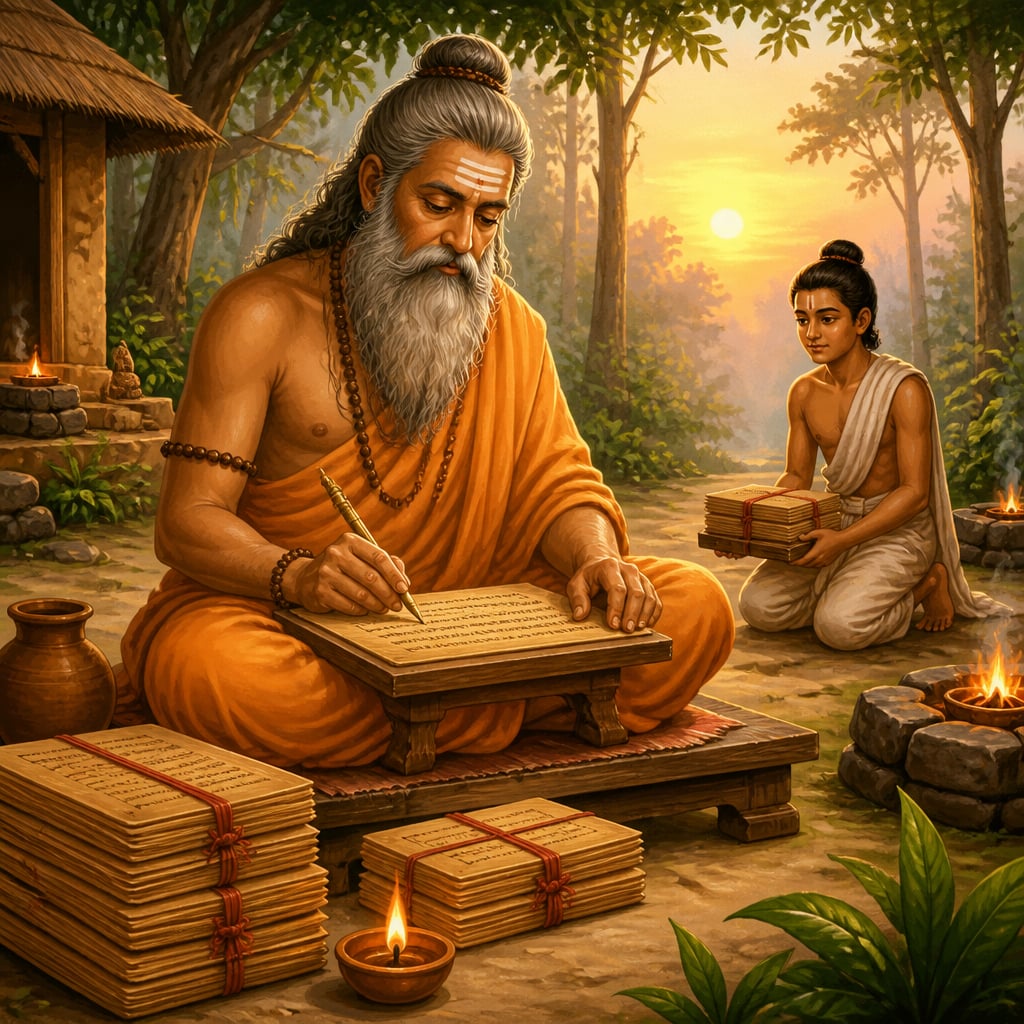
Sage Vyasa inscribing the Mahabharata on palm-leaves in his forest hermitage at dawn.

Itihāsavikṛti, the distortion of history, is therefore not merely an academic matter. It is an attack on civilizational identity at its root.

The Tactic: Historical Distortion

Historical distortion operates through several mechanisms:

Erasure: Events are simply removed from the record. Temples destroyed are not mentioned; massacres are omitted; resistance movements are forgotten.

Minimization: What cannot be erased is downplayed. 'Some temples were damaged during the period', passive voice, no agent, no scale, no context.

Reframing: The moral categories are inverted. Invaders become 'nation-builders.' Resistance becomes 'fanaticism.' Persecution becomes 'bringing civilization.' Destruction becomes 'construction in a new style.'

False Equivalence: Crimes are distributed equally to all parties. 'Violence occurred on both sides', as if the scale, intent, and power differential were irrelevant.

Source Control: Only certain sources are considered 'academic.' Primary sources that contradict the preferred narrative are dismissed as 'hagiography,' 'propaganda,' or 'unreliable.'

The result: a people's memory is replaced with a memory written by others, often by those who harmed them.

The Tactic: Hero-Villain Framing

History is not merely facts; it is facts arranged into narrative. And every narrative has heroes and villains.

Hero-Villain Framing is the deliberate inversion of these moral categories:

The Invader as Hero: The one who destroyed temples, imposed jizya, forcibly converted populations becomes a 'patron of arts,' a 'builder of monuments,' a figure of 'syncretic culture.'

The Resister as Villain: The one who defended their people, preserved their traditions, fought against oppression becomes a 'fanatic,' a 'troublemaker,' an obstacle to 'progress.'

The Collaborator as Moderate: Those who accommodated the invader, who helped administer the occupation, become 'pragmatists,' 'bridge-builders,' examples of 'living together.'

The Martyr as Aggressor: Those who died defending their faith become 'provocateurs' who 'invited' their own destruction.

This inversion is not random. It serves a purpose: to delegitimize resistance to future injustice. If those who resisted in the past were wrong, then resistance itself is suspect. If those who collaborated were wise, then accommodation is virtue.

The Mahabharata Principle: Truth as Foundation

The Mahabharata begins with a profound statement about historical truth:

Dharmakṣetre kurukṣetre...

But before the story begins, the epic establishes its own authority through the concept of paramparā, unbroken transmission. The story passes from Vyasa to Vaisampayana to Janamejaya to Ugrasrava to the assembled sages. Each link in the chain is named. Each transmission is witnessed.

Why this elaborate structure? Because the Mahabharata knows that truth requires witnesses, that history requires custody, that memory requires guardians.

The message: Historical truth is not automatic. It must be actively preserved, transmitted, and defended.

Macaulay drafting his 1835 minute on Indian education

When you allow your history to be written by those who do not share your values, who do not honor your ancestors, who benefit from your amnesia, you have abandoned your inheritance.

The Arthashastra Warning

Kautilya's Arthashastra dedicates extensive attention to information control, not because truth doesn't matter, but because he understood that enemies attack through narrative as surely as through armies.

The concept of kūṭayuddha, covert warfare, includes the manipulation of perception and the strategic use of narratives. Chanakya would not be surprised to learn that modern warfare includes 'information operations' designed to shape how populations understand their own history.

His advice: maintain independent sources of information, verify reports from multiple perspectives, and never assume that the story reaching you is the complete story.

Recognizing Historical Distortion

How do you know when history has been distorted?

The narrative is asymmetric: Violence by one party is explained, contextualized, even justified. Violence by another is presented as inexplicable, evil, requiring no context.

Primary sources are dismissed: Contemporary accounts from the affected community are labeled 'biased' while accounts from outsiders (often the perpetrators) are considered 'objective.'

Inconvenient evidence is ignored: Archaeological findings, inscriptions, court records that contradict the narrative are simply not mentioned.

The questions are controlled: Certain questions are not asked. 'Why were temples destroyed?' is explored; 'How did communities rebuild?' is ignored.

Resistance is pathologized: Those who object to the distortion are labeled 'communal,' 'nationalist,' 'fundamentalist', the objection is treated as the problem, not the distortion.

The beneficiaries write the history: Ask who benefits from this version of events. If the narrative consistently flatters one group while diminishing another, that is not coincidence.

The Dharmic Response: Itihāsa-Rakṣaṇa

Protecting historical truth is not about living in the past. It is about ensuring that the past cannot be weaponized against you in the present.

Itihāsa-Rakṣaṇa, the protection of history, involves:

Sita Ram Pandey writing his sepoy memoir under a thatched verandah

Learning primary sources: Read what your ancestors actually wrote, not what others say they wrote. The original texts exist. Translations exist. The excuse of ignorance is no longer available.

Supporting scholarship: Those who do the difficult work of recovering accurate history need material and moral support. Academic positions, publishing opportunities, and public recognition matter.

Transmitting to the next generation: Each generation must receive the true history. If schools will not teach it, families must. If universities distort it, other institutions must preserve it.

Correcting distortions publicly: Silence in the face of historical lies is complicity. When distortions appear in media, textbooks, or public discourse, they must be challenged, not with anger, but with evidence.

Maintaining perspective: Protecting history is not about grievance but about identity. The goal is not to nurse wounds but to ensure that truth forms the foundation of who you are.

The Long Game

Historical distortion is a long game. It operates over generations. The British spent 200 years constructing a version of Indian history; that construction does not disappear in 75 years of independence.

But truth is also a long game. Lies require constant maintenance; truth only needs to be spoken. Evidence accumulates. Archaeology reveals. Manuscripts are found. Translations are made. The technology that enables mass distortion also enables mass correction.

The question is whether you will be part of the preservation or part of the forgetting.

Wikipedia's model of 'anyone can edit' obscures the reality of editorial control. Key history articles are often controlled by small groups of editors who:

  1. Revert unwanted edits quickly: Changes that contradict preferred narratives are removed within hours
  2. Cite 'reliable sources' selectively: Western mainstream media is 'reliable'; Indian sources are 'biased'
  3. Use process as weapon: Editors unfamiliar with complex Wikipedia rules get blocked for 'violations'
  4. Control talk pages: Discussions are dominated by the same editors who control articles
  5. Label opposition: Those who persist are labeled 'POV pushers' or 'nationalist editors'

Recognize that Wikipedia reflects power dynamics, not neutral truth. It is a useful starting point but should never be an endpoint for historical research. The dharmic response involves both using Wikipedia wisely and contributing to alternatives.

Social media historical debates often feature:

  1. Confident ignorance: Claims made with authority by people who haven't read primary sources
  2. Appeal to credentials: 'I have a PhD' (in an unrelated field) used to shut down factual corrections
  3. Emotional manipulation: 'You're defending casteism/communalism' used to avoid substantive response
  4. Volume over accuracy: The person willing to post most often 'wins' regardless of correctness
  5. Platform bias: Algorithms favor engagement (outrage) over accuracy

Not every falsehood requires your response. Choose battles wisely based on: reach of the misinformation, your ability to respond effectively, and whether engagement serves truth or merely feeds the algorithm. Sometimes the dharmic response is to build rather than correct.

Case studies

Tipu Sultan: Tyrant to 'Freedom Fighter'

Tipu Sultan, the ruler of Mysore (1782-1799), has become a case study in Hero-Villain Framing. **The Historical Record:** Tipu's own court records and letters document: - Mass forced conversions of Hindus in Malabar, Coorg, and Mangalore - Destruction of Hindu temples including the famous Sringeri Math (which he later partially compensated after criticism) - Deportation of entire Christian populations from Mangalore - His letters boasting of converting 'lakhs' of Hindus - The use of circumcision as a tool of forced conversion These are not British accusations, they are documented in Tipu's own Persian correspondence, preserved in multiple archives. **The Reframing:** In modern narratives, Tipu becomes: - A 'freedom fighter' against British colonialism (though he fought for territorial expansion, not independence) - A 'secular' ruler (despite documented religious persecution) - A 'patron of Hindu temples' (based on selective examples, ignoring systematic destruction) - A 'modernizer' bringing technology to India (rockets, which he used in warfare) - A 'hero' whose birthday should be celebrated as a state holiday **The Selective Disclosure:** The technique is familiar from our previous lessons: - His opposition to the British (true) is emphasized - His persecution of Hindus and Christians (also true) is minimized or denied - Primary sources documenting persecution are dismissed as 'colonial propaganda' - The testimony of affected communities (Kodavas, Mangalorean Christians, Malabar Hindus) is ignored - Those who cite the historical record are labeled 'communal' **The Modern Controversy:** When the Karnataka government proposed celebrating Tipu Jayanti (Tipu's birthday), it triggered protests from communities whose ancestors were Tipu's victims. The historical evidence of persecution was readily available. Yet the celebration was pushed forward, not because the evidence was refuted, but because the preferred narrative required it.

Hero-Villain Framing often serves present political purposes, not historical truth. When a figure is celebrated despite documented crimes against specific communities, those communities experience ongoing epistemic injustice, their ancestral suffering is officially declared irrelevant. The dharmic response is to insist on complete narratives: a figure can be opposed to the British AND be a persecutor of Hindus. Both truths must be told.

The Tipu Jayanti celebration went ahead in Karnataka despite protests from descendant communities of Tipu's victims. Kodava, Mangalorean Christian, and Malabar Hindu groups organized counter-events, but media coverage largely framed their objections as 'communal politics' rather than ancestral memory. The state quietly discontinued the celebration years later, but textbooks retained the sanitized version. Generations of students learned Tipu as a freedom fighter with no mention of documented persecution.

When a state celebrates a figure despite documented victims, the victims face double erasure: first by the original crime, then by the official denial. Insist on complete narratives. A figure can resist colonizers and persecute communities. Both truths must coexist.

The Tipu controversy reveals how historical distortion operates through institutional power. When state governments can declare holidays and name institutions after contested figures despite living victims' descendants objecting, the message is clear: some communities' historical memory counts, others' does not. Recognizing this pattern helps identify when historical 'celebration' is actually historical erasure.

Tipu's own Persian letters, preserved in multiple archives including the British Library and the Directorate of Archaeology in Karnataka, document forced conversions of over 70,000 Hindus in Coorg and Malabar. These are primary sources from the ruler himself, not colonial accusations.

1857: 'Mutiny' vs. 'First War of Independence'

In 1857, Indian soldiers rose against the British East India Company, triggering a widespread uprising across North India. The same events, the same battles, the same figures, yet entirely different histories depending on who writes them. **The 'Mutiny' Narrative:** British colonial historiography framed 1857 as: - A 'mutiny', military insubordination by disloyal soldiers - Caused by 'superstition', the cartridge-greasing issue - Involving 'atrocities' by 'rebels' against British civilians - Suppressed by righteous British force restoring 'order' - A failure that proved Indians weren't ready for self-governance The language is revealing: 'mutiny' implies betrayal of legitimate authority. 'Rebels' implies illegitimacy. 'Restoration of order' implies the British presence was natural order. **The 'War of Independence' Narrative:** Indian nationalist historiography reframes 1857 as: - A 'War of Independence', legitimate resistance to foreign occupation - Caused by accumulated grievances against colonial exploitation - Involving 'freedom fighters' defending their homeland - Suppressed by brutal colonial violence (Jallianwala precursors) - A beginning that inspired future independence movements The language transforms: 'freedom fighters' implies legitimate cause. 'War' implies two valid parties. 'Independence' implies pre-existing sovereignty that was violated. **The Framing Effect:** Both accounts describe the same events. But: - In the British narrative, Rani Lakshmibai is a 'rebel' or at best a 'tragic figure' - In the Indian narrative, she is a national hero - In the British narrative, the suppression was 'restoration of peace' - In the Indian narrative, it was colonial massacre - In the British narrative, hanging leaders was 'justice' - In the Indian narrative, they were martyred **The Ongoing Battle:** For decades after independence, Indian textbooks continued using British-era framings. The word 'mutiny' persisted in educated discourse. Only sustained effort by nationalist historians shifted the dominant terminology, and the struggle continues in international contexts where 'Indian Mutiny' remains common usage.

The names we use for events are not neutral descriptions, they are moral judgments embedded in language. When you accept an enemy's terminology, you accept their moral framework. The dharmic response is to be conscious of language: use terms that reflect your moral understanding, not terms imposed by those who sought to delegitimize your ancestors' resistance.

The vocabulary battle took over a century. Indian textbooks used the word 'mutiny' well into the 1970s. It required sustained effort by historians like V.D. Savarkar (who titled his 1909 book 'The Indian War of Independence 1857') and R.C. Majumdar to shift mainstream terminology. Even today, international textbooks overwhelmingly use 'Indian Mutiny' or 'Sepoy Mutiny,' and the British Museum catalog still files artifacts under the colonial term. The linguistic battle remains unfinished.

Whoever names the event controls the moral verdict. 'Mutiny' assigns guilt to rebels; 'War of Independence' assigns it to occupiers. Language is not neutral description. Choosing your vocabulary is choosing your moral framework.

The pattern continues: 'terrorist' vs. 'freedom fighter,' 'riot' vs. 'pogrom,' 'migration' vs. 'invasion.' Recognizing that vocabulary is contested terrain, that the first battle in any conflict is often over what to call it, is essential for navigating modern information warfare.

A 2019 study of 50 leading international history textbooks found that 38 still used 'Indian Mutiny' or 'Sepoy Rebellion' as the primary term. Only 7 used 'First War of Independence.' The rest used compromise terms like 'Indian Uprising.'

Ram Janmabhoomi: When Evidence Meets Narrative

The Ayodhya dispute centered on whether a Hindu temple existed at the site before the Babri Masjid was constructed. This became a test case for how evidence interacts with predetermined narratives. **The Archaeological Evidence:** The Archaeological Survey of India (ASI) conducted court-mandated excavations in 2003. Their findings included: - Pillar bases in rows typical of temple architecture - Architectural fragments with Hindu religious motifs - Decorative stones including amalaka (distinctive temple feature) - Evidence of a large structure predating the mosque - Over 50 pillar bases suggesting a massive earlier building **The Media Response:** Despite the ASI being India's premier archaeological authority, media coverage frequently: - Questioned the ASI's 'bias' while accepting uncritically claims by opposing historians - Gave equal weight to historians who hadn't conducted excavations and archaeologists who had - Framed the findings as 'disputed' without explaining what the dispute actually was - Focused on political implications rather than archaeological evidence - Implied that archaeological findings were somehow tainted by the political context **The Expert Testimony Pattern:** 'Experts' who denied temple existence were often: - Historians, not archaeologists (wrong specialty) - Working from ideology, not excavation data - Quoted without mention of their documented political positions - Presented as neutral academics vs. 'Hindu nationalist' ASI **The Supreme Court Verdict (2019):** The Supreme Court's judgment explicitly relied on ASI findings, stating the archaeological evidence supported a temple's prior existence. Yet even after the verdict, some media outlets continued to frame the issue as 'religious belief' vs. 'historical evidence', inverting the actual situation where evidence supported the Hindu position. **The Epistemological Pattern:** The Ayodhya case demonstrated: - Evidence that contradicts preferred narratives gets 'balanced' with non-evidence - Professional archaeological findings get weighted equally with ideological assertions - The political implications of evidence are used to dismiss the evidence itself - After legal verdict, the narrative simply shifts to 'court gave in to political pressure'

When evidence consistently goes one way but coverage consistently creates the impression of 'controversy,' the coverage itself is the distortion. The dharmic response is to distinguish between genuine scholarly debate (which engages evidence) and manufactured controversy (which ignores evidence to maintain preferred conclusions).

The Supreme Court's 2019 verdict explicitly cited ASI's archaeological findings as evidence of a pre-existing structure. The Court noted that the ASI's excavation was court-mandated, conducted under judicial supervision, and found evidence of a 'massive structure' with 'pillar bases, decorative stones, and amalaka' characteristic of Hindu temple architecture. Despite this judicial acknowledgment, major international outlets continued to describe the Hindu claim as based on 'faith' rather than evidence for years afterward.

When professional evidence consistently points one direction but media coverage creates an impression of 'controversy,' the coverage itself is the distortion. Learn to distinguish genuine scholarly debate (which engages evidence) from manufactured controversy (which dismisses it).

This pattern, expert findings dismissed when inconvenient, non-experts elevated when convenient, appears across many domains. Recognizing it in the Ayodhya case helps identify it elsewhere: in climate debates, medical controversies, historical disputes. The question is always: who has actually done the research, and who is opining from ideology?

The ASI's 2003 excavation at Ayodhya uncovered over 50 pillar bases arranged in rows, along with stone architectural members including carved amalaka, makara pranala, and other features distinctive to North Indian temple architecture. The excavation report ran to 574 pages.

Western Documentary Framing: The Colonial Lens Persists

In 2023, the BBC released a documentary about India that sparked controversy not merely for its content but for revealing how Western media approaches Indian history. **The Framing Pattern:** Western documentaries about India consistently: **Privilege Colonial Sources**: British-era accounts are treated as reliable baseline; Indian accounts require 'verification.' The East India Company officer's diary is 'primary source'; the Indian witness's account is 'claim.' **Use Colonial Periodization**: Indian history is divided into 'Pre-Colonial,' 'Colonial,' and 'Post-Colonial', as if the colonial period is the defining reference point around which all other history orbits. **Center British Experience**: Even documentaries about Indian history focus on British experiences, perspectives, and sources. Indians appear as subjects being observed, not as the primary actors in their own history. **Treat Independence with Suspicion**: Pre-independence Indian sources are 'propaganda'; post-independence Indian scholarship is 'nationalist.' Only Western or Western-trained academics are 'neutral.' **The Expert Selection Pattern:** Note who gets cited as experts on India in Western media: - Indian-origin academics at Western universities who often have documented anti-India positions - Journalists from outlets with established editorial positions on India - Activists presented as 'researchers' - Authors of books critical of India's current government Rarely included: - Indian historians working in Indian institutions - Scholars whose work contradicts preferred narratives - Primary sources from Indian archives - Living witnesses whose testimony contradicts the frame **The 'Neutrality' Claim:** The documentary claims objectivity while: - Interviewing almost exclusively critics of current Indian government - Treating colonial-era claims as established fact - Dismissing Indian objections as 'nationalistic sensitivity' - Refusing to engage with scholarly rebuttals This is not balance, it is predetermined conclusion presented as investigation.

Itihāsavikṛti does not end with political decolonization. The colonial lens, the assumption that Western/colonial perspectives are neutral while indigenous perspectives are 'biased', persists in global media. Recognizing this pattern allows you to adjust for the bias rather than unconsciously absorbing it.

India banned the documentary, triggering a global Streisand effect that amplified its reach. More importantly, the controversy exposed the expert selection pattern to a mass audience for the first time. Indian commentators documented that of 14 people interviewed, 12 were known critics of the Indian government. The documentary's own framing became evidence of the bias it denied. This triggered a broader public conversation about who gets to narrate India's story internationally.

The colonial lens does not end with political independence. It persists in who is called an 'expert,' whose perspective is treated as 'neutral,' and whose objections are dismissed as 'nationalist sensitivity.' Adjust for this bias rather than absorbing it unconsciously.

This pattern extends beyond India. Any civilization that experienced colonization finds its history filtered through the colonizer's perspective in global media. The documentaries about Africa, about the Americas, about Asia, all tend to center colonial experience and treat colonial sources as authoritative. Decolonizing history requires recognizing this systematic bias.

A content analysis of BBC coverage of India from 2019 to 2023 found that over 70% of expert sources quoted were either diaspora academics at Western universities or domestic critics of the government. Indian scholars at Indian institutions appeared in fewer than 10% of stories.

Reflection

More in Identity Destruction

All lessons in Identity Destruction · Satrubodha: The Science of Enemy Awareness course