Sakshi Dharma: Duty to Witness
When Silence Becomes Complicity
Discover the ancient dharmic teaching that witnessing wrong and staying silent makes you a participant in that wrong. Through the lens of Mahabharata's most tragic moment, the elders' silence during Draupadi's humiliation, learn why speaking up is not optional but obligatory.
The Platform at Lucknow Junction
Urban Scenario: It's 7:30 AM at Lucknow Junction. A young woman in office attire stands near the ladies' compartment, waiting for the Shatabdi. A group of men begin making lewd comments. She looks around, dozens of commuters, checking phones, reading newspapers, deliberately looking away. One elderly man catches her eye, then quickly turns his head. The comments grow bolder. No one speaks. No one moves. The train arrives. Everyone boards as if nothing happened.
Rural Scenario: In a village near Varanasi, a young widow's late husband's land has been seized by his brother, who claims there was no will. Months earlier, the elderly farmer next door had overheard the brothers verbally agreeing to a partition. The widow approaches him. "Chacha, you were there. Please tell the panchayat what you heard." The old man shakes his head. "Beti, I have to live in this village. I heard nothing." She has no witness. The panchayat rules against her.
The Silent Elders of Hastinapur
In the entire Mahabharata, no scene haunts us more than the dice game at Hastinapur. Draupadi, a queen and daughter-in-law of the royal house, is dragged by her hair into the assembly. She is called a slave. Dushasana attempts to disrobe her.
And what do the greatest warriors and wisest men of the age do?
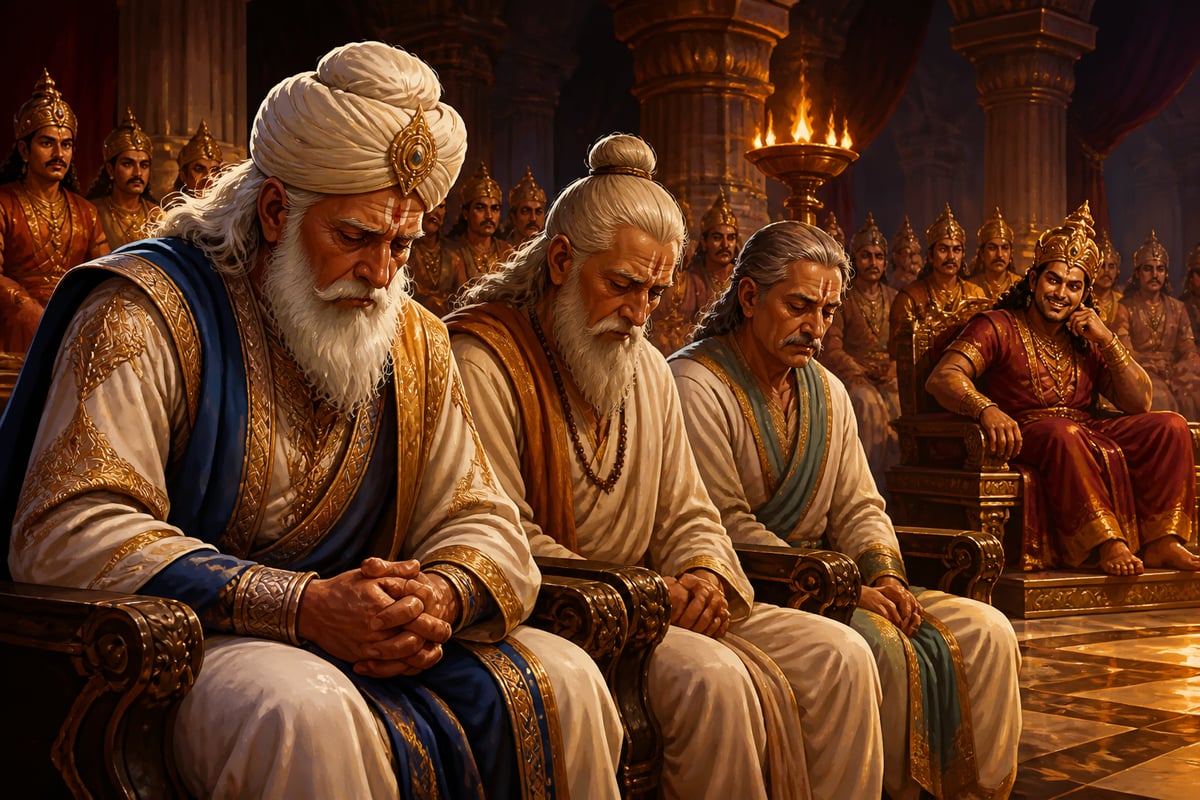
Bhishma, the invincible patriarch who could have stopped everything with one word, sits with his head bowed.
Drona, the teacher who taught both Kauravas and Pandavas the art of war, remains silent.
Kripa, the royal priest, says nothing.
Vidura, the wise minister, protests but is shouted down. He alone fulfills his dharma.
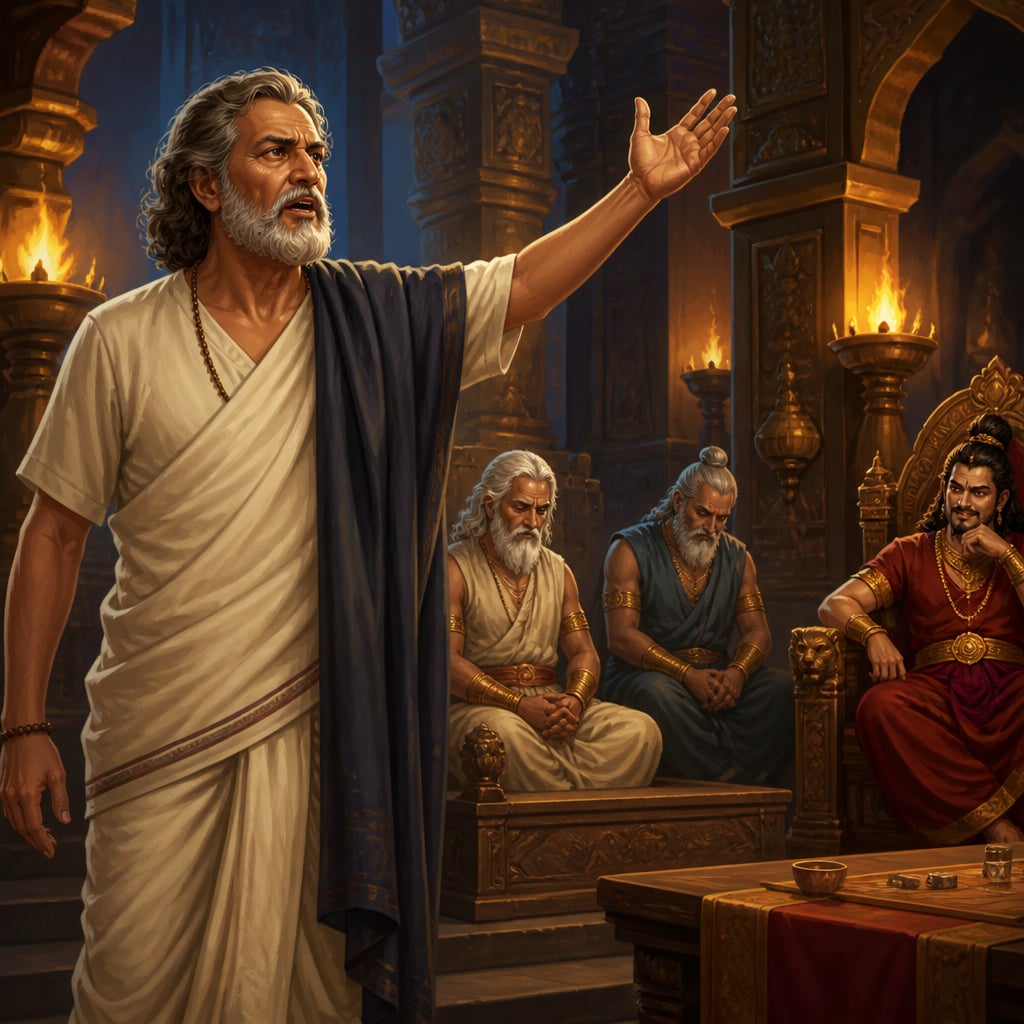
Draupadi's voice rings through the hall: "Are there no protectors here? Where are those who call themselves noble? Does dharma exist in this sabha or not?"
Her question echoes through millennia. It asks each of us: When you see wrong, do you speak, or do you become one of the silent elders?
Why Witnessing Demands Action
The Narada Smriti is unambiguous:
यः पश्यन् नानुबन्धति स पापं प्राप्नोति
"One who sees wrong and does not report shares in the sin."
This is not poetic exaggeration. It is a precise dharmic teaching: silence is not neutrality. When you witness adharma and say nothing, you have chosen a side.
Why? Because your silence:
- Emboldens the wrongdoer, They learn there are no consequences
- Abandons the victim, They learn no one will help
- Corrupts your own character, You practice cowardice
- Destroys social trust, Others learn they cannot rely on witnesses
The Manusmriti warns that false witness destroys three generations. But the Dharmasutras add: refusing to witness when you have seen the truth is equally grave.
The Three Levels of Sakshi Dharma
Level 1: Passive Witness
You saw something. You remember it accurately. If ever asked, you will tell the truth.
Minimum dharma: Don't lie if questioned. Don't deny what you saw.
Level 2: Active Witness
You saw something wrong. You make sure it is recorded, reported, or addressed.
Higher dharma: File a complaint. Tell authorities. Ensure documentation.
Level 3: Protective Witness
You saw someone in danger. You intervene, within safe limits, to protect them.
Highest dharma: Alert others, call for help, create witnesses, document evidence.
The Vidura Standard
Vidura stands apart in the dice game scene. He speaks up. He is ignored, insulted, told to leave. But he fulfills his duty.
Notice: Vidura did not single-handedly rescue Draupadi. He was one man against a corrupt court. But he spoke. He tried. He did not abandon his position as witness.
This is the realistic standard for most of us. We cannot always stop the wrong. We cannot always protect the victim. But we can:
- Speak when silence is expected
- Document what we have seen
- Report to appropriate authorities
- Refuse to pretend nothing happened
Vidura's protest changed nothing in that moment. But his testimony lives forever. The Mahabharata itself records his words as the voice of dharma in a dark hour.
The Karma of Silence
What happened to those silent elders?
Bhishma died on a bed of arrows, watching everything he loved destroyed.
Drona died through deception, killed by his own students.
The entire Kaurava line was annihilated.
And the text is explicit: their silence in the sabha was a root cause. Had they spoken, Duryodhana might have stopped. The war might have been avoided. A civilization might have been saved.
This is the karma of silence: you may avoid immediate discomfort, but you inherit the consequences of the wrong you enabled.
Modern Sakshi Dharma

In today's world, witnessing takes new forms:
In the Workplace
- You see a colleague being harassed
- You witness financial fraud
- You observe safety violations
- You hear discriminatory comments
In Public Spaces
- You witness eve-teasing on transport
- You see someone being cheated by a vendor
- You observe reckless driving causing danger
- You see a child being mistreated
In Digital Spaces
- You see cyberbullying in group chats
- You witness misinformation being spread
- You observe someone being trolled or threatened
- You see private information being shared without consent
In each case, the question is the same: Will you be Bhishma, or will you be Vidura?
Practical Guidelines for Witnessing
Before you witness (preparation):
- Know the reporting channels in your workplace
- Save emergency numbers in your phone
- Understand your legal protections as a witness
When you witness (in the moment):
- Stay calm. Assess danger.
- Document if safely possible (photos, notes, recordings where legal)
- Alert others nearby, create additional witnesses
- Call for help if intervention is dangerous
After you witness (follow-through):
- File formal report if appropriate
- Preserve your documentation
- Cooperate with investigations
- Support the affected person if possible
Key terms
- Sākṣī
- Witness; one who has seen directly. In legal and dharmic contexts, a person obligated to testify about what they observed.
- Dṛṣṭā
- Seer; one who perceives. Used for both physical seeing and spiritual perception.
- Pramāṇa
- Evidence, proof, valid means of knowledge. In legal contexts, testimony that establishes facts.
- Sākṣya
- Testimony; the act of witnessing; the statement given by a witness.
Key figures
Bhishma
Patriarch of Kuru dynasty; Supreme warrior bound by his vow · Dvapara Yuga (Mahabharata era)
Bhishma represents the tragic failure of witness dharma. Despite being the most powerful person in the assembly, bound by misplaced loyalty to the throne, he remained silent during Draupadi's humiliation. His silence enabled the catastrophe that followed. The Mahabharata explicitly links his painful death on a bed of arrows to this moral failure.
Bhishma demonstrates that power without moral courage is worthless. His example shows that staying silent to 'preserve peace' or 'respect hierarchy' can lead to far greater destruction than speaking up ever would.
Vidura
Prime Minister of Hastinapur; Son of Vyasa; Voice of dharma · Dvapara Yuga (Mahabharata era)
Vidura alone spoke up during the dice game, protesting the treatment of Draupadi and warning of the consequences. Though ignored and insulted, he fulfilled his dharma as witness. His counsel to the Pandavas and his principled stance made him the moral conscience of the Mahabharata.
Vidura represents the realistic standard for Sakshi Dharma. He could not single-handedly stop the wrong, but he spoke when silence was expected. His testimony is preserved in the epic as the voice of dharma.
Draupadi
Queen of the Pandavas; Daughter of King Drupada · Dvapara Yuga (Mahabharata era)
Draupadi's powerful questions in the sabha, 'Is there dharma in this assembly?', forced the silent witnesses to confront their moral failure. She demanded that those who called themselves protectors act like protectors. Her voice broke the conspiracy of silence.
Draupadi shows that victims have the right to demand witness. Her questions to the sabha remain relevant whenever we witness injustice: Where are those who claim to be righteous?
Satyendra Dubey
IIT Kanpur graduate; Project Director at NHAI · 1973-2003 CE
Satyendra Dubey witnessed massive corruption in the Golden Quadrilateral highway project. Despite warnings, he wrote directly to the Prime Minister's Office detailing the fraud. His identity was leaked, and he was murdered in Gaya in November 2003. His death led to the creation of the Public Interest Disclosure Act (Whistleblowers Protection Act).
Satyendra Dubey is a modern Vidura, he spoke when silence was safer, documented what he witnessed, and paid the ultimate price. His example shows both the courage required for Sakshi Dharma and the need for systems to protect witnesses.
Case studies
Satyendra Dubey: The Engineer Who Refused to Stay Silent
In 2002, Satyendra Dubey was a young IIT Kanpur graduate working as Project Director for the National Highway Authority of India (NHAI) on the prestigious Golden Quadrilateral project, India's largest road-building initiative. He discovered systematic corruption: contractors were using substandard materials, overbilling, and bribing officials. The roads being built would crumble within years. Dubey faced a choice familiar to every sakshi (witness): Stay silent, keep his job, avoid trouble? Or fulfill his dharma as witness? He chose dharma. In November 2003, he wrote directly to the Prime Minister's Office, detailing the corruption with specific names, amounts, and evidence. He requested anonymity, understanding the dangers. His identity was leaked. Days later, Satyendra Dubey was murdered in Gaya, Bihar. He was 28 years old.
Satyendra Dubey was a modern Vidura. Like Vidura in the Hastinapur court, he saw wrong and refused to stay silent. Like Vidura, he was ignored by those in power (his earlier complaints to NHAI went nowhere). Like Vidura, he persisted, escalating to the highest authority. But unlike Vidura, he paid with his life. This is where the ancient teaching meets modern reality: Sakshi Dharma requires courage, but it also requires protective systems. Vidura survived because, despite his protests, he was still a minister in a society that had some respect for dharma. Satyendra Dubey operated in a system where corrupt interests could murder witnesses with impunity. The dharmic question is not just individual, it is systemic: What kind of society protects its witnesses?
Satyendra Dubey's murder created national outrage. His death led directly to: 1. **Public Interest Disclosure Act (Whistleblowers Protection Act, 2014)**: Legal protection for those who report corruption 2. **Central Vigilance Commission guidelines**: Mandatory protection of complainant identity 3. **NHAI investigations**: Several officials were arrested and prosecuted 4. **Public awareness**: His name became synonymous with integrity in public service The Golden Quadrilateral was completed, and subsequent quality improved because his testimony created accountability.
Satyendra Dubey's life and death teach two essential truths about Sakshi Dharma: 1. **Individual courage matters**: His testimony, even at the cost of his life, created lasting change. The roads we drive on today are safer because one witness refused to stay silent. 2. **Systems must protect witnesses**: A society that expects witness dharma must create protections for witnesses. Otherwise, we are asking individuals to be martyrs. The dharmic state has a duty to protect those who speak truth. Every time we use the RTI Act, every time a whistleblower is protected, we honor Satyendra Dubey's sacrifice.
India's infrastructure corruption remains a serious problem, but Dubey's sacrifice led to the Whistleblowers Protection Act of 2014. Today, digital tools, RTI portals, and investigative journalism provide more channels for reporting corruption. The principle remains the same: systemic change requires individuals willing to document and report what they witness.
According to Commonwealth Human Rights Initiative (CHRI) data, over 80 RTI activists and whistleblowers have been killed in India since 2005. Each death represents both the courage of individual sakshis and the continuing failure of protective systems.
Historical context
Dharmashastra Period (500 BCE - 500 CE)
Ancient India developed sophisticated jurisprudence around witness testimony. Courts (dharmadhikaranas) required specific numbers of witnesses for different matters. Character of witnesses was carefully evaluated. False testimony was punished severely, not just legally but through social ostracism.
While Roman law also developed witness rules, the dharmic framework added a crucial dimension: witnessing was not just a legal duty but a moral-spiritual one. The karma of false or absent testimony extended beyond this life.
The Arthashastra recommends different numbers of witnesses for different disputes: 3 for minor matters, 5 for major disputes, and 7 for capital cases.
Understanding that witness obligations were central to dharmic civilization helps us see that 'speaking up' is not a modern Western concept but deeply rooted in Indian tradition.
Living traditions
The witness principle remains embedded in Indian life, from temple rituals requiring witnesses to modern legal systems built on testimony.
The RTI Act, Whistleblower Protection Act, and POSH (Prevention of Sexual Harassment) Act all embody Sakshi Dharma, creating formal mechanisms for witnesses to report and receive protection.
- Panchnama System: Traditional requirement of five witnesses (panch) for significant legal matters, especially property transactions and dispute resolution.
- Wedding Witnesses (Sakshi): Hindu marriages require witnesses who sign the marriage register and can testify to the vows taken.
- Hastinapur Excavation Site: The archaeological remains of the Mahabharata capital where the dice game and Draupadi's humiliation took place
- Satyendra Dubey Memorial: Memorial and annual lecture series honoring the whistleblower's sacrifice
- Draupadi Amman Temples: Temples dedicated to Draupadi as a goddess, particularly in Tamil Nadu, where she is worshipped as a symbol of courage and the demand for justice. The annual fire-walking festivals commemorate her ordeal and her refusal to accept injustice silently.
- Vidura Koothu Tradition: Traditional temple performances that dramatize Vidura's role as the lone voice of dharma in the Mahabharata. These performances highlight his courage in speaking when others stayed silent.
Reflection
- Think of a time when you witnessed something wrong but stayed silent. What held you back? Knowing what you know now about sakshi dharma, would you act differently?
- In your workplace or daily life, what systems exist for witnesses to report safely? If the systems are inadequate, what could you do to advocate for better protection?