Svadharma Over Status
Honoring the Child's Unique Path
Why forcing your ambitions onto your child destroys what you claim to develop. Learn from Nachiketa, the young seeker who defied his father's path to discover his own truth. Understand the Bhagavad Gita's teaching on Svadharma, critique tiger parenting and projection parenting, and discover practical techniques to observe (not impose) your child's unique nature.
The Boy Who Chose Death Over His Father's Path
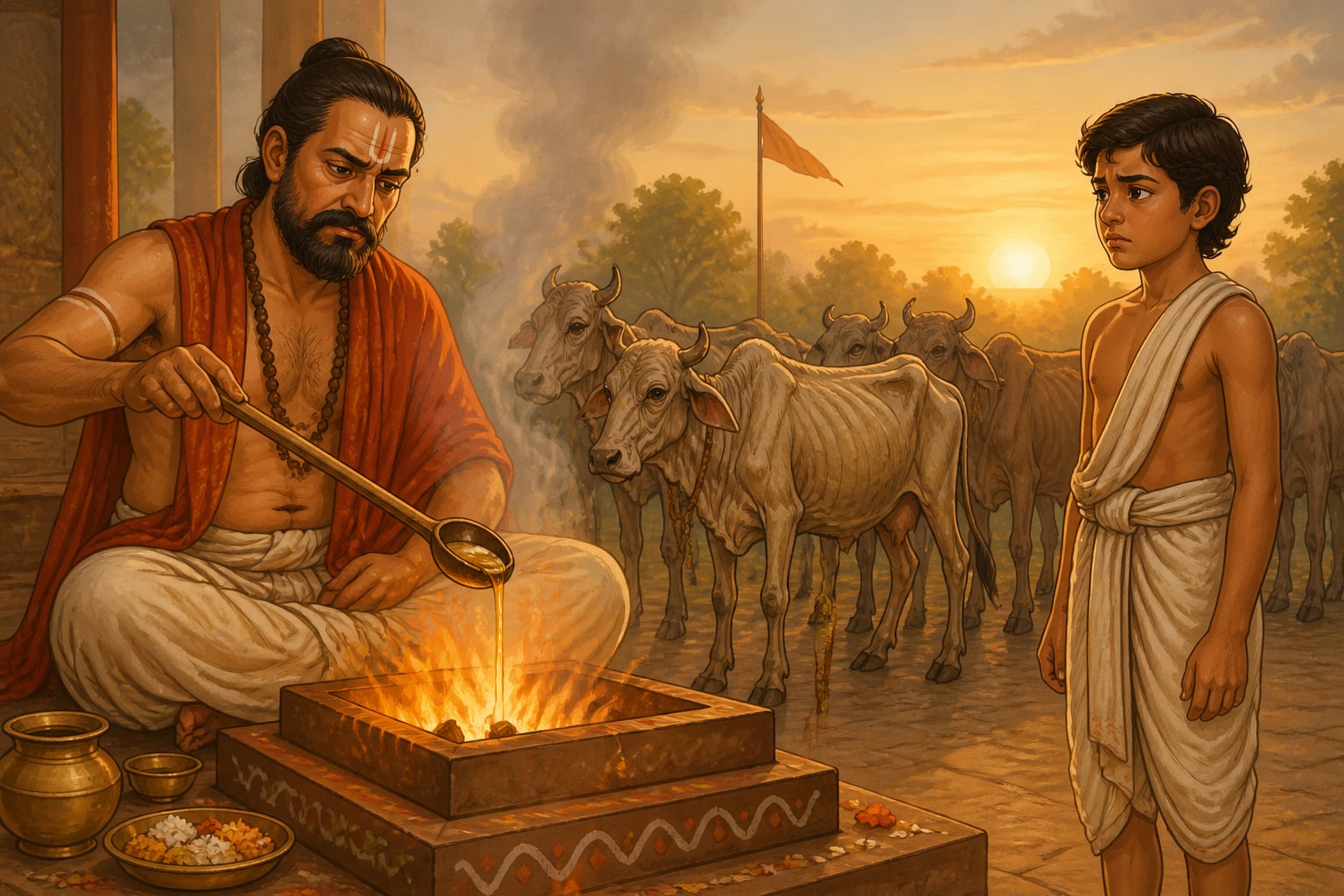
Vajashravasa was performing a great yajna. As part of the ritual, he was giving away his possessions, but his young son Nachiketa noticed something. The cows his father gave were old, barren, dry. They had "drunk their last water and eaten their last grass." The sacrifice was hollow.
Nachiketa, disturbed by this hypocrisy, asked his father repeatedly: "To whom will you give me?"
His father, irritated, finally snapped: "I give you to Death."
A conventional child would have been terrified. A conventional child would have apologized and fallen back into line. But Nachiketa was not conventional. He took his father's words literally, and traveled to the house of Yama, the Lord of Death.
For three days, Nachiketa waited at Yama's door. When Yama returned and found a brahmin boy had waited unfed as his guest, he offered Nachiketa three boons to atone for the discourtesy.
Nachiketa's first boon: May my father's anger be cooled, and may he recognize me when I return.
Nachiketa's second boon: Teach me the fire sacrifice that leads to heaven.
Nachiketa's third boon: Teach me what happens after death, the secret of immortality.
Yama tried to dissuade him from the third request. He offered instead: long life, wealth, kingdoms, beautiful women, elephants, horses, anything, except the secret knowledge. "Choose sons and grandsons who shall live a hundred years. Choose herds of cattle, gold, horses. Choose the wide earth and live upon it as many years as you desire."
Nachiketa refused it all. "These things are ephemeral, O Death. They wear away the vigor of the senses. The whole span of life is short. Keep your horses, keep your dance and song. No mortal is made happy by wealth. Teach me the truth."

This is the story of a child who discovered his svadharma, and it was utterly different from his father's.
Vajashravasa's dharma was ritual, performance, the appearance of piety. Nachiketa's dharma was truth-seeking, the essence behind appearances. The father valued possessions (even when giving them away for show); the son valued knowledge that possessions could not buy.
A tiger parent would have forced Nachiketa into his father's path. A projection parent would have lived vicariously through Nachiketa's ritual performances. Both would have destroyed what made Nachiketa extraordinary.
Instead, Nachiketa followed his own nature, and received the teaching of immortality directly from Death himself.
The Svadharma Principle
The Bhagavad Gita articulates the principle Nachiketa embodied:
श्रेयान्स्वधर्मो विगुणः परधर्मात्स्वनुष्ठितात्। स्वधर्मे निधनं श्रेयः परधर्मो भयावहः॥
"Better is one's own dharma, though imperfectly performed, than the dharma of another well performed. Death in one's own dharma is preferable; another's dharma is dangerous."
This verse is revolutionary. It doesn't say "do what's prestigious." It doesn't say "do what your parents want." It doesn't say "do what brings status."
It says: Your own path, however imperfect, is better than someone else's path perfectly walked.
Nachiketa's path was so different from his father's that it led him to Death's door. But it was his path, and it led to the highest wisdom the Upanishads contain.
Every child has a svadharma. The parent's role is to discover it, not impose something else in its place.
The Tiger Parent's Trap
In 2011, Amy Chua published Battle Hymn of the Tiger Mother, describing her approach to parenting: no sleepovers, no TV, no grades below A, mandatory piano and violin, hours of practice enforced through screaming, threats, and coercion.
The book sparked international debate. Some praised the "high standards." Others recognized the damage.
Research now provides answers:
| Finding | Source |
|---|---|
| Children of authoritarian parents show lower life satisfaction | Dwairy & Menshar, 2006 |
| Excessive parental pressure correlates with anxiety and depression | Luthar & Latendresse, 2005 |
| Externally motivated achievement is less sustained than intrinsic motivation | Deci & Ryan, Self-Determination Theory |
| Tiger parenting produces high achievement but lower wellbeing | Kim et al., 2013 |
| Asian-American students with tiger parents show more academic stress | Qin et al., 2015 |
The tiger parent imposes their vision of success onto the child. The metrics are standardized: academic grades, prestigious instruments, competitive rankings. The child's actual nature is irrelevant, what matters is whether they conform to the parent's blueprint.
This is paradharma forced upon a child. The parent walks the child down someone else's path, the parent's path, society's path, the status-maximizing path, while the child's actual svadharma withers.
The Projection Parent's Prison
Even more insidious than tiger parenting is projection parenting: using your child's achievements to fulfill your own unfulfilled dreams.
The father who never made the sports team pushes his son into athletics, not because the son loves sports, but because the father needs to experience success vicariously.
The mother who never attended an elite university drives her daughter toward Ivy League admission, not because the daughter's path leads there, but because the mother needs to finally achieve what she couldn't.
The parent who never became a doctor, lawyer, or engineer steers the child toward that profession, because the parent's unfinished business must be completed through the child.
Signs of projection parenting:
- You feel personally devastated when your child fails at something you wanted
- Your identity is entangled with your child's achievements
- You have specific career/achievement expectations that existed before you knew your child's nature
- Your child's success makes you feel validated; their failure makes you feel ashamed
- You find yourself saying "we" got into college, "we" won the competition
- You can't imagine your child succeeding on a path different from what you've envisioned
Projection parenting treats the child as an extension of the parent rather than a separate soul with a separate svadharma. The child becomes a vehicle for the parent's unlived life, and the child's actual life goes unlived in turn.
The Nachiketa Alternative
Nachiketa's story offers a different model. His father Vajashravasa was clearly invested in a particular kind of success, public ritual, social status, the performance of piety. Nachiketa's svadharma was completely different: philosophical inquiry, the pursuit of truth beneath appearances, the courage to face death for knowledge.
What made Nachiketa's development possible?
1. He was allowed to observe and question
Nachiketa noticed the hypocrisy in his father's sacrifice. He wasn't forced to perform rituals mechanically, he was present, observing, thinking. His questions emerged from genuine engagement with reality.
2. His difference wasn't suppressed
When Nachiketa challenged his father, he wasn't beaten into compliance. Yes, his father cursed him in anger, but that curse became the vehicle for Nachiketa's journey. His difference was allowed to exist.
3. He followed his curiosity to its conclusion
Nachiketa didn't accept Yama's alternative offers, the wealth, the long life, the pleasures. He knew what he was seeking. His svadharma was truth, and he pursued it with the focus that only authentic purpose can generate.
4. The universe supported his authentic path
When Nachiketa chose his svadharma over comfort, Death himself became his teacher. The authentic path, however unusual, receives support that the false path never receives.
How Children Signal Their Svadharma
Every child reveals their nature, if parents are paying attention.
Flow states: What activities completely absorb your child? When do they lose track of time? Where do they need no external motivation to continue? These are svadharma signals.
Natural questions: What does your child spontaneously wonder about? Nachiketa's questions were about truth and death, not about ritual techniques. The questions reveal the seeking.
Energy patterns: Where does your child gain energy rather than lose it? What activities leave them tired but fulfilled versus depleted and resentful?
Resistance patterns: What do they resist despite your pushing? Persistent resistance to a particular path may indicate it's not their path, not that they need more pushing.
Natural skills: What comes easily without instruction? Not just talent, but the combination of interest and capability that marks genuine affinity.
Play choices: Before socialization imposes expectations, what does the child naturally gravitate toward? Early play patterns often reveal deep nature.
Nachiketa's nature was visible early: he was a questioner, a truth-seeker, someone unimpressed by appearances. His svadharma was written in his behavior long before he traveled to Death's door.
The Dharmic Parent's Approach
The Dharmic parent is neither permissive ("do whatever you want") nor authoritarian ("do what I say"). They are observant guides:
1. Watch before directing
Spend time observing your child without agenda. What are they drawn to? What do they avoid? What questions do they ask? What problems do they try to solve? The answers reveal svadharma.
2. Provide exposure, not imposition
Expose your child to many possibilities, arts, sciences, physical activities, intellectual pursuits, practical skills. Then watch where they lean. Exposure is your job; choice is theirs.
3. Separate your dreams from their path
Explicitly ask yourself: "Is this my dream or their path?" Be honest. Your unfulfilled ambitions are yours to address, not theirs to fulfill.
4. Support the unexpected
When your child's svadharma is different from what you expected or wanted, support it anyway. Nachiketa's path was completely different from Vajashravasa's, but it led to the highest wisdom. Your child's unexpected path may lead somewhere you can't imagine.
5. Hold lightly
Even your best observations about your child's nature might be wrong. Hold your conclusions lightly. Their svadharma will reveal itself through their life, not through your analysis. Be ready to be surprised.
The Status Trap
Much projection parenting is driven by status anxiety. The parent pushes the child toward prestigious paths, medicine, law, elite universities, high-status careers, not because these match the child's nature but because they offer social validation.
The Gita is clear: paradharma bhayavaha, another's dharma is dangerous.
A child forced into medicine when their svadharma is art will be a mediocre doctor and a frustrated artist. A child pushed toward law when their nature is entrepreneurial will be an unhappy lawyer and an unlived entrepreneur.
The status achieved through paradharma is hollow. The person looks successful but feels empty. They've achieved what others wanted, not what they were born to do.
The child who follows their svadharma may achieve less status but more fulfillment. They may never be famous, never be rich, never achieve what the projection parent dreamed, but they will be doing what they were actually meant to do.
Nachiketa didn't become a famous ritualist like his father. He became something else entirely: a seeker who received the teaching of immortality. His father's path would have made him successful; his own path made him wise.
Arjuna's Crisis and Krishna's Answer
The Bhagavad Gita opens with a projection crisis in reverse.
Arjuna, the warrior, suddenly doesn't want to fight. He wants to become a renunciate, a sannyasi, a non-combatant. He argues philosophically for why he should lay down his weapons.
But Krishna sees through it. Arjuna is a warrior. His svadharma is the path of the Kshatriya. His attempt to adopt the dharma of renunciation, however noble it sounds, is flight from his own nature.
Your own dharma, imperfectly performed, is better than another's dharma, perfectly performed.
Arjuna's dharma is to fight. His attempt to become a renunciate would be paradharma, someone else's path. However peaceful it looks, it would be a betrayal of his actual nature.
This is Krishna's answer to both tiger parenting and its opposite:
- The tiger parent forces the child into the parent's dharma
- The permissive parent allows the child to drift into no dharma
- The Dharmic parent helps the child discover and fulfill their own dharma
Arjuna's path was to fight. Nachiketa's path was to question. Neither could walk the other's path. Both had to discover and embrace their own.
The Multi-Path Family

In the Mahabharata, the five Pandava brothers have radically different svadharmas:
- Yudhishthira: The dharma of kingship and justice
- Bhima: The dharma of strength and combat
- Arjuna: The dharma of the warrior-artist
- Nakula: The dharma of beauty and horse-mastery
- Sahadeva: The dharma of astrology and wisdom
Kunti raised all five, but she didn't try to make them identical. She recognized that Bhima's path was not Arjuna's path, that Yudhishthira's nature was different from Sahadeva's. Each brother developed according to his own svadharma.
A family can contain radically different paths. The parent's job is not to homogenize children into a single mold but to recognize and nurture each child's unique nature.
The Tragedy of the Unfulfilled Child
What happens when svadharma is suppressed?
The child who was meant to be an artist becomes an accountant. They do adequate work, pay the bills, achieve "success." But something essential is missing. They feel a persistent hollowness they can't name.
The child who was meant to be a craftsman becomes a corporate lawyer. They have the big house, the prestigious title, the social validation. But they spend their weekends doing woodworking in the garage, the only place they feel alive.
The child who was meant to be an explorer becomes a middle manager. They travel for vacations, read adventure books, live vicariously through documentaries. Their actual life feels like someone else's story.
These are the walking wounded of projection parenting. They achieved what their parents wanted. They lost what they were born to be.
The Gita warns: svadharme nidhanam shreyah, better death in your own dharma than life in another's. The "death" in this context is metaphorical: the living death of a life lived inauthentically.
What Research Shows About Imposed Paths
Modern psychology validates the svadharma principle:
Self-Determination Theory (Deci & Ryan): People have three basic psychological needs, autonomy, competence, and relatedness. When these are satisfied, motivation is intrinsic and sustainable. When they're thwarted (as in tiger parenting), motivation becomes external and fragile.
Person-Environment Fit: Research shows that people flourish when their activities match their traits. A child forced into a mismatched path will struggle even with high ability; a child whose path fits their nature will thrive even with modest ability.
Burnout Research: Burnout occurs not just from overwork but from meaninglessness, doing work that doesn't align with one's values and nature. Adults who were pushed into paradharma as children are at higher risk for burnout.
Life Satisfaction Studies: Long-term happiness correlates more strongly with living according to one's values than with achievement of externally defined success. The surgeon who wanted to be a chef is less happy than the chef who wanted to be a chef, regardless of income differential.
The Discovery Process
How do you actually discover a child's svadharma?
Phase 1: Observation (Ages 0-7)
Watch. Don't direct. Notice:
- What games does the child invent when left alone?
- What toys/activities are returned to repeatedly?
- What questions does the child ask spontaneously?
- What fears and fascinations appear?
- Where does the child show unusual persistence?
Phase 2: Exposure (Ages 7-12)
Provide wide exposure:
- Arts, music, physical activities, intellectual pursuits
- Different types of people and professions
- Challenges of various kinds
- Time in nature, time in cities, time alone, time in groups
Watch where the child leans. Note what they ask to do again.
Phase 3: Exploration (Ages 12-16)
Allow deeper exploration:
- Let them go deep into their areas of interest
- Provide resources without controlling direction
- Ask about their experience, what did they love? What did they hate?
- Resist the urge to redirect toward "practical" options
Phase 4: Support (Ages 16+)
Support their emerging path:
- Help them find mentors in their area of interest
- Provide practical support for their chosen direction
- Manage your own anxiety about status and security
- Trust that their svadharma will provide, even if it doesn't look like "success"
The Parent's Own Work
Discovering your child's svadharma requires discovering your own.
If you haven't fulfilled your own dharma, you're at risk of projecting it onto your child. If you haven't made peace with your own unlived life, you'll unconsciously try to live it through them.
The parent's work includes:
1. Acknowledging your own unlived life
What did you want to be that you didn't become? What paths did you not take? What do you regret? Be honest with yourself.
2. Separating your needs from theirs
Your child is not here to complete your life. They have their own life to live. Their success or failure doesn't reflect on you, it reflects their own journey.
3. Grieving what you missed
If you wanted to be a musician and became an accountant, grieve that loss. Don't make your child carry it.
4. Finding your own paths forward
It's not too late to engage with your own svadharma. The weekend guitar playing, the evening painting, the part-time study, these can satisfy your unfulfilled longings without burdening your child.
Nachiketa's Gift
Nachiketa returned from Death's kingdom with the highest knowledge, the secret of immortality that Yama had finally agreed to teach. He returned to his father, who received him with love (as Nachiketa had requested in his first boon).
But Nachiketa didn't become his father. He became something else entirely: the seeker whose dialogue with Death opens the Katha Upanishad, one of the most profound texts in human history.
His father's ritual path was necessary for its time and place. Nachiketa's inquiry path was necessary for his nature and destiny. Neither was wrong, but they were different.
Every child comes with their own dialogue to have, their own Death to meet, their own secrets to receive. The parent's job is not to write that dialogue but to step aside so it can unfold.
Nachiketa's father, in his anger, accidentally launched his son's destiny. What if, instead of accidental blessing, we offered intentional support for the journey our children are actually meant to take?
Every child reveals their svadharma through their spontaneous behavior, what absorbs them, what questions they ask, where they resist, what comes naturally. Systematic observation can discover this nature before it's obscured by social expectations and parental projection.
Modern psychology recognizes 'intrinsic motivation', the drive to engage in activities for their inherent satisfaction. Flow research (Csikszentmihalyi) shows that people enter flow states when the activity matches their nature and challenges their skill level. Svadharma observation is essentially identifying where intrinsic motivation and flow naturally arise.
The Dharmic framework provides explicit categories: svadharma vs paradharma, shreya vs preya. These concepts make the distinction between authentic and imposed paths philosophically clear, not just psychologically intuitive.
Nachiketa's svadharma was visible early: he questioned, he observed hypocrisy, he refused to accept appearances. A wise parent would have recognized these signals and nurtured his philosophical nature rather than trying to force him into ritual performance.
Projection parenting occurs when the parent's unlived life gets confused with the child's path. The 'ambition audit' is the practice of explicitly separating what you wanted for yourself from what your child actually is and wants.
Psychotherapy often involves helping adults disentangle their own desires from their parents' projections. This 'differentiation' process can take years. The ambition audit is preventive: doing the separation consciously as a parent so your child doesn't have to do it later in therapy.
Case studies
Nachiketa's Journey: From Father's Curse to Cosmic Teaching
Young Nachiketa observed his father's yajna and noticed the hypocrisy: the cows being given away were old and worthless. His persistent questioning angered his father, who cursed him to Death. Instead of cowering, Nachiketa traveled to Yama's abode and waited three days for the Lord of Death. When Yama offered him any boon, wealth, long life, pleasures, Nachiketa refused everything except the teaching about what happens after death.
Nachiketa's story illustrates svadharma in action: **His nature was evident early**: He questioned, observed, refused to accept appearances. This was his svadharma revealing itself. **His path diverged from his father's**: Vajashravasa's dharma was ritual performance. Nachiketa's was philosophical inquiry. Both valid, but fundamentally different. **He refused preya for shreya**: When offered the pleasant path (wealth, pleasure, long life), he chose the difficult good (truth about death and immortality). **His authentic path led to the highest teaching**: Because he followed svadharma, he received wisdom that the Katha Upanishad preserves for all humanity.
Nachiketa received the teaching of the Atman, the immortal Self within all beings, directly from Death. He returned to his father, was recognized with love (as he had requested), and became the questioner whose dialogue opens one of the most profound Upanishads. His father's dharma was preserved; Nachiketa's dharma was fulfilled; both paths served the cosmic order.
A child's svadharma may look completely different from the parent's. Nachiketa's truth-seeking bore no resemblance to Vajashravasa's ritual performance. The parent who forces their path onto such a child destroys a potential sage to produce a mediocre ritualist.
The child who wants to study philosophy when the family expects engineering, the daughter who chooses social work over medicine, the son who prefers carpentry over a corporate job. Each is a modern Nachiketa whose svadharma diverges from the parent's script. Research on career satisfaction consistently shows that people who follow intrinsic interests outperform and outlast those who follow imposed paths, even when the imposed path looked more 'successful' on paper.
The Katha Upanishad, composed between 800 and 300 BCE, records Nachiketa's three-night vigil at Yama's door. Yama offered wealth, long life, and kingdoms as alternatives, but Nachiketa refused all material boons in favor of knowledge of the Self.
The Tiger Mother Phenomenon
In 2011, Amy Chua published 'Battle Hymn of the Tiger Mother,' describing strict Chinese parenting: no sleepovers, no TV, no grades below A, mandatory piano and violin practice enforced through screaming and threats. The book sparked debate about whether such intensive parenting produces excellence or damage.
From a svadharma perspective, tiger parenting has a fundamental problem: it imposes the parent's vision of success without regard for the child's nature. **Paradharma enforcement**: The child's actual path is ignored; the parent's path is forced upon them. **External metrics dominate**: Achievement is measured by standardized markers (grades, prestigious instruments) rather than by alignment with the child's svadharma. **The child's signals are overridden**: Resistance, unhappiness, and lack of intrinsic motivation are seen as obstacles to overcome rather than information about misalignment. **Short-term success, long-term cost**: Tiger-parented children may achieve academically but often suffer from anxiety, depression, and the hollow feeling of having lived someone else's life.
Research on tiger parenting shows mixed results: higher academic achievement but lower psychological wellbeing. Many adult children of tiger parents report feeling that their accomplishments are hollow, they succeeded at something that wasn't truly theirs. Some rebel entirely; others achieve but feel empty; few report genuine fulfillment from the path that was forced upon them.
Excellence in paradharma is still paradharma. The child who achieves high marks in the parent's chosen field while their own svadharma withers has been successful at the wrong thing. Better imperfect performance on one's own path than perfect performance on someone else's.
Tiger parenting is widespread in Indian, Chinese, and Korean diaspora communities, and the mental health consequences are now well-documented. Therapists in these communities report that 'living someone else's life' is the most common presenting complaint from adults in their 30s and 40s. The physician who hates medicine, the engineer who dreams of music, the lawyer who wanted to teach. Each is paying the long-term cost of a parent who optimized for prestige rather than fit.
Amy Chua's 'Battle Hymn of the Tiger Mother' sold over 1 million copies worldwide after its 2011 publication. A 2013 study in Asian American Journal of Psychology found that children of tiger parents reported lower GPA and greater depressive symptoms compared to children of supportive parents.
The Projection Parent's Unlived Life
A parent who never achieved their dream of attending an elite university pushes their child relentlessly toward Ivy League admission. The parent experiences the application process as if it were their own, feels devastated by rejections, and cannot separate their emotional wellbeing from the child's outcomes. The child's actual interests and aptitudes are irrelevant, only the parent's unfinished business matters.
Projection parenting is a particularly insidious form of paradharma imposition: **The child becomes an extension of the parent**: Rather than a separate soul with their own svadharma, the child is treated as a vehicle for the parent's unlived life. **The parent's grief is unprocessed**: The parent hasn't mourned their own missed opportunities, so they unconsciously demand the child fulfill them. **Identity confusion results**: The child cannot distinguish their own desires from their parent's projections. Even when they achieve, they don't know if it was their goal or their parent's. **The cycle continues**: Children who fulfill their parents' projections often project their own unfulfilled dreams onto their children, perpetuating the pattern.
The child who fulfills the projection may achieve the parent's dream, and feel nothing. They got into the elite university, but it wasn't their university. They succeeded, but at someone else's goal. The hollowness that follows often leads to crisis in the twenties or thirties when they finally ask: 'What do I actually want?' Many enter therapy to unlearn the projection and discover their own path, years after it should have begun.
The parent's unlived life is the parent's responsibility, not the child's. Grieve your own missed opportunities. Find your own ways forward. Don't make your child carry the weight of your unfinished business.
Social media has intensified projection parenting by making children's achievements publicly visible markers of parental status. The Instagram post celebrating a child's IIT admission is often more about the parent's identity than the child's. Parents who catch themselves feeling devastated by their child's rejection from a school or program should ask honestly: whose dream was this? The grief of an unlived life is real, but it belongs in therapy, not on a child's shoulders.
A 2019 study in the Journal of Family Psychology surveyed 302 parent-child dyads and found that 47% of parents reported living vicariously through their children's achievements, with projected ambitions most strongly associated with lower child wellbeing and higher child anxiety.
Living traditions
- Nachiketa Cave: Traditional site associated with Nachiketa's meditation after receiving Yama's teaching
- Kashi (Varanasi): The city of Shiva, associated with death and liberation, where Yama's teaching becomes lived reality
Reflection
- What aspects of your own unlived life might you be projecting onto your child? What did you want that you didn't achieve, and are you unconsciously asking them to achieve it for you?
- When you imagine your child's future, do you picture their fulfillment or your pride? Are you thinking about what makes them come alive, or about what you could tell others?
- What signals has your child been sending about their svadharma that you might have ignored or overridden because they didn't match your expectations?