The Param Veer Spirit
What Connects All 21 Heroes - And How We Carry Their Legacy Forward
From Major Somnath Sharma in 1947 to Colonel Santosh Babu in 2020, what connects India's 21 Param Vir Chakra recipients across 73 years? They came from different regions, religions, and regiments, but they shared something eternal - the Param Veer Spirit. This final lesson explores that spirit and asks: how do we carry it forward in our own lives?
The Common Thread
Twenty-one men. Seven decades. Different wars. Different weapons. Different terrains.
Major Somnath Sharma directed mortar fire at Badgam airfield in 1947. Grenadier Yogendra Singh Yadav scaled Tiger Hill in 1999. Colonel Santosh Babu fought with stones and fists at Galwan in 2020.
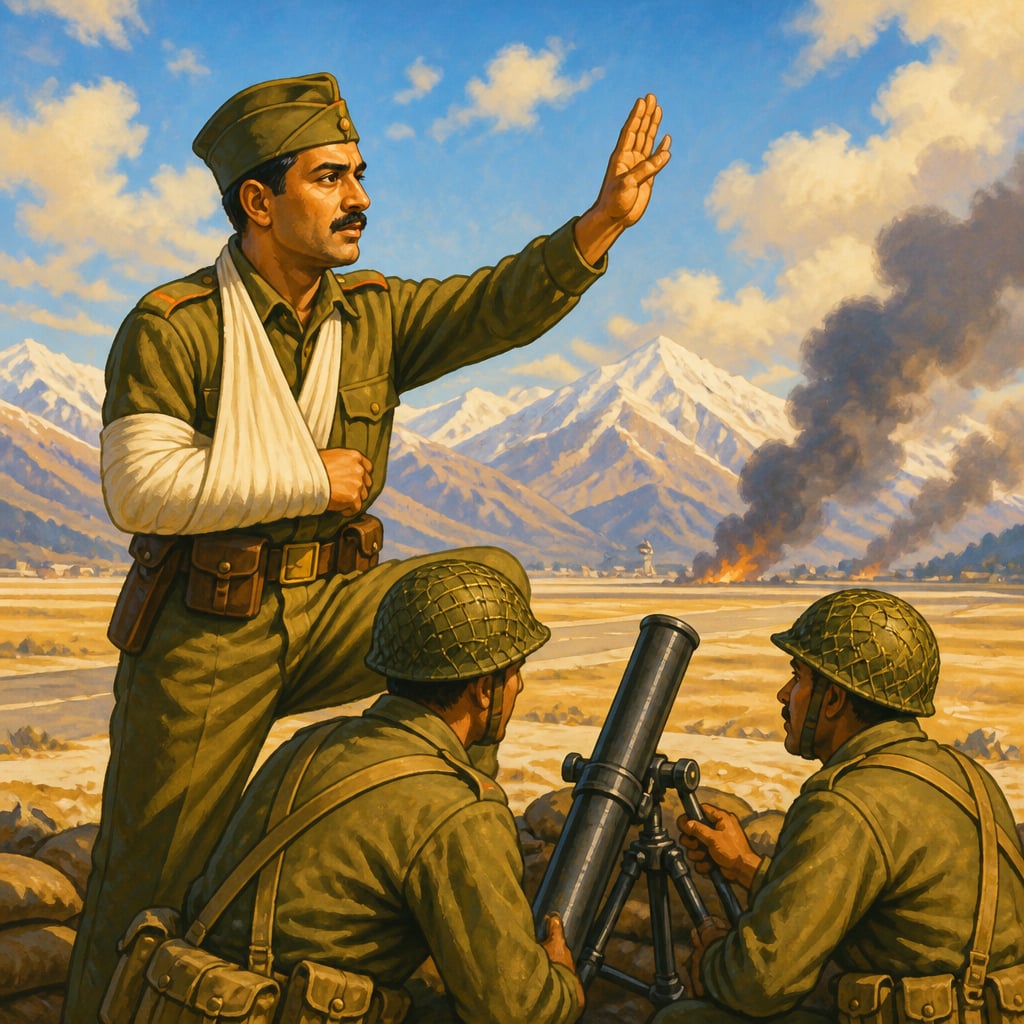
They came from Punjab and Tamil Nadu, from Rajasthan and Jharkhand, from Kashmir and Nagaland. They were Hindu, Muslim, Sikh, Christian. They served in infantry, armor, engineers, air force.
Yet something connected them - something that made each of them, in their defining moment, choose certain death over retreat, duty over survival, honor over self.
What is this connection? What is the Param Veer Spirit?
The Unchanging Core
They Chose to Be There
Every PVC recipient was a volunteer. India has never had conscription. These were men who chose to serve.
More than that, in their defining moments, many volunteered again - for the dangerous mission, for the assault team, for the forward position. Captain Vikram Batra volunteered for Point 4875 after already capturing Point 5140. Major Shaitan Singh chose to command the isolated Charlie Company at Rezang La. Grenadier Yogendra Singh Yadav volunteered for the Ghatak Platoon.
They didn't just accept danger. They sought it.
They Knew the Cost
These were not naive men who didn't understand death. Many had seen comrades fall. They knew exactly what they were risking.
2Lt Arun Khetarpal saw his tank on fire and knew what continuing to fight meant. Lance Naik Albert Ekka felt bullets enter his body and kept charging. Naib Subedar Bana Singh climbed through a blizzard at 21,000 feet knowing that the cold alone could kill.
They chose anyway.
They Thought of Others
Perhaps the most common thread: in their final moments, they thought not of themselves but of comrades.
Yogendra Singh Yadav kept climbing because "if I stopped, everyone behind me would die." Major Somnath Sharma's last radio message was about his men's position, not his own wounds. Lieutenant Manoj Kumar Pandey's last words were "Na Chodnu" - don't leave them.
The self disappeared. Only the mission and the comrades remained.
They Never Gave Up
Not one PVC recipient surrendered or retreated when fighting was still possible.

Major Shaitan Singh, wounded and ordered by his men to be carried to safety, refused to let them waste strength on him and crawled toward the enemy with his pistol. CHM Piru Singh, hit multiple times, continued his one-man assault until the objective was taken. Colonel Santosh Babu, without weapons, fought with bare hands.
The word "retreat" was not in their vocabulary.
The Dharmic Foundation
Kshatriya Dharma
The Hindu tradition speaks of Kshatriya Dharma - the warrior's sacred duty. It is not about violence but about protection. The Kshatriya uses force only in defense of the innocent, never for personal gain.
Every war India has fought since independence was defensive. Pakistan invaded in 1947, 1965, and 1999. China attacked in 1962 and 2020. Terrorists struck at Mumbai and Pahalgam. India responded - not for conquest, but for protection.
The PVC recipients embodied this dharma. They fought to protect - the nation, the regiment, the comrade. Their violence was sacred because it was defensive.
The Gita's Teaching
The Bhagavad Gita was spoken on a battlefield. Arjuna faced warriors who were family, teachers, friends. He did not want to fight. Krishna taught him that when dharma is threatened, the warrior must act - without attachment to results, without hatred for the enemy, but with clear recognition of duty.
"Karmanye vadhikaraste ma phaleshu kadachana."
You have the right to action alone, never to its fruits.
The PVC recipients acted without calculating personal benefit. They didn't charge machine gun nests expecting medals. They did their duty and accepted whatever came.
Ahuti - The Sacred Offering
In Vedic tradition, Ahuti is the offering made into sacred fire - giving something precious to the divine. The soldier's sacrifice is Ahuti - the offering of life itself for the nation, which is another form of the divine Mother.
"Maa Bharati" - Mother India - is not just a phrase. It is a theological reality for those who serve. The nation is a sacred entity worthy of ultimate sacrifice.
This understanding transforms death in battle from tragedy to transfiguration. The fallen soldier doesn't simply die; he offers himself on the altar of the nation.
The Regimental Bond
The Indian Army's regimental system creates bonds stronger than blood.
Soldiers live together, train together, eat together, and fight together for years. The regiment becomes family. Its history becomes personal history. Its honors become personal honor.
When a Kumaoni soldier learns of Major Somnath Sharma, he doesn't learn of a distant hero - he learns of his regimental brother. When a soldier of 17 Poona Horse studies Arun Khetarpal, he sees not a legend but a role model for how Poona Horse officers behave.
This is why the same regiments produce heroes across generations:
- 1 Sikh Regiment: L/Nk Karam Singh (1948), Sub Joginder Singh (1962)
- 17 Poona Horse: Lt Col Ardeshir Tarapore (1965), 2Lt Arun Khetarpal (1971)
- 13 JAK Rifles: Capt Vikram Batra (1999), Rfn Sanjay Kumar (1999)
The regimental tradition creates expectations. When you wear the cap badge, you inherit a standard. You must live up to those who wore it before.
The Common Humanity
Beyond dharma and regiment, the PVC recipients shared common humanity.
They were sons who loved their mothers. Brothers who teased siblings. Young men who dreamed of marriage. Fathers who wanted to see children grow.
Vikram Batra wrote poetry to Dimple Cheema. Arun Khetarpal looked forward to a long career. Santosh Babu had just been promoted to Colonel and was thinking about his next posting.
They were not born extraordinary. They became extraordinary in extraordinary moments. The Param Veer Spirit was always there, dormant, waiting - and when the moment came, it emerged.
This is perhaps the most important truth: the spirit resides in ordinary people. You don't need to be born special to be capable of supreme courage. You need only to be willing to let the spirit emerge when called.
What the Param Veer Spirit Is Not
Not Hatred
The PVC recipients did not fight out of hatred for the enemy. Their citations speak of duty, courage, leadership - never of vengeance or malice.
Brigadier Khetarpal embraced the Pakistani commander who killed his son. Yogendra Singh Yadav speaks of the enemy soldiers at Tiger Hill without bitterness. The warriors of Galwan, attacked without weapons, fought to defend - not to destroy.
Dharmic warfare is different from hatred-driven warfare. The enemy is an obstacle to be overcome, not a demon to be destroyed.
Not Recklessness
Supreme courage is not the same as foolishness. The PVC recipients took calculated risks, not random chances.
Major Shaitan Singh positioned his company with tactical wisdom. Naib Subedar Bana Singh planned the Siachen assault carefully. Lieutenant Manoj Kumar Pandey led his men with professional skill.
They were brave, not reckless. They accepted risk when duty demanded, not for thrill-seeking.
Not Certainty
These men were not certain of survival. They were terrified, as any human would be. Courage is not the absence of fear but action despite fear.
Yogendra Singh Yadav has spoken of fear at Tiger Hill. The soldiers of Rezang La surely felt terror as Chinese waves approached. The warriors of Galwan faced armed men with stones, knowing the odds.
The Param Veer Spirit does not eliminate fear. It masters fear.
Carrying the Spirit Forward
The Soldier's Path
Some carry the spirit by following in the heroes' footsteps - joining the armed forces, serving at Siachen, patrolling the LOC.
If this is your calling, answer it. The nation needs defenders. The regiments need recruits who understand the tradition they inherit.
But this path is not for everyone, and that is okay. The Param Veer Spirit can manifest in civilian life too.
Courage in Daily Life
You may never face a machine gun nest. But you will face moments that demand courage:
- Speaking truth when lies would be easier
- Defending the weak when others look away
- Taking responsibility when blame would be convenient
- Persisting through difficulty when quitting would be comfortable
- Standing for principle when compromise would be profitable
Every such moment is a small battlefield. Every act of moral courage honors the Param Veers.
Remembrance as Service
Remembering is itself service. When you teach a child about Vikram Batra, you keep his spirit alive. When you visit the National War Memorial, you honor all who fell. When you observe silence on Kargil Vijay Divas, you connect with the eternal.
Memory is not passive. It is active preservation of the nation's soul.
Building What They Protected
The Param Veers died so that India might live. The best way to honor their sacrifice is to build the India they died for:
- A nation where every citizen has dignity
- A nation where justice is available to all
- A nation where children can dream without limit
- A nation worthy of the blood shed to protect it
Every act of nation-building - honest work, good citizenship, service to community - honors those who died on battlefields.

The Eternal Flame Within
The eternal flame at the National War Memorial never dies. It is tended constantly, kept alive through night and day, storm and calm.
But there is another eternal flame - the one within each Indian citizen. The spark of the Param Veer Spirit that waits to be kindled.
Most of us will never face combat. But all of us face moments that test our courage, our integrity, our willingness to sacrifice for something greater than ourselves.
In those moments, the Param Veers speak to us:
"We charged into machine guns so you could live in peace. What will you charge into? We gave our lives for the nation. What will you give?"
The answer is yours to write.
A Final Word
We began this course with Major Somnath Sharma at Badgam in 1947, fighting to save a newborn nation. We end with the living presence of Yogendra Singh Yadav and Bana Singh, the sacred spaces where memory is preserved, and the eternal spirit that connects all who serve.
The Param Vir Chakra is a small bronze disc. But what it represents is vast - a tradition of courage spanning millennia, a commitment to duty unto death, a love of nation that transcends self.
Twenty-one men have earned this medal. Millions more have served with the same spirit without recognition. And billions of Indians live today because of what they gave.
This is the Param Veer Legacy. It is not a story that ended. It is a story that continues - in every soldier who stands guard on a frozen frontier, in every citizen who acts with courage and integrity, in every child who learns these stories and is inspired.
The spirit lives.
It lives in the memorials and museums. It lives in the regimental traditions. It lives in the hearts of a grateful nation.
And if you let it, it can live in you.
Jai Hind.
Key figures
The Twenty-One
Savitri Bai Khanolkar
Case studies
The Ordinary Becoming Extraordinary
You learn that all 21 PVC recipients came from ordinary backgrounds - farmers' sons, village boys, middle-class families. None was born into military aristocracy. What does this tell us about heroism?
Heroism is not a birthright but a choice. The potential for supreme courage resides in ordinary people. The moment of truth reveals what was always there, waiting.
India's startup ecosystem is increasingly powered by founders from small towns and non-elite backgrounds. The founders of Zerodha, PhonePe, and hundreds of other successful companies came from ordinary families. Just as PVC recipients were ordinary people who chose extraordinary action, India's economic transformation is driven by people who refused to be limited by their origins.
Thinking of Others at the End
In their final moments, the PVC recipients thought of comrades, mission, duty - rarely of themselves. How does this orientation shape courage?
Courage flows more easily when we focus on others rather than ourselves. Self-preservation instincts can be overridden by responsibility to those who depend on us.
Psychological research on altruism confirms that people who habitually think of others, whether through parenting, community service, or team sports, find it easier to act selflessly in crisis. Selflessness is not a sudden gift. It is a muscle built through daily practice of putting others first.
Carrying the Spirit Forward
You will probably never face combat. How can you honor the Param Veers in civilian life? What does their example mean for ordinary days?
Every moment that demands courage is a small battlefield. Every act of integrity honors those who gave everything. The spirit lives in how we face our own challenges.
Standing up against workplace bullying, refusing to participate in corruption, supporting an unpopular but right cause, and choosing integrity over convenience are all civilian equivalents of battlefield courage. The Param Veer spirit is not about combat. It is about choosing the harder right over the easier wrong, every single day.
Historical context
The Full Arc (1947-2020)
Reflection
- The Param Veers came from ordinary backgrounds and became extraordinary. Do you believe this potential resides in everyone? What prevents most people from accessing it?
- How will you carry the Param Veer Spirit forward in your own life? What specific actions or commitments will honor their sacrifice?
- The Param Veers are honored with memorials, museums, and courses like this one. But is memory enough? What more do we owe them?