Naraka: The Illusion of Hell
Yudhishthira sees brothers in hell
Yudhishthira enters heaven expecting reunion with his loved ones, only to find Duryodhana seated in glory while his brothers cry out from darkness. In his final act of dharma, the king of righteousness chooses hell with the virtuous over heaven with the wicked, triggering the ultimate revelation.
Heaven's Bitter Welcome
The golden chariot descended through clouds of silver and light. Yudhishthira beheld the realm of the gods, Svarga, the celestial kingdom where divine beings dwelt in eternal bliss. Gardens of wish-fulfilling trees stretched in every direction. Celestial music filled the air. Apsaras danced in perpetual celebration.
But as his eyes adjusted to the brilliance, Yudhishthira saw something that made his blood run cold.
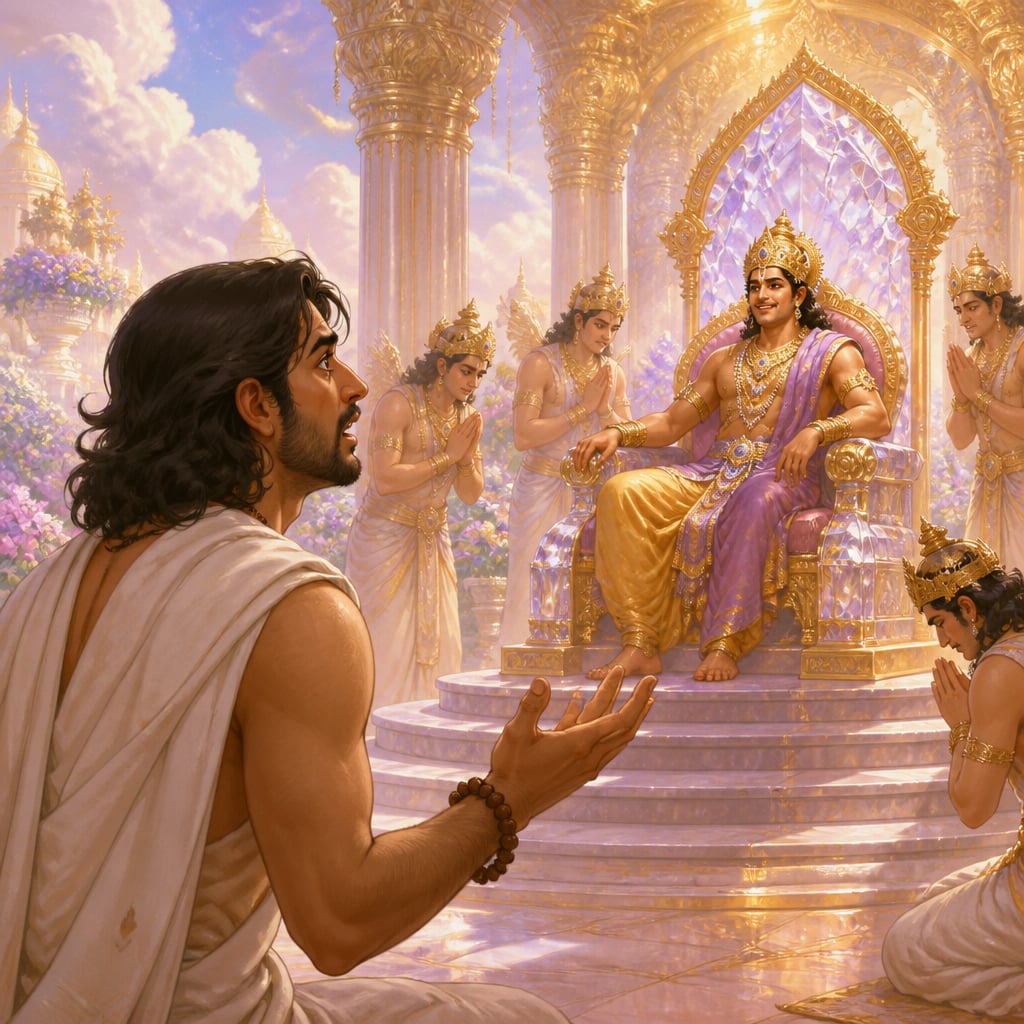
There, seated on a throne of crystal and gold, surrounded by attendants and honored by the gods themselves, sat Duryodhana.
The architect of the war. The man who had humiliated Draupadi. The cousin who had poisoned Bhima, burned the Pandavas in the house of lac, stolen their kingdom through loaded dice. The villain responsible for the deaths of millions, seated in glory in the highest heaven.
"What mockery is this?" Yudhishthira whispered.
The Absence of the Righteous
Yudhishthira turned to the celestial messenger who had guided him.
"Where are my brothers? Where is Draupadi? Where is Karna, who fought with honor even against us? Where are Bhishma and Drona, who gave their lives for duty?"
The messenger's face was impassive. "The souls you seek are not here, O King."
"Not here? Then where?"
"They are... elsewhere."
Yudhishthira felt something break inside him. He looked again at Duryodhana, who seemed not to notice him, lost in celestial pleasures, his wicked smile unchanged even in death.
"Take me to them," Yudhishthira commanded. "Take me to my family."
The Descent
The messenger led Yudhishthira away from the gardens of light. They walked a path that grew darker with each step. The sweet fragrance of heaven gave way to something foul. The celestial music faded, replaced by sounds that made Yudhishthira's heart clench, sounds of weeping, of lamentation, of souls in anguish.
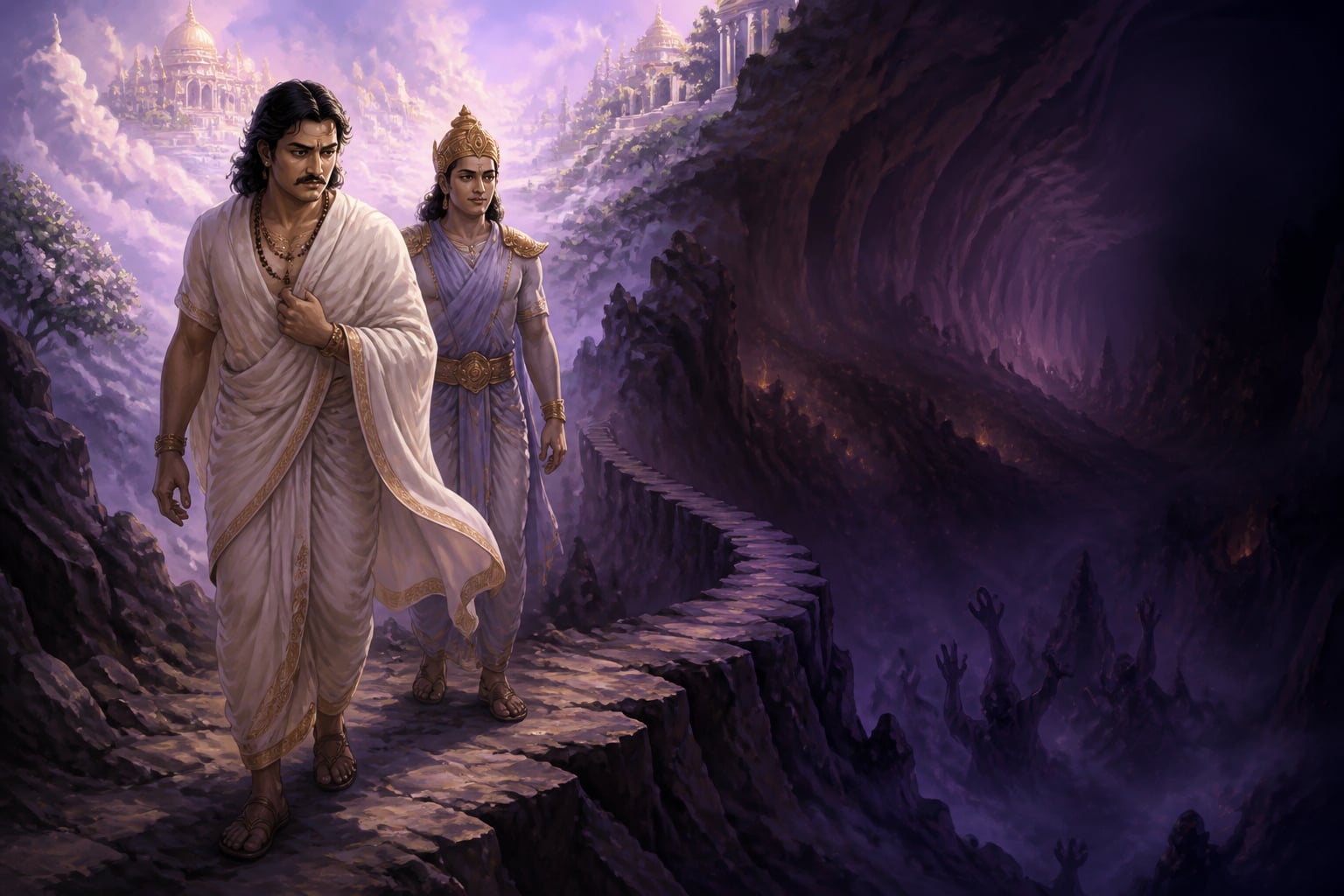
The path twisted downward through realms of increasing darkness:
- First, shadows obscured the light
- Then, the air grew thick with the smell of decay
- Finally, complete darkness swallowed everything
Yudhishthira could see nothing. He could only hear.
Voices in the Darkness
From the blackness came voices he knew better than his own heartbeat.
"Yudhishthira! Brother! Stay a moment, your presence brings us peace!"
That was Bhima's voice, mighty Bhima, reduced to pleading in the dark.
"Do not leave us! A moment of your nearness eases our torment!"
Arjuna. The invincible archer, now crying out like a child lost in the night.
"Brother, the air itself is sweeter when you are near. Please stay!"
The twins, Nakula and Sahadeva, their voices intertwined in desperation.
And then, a voice that pierced Yudhishthira more deeply than any weapon:
"Husband... stay with us. Even here, your dharma is our shelter."
Draupadi. His queen, who had endured humiliation for his failures, who had walked into the mountains to die beside them, suffering in this realm of torment.
The Question That Shook Heaven
Yudhishthira stood rigid in the darkness. He who had never raised his voice in anger, who had borne every injustice with patience, who had been called weak for his gentleness, now felt rage rising like a tide within him.
He turned to the messenger, and when he spoke, his voice carried the weight of a man who had finally been pushed beyond endurance:
"Explain this to me. Duryodhana, who orchestrated every injustice, who violated every law of dharma, who caused the deaths of millions through his greed, sits in the highest heaven. While my brothers, who fought for righteousness, who endured exile without complaint, who gave their lives for justice, suffer in this pit of darkness?"
His voice rose:
"What kind of cosmic order permits this? What dharma places the wicked in paradise and the virtuous in hell? Is this the justice of the gods?"
The King's Final Stand
The messenger remained silent. Perhaps he had no answer. Perhaps this was simply the way of things.
Yudhishthira drew himself up, the same posture he had held when refusing to abandon the dog, the same steel in his spine that had carried him through thirteen years of exile and eighteen days of war.
| What Yudhishthira Rejected | What Yudhishthira Chose |
|---|---|
| Heaven with the wicked | Hell with the righteous |
| Celestial pleasures | Suffering beside his family |
| The reward he had "earned" | The duty he owed to love |
| Personal salvation | Solidarity with the suffering |
"Then let the gods keep their heaven," Yudhishthira declared. "If this is where my brothers dwell, if this is where Draupadi suffers, if this is where those who fought for dharma have been cast, then I will remain here with them."

He sat down in the darkness.
"Go back and tell Indra: Yudhishthira has made his choice. I choose hell with the virtuous over heaven with the villains. I choose darkness with those I love over light with those I despise. If cosmic justice has failed, then let me at least bring what small comfort I can to those who deserved better."
The Impossible Choice Made Easy
It was not a difficult decision.
That was what the gods did not understand, they had designed this as a test, as a dilemma, as a moment of impossible choosing. But for Yudhishthira, it was the easiest choice he had ever made.
What good was heaven without Bhima's laughter? What use was paradise without Arjuna's companionship? What value had eternal bliss if Draupadi wept in darkness?
The gods measured reward and punishment. They calculated merit and sin. They assigned souls to realms based on cosmic accounting.
But Yudhishthira measured something else entirely: loyalty. Love. The simple truth that those who had stood beside him in life should not be abandoned in death, regardless of which realm they occupied.
The Darkness Deepens
Yudhishthira sat in that hell, surrounded by the voices of his suffering family. He could not see them. He could not touch them. But he could be present.
The messenger stood watching, perhaps waiting for Yudhishthira to change his mind, to reconsider, to choose the sensible path back to heaven.
But Yudhishthira had spent a lifetime being called a fool for his choices. For not fighting back against Shakuni's cheating. For honoring promises that cost him everything. For refusing to hate even those who had wronged him.
They called it weakness. He called it dharma.
And now, at the end of all things, his dharma remained unchanged. He would not abandon those he loved, not for a dog at heaven's gates, and not for the suffering souls in hell's depths.
The darkness pressed in. The cries of torment continued. And Yudhishthira, King of Dharma, sat in perfect stillness.
Waiting.
Not for rescue. Not for justice. Simply... present.
In that moment of ultimate choice, something began to shift. The darkness itself seemed to waver. The air grew less foul. The voices of anguish softened.
For the final revelation was about to unfold, and nothing Yudhishthira had experienced in heaven or hell would prepare him for the truth that awaited.
Living traditions
This episode is frequently cited in discussions of theodicy (why suffering exists under a just God/cosmos). It has influenced Indian literature's exploration of injustice, appearing in works from Tagore to contemporary writers. The image of choosing hell with loved ones over heaven alone resonates across cultures.
- Pitru Paksha (Ancestor Fortnight): A 15-day period when Hindus perform rituals for deceased ancestors, believing their offerings reach loved ones regardless of which realm they occupy. The underlying belief, that our actions can benefit the dead, echoes Yudhishthira's conviction that presence matters even in hell.
- Gaya: The most sacred site for performing ancestral rites (shraddha). Pilgrims come here to offer pinda (rice balls) to liberate ancestors from suffering realms, embodying the belief that love and ritual can transcend cosmic boundaries.
Reflection
- Why do you think Duryodhana was shown in heaven? What might the epic be saying about the relationship between merit, karma, and ultimate justice?
- Would you choose to suffer alongside loved ones or enjoy happiness alone? What does your answer reveal about what you truly value?
- Yudhishthira questioned even the gods' arrangement of heaven and hell. When is it appropriate to question religious or cosmic teachings, and when should one accept them?