Dharma: The Faithful Dog
Only Yudhishthira walks on
Yudhishthira reaches the summit of Mount Meru, where Indra offers him entry to heaven, but only if he abandons the faithful dog. Yudhishthira's refusal leads to the revelation that changes everything: the dog is Dharma himself, and this was the final test.
The Summit
Yudhishthira stood at the roof of the world.
Behind him lay the slopes of Mount Meru, scattered with the bodies of everyone he had ever loved. Ahead lay the threshold of heaven itself, that realm where gods dwelt, where suffering ended, where the long journey of existence finally found rest.
And beside him, as always, stood the dog.
The creature looked no different than it had when it first appeared at the gates of Hastinapura. Still lean. Still unremarkable. Still faithful. It had walked every step of the journey without complaint, without wavering, without falling.
Yudhishthira looked at it with new eyes. Of all his companions, his four mighty brothers, his queen who had endured unimaginable suffering, this simple animal alone had completed the journey.
What does that mean? he wondered. What truth does this creature carry that I have not yet understood?
The answer would come soon enough.
The Arrival of Indra
A sound like thunder rolled across the peak, though the sky was clear. Then light, brilliant, golden, overwhelming, filled the air. Yudhishthira shielded his eyes as a celestial chariot descended from the heavens.
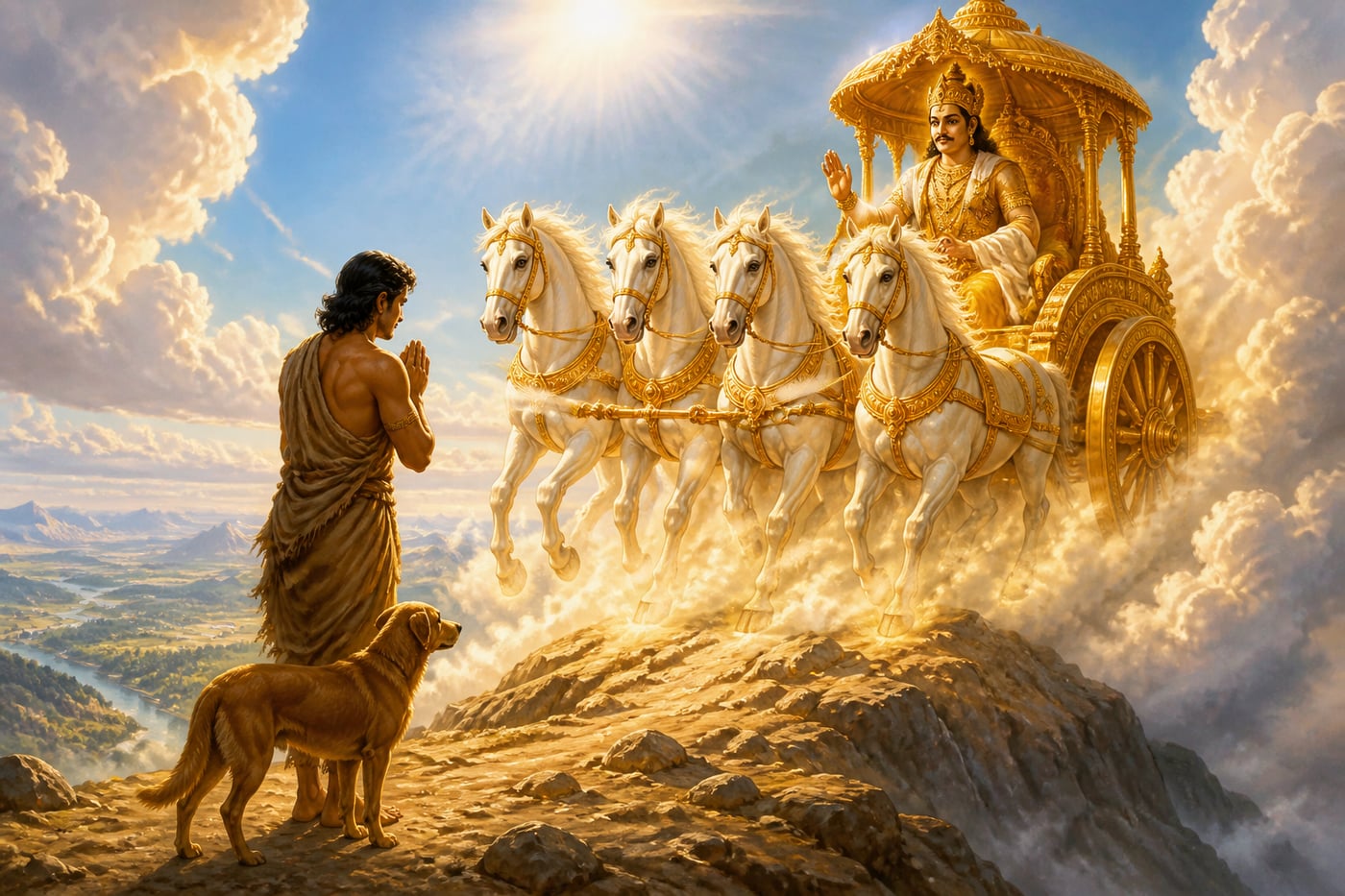
In the chariot stood Indra, king of the gods, lord of Svarga, ruler of the celestial realm. His form blazed with divine radiance. His crown bore the light of a thousand suns. His voice, when he spoke, seemed to come from everywhere at once.
"Yudhishthira, son of Kunti, son of Dharma himself! You have accomplished what few mortals ever achieve. You have walked the Mahaprasthana and reached the summit of Meru in your mortal body. The gates of heaven stand open for you."
Yudhishthira bowed low. Despite everything, the war, the kingdom, the journey, he had never lost his humility before the divine.
"Lord Indra, I am honored beyond measure. But I cannot accept this invitation alone."
Indra smiled. "Your brothers and Draupadi have already attained heaven, Yudhishthira. They fell on the mountain, yes, but their souls have risen. They await you in the celestial realm. You shall see them again."
Hope flickered in Yudhishthira's heart. His family was not lost after all. They had merely gone ahead.
"Then I am ready to ascend," he said.
He moved toward the chariot, and the dog moved with him.
The Condition
Indra's smile faded.
"Not the dog," the king of gods said firmly. "The dog cannot enter heaven. Dogs are impure. They are not fit for the celestial realm. Leave this creature here and ascend with me."
Yudhishthira stopped. He looked at the dog, then at Indra, then back at the dog.
"This dog has followed me faithfully from Hastinapura. It has walked every step of this journey without faltering. It has asked nothing of me and given everything. I cannot abandon it now."
Indra's expression hardened.
"Yudhishthira, you have renounced everything, your kingdom, your weapons, your identity. You did not stop when Draupadi fell. You did not stop when your brothers fell. Yet now you would stop for a dog?"
"My brothers and Draupadi fell because of their own karma," Yudhishthira replied. "I could not save them from the consequences of their attachments. But this dog has no such flaw. It has done nothing wrong. It has simply followed me in faith."
"It is still a dog," Indra insisted. "And dogs do not enter Svarga."
Yudhishthira did not move.
The Arguments
Indra tried another approach.
"Consider, Yudhishthira, what awaits you in heaven. Your father Pandu is there. Your mother Kunti is there. Your beloved Krishna is there. Bhishma, Drona, and all the great warriors who fell in the war have found their rest. Your brothers and Draupadi wait for you. Will you truly sacrifice all of this for a stray dog?"
For a moment, Yudhishthira wavered. The faces of the dead rose before him, his father whom he had never known, his mother who had suffered so much, Krishna whose loss had broken something in his heart. All of them, waiting. All of them, finally at peace.
And then he looked at the dog again.
It looked back at him with eyes that held no demand, no plea, no accusation. It simply waited to see what he would do.
"Lord Indra," Yudhishthira said slowly, "there are four sins that are considered unforgivable: abandoning one who has come to you in fear, killing a woman, stealing a Brahmin's property, and causing harm to a friend. If I abandon this dog, I will be guilty of the first."
| Unforgivable Sin | Description |
|---|---|
| Abandoning the fearful | Rejecting one who seeks protection |
| Killing a woman | Taking an innocent life |
| Stealing from Brahmins | Violating sacred property |
| Harming a friend | Betraying trust |
"This creature came to me seeking nothing but companionship. It has been faithful through every hardship. To abandon it at the threshold of heaven would be to commit a sin that no heavenly reward could justify."
The Test Intensifies
Indra's eyes flashed.
"You are being foolish, Dharmaraja. This is your one chance to enter heaven in your mortal body, an honor granted to almost no one in history. And you would throw it away for sentimental attachment to an animal?"
"Is it attachment," Yudhishthira asked quietly, "or is it dharma?"
"What?"
"You call this creature unclean and unworthy of heaven. But it has shown more steadfastness than my own brothers. It has demonstrated more faithfulness than most humans ever achieve. If heaven has no place for such devotion, then perhaps heaven's standards are not as high as we imagine."
Indra was silent for a long moment.
"You would truly refuse heaven for this dog?"

"I would refuse any reward that requires me to betray one who trusts me."
Yudhishthira's voice was steady now, all uncertainty gone.
"I have walked away from my kingdom. I have walked away from my weapons. I have walked away from the bodies of my brothers and my wife lying cold in the snow. But I will not walk away from a being that has given me its complete trust. That is the one thing I cannot renounce."
The Revelation
And then the dog was gone.
In its place stood a figure of radiant light, tall, dignified, with eyes that held the wisdom of ages. The form was unmistakable to anyone who knew the scriptures.
It was Dharma himself, the god of righteousness, the lord of death, the divine father of Yudhishthira.
Yama Dharmaraja smiled at his son.
"Well done, Yudhishthira."
Yudhishthira fell to his knees, overwhelmed. His father. The god whose essence he had carried in his blood since birth. The principle he had tried to embody throughout his life.
"Father... you were the dog?"
"I was testing you," Dharma said gently. "Just as the mountain tested your brothers and Draupadi, I tested you. And you have passed."

"But why? Why this test?"
Dharma's answer was the final teaching of the Mahaprasthana:
"Anyone can practice dharma when it is easy. Anyone can be righteous when there is nothing to lose. The true test of character comes when dharma demands that you sacrifice what you most desire. You desired heaven, and you were willing to give it up rather than abandon a creature who trusted you. That is true dharma. That is why you alone could reach this summit in your mortal body."
The Meaning
Yudhishthira rose slowly, his mind spinning with understanding.
The entire journey had been a test. The falling of his companions. The long lonely climb. And finally, the choice between heaven and a dog.
But it was never really about a dog. It was about the principle that Yudhishthira had built his entire life upon:
Those who seek your protection must never be abandoned.
This was why he had fought the war, because the Pandavas' subjects had been betrayed by the Kauravas. This was why he had ruled justly for thirty-six years, because a king's duty is to protect his people. And this was why he could not enter heaven if it meant abandoning a faithful creature.
Indra stepped forward, all pretense of severity gone.
"Yudhishthira, you have been tested by the gods and found worthy. Your devotion to dharma is complete. Now enter heaven, not as a reward for what you have achieved, but as a recognition of who you are."
Dharma added:
"Your brothers and Draupadi will join you. Their flaws prevented them from completing the journey in mortal form, but their souls have already ascended. You shall see them again, purified, perfected, at peace."
Yudhishthira looked once more at the slopes below, at the path he had walked, at the places where his loved ones had fallen.
"Then the journey was worth it," he said quietly. "All of it."
He stepped into the celestial chariot.
The Lesson of the Dog
As the chariot rose toward the heavens, Yudhishthira reflected on what the dog had taught him.
In the end, the Mahaprasthana was not about reaching a destination. It was about discovering what you would not abandon even to reach that destination.
Draupadi had fallen because of partiality. The brothers had fallen because of pride. But Yudhishthira would have fallen too, fallen into moral failure, if he had abandoned the dog for the sake of heaven.
The dog was dharma itself. Not the abstract principle, but the living practice. The daily commitment to protect those who trust you, to keep faith with those who depend on you, to never betray the vulnerable for the sake of personal gain.
This was the final teaching of the Mahaprasthana:
Heaven is not a reward for the righteous. Heaven is what the righteous create wherever they go, by their refusal to abandon, their commitment to protect, their unwavering practice of dharma even when it costs them everything they desire.
The chariot disappeared into the light.
The Mahaprasthanika Parva was complete.
Living traditions
The story of Yudhishthira and the dog has become a touchstone for ethical discussions about loyalty, integrity, and the treatment of animals. Corporate ethics trainers use it to discuss non-negotiable principles. Animal welfare advocates cite it as ancient support for compassionate treatment of all creatures. The image of rejecting heaven rather than betraying trust resonates across cultures and contexts.
- Shvan Puja (Dog Worship during Kukur Tihar): In Nepal and parts of India, dogs are worshipped during the Tihar festival. They are garlanded, given tika, and fed special foods. This practice echoes the Mahaprasthana teaching that dogs, like all creatures, deserve respect and protection.
- Dharma Temple (Dharmaraja Yudhishthira Temple): One of the rare temples dedicated to Dharmaraja Yudhishthira, commemorating his unwavering commitment to righteousness. The temple celebrates the principles demonstrated in the Mahaprasthana.
- Tungnath Temple: The highest Shiva temple in the world (3,680 m), believed to have been built by the Pandavas during their journey. The location represents the extreme heights of the Mahaprasthana path.
Reflection
- Is there someone or something in your life that you might be tempted to abandon for the sake of a great opportunity? What would you lose by such abandonment?
- Why did Dharma choose to appear as a dog rather than in any other form? What does this choice teach about where dharma is most truly tested?
- If Yudhishthira had abandoned the dog and entered heaven, would that heaven have been truly heavenly for him? What does this suggest about the nature of spiritual reward?