Culla-Hamsa: The Brave Golden Swan
A swan who chose loyalty over safety
In a golden lake lives a flock of magnificent swans led by their noble king, Dhritarashtra. When royal hunters trap the Swan King in a snare, his entire flock flees in terror - all except one. Sumukha, the brave commander, refuses to abandon his trapped king, even as hunters close in. His extraordinary courage in the face of certain capture will move even the hardest heart.
The Golden Lake
Far in the Himalayas, hidden among snow-capped peaks, lay a lake of surpassing beauty. Its waters gleamed like liquid gold in the morning light, and lotus flowers as big as cartwheels floated on its surface.
On this lake lived ninety thousand golden swans - the most magnificent birds in all the world. Their feathers shimmered like burnished metal. Their calls echoed through the mountains like temple bells.
The swans were led by their king, Dhritarashtra, whose wisdom matched his beauty. His chief commander was Sumukha, a swan whose courage was legendary even among the brave.
"My king," Sumukha would say, "where you go, I follow. Your safety is my life's purpose."
Dhritarashtra would smile. "Such loyalty is rare, my friend. May you never have to prove it."
The Queen's Dream
Far to the south, in the wealthy kingdom of Benares, Queen Khema woke from a strange dream. She had seen golden swans flying across the moon, their feathers trailing light like shooting stars.
"I must have them," she told King Brahmadatta. "I must hear the golden swans speak of dharma. Please, my lord - send hunters to capture them."
The king loved his queen. He summoned his finest hunter, a man named Khemaka.
"Find the golden swans," the king commanded. "Bring them to my queen - alive."
Khemaka bowed. "It will be done, Your Majesty."
The hunter searched for years. He traveled through forests and over mountains. He asked sages and followed rumors. Finally, he found the golden lake.
"Magnificent," he breathed, watching the swans from behind a rock. "But how can one man catch ninety thousand birds?"
He thought for days. Then he smiled.
"I don't need to catch them all. I only need to catch their king."
The Trap
Khemaka studied the swans' habits. He noticed that Dhritarashtra always led the flock to feed in the same shallow bay each morning. The king always landed on the same large lotus leaf.
The hunter crept out at midnight. Moving silently through the water, he set a snare beneath the lotus leaf - a loop of horsehair so fine it was invisible, but strong enough to hold an elephant.
Then he hid among the reeds and waited.
Dawn came. The swans descended like a golden cloud. Dhritarashtra, as always, landed first on his favorite lotus.
The snare closed around his foot.
The Swan King felt the trap bite into his leg. He didn't struggle - he knew that would only tighten the knot. Instead, he stood perfectly still.
"Fly!" he commanded his flock. "Fly now! It's a trap!"
Ninety thousand swans exploded into the sky in a thunder of wings. They circled once, twice - then streamed away toward the safety of the mountains.
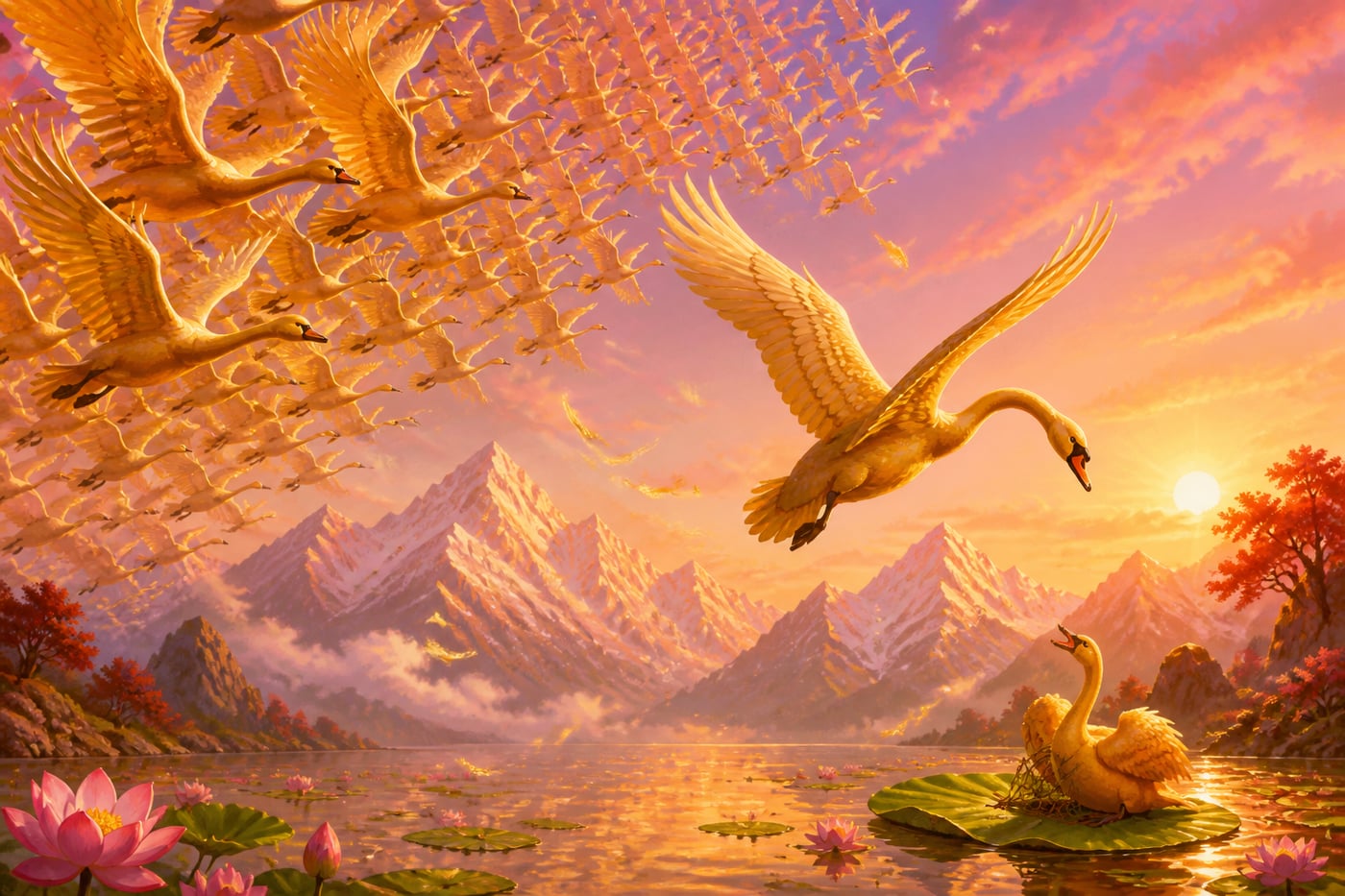
All except one.
The Swan Who Stayed
Sumukha had been in the air with the others. He had felt the rush of escape, the relief of safety. But as he flew, he looked back.
His king stood alone on the lotus leaf, trapped.
Sumukha's wings faltered. Every instinct screamed at him to flee. The hunter was coming. Capture meant cages, perhaps death.
But his king was alone.
Sumukha turned and flew back.
"What are you doing?" Dhritarashtra cried as his commander landed beside him. "I ordered you to fly! Go now - save yourself!"
Sumukha folded his wings calmly.
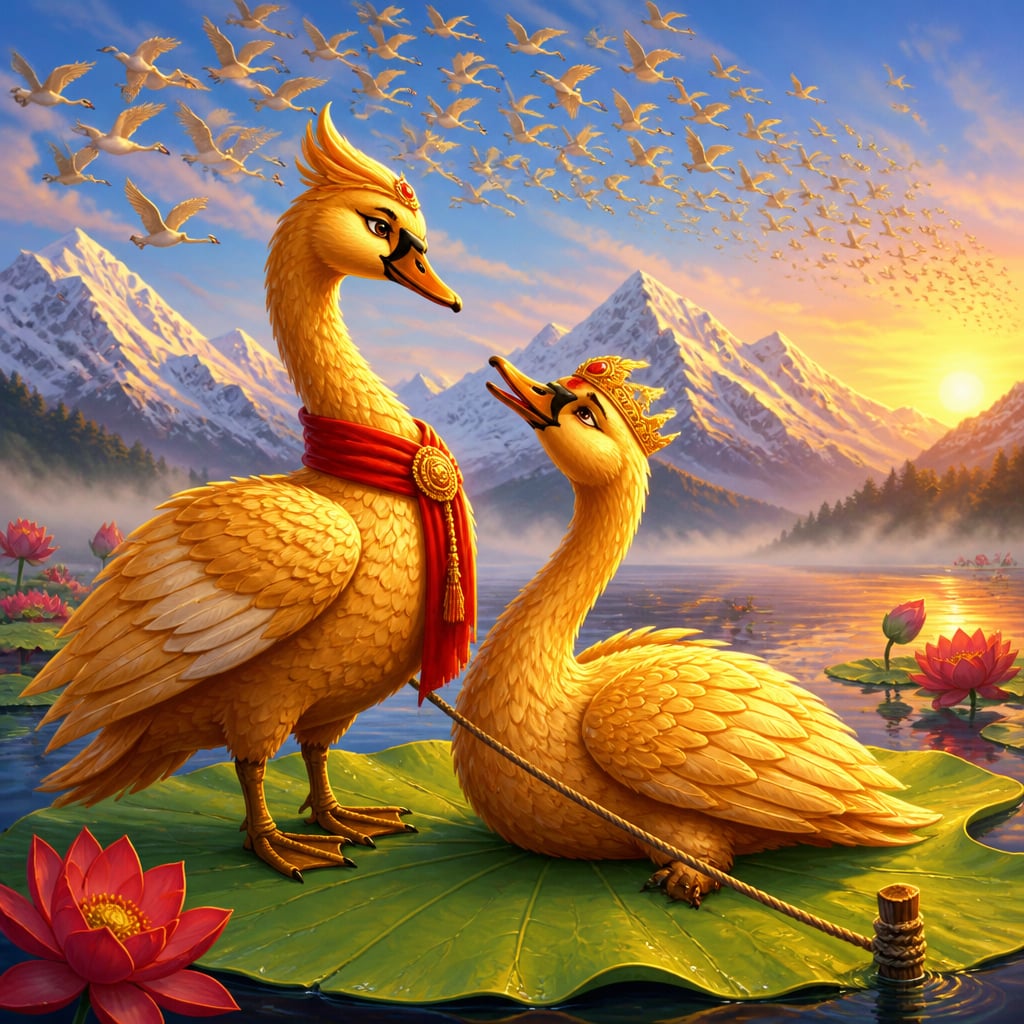
"My king, I have served you since I was a hatchling. I have sworn to protect you. How can I abandon you now, in your darkest hour?"
"You cannot help me! The trap is too strong. You will only be captured yourself!"
"Then we will be captured together." Sumukha's voice was steady. "I would rather die at your side than live with the shame of having fled."
Dhritarashtra's eyes filled with tears.
"Oh, Sumukha. Of all my ninety thousand swans, you alone stayed. Your loyalty is worth more than a kingdom."
The Hunter's Choice
Khemaka emerged from the reeds, his net ready. He had expected to capture one swan. Instead, he found two.
He stared at the birds. The trapped king stood with quiet dignity. Beside him, the other swan - clearly free to escape - refused to leave.
"Why do you stay?" Khemaka asked, amazed. "I have not trapped you. You could fly away this instant."
Sumukha met the hunter's eyes.
"This is my king. I will not abandon him."
"But I will capture you. I will put you in a cage."
"Then I will be caged with my king."
"You might die."
"Then I will die with my king."
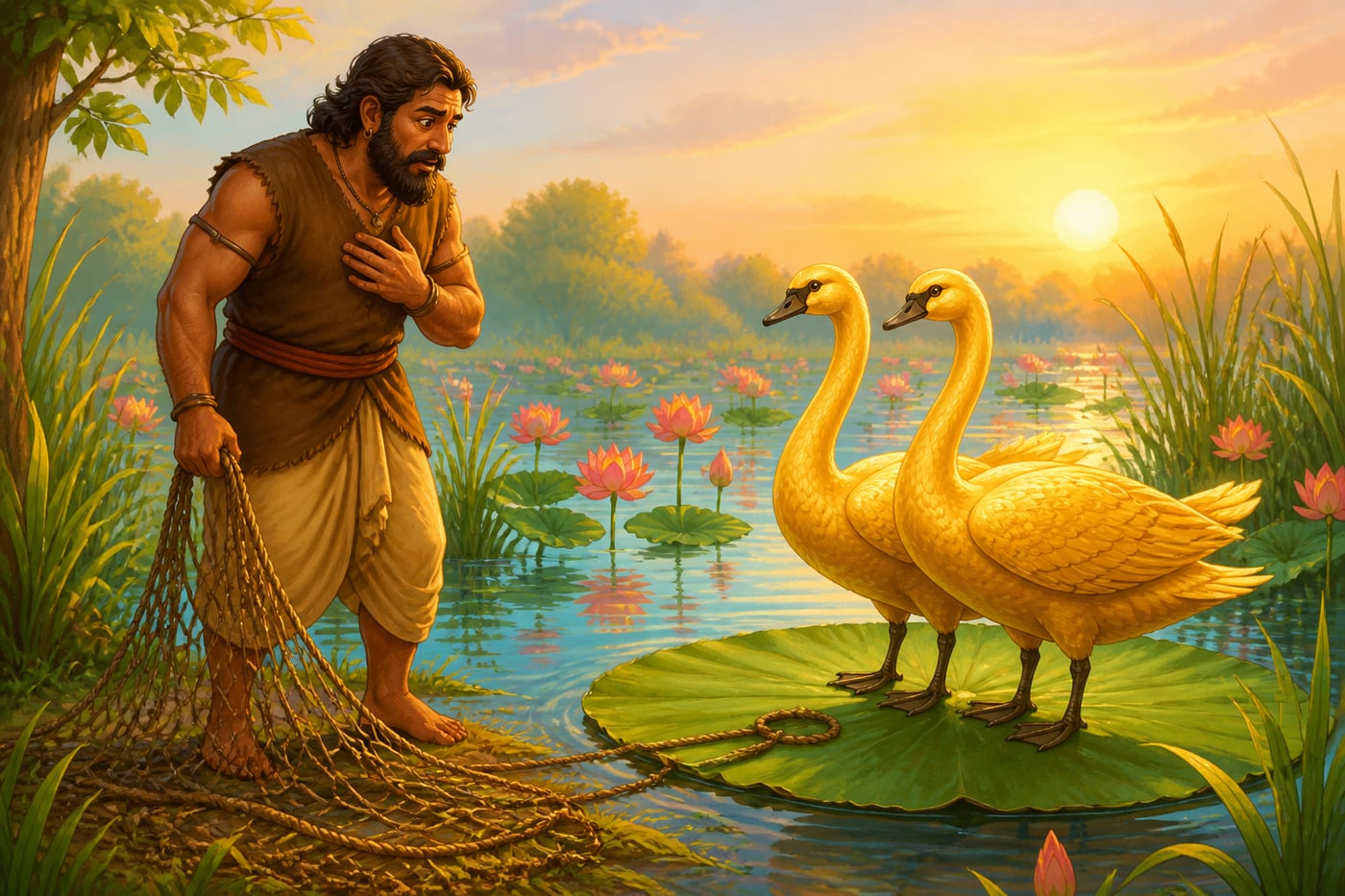
Khemaka lowered his net. In all his years of hunting, he had never seen such courage. He had trapped deer that abandoned their fawns. He had caught elephants that fled without their herds. But this swan - this small, fragile creature - was willing to give up everything for loyalty.
"I cannot do it," the hunter whispered. He reached down and cut the snare.
Dhritarashtra stretched his freed leg in amazement.
"You... release me?"
"I came to capture golden swans for my queen. But what I have found is worth more than gold." Khemaka bowed his head. "Teach me, noble ones. What dharma makes a creature value loyalty over life itself?"
Before the Queen
Khemaka brought both swans to the palace - not as prisoners, but as honored guests. Queen Khema was confused.
"Where are their cages? Why are they not bound?"
Khemaka told her everything: the trap, the fleeing flock, the one swan who returned, the courage that shamed his hunter's heart.
The queen was moved to tears.
"I dreamed of golden swans who could teach dharma. I thought I wanted them as pets, as ornaments." She looked at Sumukha with wonder. "But you have already taught me more than I imagined. You showed me what true loyalty looks like."
Dhritarashtra spoke then, his voice like temple bells.
"Great Queen, the dharma is simple: we protect what we love, not because it benefits us, but because love itself demands it. Sumukha did not calculate his chances. He did not weigh his life against mine. He simply could not abandon what he loved."
The queen and king honored the swans with a great feast. When it ended, they opened the palace windows wide.
"Go," Queen Khema said. "Fly back to your golden lake. And know that you have changed my heart forever."
Two golden swans rose into the sky, circling the palace once in gratitude before vanishing into the northern clouds.
The Wisdom
Sumukha's courage wasn't loud or violent. He didn't fight the hunter or try to destroy the trap. His bravery was quieter but deeper: the courage to stay when staying meant sacrifice.
True loyalty isn't just being there when times are good. It's being there when times are terrible - when staying puts you at risk, when leaving would be easy and safe and sensible.
The ninety thousand swans who fled weren't evil. They were normal. Sumukha was extraordinary because he chose love over safety, loyalty over logic.
In Your Life
Loyalty gets tested in small ways every day. Maybe a friend is being teased, and joining the laughter would be easier than standing with them. Maybe someone you care about made a mistake, and it would be simpler to distance yourself than to stick by them.
You don't have to face hunters to prove your loyalty. But when the moment comes - when it would be easier to walk away, when staying means risk or discomfort or embarrassment - remember Sumukha.
He flew back.
The swans who fled are forgotten. But the one who stayed? His name lives forever.
Reflection
- Have you ever stayed loyal to a friend when it would have been easier to walk away? What made you stay?
- The ninety thousand swans who fled weren't punished in the story - only Sumukha was praised. Is it wrong to protect yourself, or is extreme loyalty just one choice among many valid ones?
- Khemaka the hunter was transformed by witnessing Sumukha's loyalty. Can you think of a time when seeing someone else's courage or kindness changed how you think or act?