The Princess Who Became a Goddess
Meenakshi was born with three eyes and led armies. She only stopped fighting when she met her equal.
In the southern city of Madurai, a king prayed for a son and got a daughter instead. She was born with fish-shaped eyes and a third eye on her forehead. She grew up to become the bravest queen in the south, leading armies and ruling lands. She fought every great warrior in the world. And then, on a battlefield in the Himalayas, she met the one warrior whose calm matched her courage. He looked at her, and her third eye disappeared. She had finally met her equal.
A King Who Wanted a Son
Long ago, in the southern city of Madurai, there was a king named Malayadhwaja. He and his queen, Kanchanamala, were good rulers. The city was rich. The temples were busy. The streets were clean. The river flowed gently past the palace walls.
There was just one problem. They had no children.
After many years of waiting and praying, Malayadhwaja decided to perform a great yajna (a sacred fire ceremony). He invited the holiest priests in the south. They lit the fire. They poured ghee. They chanted for many days. The whole city watched.
"O great gods," the king prayed at the end of the yajna, "please give us a son. A brave son. A strong son. A son who can rule Madurai after us."
The fire crackled. The smoke rose. And then, out of the very middle of the flames, something amazing happened.
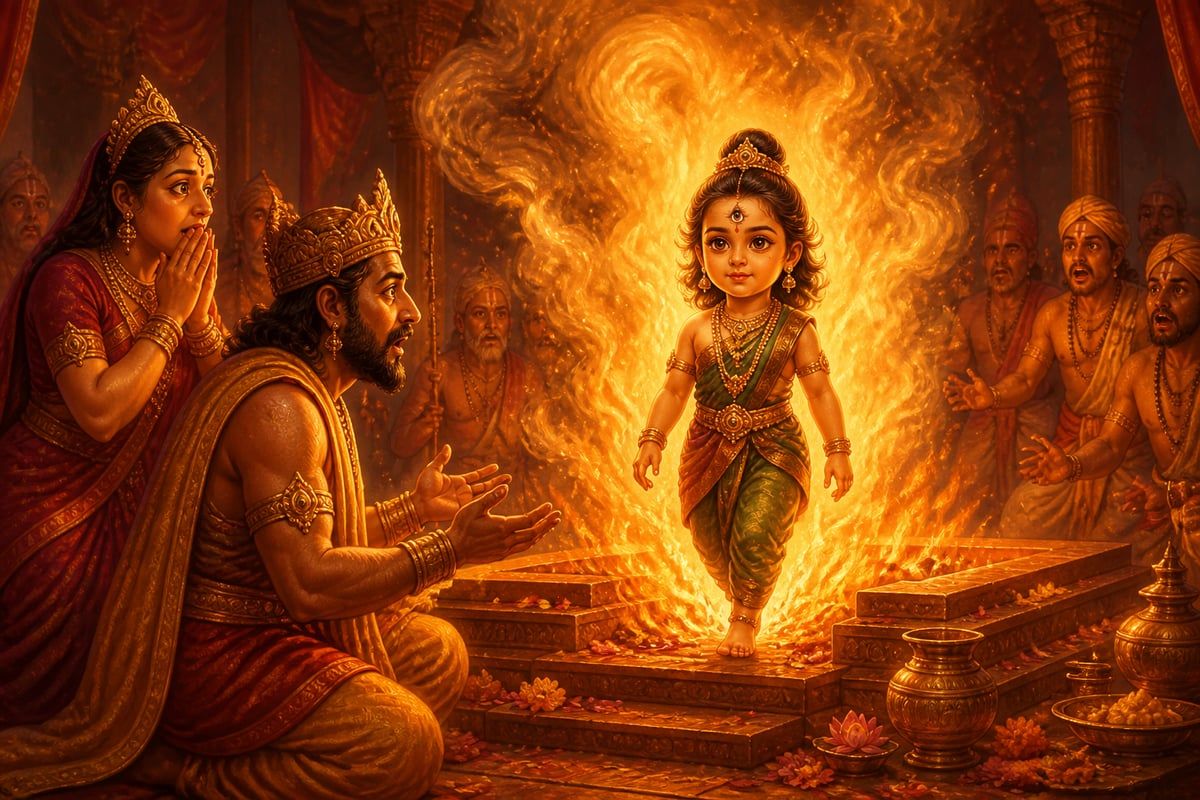
A little girl walked out.
She was about three years old. She had black hair, a soft yellow dress, and the most beautiful eyes the king had ever seen. They were shaped like meena, the Sanskrit word for fish. Long, dark, with a graceful curve.
And in the middle of her forehead, there was a third eye.
The king blinked. "A daughter? But I asked for a son."
A voice came from the fire. It was the voice of Shiva.
"You asked for a brave one," said Shiva. "You asked for a strong one. You asked for one who could rule Madurai. I am sending you all of those. You are not getting a son. You are getting better than that. You are getting Meenakshi."
The Princess With Three Eyes
The little girl was named Meenakshi, which means the one with fish-shaped eyes.
But everybody also noticed the third eye on her forehead. It made the priests a little nervous.
"O king," one old priest whispered, "a third eye is unusual on a girl. The gods may be giving you a sign. Perhaps the third eye will disappear on its own when she finds the right partner. We shall see."
The king nodded slowly. He did not really understand. But he was a happy father, and he decided to raise this strange and lovely girl exactly as he would have raised a son.
Meenakshi grew up in the palace. She wore silk dresses, but she also wore armour. She learned to dance, but she also learned to fight. She read poetry, but she also learned how to plan a battle.
She was kind to everyone. She fed the temple cows herself, every morning. She remembered the names of the gardener's children. She gave her own jewellery to a poor weaver one day, just because the weaver looked tired.
But the moment somebody touched a sword, Meenakshi's eyes lit up. She trained every day. By twelve, she was beating her own sword teacher. By fifteen, no warrior in Madurai could match her. By eighteen, she was famous all across South India.
The Queen Who Won Every Battle
When King Malayadhwaja grew old, he placed his crown on Meenakshi's head himself.
"My daughter," he said, "rule Madurai well. And take whatever else you want. The world is yours."
Meenakshi bowed. She kissed his hand. Then she gathered her army and rode out to conquer the world. Or as much of it as a queen of Madurai could conquer in those days.

She rode east. She defeated kings. She rode west. She defeated more kings. She rode south to the sea. She rode north and crossed the Vindhya mountains.
Meenakshi was not cruel. She did not hurt people who did not fight her. She simply showed up, fought the king, won, and accepted his bow. She added each kingdom to her own. The kings remained in their cities. The people kept their lives. The taxes were fair. Meenakshi was a good conqueror, the way good ones were in the Dharmic tradition. She wanted to bring the world together, not break it.
But every kingdom she conquered, she still had her third eye. It still glowed faintly on her forehead.
The priest's words came back to her sometimes. Perhaps the third eye will disappear when she finds the right partner.
She shook the thought off. I don't need a partner. I have my army.
And so she rode further north.
The Mountain Where Everything Stopped
Finally, Meenakshi reached the Himalayas. The mountains rose like white walls in front of her. She had never seen anything so big, even though she had crossed half of India.
Up on those mountains, she had been told, lived a strange yogi. He sat on a tiger skin. He had matted hair piled on top of his head. There was a cool blue mark on his throat. Snakes wrapped around his neck like ornaments. He never seemed to sleep. He never seemed to eat. He just sat, on the snow, with his eyes half-closed, on a peak called Mount Kailash.
His name was Shiva.
"He is the one undefeated warrior left," Meenakshi's generals told her. "Every other king bows to you. He does not bow to anyone. If you defeat him, the whole world is truly yours."
Meenakshi tightened her armour. She climbed Kailash with her army behind her.
The air grew thin. The snow grew deeper. The wind howled. Even her bravest soldiers began to slow down. But Meenakshi kept walking.
Finally, she reached a wide flat space at the top, with a great rock in the middle. And on that rock sat the yogi.
He did not stand up. He did not open his eyes fully. He did not pick up a weapon. He just sat there, with his half-smile, completely still.
Meenakshi raised her sword. "Yogi," she said, in her queen's voice, "I have come to fight you. Stand up."
Shiva opened his eyes slowly. They were the deepest, calmest eyes she had ever seen. Like still pools of water that had been still for a thousand years.
He looked at her.
Really looked at her.
Not the way men usually looked at her, with surprise (a woman?) or with fear (her sword!) or with hunger (her crown!). He looked at her the way a mountain looks at the sun. Calmly. With recognition. As if he had been waiting for her to arrive.

And in that one moment, something shifted inside Meenakshi.
She could not lift her sword. Not because she was weak. Because, suddenly, she did not want to.
She lowered the sword slowly. She took a step closer. He did not move.
She took another step. He did not move.
She came right up to him. He looked up at her, gently.
And her third eye, the one that had been glowing on her forehead since the day she walked out of the fire, slowly, slowly, faded away.
The Meaning of the Third Eye
Meenakshi gasped. She touched her forehead. The third eye was gone.
She understood, finally, what the priest had meant all those years ago.
The third eye was not an extra eye. The third eye had been a sign. A sign that she was a goddess in human form, walking the earth in search of something. Not a kingdom. Not a battle. A match.
All her conquering, all her riding, all her fighting, had been a long search. The whole world had to be checked to find the one being who, when she stood in front of him, made her want to put down the sword.
Shiva.
She had been searching for Shiva.
And Shiva, sitting on his rock for thousands of years, had been waiting for exactly her.
Meenakshi laughed. A real, surprised, happy laugh. She bowed.
"O Mahadeva," she said, "I think I have come a very long way to meet you."
Shiva smiled fully now. "I have been waiting for you, my queen. But I will not stay on this mountain. We will go back to your city. We will live in Madurai. The two of us. As equals. The way we were always meant to."
The Wedding That Shook the World
Meenakshi rode back to Madurai with Shiva by her side. The whole city came out to see them. The streets were lit with thousands of oil lamps. The priests blew conch shells. The river sang. Every flower in the south burst open at once.
The wedding lasted seven days. All the gods came. Vishnu himself, who is Meenakshi's brother in the Madurai tradition, walked her around the sacred fire and gave her hand to Shiva. Brahma chanted the marriage hymns. The Saptarishis, the seven great sages, blessed the couple. Even Yama (yes, the same Yama from the last lesson) stood quietly in the back, smiling for once.
From that day, Meenakshi and Shiva ruled Madurai together. She did not stop being a queen. He did not stop being a yogi. They simply became equal. He as Sundareshvara, the handsome lord. She as Meenakshi, the fish-eyed queen. Together they are the most-loved divine couple in all of South India.
And because Meenakshi was already a queen when Shiva married her, the Madurai temple gives her name first, before his. Meenakshi-Sundareshvara. The wife's name comes first. The Tamil tradition is gentle, but firm, about this. Meenakshi was nobody's helper. She was an equal.
The Lesson of the Third Eye
The Dharmic tradition teaches that Meenakshi's third eye is not unique to her. The third eye is something every brave girl in the world carries. It is a way of seeing what is not yet there. It is the eye that goes searching. It is the eye that does not stop fighting until it has found what it was actually looking for.
For Meenakshi, what she was looking for was her equal. Not a husband she would obey. Not a king she would serve. An equal. The third eye of a brave girl is searching for that, even when she does not know it yet.
When she finds it, the third eye does not need to glow anymore. It softens. The girl does not stop being brave. She does not stop being strong. She just stops being alone.
In Your Life
If you are a brave kid, do not be in a hurry to put down your sword. Meenakshi conquered half of India before she met her match. The Dharmic tradition does not ask you to be small. It does not ask you to give up. It asks you to keep searching, with your third eye open, until you meet your equal.
And it does not have to be a husband or a wife when you grow up. Your equal can be a best friend. It can be a teacher. It can be a calling. It can be a god. The point is to keep going until you find the one in front of whom you can finally put down your sword and say: I think I have come a very long way to meet you.
You know you have found your equal when, sitting next to them, you do not feel smaller. You feel exactly the right size.
Reflection
- Has anybody ever told you that you are *too much* of something? Too brave, too loud, too fierce, too clever, too curious, too anything? What did they say, and how did it feel? After hearing Meenakshi's story, what would you tell them now? What would you tell yourself?
- In the Madurai temple, Meenakshi's name comes before Shiva's. The wife is named first. Why do you think the Tamil tradition does this? What does it tell us about what real love looks like in our tradition?