Bringing the Whole Mountain
Lakshmana was dying. The herb was on a faraway mountain. Hanuman couldn't find it. So he brought the whole mountain.
On a battlefield in Lanka, Lakshmana was dying. The only thing that could save him was a tiny glowing herb called Sanjeevani, growing on a far mountain in the Himalayas, and Hanuman had until sunrise to fetch it. He flew, he searched, he could not tell which plant was the right one, so he did the only thing he could. He picked up the entire mountain and flew back with it.
Lakshmana Falls
The war in Lanka had been going on for many days. Rama and his strange army (the monkeys, the bears, the eagles, and one very small squirrel from the last lesson) had crossed the bridge, climbed the cliffs, and were now fighting Ravana's terrible army, demon by demon.
It had been a long, hard battle. And then something happened that nobody had been ready for.
Indrajit, who was Ravana's clever son and the most dangerous warrior in his army, fired a magical arrow. The arrow whistled through the air. It struck Lakshmana, Rama's beloved younger brother, right in the chest.
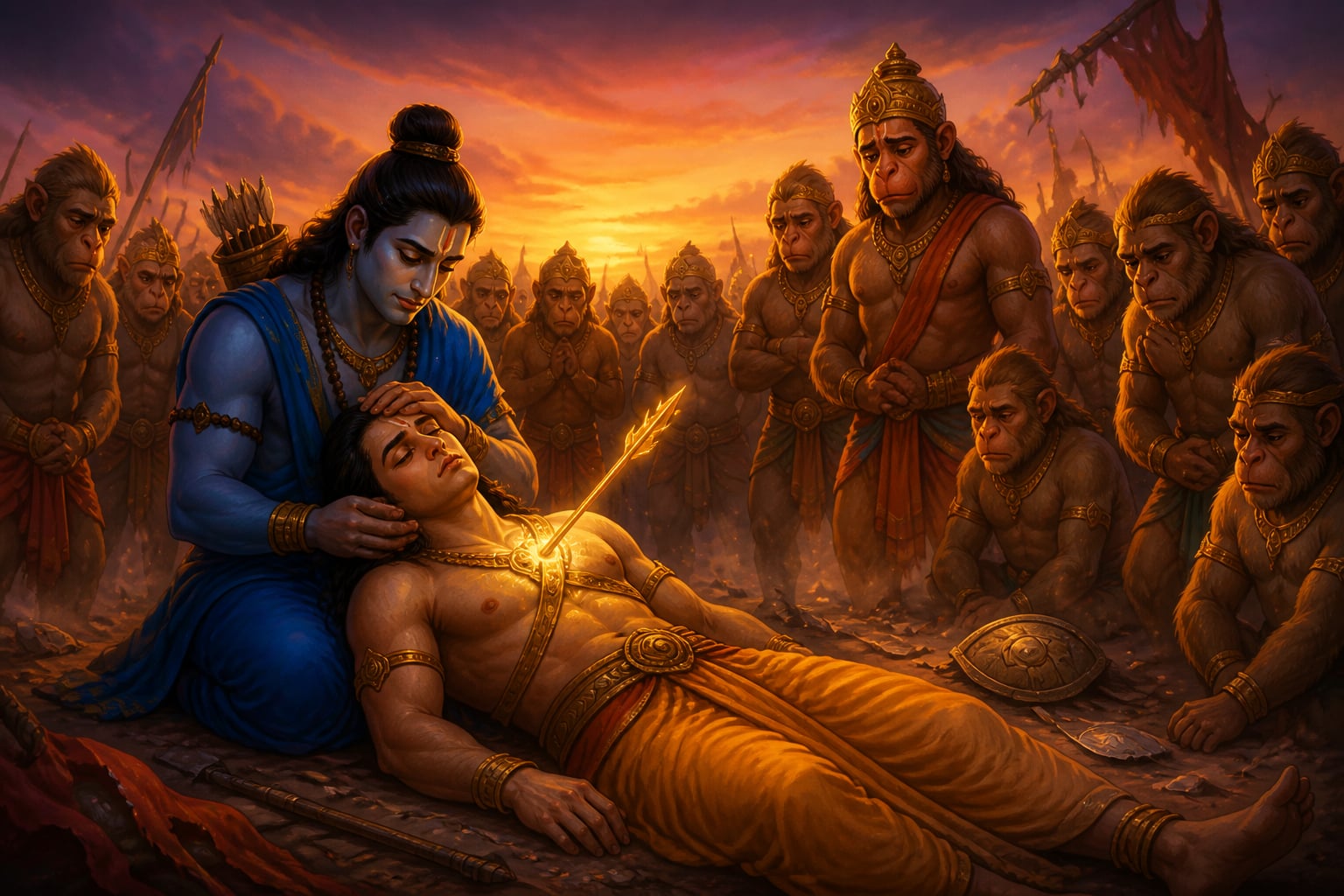
Lakshmana fell.
He did not get up.
His breath was very shallow. His skin grew cold. His eyes were closed.
Rama ran to him. Rama, who had broken the unbreakable bow, who had crossed the ocean, who had defeated a hundred demons, suddenly looked like a small boy who had lost the most important thing in the world. He held his brother's head in his lap.
"Lakshmana," he whispered. "Don't go. Please don't go. I gave up my kingdom and you came with me. I went into the forest and you came with me. You have been with me my whole life. I cannot do this without you."
The whole army stood around them in silence. The monkeys had stopped chattering. The bears had sat down on the ground. Even the eagles in the sky had stopped flying.
Then the great old bear, Jambavan, came forward. Jambavan was so old that he had seen many, many things. And he had a small piece of news.
The Mountain of Medicines
"My king," said Jambavan, "there is a way. But it is very, very hard."
Rama looked up. "Tell me."
"Far, far away," said Jambavan, "in the great mountains we call the Himalayas, there is a special hill. They call it the Drona-giri mountain. On that mountain, four magic herbs grow. One of them is called Sanjeevani. It is a tiny plant. It glows in the dark with a soft golden-green light. If a dying person is given a little bit of Sanjeevani, the soul comes back. The breath returns. The eyes open."
Rama's heart leapt. "Then we must go!"
"Wait, my king," said Jambavan. "There is a problem. The Drona-giri mountain is many, many thousands of miles away. North of here. Past forests. Past rivers. Past the desert. And we have only one night. Lakshmana must take the Sanjeevani before the sun rises tomorrow morning. Otherwise, the medicine will not work."
Rama's face fell. "Who can travel that far in one night?"
The whole army was silent. Nobody could.
And then a voice came from the back. A familiar voice. A voice you already know.
"I will go," said Hanuman.
Hanuman Remembers Who He Is
Do you remember the second lesson of this chapter? The Strongest One Who Forgot. When Hanuman was a child, the gods had blessed him with all the power in the world. But he had been so naughty with his powers that the rishis had put a small spell on him. You will forget your strength, they had said, until somebody reminds you.
In the third lesson of this chapter, Jambavan had reminded him. You can fly across the ocean, Hanuman. You can do this. And Hanuman had flown. He had found Sita. He had burned Lanka.
Now, here he was again. Standing in front of the dying Lakshmana, in front of Rama whose face was wet with tears, with the whole army watching. And once more, he remembered who he was.
"I will go," said Hanuman. "I will be back before sunrise. With the Sanjeevani."
He bowed to Rama. Then he closed his eyes for one moment. He folded his hands at his heart. He breathed in.
And then he grew.
He grew taller than the trees. Taller than the hills. Taller than the clouds. His tail lashed back and forth like a giant whip. His eyes shone like two suns. His shadow covered the whole battlefield.
He leapt.
The earth shook. The wind howled. And Hanuman went up, up, up, into the night sky, a streak of gold flying north.
Trouble In The Sky
Not everyone wanted Hanuman to succeed.
First, Ravana found out. He was very angry. He had a half-demon nephew named Kalanemi who lived as a fake holy man on the way to the Himalayas. Ravana sent Kalanemi a quick message. "Stop the monkey. Pretend to bless him. Drown him if you can."
When Hanuman flew over Kalanemi's hermitage, the fake rishi waved at him with a sweet smile. "Come down, brave Hanuman! You must be tired! Drink some water from my pond first!"
Hanuman, polite as always, came down. But just as he reached for the water, a giant crocodile rose from the pond and snapped at him. Hanuman jumped back, looked carefully at Kalanemi, and saw the demon's true face under the holy disguise.
"Nice try," said Hanuman. He picked up Kalanemi by his fake beard, swung him around, and threw him so far that the demon never came back.
Then Hanuman flew on.
Next, Surya the sun god rose a little earlier than usual. (Some people say the sun was tricked into rising. Some say Ravana sent a special chariot to fetch the sun. Some say Hanuman just happened to be flying very fast.) Either way, the eastern sky began to lighten. Sunrise was close.
Hanuman did the only thing left to do. He flew up, caught the sun in his armpit (yes, his armpit), and held him there. "Surya, my friend," he said, "please wait just a little longer. Lakshmana is dying. I am almost there."
The sun, who liked Hanuman very much (you remember why, from the very first lesson of this chapter), said, "Of course. Take your time." And he stayed under Hanuman's armpit and did not rise.

The Mountain Of Glowing Herbs
Finally, after flying over many, many lands, Hanuman reached the Himalayas.
The air was cold. The peaks were white with snow. He landed on the great Drona-giri mountain, just as Jambavan had said. The mountain was covered with herbs. Tiny flowers. Soft mosses. Strange-looking plants with leaves shaped like hearts and stars and tiny fingers.
And many of them were glowing.
This was the problem.
Many of them were glowing.
Not one. Not a few. Hundreds.
Hanuman walked up and down, peering at the plants. "Is this the Sanjeevani? Is that one? Or is that one?"
He had not asked Jambavan exactly which glowing plant it was. He could not tell which was Sanjeevani, which was one of the other three magic herbs (Vishalyakarani, Suvarnakarani, and Sandhanakarani), and which was just a normal mountain plant having a glowy night.
He knelt down. He sniffed one. He sniffed another. He frowned.
In his armpit, the sun shifted gently. Hanuman, whispered Surya, I cannot wait forever. The world is starting to wake up.
Hanuman knew. He had no time to figure out which plant was Sanjeevani.
So he made a decision that nobody had ever made before, and nobody has made since.
"If I cannot find the right plant," he said, "I will take the whole mountain."
Lifting A Mountain
He walked to the bottom of the Drona-giri. He bent his knees. He took a deep breath. He put his hands under the mountain. He lifted.
The mountain came up.
All of it. All the trees. All the snow. All the streams. All the deer who had been sleeping in the forests. All the herbs, glowing and not glowing.
Hanuman tucked the entire mountain into his right hand, the way you might pick up a small book.

And then he turned, gripped the sun gently with his other arm, and flew south.
A Streak Of Gold In The Morning Sky
At the same time, in Lanka, Rama still had Lakshmana's head in his lap. The army was waiting. The hours had passed. The eastern horizon should have been bright by now, but it was strangely dim.
(That was the sun, of course, still tucked under Hanuman's arm.)
The monkeys watched the sky. The bears watched the sky. The eagles flew up to look.
And then somebody pointed.
"There!"
A shape was coming. A great golden shape against the dim sky. As it came closer, the army could see it more clearly.
It was Hanuman. Hanuman holding a whole mountain. Hanuman with the sun under one arm.
The army let out a roar. The monkeys jumped. The bears stood on their hind legs. The eagles screamed in joy.
Hanuman landed gently next to Rama. He put down the mountain. He let go of the sun. He bowed.
"My lord," he said, "I could not tell which herb it was. So I brought the whole mountain. The Sanjeevani is in there somewhere."
The healer monkey ran up. He climbed onto the mountain. He found the glowing Sanjeevani plant, plucked one tiny leaf, and held it under Lakshmana's nose.
Lakshmana's eyes opened.
He sat up. He looked confused for a moment. Then he saw Rama crying with relief, and Hanuman bowing in front of him, and a whole mountain that should not have been there.
"What did I miss?" asked Lakshmana.
Rama laughed and cried at the same time, and hugged his brother. The army cheered. The sun, finally allowed to come out, climbed into the sky and lit up Lanka.
It was morning.
Why We Love Hanuman Most Of All
This is the story Hindus love most about Hanuman. Not because of the strength. Not even because of the flying. Because of something simpler.
Hanuman did not say, I cannot find the right herb, I have failed. He did not say, let me come back to ask Jambavan and waste another night. He did not say, this is impossible.
He said, if I cannot do it the small way, I will do it the big way. He brought the whole mountain.
This is what bhakti (loving devotion) looks like. Bhakti does not stop. Bhakti does not give up because the task is hard. Bhakti finds a way. Even if the way is carrying a mountain across half of India.
That is why every temple wall in India has a picture of Hanuman flying through the sky with a glowing mountain in his hand. It is the most-loved image in the whole Ramayana. It is on calendars. It is on schoolbags. It is on the tea cups in railway stations. The whole country knows it.
And it is on the chest of almost every person in India who has ever been told by somebody, that is too hard for you, you cannot do it.
Because when you remember Hanuman bringing the whole mountain, too hard stops being a real word.
After The Mountain
After the war, Rama defeated Ravana. Sita was rescued. The fourteen years of exile finally ended.
And after that, Rama and Sita went home to Ayodhya. You know that night. That was Diwali.
That night belonged to Rama. But the night before, when Hanuman flew through the dark sky with a glowing mountain and a hidden sun, that night belonged to Hanuman. The world was nearly lost. He brought it back.
In Your Life
The next time you have a hard task, and you do not know exactly how to do it, do not stop. Try the small way first. If the small way does not work, try the big way.
And if the big way means carrying a whole mountain when everyone said you only needed to carry one little plant, carry the mountain. Hanuman will smile at you from every temple wall in India.
That is the secret of bhakti. You do whatever it takes. You do not measure the size of the task. You only measure the size of your love.
Reflection
- Has there been a time when something you really wanted to do felt too hard, and somebody told you it was impossible? What was it? If Hanuman had been there, what bigger way might he have suggested? And what is one thing you can still try, today, to take a step toward that hard thing?
- Hanuman has all the strength in the world, but he uses it only for other people, never for himself. He fights for Rama. He flies for Sita. He lifts the mountain for Lakshmana. Why do you think this is what makes him the most-loved character in the whole Ramayana? What does it tell you about the kind of strength that the Dharmic tradition admires the most?