Why India Lost

The Hard Questions

The Second Battle of Tarain was not just a single defeat, it opened the door to centuries of foreign rule. This lesson examines the systemic failures that made conquest possible: military gaps, political fragmentation, and strategic blindness. Honest analysis is the only tribute worthy of those who fell.

The Question That Demands an Answer

Why did India lose?

This is not a question about one battle or one king. Muhammad Ghori's victory at Tarain in 1192 led to the conquest of virtually all of North India within two decades. By 1206, the Delhi Sultanate ruled from Bengal to Punjab.

How could a relatively small Central Asian army conquer the most populous, wealthiest region on earth? The answer requires honest analysis, not to assign blame, but to understand, learn, and ensure such failures never recur.

The Conventional Explanations

Many explanations have been offered. Let's examine them critically:

"Rajput Chivalry Lost to Muslim Ruthlessness"

The Claim: Rajputs fought by honorable rules; Muslims did not.

The Reality: This is partially true but incomplete. Rajput codes of warfare, not attacking at night, not pursuing fleeing enemies, releasing captured nobles, were not universal human standards but specific cultural practices. When facing enemies with different practices, rigid adherence to these codes became a liability.

However, this explanation ignores that Indians had faced "unchivalrous" enemies before. The Hunas, Shakas, and Greeks all fought differently. Earlier Indian empires adapted and prevailed.

The Real Issue: Not that enemies were unchivalrous, but that 12th-century Rajputs failed to adapt as earlier Indians had.

"Jayachandra's Betrayal"
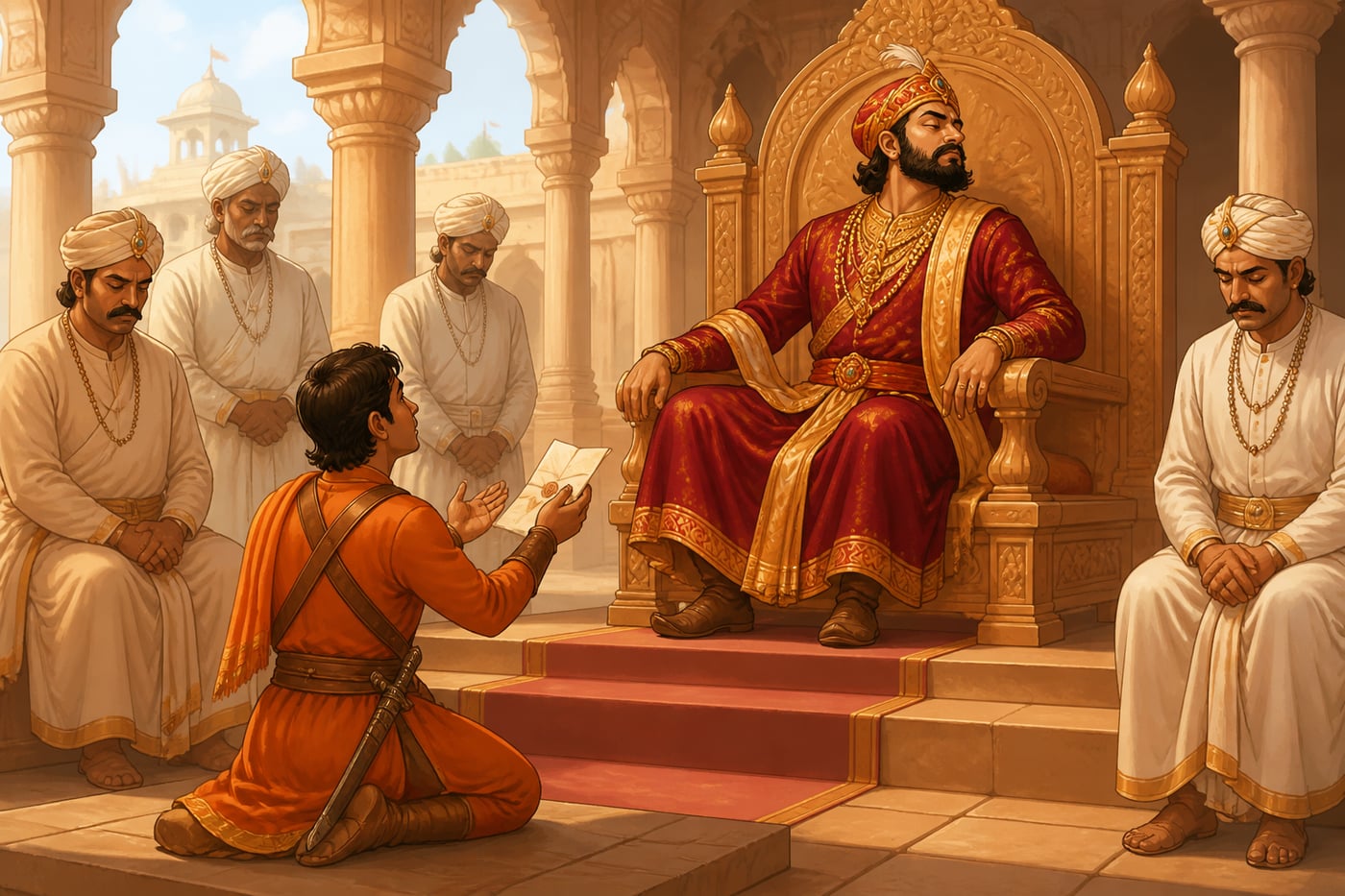
Jayachandra of Kannauj refusing aid to Prithviraj's envoy

The Claim: If Jayachandra had joined Prithviraj, India would have won.

The Reality: This is unknowable. A united front would have improved chances, but there is no guarantee of victory. More importantly, this explanation masks the deeper question: why couldn't Jayachandra and Prithviraj unite?

The Real Issue: The political system that made such unity impossible.

"Superior Ghurid Military Technology"

The Claim: The Ghurids had better weapons and tactics.

The Reality: The Ghurids did have advantages, superior cavalry tactics, effective composite bows, better logistics for long campaigns. But Indians had faced and defeated armies with similar advantages before.

The Real Issue: Not that Ghurids had advantages, but that Indians failed to analyze and counter them.

The Military Gap

Let's examine the military factors honestly:

Cavalry Doctrine

Rajput Cavalry Ghurid Cavalry
Heavy, armored Light, mobile
Designed for shock charges Designed for mobility and archery
Devastating on contact Could avoid contact while inflicting damage
Horses tired quickly Horses preserved for decisive moments
One primary tactic Multiple tactical options

The Rajputs had excellent heavy cavalry, but they had only one way to use it: the mass charge. If the charge succeeded, they won. If it failed, as at Second Tarain, they had no backup plan.

Rajput heavy cavalry meeting Ghurid mounted archers

The Elephant Problem

War elephants had been the pride of Indian armies for millennia. But by the 12th century, they had become a liability:

The Ghurids specifically trained to neutralize elephants. Indians continued to rely on them anyway.

Intelligence Failure

The Rajputs had no systematic way to:

Ghori spent a full year preparing new tactics after First Tarain. There is no evidence that Prithviraj made any effort to discover what those preparations were.

The Political Fragmentation

The military failures were symptoms of deeper political problems:

The Rajput System

The Rajput kingdoms were not centralized states but feudal confederations:

The Jayachandra Problem

Jayachandra's absence from Tarain was not an aberration but the norm. Rajput kings routinely:

No Pan-Indian Identity

Perhaps most critically: there was no concept of "India" to defend. Each king defended his kingdom. The idea that all Hindu kings should unite against foreign invasion was simply not part of the political vocabulary.

The Strategic Blindness

Beyond tactics and politics lay deeper failures of understanding:

Failure to Recognize the Threat

Rajput kings treated the Ghurids as just another enemy to be defeated, like Chandellas or Chalukyas. They did not understand that:

No Learning System

Chandragupta Maurya and Chanakya created institutions for:

The 12th-century Rajputs had none of these. Each king relied on personal valor and traditional tactics. There was no equivalent of the Arthashastra being written or studied.

The Arthashastra Forgotten

The contrast with Mauryan-era statecraft is stark:

Mauryan Principles Rajput Practice
Study your enemy systematically Assume enemies fight conventionally
Pursue defeated enemies relentlessly Allow defeated enemies to retreat
Build intelligence networks Rely on rumor and tradition
Adapt tactics to circumstances Use traditional tactics regardless
Secure diplomatic alliances first Fight without coordinating with potential allies

Comparison: Why Chandragupta and Skandagupta Succeeded

Chandragupta Maurya and Chanakya planning against the Greek frontier

Both Chandragupta Maurya (against the Greeks) and Skandagupta (against the Hunas) faced foreign invasions. Both prevailed. What did they do differently?

Chandragupta Maurya vs. Prithviraj Chauhan

Chandragupta Prithviraj
Years of preparation under Chanakya Inherited power young, learned on the job
Built alliance networks before striking Fought without securing major allies
Created centralized army Relied on feudal levies
Pursued Seleucus until treaty secured Let Ghori escape after First Tarain
Established border defenses Made no systematic frontier preparations

Skandagupta vs. Prithviraj

Skandagupta Prithviraj
Recognized Hunas as existential threat Treated Ghurids as just another enemy
Fought continuous frontier warfare Fought single decisive battles
Exhausted treasury but preserved civilization Preserved treasury but lost civilization

The Honest Assessment

The fall of Hindu North India was not due to:

It was due to:

The Lessons

What should we learn from this catastrophe?

1. External Threats Require Internal Unity

Prithviraj and Jayachandra's rivalry cost both their kingdoms. When civilizational threats appear, internal competition becomes suicidal.

2. Enemies Must Be Studied, Not Assumed

The Ghurids were not like previous enemies. Prithviraj's failure to understand this cost everything.

3. Honor Codes Must Adapt to Circumstances

The Dharmic tradition includes āpad-dharma, modified conduct during emergencies. Rigid adherence to peacetime codes against existential threats is not virtue but foolishness.

4. Military Victory Requires Follow-Through

First Tarain should have ended the Ghurid threat. Prithviraj's failure to pursue made his victory meaningless.

5. Institutions Outlast Individuals

Chandragupta's institutions protected India for generations. Prithviraj's personal valor protected India for one battle.


In the final lesson, we examine Prithviraj's legacy, how a defeated king became a symbol of resistance, and what his story means for India today.

Historical context

Analysis of Medieval Indian Decline (1192 CE and after)

The political fragmentation that characterized India in 1192 CE had deep roots in the subcontinent's history. The ancient tradition of multiple competing kingdoms, from the sixteen mahajanapadas of the Buddha's time to the medieval Rajput clans, meant that no unified response to external invasion was institutionally possible. Unlike China's centralized bureaucracy or the Caliphate's religious unity, India's strength in cultural diversity became a military weakness when facing determined, unified invaders.

Living traditions

The Second Battle of Tarain is a mandatory case study at the Indian Military Academy, Dehradun, and the National Defence Academy, Pune, teaching cadets about intelligence gathering, the dangers of underestimating adversaries, and the need for strategic flexibility. The defeat's analysis has influenced modern Indian military doctrine on border security, rapid response, and avoiding fragmented command structures. Defence Minister speeches regularly reference this period when discussing national unity. The Archaeological Survey of India maintains transition-era sites as reminders of the consequences of political disunity, while academic conferences at JNU and Delhi University annually examine what K.M. Panikkar called 'the most decisive battle in Indian history.'

Reflection

More in Prithviraj Chauhan

All lessons in Prithviraj Chauhan · Great Emperors: Revival & Resistance course