The Bhil Brotherhood
The Forgotten Alliance That Saved Mewar
Behind every legend of Rajput valor stands an often-forgotten alliance. This lesson explores the extraordinary relationship between Mewar's rulers and the Bhil tribes, indigenous forest-dwellers who became the kingdom's most loyal defenders. From providing intelligence and guerrilla fighters to sheltering the royal family during its darkest hours, the Bhils proved that true brotherhood transcends caste and status. Their contribution is honored to this day in every coronation of a Mewar ruler.
The People of the Hills
The Aravalli ranges that sheltered Maharana Pratap during his years of resistance were not empty wilderness. These forested hills were home to the Bhils, one of India's oldest indigenous communities. While the plains belonged to settled agriculturalists and the cities to merchants and craftsmen, the Bhils had made the forests their own for millennia, developing an intimate knowledge of every valley, spring, and mountain path.
The Bhils lived differently from the caste-structured Hindu society of the plains. They were hunters, gatherers, and shifting cultivators whose society emphasized egalitarianism and communal decision-making. Their expertise with the bow was legendary, 'Bhil' itself derives from 'bil' or 'veedh,' meaning one who pierces, a reference to their archery skills. Their knowledge of forest medicines, tracking, and survival made them masters of their environment.
An Ancient Alliance
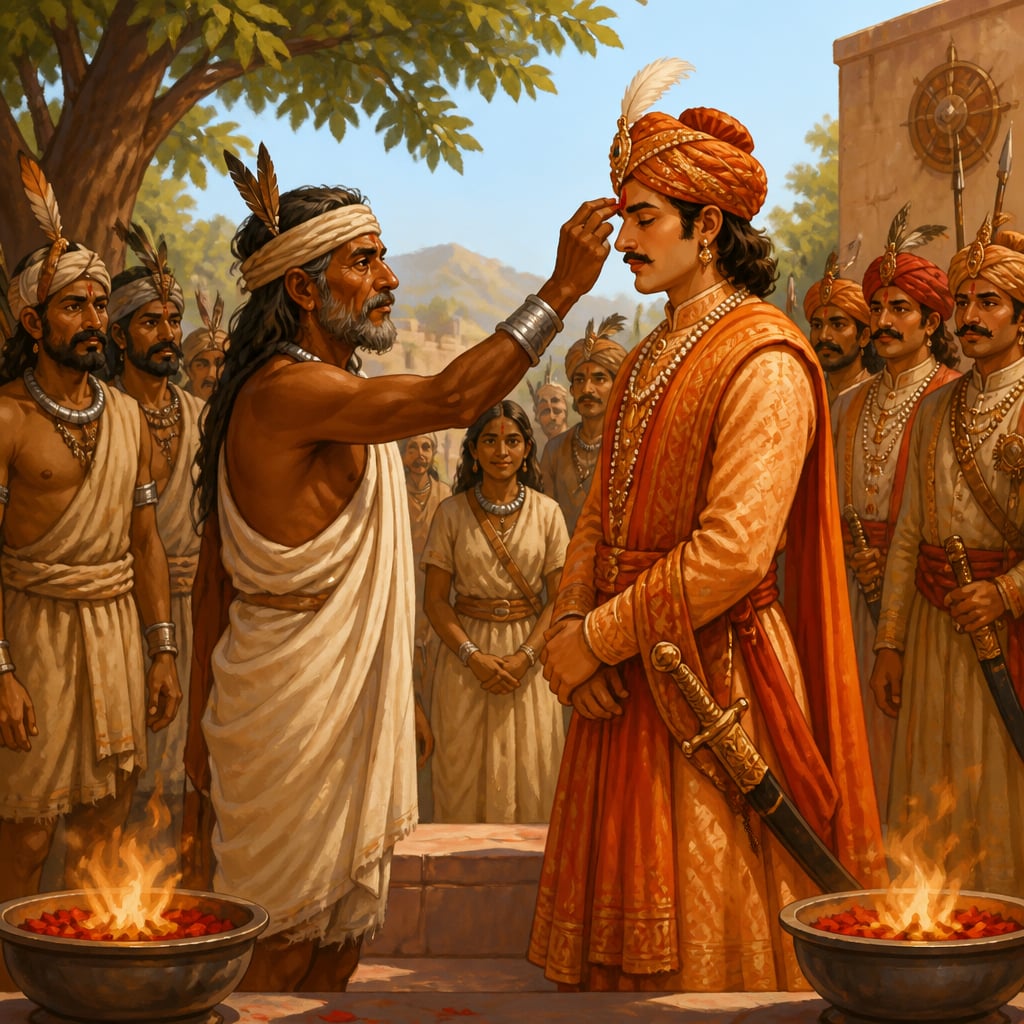
The relationship between Mewar's rulers and the Bhil tribes predates recorded history. According to tradition, when Bappa Rawal established the Guhila dynasty in the 8th century, the Bhils were among his earliest supporters. The alliance was formalized through a remarkable ritual: at every coronation of a Mewar ruler, a Bhil chieftain applies the tilak (ceremonial mark) of blood from his own thumb to the forehead of the new Rana.
This ritual, still performed today, symbolizes something profound. The Bhil's blood-tilak precedes even the Brahmin's sandalwood tilak, acknowledging that the Bhils' acceptance of Mewar's sovereignty is foundational to its legitimacy. The kings of Mewar ruled not just by divine right or military power but by an ancient compact with the original inhabitants of the land.
The Mewar coat of arms itself bears witness to this alliance. The royal emblem shows a Rajput and a Bhil standing together, the Bhil holding a bow while the Rajput holds a sword. Two peoples, different in culture but united in purpose, their partnership central to Mewar's identity.
The Bhils and Pratap
When Maharana Pratap fled to the Aravallis after Haldighati, it was the Bhils who received him. Rana Punja, the Bhil chieftain of the Merpur region, had fought alongside Pratap at Haldighati. Now he offered something equally valuable: sanctuary. The Bhil villages deep in the forests became safe havens where the Mughal cavalry could not penetrate.
The Bhils provided Pratap with more than shelter. Their young men served as scouts, their hunters as guides, their archers as deadly ambushers. The intelligence network that allowed Pratap to track Mughal movements while remaining invisible was largely a Bhil creation. They knew which paths were passable, which villages were loyal, which Mughal commanders could be surprised.
During the desperate years when Pratap's family survived on wild jungle produce, it was Bhil knowledge of forest foods that kept them alive. The berries, roots, and game that sustained the royal family were identified by Bhil trackers who had lived on such fare for generations. When the Mughals thought they had starved Pratap into submission, the Bhils helped him survive.

Guerrilla Warfare: The Bhil Contribution
The guerrilla tactics that made Pratap's resistance possible were largely adapted from traditional Bhil warfare. For centuries, the Bhils had defended their forests against all intruders using methods suited to their terrain: ambushes on narrow paths, night raids on encampments, harassment of supply lines, and instant dispersal into familiar forests.
Pratap's chhapamari (hit-and-run) warfare drew directly on these techniques. Bhil archers could loose poisoned arrows from concealed positions and vanish before the enemy could respond. They could track Mughal columns for days, reporting every movement while remaining invisible. When Pratap's cavalry struck, Bhil guides led them through paths the Mughals didn't know existed, enabling retreat routes that baffled pursuit.
The psychological impact was devastating. Mughal soldiers learned to fear the forests, knowing that every shadow might hide a Bhil archer. Supply convoys required massive escorts that slowed movement and consumed resources. Isolated garrisons faced constant harassment that eroded morale without offering any target for retaliation.

Rana Punja: Hero of the Resistance
Among the many Bhil warriors who fought for Mewar, Rana Punja of Merpur holds a special place. He was a chieftain of considerable local power who chose to ally with Pratap not from compulsion but conviction. At Haldighati, he commanded a contingent of Bhil archers whose deadly volleys disrupted Mughal formations.
During the wilderness years, Rana Punja's territory became Pratap's primary sanctuary. The Bhil chieftain mobilized his people to support the Rajput cause, providing not just warriors but the entire infrastructure of resistance: food, shelter, intelligence, and safe passage. His loyalty never wavered, even when Mughal agents offered substantial rewards for betraying Pratap's location.
The relationship between the two leaders transcended mere military alliance. They became brothers in a cause, their mutual respect deepening through shared hardship. When Pratap's son was born during the exile, Bhil women served as nursemaids. When Pratap needed funds, Bhil communities contributed what little they had. This was not the relationship of a king to his subjects but of comrades in arms.
The Social Compact
The Bhil-Rajput alliance challenges simplistic narratives about Indian social history. Here was a ruling caste depending utterly on those considered outside the caste system. The relationship demanded mutual respect and reciprocity. The Bhils were not servants but partners; their chiefs were honored, their customs respected, their territories acknowledged.
Pratap's treatment of the Bhils reflected this reality. He did not merely use them and discard them. When Mewar was reconquered, Bhil contributions were recognized. Bhil chieftains were granted honorable positions in the court. Bhil territories were protected from encroachment. The alliance that saved Mewar in its darkest hour was honored when better times returned.
This partnership offers a different model of Indian statecraft, one based on inclusion rather than extraction, on alliance rather than domination. The Bhils fought for Mewar not because they were forced to but because they were part of Mewar, their identity intertwined with the kingdom's survival.
Legacy of Brotherhood
The Bhil contribution to Mewar's survival lived on in institutional memory. The blood-tilak ceremony at coronations continues to this day. When the last Maharana of Mewar celebrated his succession in the modern era, a Bhil chieftain still applied the first tilak. The ritual has survived democracy, independence, and modernization because it speaks to something fundamental about Mewar's identity.
The Mewar emblem with its Rajput and Bhil figures has become a symbol of unity across difference. In an India often divided by caste and community, it stands as reminder that loyalty and brotherhood need not follow social boundaries. The Bhils who sheltered Pratap's family, who fought beside him at Haldighati and through the long years of resistance, had proven that courage knows no caste.
Today, the Bhil community of Rajasthan numbers in the millions. Many trace their identity to the tribes who stood with Pratap. The songs they sing still celebrate that alliance, passing down to each generation the memory of when their ancestors helped save a kingdom, and were honored for it.
Lessons of the Alliance
The Bhil-Mewar relationship offers lessons that transcend its historical context. It demonstrates that sustainable leadership requires genuine partnership, not mere domination. Pratap could not have survived, let alone triumphed, without the Bhils. His willingness to depend on them, to trust them with his family's safety, to fight beside them as equals, enabled an alliance that outlasted his enemies.
It also shows that loyalty is earned, not compelled. The Bhils could have betrayed Pratap at any time, the Mughals offered substantial rewards, and no force could have prevented them from simply refusing sanctuary. They chose loyalty because Mewar's rulers had proven worthy of it, honoring ancient compacts and treating the Bhils as partners rather than subjects.
In an age when leaders often see constituencies as resources to be exploited, the Bhil-Mewar alliance stands as reminder that the deepest loyalties arise from mutual respect and shared purpose. The kingdom survived because it was worth defending, not just by those who ruled it but by those who had chosen to be part of it.
Historical context
Medieval India (8th-16th century CE)
The Bhil-Mewar alliance was unusual in medieval India, where tribal communities were often marginalized. Mewar's institutionalization of the partnership, through the coronation ritual and royal emblem, represented a different model of state-building based on inclusion rather than subordination.
Living traditions
The Bhil community of Rajasthan now numbers over 5 million. The coronation tilak ceremony continues even for ceremonial occasions. The Mewar royal family maintains connections with Bhil communities, and the alliance is cited in Indian political discourse as an example of inclusive state-building that transcended caste boundaries.
- Mewar Royal Coronation Site: The site where Mewar coronations occur, including the Bhil blood-tilak ceremony. The ritual continues to this day when succession ceremonies are performed, honoring the ancient alliance.
- Bhil Heritage Museum: Part of the Tribal Research Institute, this museum documents Bhil culture, history, and their role in Mewar's history. Exhibits include traditional weapons, tools, and displays about the Bhil-Pratap alliance.
- Aravalli Tribal Regions: The forested hills where Bhil communities still live traditionally. While tourism infrastructure is limited, cultural tours can be arranged through local organizations to learn about Bhil traditions, crafts, and their historical connection to Mewar.
Reflection
- In your own life, who are the 'Bhils', people whose contributions are essential but often go unrecognized? How might you better honor their role?
- Why do you think the Bhils remained loyal to Pratap when betraying him would have been safer and more profitable?
- What does the Bhil-Mewar alliance teach us about the relationship between formal hierarchy and genuine partnership?