Legacy of the Dakshina Chakravarti
Legacy & Lessons
Gautamiputra Satakarni transformed a declining dynasty into the greatest power in peninsular India. His titles, Destroyer of Shakas, the Unique Brahmin, Lord of the Three Oceans, would inspire Deccan rulers for centuries. Explore the final years of his reign, the challenges his successors faced, and why the Southern Lion remains the archetypal emperor of the Deccan.
The Reign Assessed
Gautamiputra Satakarni ruled for approximately 24 years (though exact dates remain debated). In that time, he achieved what his predecessors had failed to accomplish and what his successors would struggle to maintain: the unification of peninsular India under Satavahana rule and the decisive defeat of foreign invaders.
The Accomplishments
Let us catalog what Gautamiputra achieved:
Military:
| Achievement | Significance |
|---|---|
| Destruction of Nahapana's Shaka kingdom | Eliminated the primary foreign threat |
| Recovery of western territories | Restored access to Roman trade |
| Extension to "three oceans" | Claimed near-universal peninsular sovereignty |
| Melting and restriking Shaka coins | Symbolic erasure of enemy memory |
Administrative:
- Unified governance across diverse regions
- Maintained trade route security
- Balanced central authority with local autonomy
- Worked effectively with powerful guilds
Religious:
- Claimed Brahminical legitimacy while patronizing Buddhism
- Funded cave monasteries that survive today
- Restored varnashrama order disrupted by foreign rule
- Created a model of dharmic pluralism
Economic:
- Secured control of Dakshinapatha trade routes
- Ensured continued Indo-Roman commerce
- Supported guild-based economic organization
- Created conditions for lasting prosperity
The Final Years
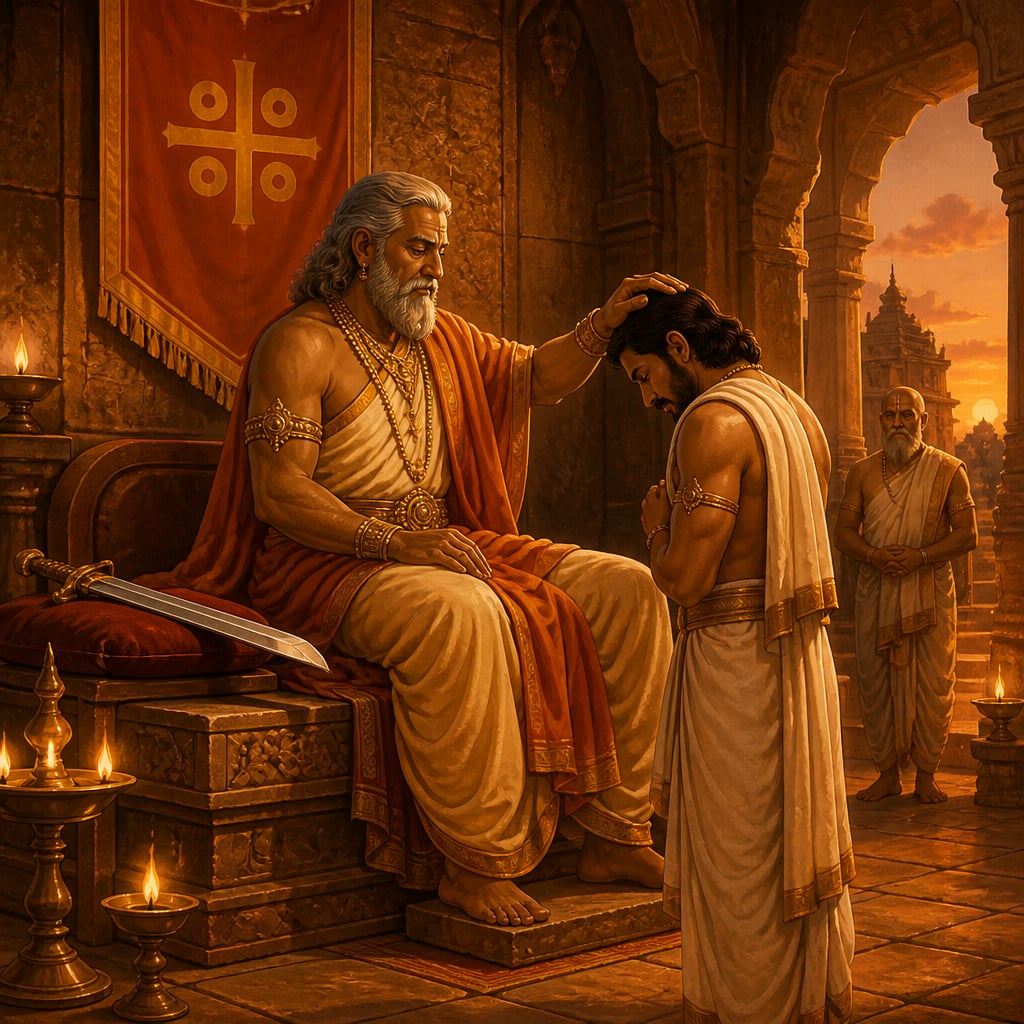
Little is known about Gautamiputra's final years. The Nashik Prasasti, our primary source, was composed after his death by his mother, meaning its account is retrospective rather than contemporary.
What we can infer:
Succession planning: Gautamiputra's son Vashishtiputra Pulumavi succeeded him. The smooth transition suggests some advance preparation.
Continued patronage: Late inscriptions show continued royal donations, indicating administrative stability.
No recorded defeats: Unlike some rulers, Gautamiputra's record shows no late-reign military reversals. He died at the height of his power.
The mother's inscription: That Gautami Balashri could commission the Nashik Prasasti shows the queen mother retained influence after her son's death.
The Immediate Succession
Vashishtiputra Pulumavi (c. 102-130 CE) inherited his father's empire. His reign shows both continuity and challenges:
Continuities:
- Maintained the core Satavahana territories
- Continued Buddhist and Brahminical patronage
- Preserved trade route control
- Used similar administrative structures
Challenges:
- The Shakas re-emerged under the Kardamaka dynasty
- Western territories required constant defense
- Maintaining unity across vast distances proved difficult
- Economic prosperity couldn't be assumed
Pulumavi's coins show him maintaining the Satavahana presence, but the empire's extent gradually contracted.
The Shaka Revival
Gautamiputra had destroyed Nahapana's Kshaharata dynasty so completely that the Western Kshatrapas had to rebuild from scratch. The Kardamaka dynasty, a different Shaka family, eventually re-established power:
Chashthana (c. 78-130 CE) founded the new dynasty, probably as a vassal before asserting independence.

Rudradaman I (c. 130-150 CE) became the most powerful of the later Western Kshatrapas. His famous Junagadh inscription records:
- Twice defeating the Satavahanas in battle
- Refraining from destroying them due to family connections (his daughter married a Satavahana prince)
- Control of Gujarat, Malwa, and adjacent regions
The territories Gautamiputra had reconquered were lost again within a generation of his death.
Why Couldn't Successors Maintain the Empire?
Several factors explain the post-Gautamiputra decline:
Personal capability: Gautamiputra's combination of military, administrative, and diplomatic skills was extraordinary. Such talent rarely appears twice in succession.
Structural challenges:
- The Deccan's geography made unified rule difficult
- Provincial governors tended toward autonomy
- Trade routes required constant military protection
- No institutional mechanisms ensured competent succession
External pressure:
- The Shakas rebuilt their strength
- The Kushanas dominated the north
- Competition for trade never ceased
Economic factors:
- Roman trade began declining in the 2nd century CE
- Revenue from commerce decreased
- Resources for military defense diminished
The Later Satavahanas
The Satavahana dynasty continued for another century after Gautamiputra, but never regained his level of dominance:
| Ruler | Approximate Dates | Significance |
|---|---|---|
| Vashishtiputra Pulumavi | 102-130 CE | Maintained father's empire initially |
| Vashishtiputra Satakarni | 130-160 CE | Lost territories to Rudradaman |
| Shivaskanda Satakarni | c. 145-152 CE | Brief reign |
| Yajna Sri Satakarni | c. 174-203 CE | Last significant Satavahana ruler |
Yajna Sri Satakarni achieved a partial revival, recovering some eastern territories and maintaining trade connections. His coins show ships, emphasizing maritime commerce. But the empire he ruled was far smaller than Gautamiputra's.
By the mid-3rd century CE, the Satavahana dynasty had fragmented into regional successors.
The Model for Deccan Rulers
Gautamiputra's legacy shaped how later Deccan rulers conceived of themselves:
The Vakatakas (c. 250-500 CE):
- Ruled much of the same territory
- Patronized Buddhist cave art (Ajanta)
- Claimed similar dharmic legitimacy
The Chalukyas of Badami (c. 543-753 CE):
- Styled themselves as southern emperors
- Defeated northern invaders (Harsha)
- Combined martial prowess with cultural patronage
The Rashtrakutas (c. 753-982 CE):
- Claimed even broader imperial titles
- Funded Ellora cave temples
- Projected power across the subcontinent
The Kakatiyas (c. 1163-1323 CE):
- Ruled from the eastern Deccan
- Emphasized Telugu identity
- Built Warangal fort as imperial capital
The Marathas (17th-18th centuries):
- Explicitly invoked Deccan imperial tradition
- Shivaji's titles echoed ancient precedents
- Saw themselves as protectors of dharma against foreigners
Each of these dynasties knew Gautamiputra's story, the Southern Lion who had crushed foreign invaders and united the peninsula.
The Nashik Prasasti: A Mother's Tribute
Our detailed knowledge of Gautamiputra comes from his mother's inscription. Consider what this means:
A woman commissioned one of ancient India's most important historical documents. Gautami Balashri had the authority, resources, and literacy to create a permanent record.
A mother's love shapes how we remember the king. The portrait is heroic, but also tender, she recalls the son she raised, not just the emperor he became.
A political document legitimized the succession. By recording Gautamiputra's achievements, the inscription supported his son's claim to rule.
A religious act earned merit for the deceased and the donor. The cave monastery would benefit from the associated donation.
The prasasti serves multiple purposes simultaneously, personal, political, religious, and historical.
The Titles as Legacy
Gautamiputra's titles became a vocabulary of Deccan imperialism:
"Shaka-Yavana-Pahlava-nisudana" (Destroyer of Shakas, Greeks, and Parthians) Later rulers facing foreign threats invoked this model. The Deccan could defeat invaders.
"Tri-samudra-toya-pita-vahana" (Whose horses drank from three oceans) This became the ultimate imperial claim. The Rashtrakutas would later echo it.
"Eka-brahmana" (The unique Brahmin) A Brahmin could rule, combining spiritual and temporal authority. This challenged and enriched traditional thinking.
"Kshatriya-darpa-mana-mardana" (Crusher of Kshatriya pride) Dharmic authority trumped mere martial power. The righteous ruler could defeat those who relied on force alone.
What Gautamiputra Teaches
Across the centuries, Gautamiputra's reign offers lessons:
On leadership: Success requires multiple competencies, military skill, administrative ability, religious authority, economic understanding. Excellence in one domain doesn't guarantee success.
On inheritance: A great inheritance brings great responsibility. Gautamiputra received a diminished kingdom and made it great; his successors received greatness and struggled to maintain it.
On victory: Complete victory eliminates threats more effectively than compromise. Half-measures leave problems to recur.
On synthesis: Contradictory elements can be combined into stronger wholes. Brahmin and warrior, Hindu and Buddhist patron, conservative and innovative, Gautamiputra united what others kept separate.
On permanence: Invest in what lasts. The caves Gautamiputra patronized survive; the wooden palaces have vanished.
On memory: How we are remembered depends on who tells our story. Gautami Balashri's loving tribute preserved her son for posterity.
The Archaeological Legacy
What remains from Gautamiputra's time?
Coins:
- The overstruck coins, Nahapana's silver restruck with Satavahana symbols
- Original Satavahana coins in lead, copper, and silver
- Evidence of economic activity and political control

Inscriptions:
- The Nashik Prasasti in Cave No. 3
- Donor inscriptions at multiple sites
- Historical records that would otherwise be lost
Caves:
- Nashik, Karla, Bhaja, Kanheri, Junnar
- Architecture that survives when buildings decay
- Art that reveals religious and social life
Trade goods:
- Roman coins found across the Deccan
- Mediterranean pottery and glass
- Evidence of international connections
The Continuing Relevance
Why study Gautamiputra today?
Historical importance: He shaped the political geography of peninsular India for centuries. The Deccan imperial tradition he exemplified lasted until the colonial period.
Leadership lessons: His reign demonstrates how multiple competencies combine for success, how inheritance creates obligation, and how permanent achievements outlast ephemeral ones.
Cultural heritage: The caves he patronized remain part of India's living heritage. Understanding their context enriches the visitor's experience.
Identity formation: For those with roots in Maharashtra, Andhra, or the broader Deccan, Gautamiputra represents ancestral achievement. His story is part of regional identity.
The Southern Lion
When Gautamiputra came to power, the Satavahanas were a declining dynasty confined to their eastern heartland, facing foreign enemies who seemed invincible.
When he died, he ruled from the Arabian Sea to the Bay of Bengal. The Shakas were destroyed. The trade routes flowed with Roman gold. Cave monasteries proclaimed Satavahana glory in permanent stone.
He earned his epithets:
- Destroyer of Shakas, who eliminated the foreign threat
- The Unique Brahmin, who combined spiritual and temporal authority
- Lord of the Three Oceans, whose power touched every coast
- The Southern Lion, who made the Deccan roar
Two thousand years later, the caves remain. The coins remain. The inscription remains. The memory remains.
Gautamiputra Satakarni, the greatest of the Satavahanas, the model for Deccan rulers, the Southern Chakravarti, achieved what his ancestors could not and left a legacy his successors could not fully maintain.
In the end, that is the measure of greatness: to accomplish the unprecedented and to be remembered when empires have fallen.
The Southern Lion sleeps, but his monuments stand witness to what was, and what a determined ruler can achieve when inheritance becomes responsibility, and crisis becomes opportunity.
Historical context
End of Gautamiputra's Reign and Aftermath (c. 102-150 CE)
The mid-2nd century CE saw the Kushana Empire dominant in the north under Kanishka and his successors. The Western Kshatrapas recovered under the Kardamaka dynasty. The Satavahanas, despite their decline from Gautamiputra's heights, remained significant in the Deccan. Buddhism continued to flourish, while Brahminical Hinduism was systematizing its texts and practices.
Living traditions
Gautamiputra Satakarni has become a symbol of Deccan regional pride. Telugu and Marathi popular culture, films, novels, public monuments, celebrate him as a defender of Indian civilization against foreign invasion. The 2017 Telugu film 'Gautamiputra Satakarni' brought his story to mass audiences. His example is invoked in discussions of regional identity, resistance to external domination, and the capabilities of southern Indian rulers. For historians, his reign remains a crucial period for understanding early Indian state formation, religious patronage, and economic history.
- Nashik Caves - Complete Circuit: A final visit to the caves where Gautamiputra's memory was inscribed. Standing before Cave No. 3, you can read the Prakrit words that Gautami Balashri composed for her son, words that have survived two thousand years of history.
- Government Museum, Mumbai: Houses collections of Satavahana coins including examples of Gautamiputra's overstruck coins from Nahapana's silver. Seeing the physical evidence of the Satavahana victory makes the history tangible.
- Amaravati Museum: Though the famous stupa dates to later periods, the museum preserves Satavahana-era sculptures and inscriptions from the eastern part of the empire. Shows the dynasty's reach beyond Maharashtra.
Reflection
- Gautamiputra's successors couldn't maintain what he built. If you've ever created something excellent that later declined, what factors contributed? Could institutional design have helped?
- We know Gautamiputra through his mother's loving tribute. How do the perspectives of those who remember us shape our legacy? Who will tell your story?
- Gautamiputra achieved the unprecedented but couldn't ensure its permanence. Is impermanence of achievement a reason for despair, or does achievement have value regardless of duration?