The God Who Came from the Forest
Tribal origins and the inclusive embrace of Jagannath
Discover the extraordinary origin story of Lord Jagannath, how a tribal deity worshipped by the Savara people became the 'Lord of the Universe.' Learn about King Indradyumna's prophetic dream, Vishwakarma's mysterious condition, why the idols remain deliberately unfinished, and how Puri became Hinduism's most radically inclusive pilgrimage site where caste dissolves in devotion.
The Dream That Started Everything
In the ancient kingdom of Malwa, King Indradyumna was known for his extraordinary devotion. He had visited every sacred site, performed every prescribed ritual, yet something remained unfulfilled. A yearning he could not name kept him awake at night.
Then came the dream.
In his vision, a voice spoke: 'There is a deity hidden in the eastern forests, near the great sea. He is worshipped by tribal people who guard his secret. Find him, and you will find what you seek.'
Indradyumna woke with certainty. He summoned his most trusted priests and counselors. 'I must find this deity,' he declared. 'Send search parties to the eastern coast.'
The Savara Secret
The search parties traveled for months through dense forests toward the Bay of Bengal. They found many tribal communities but no special deity. Discouraged emissaries returned empty-handed.
Then one party, led by the brahmin Vidyapati, encountered the Savara tribe. These forest-dwellers lived in harmony with nature, their ways ancient beyond memory. They spoke of Nila Madhava, the Blue Lord, whom they worshipped in secret.
Vidyapati knew he had found what the king sought. But the Savaras guarded their deity jealously. No outsider had ever seen Nila Madhava.
The clever brahmin devised a plan. He befriended the Savara chieftain Vishvavasu and eventually married his daughter Lalita. Through this family connection, Vidyapati hoped to gain access to the sacred secret.
Nila Madhava Revealed
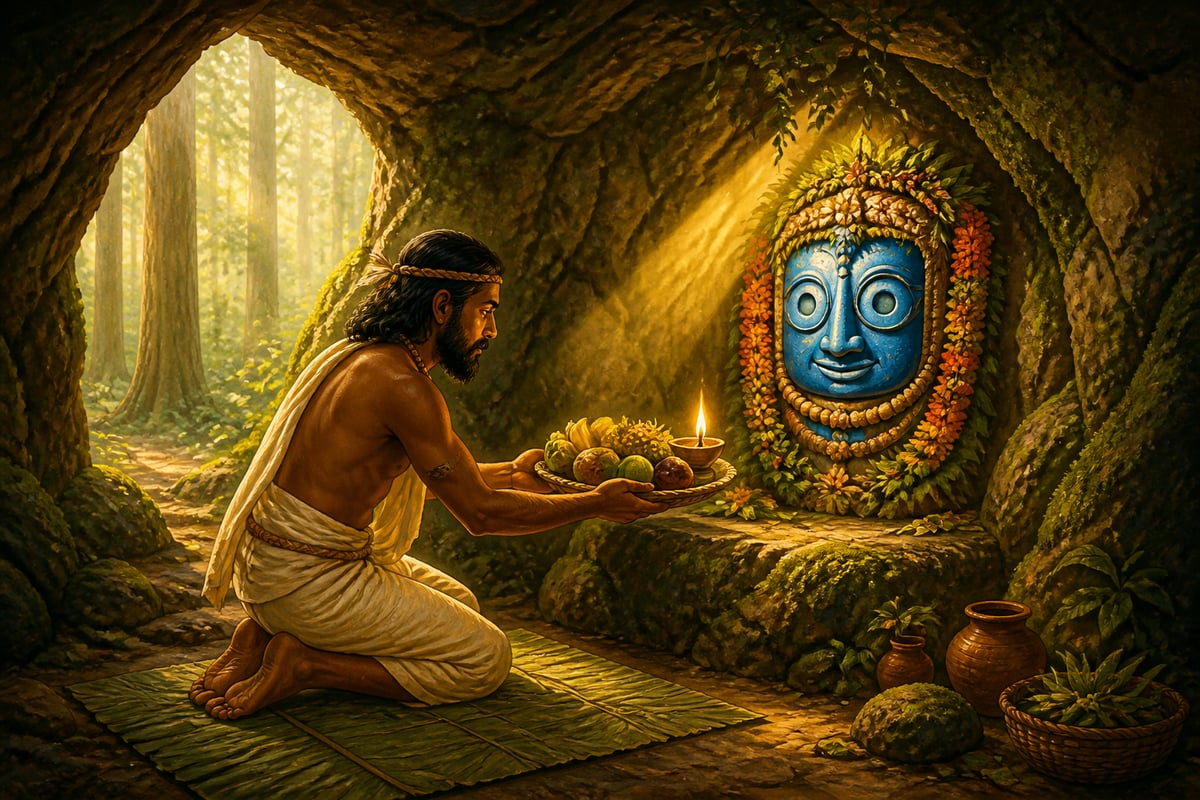
Finally, Vishvavasu agreed to take his son-in-law to see Nila Madhava. But there was a condition: Vidyapati must be blindfolded throughout the journey. The deity's location was that sacred.
Vidyapati agreed but secretly dropped mustard seeds along the path as they walked. When they arrived, the blindfold was removed. Before him stood a magnificent blue stone deity, radiating divine presence in a cave surrounded by jungle.
The brahmin was overwhelmed. This was indeed the god the king sought, but he was the god of these tribal people, worshipped for countless generations in their own way.
Vidyapati returned and reported to King Indradyumna. The king immediately set out to claim the deity for his kingdom.
The Disappearing God
But when the royal expedition arrived at the cave, they found it empty. Nila Madhava had vanished. The deity had disappeared into the sand, leaving no trace.
The Savaras were devastated. Their god had abandoned them because the secret had been revealed. They blamed Vidyapati for the loss of their most sacred treasure.
King Indradyumna was equally distressed. He had come seeking the divine only to find an empty cave. Had his ambition destroyed what he sought to honor?
In his despair, the king performed severe penances. He fasted and prayed, seeking guidance. Finally, a divine voice spoke: 'Do not grieve. I will come to you in another form. Build a great temple on the seashore, and I will appear.'
The Daru Brahma
Following divine instruction, Indradyumna began constructing a magnificent temple at Puri, where the land met the sea. But the deity to install in it had not yet appeared.
Then came reports of a miraculous log, a massive piece of wood (daru) floating in the sea. It glowed with supernatural light. Fishermen who tried to retrieve it found it impossibly heavy. No number of men could move it.
The king understood: this was the daru brahma, the sacred wood from which the deity would manifest. He ordered it brought ashore, but every attempt failed.
Finally, the Savara chieftain Vishvavasu was summoned. When he touched the log, it became light as a feather. The message was clear: this deity, though now belonging to a king, would forever require the Savara's sacred touch.
Vishwakarma's Condition
With the sacred wood recovered, Indradyumna needed a sculptor to carve the deities. But who could give form to the formless? Who had the skill to manifest the divine in wood?
A mysterious old carpenter appeared at court. He was Vishwakarma, the divine architect, in disguise. He agreed to carve the deities, but with a non-negotiable condition: he would work in complete isolation. No one could open the door to his workshop until he himself emerged. Any intrusion would end his work immediately.
The king agreed. Vishwakarma entered the sealed chamber with the sacred wood. Days passed. Weeks passed. From within came sounds of carving, but no word from the sculptor.
The Door Opens Too Soon

The queen grew anxious. No sound had emerged from the chamber for days. Was the old man still alive? Had something terrible happened?
Despite the king's warning, she convinced the guards to open the door. Just a peek, to ensure the sculptor lived.
The moment the door cracked open, Vishwakarma vanished. The sound of carving ceased. Where the divine architect had stood, there was nothing.
On the floor stood four wooden figures: Jagannath, his brother Balabhadra, their sister Subhadra, and the Sudarshana Chakra. But they were incomplete. The deities had no hands. Their features were rough, their bodies unfinished. The interrupted work would never be completed.
Sacred Incompleteness
The king was horrified. He had sought perfection and received incompleteness. Should he find another sculptor to finish the work? Should he start over?
Again, divine guidance came: 'This is how I wish to be worshipped. In this unfinished form, I am accessible to all. I am not a perfect deity for perfect people. I am the rough-hewn god who welcomes everyone.'
This teaching transformed disaster into design. The unfinished idols were not a mistake, they were a message. The divine chose to appear imperfect, incomplete, because the divine welcomes imperfect, incomplete beings.
Jagannath's vast round eyes see all beings equally. Without defined hands, the Lord cannot exclude anyone from embrace. The rough features make him approachable rather than intimidating. This is the god of the masses, not the elite.

The Meaning of Jagannath
The name 'Jagannath' literally means 'Lord of the Universe' (jagat + natha). But how did a tribal forest deity become the universal lord?
The answer lies in the radical theology that developed around Puri. Jagannath is not Krishna, not Vishnu, not any single deity, he is all of them and beyond them. He is the tribal Nila Madhava, the Vedic Purushottama, the Vaishnava Krishna, the Buddhist Buddha (whom some traditions identify with Jagannath), and the Jain Tirthankara.
This syncretism was not confused theology but deliberate inclusion. Whoever you are, whatever tradition you follow, Jagannath is your god too. The 'Lord of the Universe' must by definition belong to everyone in that universe.
The Daitapati: Tribal Priests
Remember Vishvavasu, the Savara chieftain who lost his god and then recovered the sacred log? The tradition holds that his descendants would forever have a special role in Jagannath worship.
The daitapati (or daitya) are priests of Savara tribal origin who perform some of the most sacred rituals for Jagannath. While Brahmin priests handle many temple duties, certain ceremonies can only be performed by the daitapatis.
During Nabakalebara (the ceremony when the deities receive new bodies), the daitapatis play crucial roles. They are involved in finding the sacred trees and in the most secret moments of the ritual. During Rath Yatra, they serve the Lord on the chariot.
This arrangement preserves the original truth: Jagannath came from the tribal forest people. No matter how grand the temple became, how royal the patronage, how Brahminical the daily worship, the Savara connection could never be severed. The tribal priests are living reminders that this god's roots are not in Vedic ritual but in forest devotion.
Caste Dissolved in Prasada
Puri's temple enforced caste distinctions in many ways, who could enter which area, who could perform which rituals. But in one revolutionary practice, it dissolved caste entirely: the prasada.
Food offered to Jagannath and then distributed to devotees is called mahaprasada (great prasada). In Puri's tradition, this prasada is so sacred that normal caste rules do not apply. A Brahmin can receive prasada from anyone. No touch pollutes the food. In the act of eating Jagannath's prasada, all devotees become equal.
This is not a modern reform, it is ancient practice. The temple's own kitchen, Ananda Bazaar, has fed people of all castes together for centuries. When you eat with Jagannath, human divisions become meaningless.
King Indradyumna's Redemption
The story says that King Indradyumna, having built the temple, installed the deities himself. The Savara chieftain, initially aggrieved, found that his Nila Madhava had not been stolen but transformed. The tribal god had become the universal god, accessible to millions rather than hidden in a cave.
The king's dream had been fulfilled in ways he never expected. He sought a perfect deity and received an imperfect one. He wanted to claim a tribal god and found that god claiming the whole world. His kingdom would fade, but the temple would stand for millennia.
Some versions say Indradyumna worshipped Jagannath for the rest of his life and attained liberation at Puri. The city where the Lord of the Universe dwells became mokshapuri, a place where death itself becomes a doorway to freedom.
Why 'Puri'?
The city's name simply means 'city', Puri is the city, the city par excellence, the city that matters. Its full name is Jagannath Puri, the city of the Lord of the Universe. But devotees often drop the 'Jagannath' because where else would 'Puri' refer to?
The city is also called Shrikshetra, the sacred field or the auspicious territory. This name emphasizes that the entire city is sacred, not just the temple. Walking Puri's streets is pilgrimage. Dying in Puri is liberation. The sand, the sea, the air, everything is touched by Jagannath's presence.
The Four Dhamas and Puri's Role
Adi Shankaracharya established Puri as one of the four cardinal dhamas, the eastern dhama corresponding to the rising sun, to new beginnings, to the birthplace of light.
In the directional symbolism of the Char Dham, each location represents different aspects:
- Badrinath (North): Wisdom, transcendence, the heights of spiritual achievement
- Dwarka (West): Karma yoga, action in the world, Krishna's kingship
- Puri (East): Bhakti, devotion, the democracy of divine love
- Rameswaram (South): Dharma, duty, Rama's righteousness
Puri represents pure devotion, bhakti without prerequisites. The unfinished god, the tribal origins, the caste-dissolving prasada, everything points to a spirituality that values sincerity over status, love over learning, devotion over qualification.
The God Available to All
The most profound teaching of Jagannath's origin is accessibility. This deity chose incompleteness, chose tribal origins, chose to dissolve caste distinctions. Every aspect of the story points toward radical inclusion.
When you stand before Jagannath's vast eyes, you are seen, not as a caste, not as a gender, not as a status, but as a devotee. The Lord who came from the forest, who appeared to a tribal chief, who refused to be finished, who feeds all castes together, this Lord is available to whoever approaches with sincere heart.
This is why millions travel to Puri. Not for architectural splendor (though the temple is magnificent) but for an encounter with a god who has no hands because his embrace has no limits.
The Journey Continues
Jagannath's story doesn't end with his installation. The unfinished idols are replaced every 12-19 years in a secret ceremony. The Lord rides out of his temple every year on the great Rath Yatra. His kitchen feeds a hundred thousand daily. His worship continues to evolve while remaining rooted in ancient tribal devotion.
But all these ongoing stories flow from this origin: a king's dream, a tribal secret, a vanishing god, a mysterious carpenter, and an opened door that revealed incompleteness as divine design.
The god who came from the forest still welcomes the world.
Case studies
The Gajapati Kings and Jagannath's Inclusive Kingdom
The Gajapati dynasty ruled Odisha from the 15th century with Jagannath worship as the foundation of their kingship. King Kapilendra (1435-1467) titled himself 'Raut-i-rayan' (king of kings) but declared himself merely Jagannath's 'sweeper', the one who cleans the Lord's path during Rath Yatra. This was not false humility but political theology: the king derived legitimacy from serving the god who welcomed all. The Gajapatis deliberately maintained the daitapati system and expanded temple access. They saw Jagannath's inclusive nature as politically valuable, a god worshipped by tribals, low castes, and Brahmins alike could unite a diverse kingdom. When Muslim invasions threatened, local defense was organized around protecting 'everyone's god' rather than a Brahminical elite's deity. The Gajapati system collapsed with Mughal conquest, but the theological foundation remained. Even Muslim governors found it politic to respect Jagannath worship, recognizing its popular power.
Jagannath theology represents one of Hinduism's most radical expressions of divine accessibility. The deity's tribal origins, unfinished form, and caste-dissolving prasada all point to a single principle: the divine cannot be contained by human social categories. The Gajapati kings understood this intuitively. By making the most powerful ruler a 'sweeper' before Jagannath, they inverted the caste hierarchy at its apex. This was not mere symbolism. The Mahaprasad (sacred food) of Jagannath temple was and remains the only temple prasada in India that all castes eat together without distinction. The theological logic is precise: if God himself emerged from a tribal context and chose an 'incomplete' form, then no human claim to superiority based on birth, caste, or social position can stand in his presence.
The Gajapati political model proved remarkably durable. For over three centuries, Jagannath-centered kingship unified Odisha across linguistic, caste, and regional lines. Even after the Gajapati dynasty lost political power to Mughal and Maratha rulers, the institution of Jagannath worship remained the primary source of Odia cultural identity. When Odisha fought for statehood in the early 20th century, Jagannath was the unifying symbol. The state was created in 1936, and Jagannath remains its defining cultural institution. No other Indian deity so completely defines a state's identity.
The Gajapati example shows how inclusive theology creates durable political community. A god claimed exclusively by elites can be rejected by the masses; a god who belongs to everyone generates broad-based loyalty. Jagannath's tribal origins and caste-dissolving prasada were not embarrassments to be hidden but assets to be celebrated.
Modern institutions building coalitions across identity lines face the same design challenge the Gajapati kings solved. Political parties that claim to represent 'everyone' often fail because their universalism feels hollow. Jagannath's model succeeds because it does not erase difference but creates a shared practice (the Mahaprasad) that temporarily dissolves boundaries. Corporate diversity programs that focus on shared rituals rather than abstract policies tend to produce more lasting inclusion.
The Jagannath Temple's Mahaprasad is prepared daily for approximately 100,000 devotees in what is considered the world's largest kitchen. Over 500 cooks prepare 56 different dishes (Chappan Bhog) using only earthen pots and firewood, a practice unchanged for centuries.
The Community Center That Couldn't Choose
A diverse urban neighborhood decides to build a community center. The planning committee includes members from various religious, ethnic, and class backgrounds. They must decide: What style should the building be? What images should decorate it? What food should be served at events? Some advocate for a 'neutral' space with no cultural identity. Others want their particular tradition represented. Conflict threatens to collapse the project. An elderly member tells the story of Jagannath: 'The temple didn't resolve differences by eliminating them but by including them. The tribal priests serve alongside Brahmins. The unfinished idols welcome the unfinished person. The prasada makes everyone equal at the meal.' The committee adopts the Jagannath principle: the center will display symbols from all community traditions, not eliminating any. The kitchen will serve all dietary requirements together. Leadership roles will include members from every group. The building is deliberately 'unfinished' in style, capable of incorporating new elements as the community evolves.
Jagannath's unfinished form carries a profound theological message: completion is an illusion when it comes to sacred spaces and communities. The Brahma who carved Jagannath was interrupted before finishing, yet the deity was consecrated anyway. The 'imperfection' became the point. Hindu thought recognizes this through the concept of purna (fullness), which is not the same as completion. A community center that tries to represent every tradition perfectly will satisfy none. But one that remains honestly open, 'unfinished' in its identity, allows everyone to find space within it. The Jagannath model says: do not resolve the tensions, do not force a single aesthetic. Let the incomplete form speak to the universal truth that all traditions share.
The committee settles on a design that avoids a single dominant aesthetic. The building features a large, flexible main hall with movable partitions, surrounded by smaller alcove spaces that different groups can decorate according to their traditions. The central shared kitchen, inspired by Ananda Bazaar, becomes the heart of the building. Food is the universal language. The first community meal, a potluck where every group contributes one dish, draws twice the expected attendance. Over time, the kitchen generates more community bonds than any programmed interfaith dialogue. The building's deliberately neutral architecture becomes its strength, a blank canvas that each group fills with meaning.
Jagannath's inclusive theology offers a model for diverse communities. Unity need not require uniformity. A shared space can honor multiple traditions without privileging any. The 'unfinished' approach allows ongoing incorporation rather than demanding a final, fixed identity.
Community spaces, from coworking offices to neighborhood associations, constantly struggle with the tension between distinct identities and shared purpose. Jagannath's 'unfinished' form suggests that the solution is not to force consensus but to create shared practices that allow ongoing negotiation. The Stanford finding that shared meals increase trust by 42% more than dialogue programs gives empirical weight to what Puri's kitchen has demonstrated for centuries.
A 2019 Stanford study on community cohesion found that shared meals across cultural lines increased trust between groups by 42%, more than any other single intervention including dialogue programs, joint service projects, or cultural exchange events.
Living traditions
Jagannath's inclusive theology has made him a symbol for social reformers throughout Indian history. Chaitanya Mahaprabhu's ecstatic devotion at Puri in the 16th century launched a bhakti movement that crossed caste lines. In the 20th century, Gandhi used the mahaprasada tradition as evidence that caste discrimination contradicted Hindu core values. Today, the temple administration continues to grapple with balancing tradition and inclusion, certain areas remain restricted by birth, while the mahaprasada tradition remains radically equal. Jagannath Puri is a living laboratory for negotiating unity and diversity.
- Chhera Pahanra: During Rath Yatra, the king of Puri (now the Gajapati titular head) sweeps the chariots with a golden broom. Despite royal status, the king performs this servant's task, demonstrating that before Jagannath, all, including kings, are equals. This practice continues to this day.
- Mahaprasada at Ananda Bazaar: After darshan, pilgrims proceed to Ananda Bazaar to receive mahaprasada. The food is served on banana leaves to all comers, regardless of caste. Accepting prasada from any hand is required, refusal on caste grounds is considered rejection of Jagannath himself.
- Lokanath Temple: This Shiva temple in Puri is said to have been established by Rama himself. It demonstrates that Puri, though dominated by Jagannath, maintains Shaiva worship too. Pilgrims traditionally visit both temples, honoring the Shiva-Vishnu synthesis.
- Gundicha Temple: This temple is Jagannath's 'summer home', his destination during Rath Yatra. According to legend, it was built by Queen Gundicha, Indradyumna's wife. The deities stay here for seven days during the annual chariot festival.
Reflection
- Jagannath's idols remain deliberately unfinished. Where in your own spiritual life do you demand 'finished' or 'perfect' forms of the divine? What might an encounter with an unfinished, rough-hewn god offer that polished theology cannot?
- The daitapati priests maintain tribal authority within Brahminical temple worship. What voices in your community hold ancient wisdom but lack formal authority? How might you help create 'daitapati roles', permanent positions of honor for marginalized knowledge-keepers?
- Nila Madhava disappeared when his secret was revealed, then reappeared transformed. What sacred things in your own tradition or experience cannot survive exposure in their original form? Is transformation through revelation loss, gain, or both?