The Enduring Relevance

Why It Still Matters

2,300 years after Kautilya wrote, his text remains assigned reading at war colleges, business schools, and policy institutes worldwide. What makes wisdom endure across millennia? The Arthashastra's continued relevance reveals something profound about the permanent challenges of organized human life.

The Rediscovery
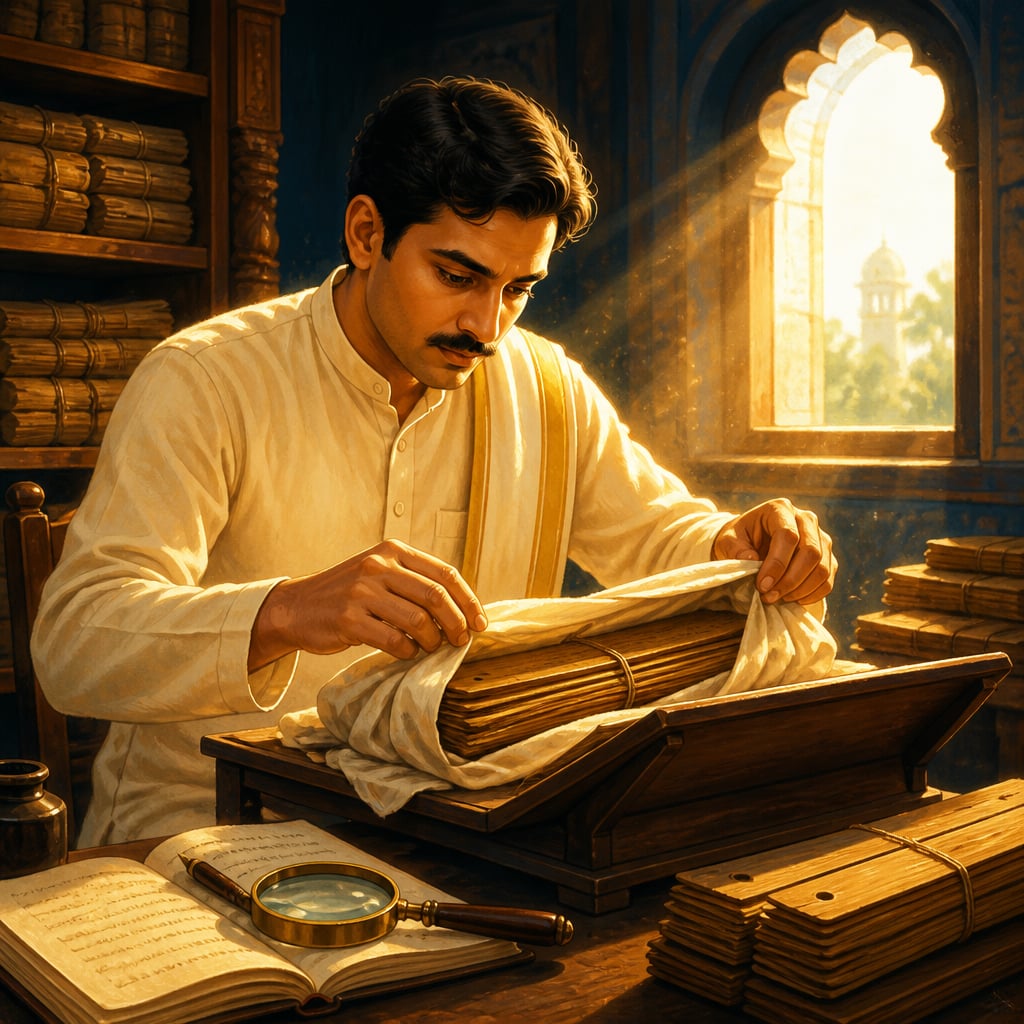
Shamasastry unwrapping the Arthashastra in 1905 Mysore

R. Shamasastry was cataloguing palm-leaf manuscripts in the Mysore Government Oriental Library when he found it.

The year was 1905. India was under British rule. The dusty bundle seemed unremarkable - another ancient text in a collection of thousands. But as Shamasastry began translating, he realized what he held: a complete treatise on statecraft, economics, and governance that predated Machiavelli by 1,800 years.

For centuries, the Arthashastra had been lost. Scholars knew of its existence - other texts quoted it - but the manuscript itself had vanished. Now it was back.

The rediscovery sent shockwaves through the scholarly world. Europeans had assumed that sophisticated political theory was their invention. Here was evidence that ancient India had produced an equally elaborate - and in some ways more sophisticated - system of governance thought.

But why does it matter today? What makes a text written for 4th-century BCE monarchies relevant to 21st-century democracies?

The Permanent Problems

The Arthashastra endures because the problems it addresses are permanent.

How do you build capable organizations? Kautilya answered: recruit for character and competence, test loyalty over time, create conditions where excellence thrives.

How do you prevent corruption? Kautilya answered: assume temptation exists, design systems that detect abuse, make consequences severe and certain.

How do you achieve goals when others resist? Kautilya answered: try persuasion first, then incentives, then strategic pressure, force only as last resort.

How do you sustain success across generations? Kautilya answered: build institutions, not just individual brilliance; develop successors; create systems that outlast any single leader.

These questions don't change with technology or political system. A startup founder in Silicon Valley faces the same fundamental challenges as Chandragupta building the Mauryan empire. The context is different; the underlying problems are identical.

"Man changes, yet remains the same; hence the lasting value of ancient wisdom." , Heinrich Zimmer, Indologist

The War College Reading List

Army War College officers studying the Arthashastra

The U.S. Army War College includes the Arthashastra in its curriculum. So does the Indian National Defence College, the Australian Defence College, and strategic studies programs worldwide.

Why do military officers study a 2,300-year-old text?

The mandala theory - Kautilya's framework of concentric circles of allies and enemies - directly influenced modern geopolitical thinking. Henry Kissinger's balance-of-power approach echoes Kautilyan analysis.

The chaturnaya - sama, dana, bheda, danda - provides a framework for influence operations that predates modern psychological warfare doctrine.

The intelligence system - Kautilya's detailed treatment of espionage and information gathering anticipated many principles that intelligence agencies "discovered" millennia later.

General David Petraeus, studying counterinsurgency, found that Kautilya had addressed the same challenges: how to win hearts and minds, how to gather intelligence in hostile environments, how to balance force and persuasion.

"Ancient doesn't mean obsolete," Petraeus noted. "Some insights are timeless because the fundamentals of conflict don't change."

The Business School Application

Indian MBA professor teaching the chaturnaya framework

MBA programs at Harvard, INSEAD, and leading Indian business schools reference Kautilyan principles. Corporate strategy courses cite the chaturnaya. Leadership programs draw on his insights about talent development.

Why does ancient statecraft apply to modern business?

Because the challenges of organized enterprise are fundamentally similar whether you're managing a kingdom or a corporation.

Building teams: Kautilya's amatya selection criteria - competence, character, loyalty tested over time - translate directly to executive recruitment.

Strategy: The mandala framework applies to competitive positioning. Your competitor's competitor might be your natural ally. Market dynamics have geometric structure.

Negotiation: The chaturnaya provides a complete negotiation toolkit. Most business schools teach the same sequence under different names.

Sustainability: The gardener principle - extracting value without destroying productive capacity - is exactly what stakeholder capitalism advocates.

Ram Charan, the legendary business consultant, has noted:

"Kautilya understood organizational dynamics that modern management theory is still catching up to. His insights about talent, strategy, and execution remain directly applicable."

The Personal Development Application

Beyond institutions, the Arthashastra speaks to individuals.

Self-mastery: Kautilya's emphasis on indriyajaya - conquering the senses - anticipates modern research on impulse control and emotional intelligence.

Relationship management: His framework for evaluating allies (tests of temptation, danger, and time) provides practical guidance for building genuine support networks.

Financial wisdom: The gardener principle, diversification of income, productive effort as the root of wealth - these translate directly to personal finance.

Decision-making: The pause before decisions, the sequencing of methods, the realistic assessment of self and others - all applicable to individual choices.

Tim Ferriss, the productivity author, has cited Kautilyan principles without knowing their source:

"Everything I've learned about decision-making under uncertainty - waiting when emotions are high, exhausting peaceful options before escalation, building systems rather than depending on willpower - appears in ancient texts."

What Makes Wisdom Timeless

Not all ancient texts remain relevant. What distinguishes those that do?

First: They address permanent features of human nature.

People are tempted by power. They form alliances and rivalries. They respond to incentives. They need governance to prevent chaos. These constants don't change with technology or culture.

Kautilya wrote for human nature as it is, not as idealists wish it were. His realism ensures continued relevance.

Second: They provide principles, not just prescriptions.

Kautilya's specific recommendations for elephant management are obsolete. His principle that sustainable extraction beats maximum extraction applies forever. The wisdom lies in the principles; the examples are illustrations.

Texts that provide only context-specific rules become historical curiosities. Texts that extract timeless principles from specific contexts endure.

Third: They integrate multiple domains.

The Arthashastra combines economics, psychology, military strategy, administration, and ethics into a coherent system. This integration is rare and valuable - most texts address single domains.

Leaders face integrated challenges. They need integrated wisdom. The Arthashastra provides it.

The Limits of Ancient Wisdom

But intellectual honesty requires acknowledging limits.

Kautilya wrote for monarchies. His system assumes centralized authority without democratic accountability. Extracting principles for democratic contexts requires interpretation.

His specific contexts are obsolete. Recommendations for managing royal harems or elephant corps don't apply. The challenge is distinguishing timeless principles from period details.

He didn't face modern challenges. Nuclear weapons, global media, instant communication, climate change - Kautilya couldn't anticipate these. His framework needs extension, not just application.

His assumptions need examination. Did he adequately consider women's perspectives? The interests of conquered peoples? The limits of state power? Critical engagement is essential.

The goal isn't uncritical acceptance but thoughtful appropriation - taking what applies, adapting what needs translation, discarding what's genuinely obsolete.

The Synthesis Position

After studying the Arthashastra, what should you take forward?

The citizen welfare test: Judge institutions by whether they genuinely serve those they claim to serve. This criterion cuts through ideology.

The sequence of methods: Exhaust peaceful options before escalating. The discipline of the chaturnaya prevents premature force.

The gardener principle: Extract sustainably. Short-term maximization destroys long-term capacity.

The self-mastery foundation: Governance begins with self-governance. External success built on internal chaos will collapse.

The institutional focus: Build systems that outlast individuals. Personal brilliance doesn't scale; institutional capability does.

The realistic assessment: Know your actual capabilities and those of others. Neither pride nor insecurity serves effective action.

These principles apply across contexts - governance, business, personal life - because they address permanent features of organized human activity.

Your Place in the Tradition

You've now studied a text that has influenced thinkers for over two millennia.

Before you, generations of Indian rulers, British administrators, independence activists, and modern strategists have read these same words. After you, future generations will grapple with the same questions.

You're part of a living tradition of engagement with Kautilya. Your interpretations, applications, and critiques contribute to how this wisdom evolves.

What will you do with what you've learned?

The Arthashastra offers no final answers - only frameworks for thinking. The application is yours to work out. The challenges are yours to face.

Kautilya gave you tools. Building with them is your responsibility.

"विद्या विवादाय धनं मदाय शक्ति: परेषां परिपीडनाय। खलस्य साधो: विपरीतमेतत् ज्ञानाय दानाय च रक्षणाय॥"

"For the wicked, knowledge is for disputation, wealth for arrogance, power for oppression. For the good, it is the opposite: knowledge for wisdom, wealth for giving, power for protection."

The choice is yours.

Elon Musk advocates 'first principles thinking' - reasoning from fundamentals rather than copying existing solutions. Kautilya similarly extracted principles that apply across changing contexts.

Kautilya's principles have been tested across 2,300 years and multiple contexts - governance, business, personal life. This track record provides confidence that the principles, not just specific applications, are sound.

Singapore applied Kautilyan principles without following his specific prescriptions. The gardener principle guided tax policy; the praja-sukhe principle shaped governance philosophy. Principles transferred; applications adapted.

Charlie Munger advocates 'mental models' from multiple disciplines. Systems thinking emphasizes interconnections. Modern complexity science studies how domains interact. Kautilya anticipated all of these.

The Arthashastra provides an integrated system, not just insights from multiple domains. Kautilya shows how economics connects to politics connects to psychology connects to ethics. The integration itself is the value.

Lee Kuan Yew combined economic understanding, psychological insight, political strategy, and institutional design to build Singapore. His success came from integration, not single-domain expertise.

Richard Feynman distinguished 'knowing the name of something' from 'knowing something.' Kautilya similarly provides frameworks for understanding, not just facts to recall.

The Arthashastra's self-description as 'light' encourages critical engagement rather than blind acceptance. This prevents the text from becoming rigid dogma while preserving its illuminating power.

The most successful applications of Kautilyan wisdom - Singapore, modern business - involved creative adaptation, not literal implementation. The text illuminated challenges; practitioners found solutions.

Verses

आन्वीक्षिकी त्रयी वार्ता दण्डनीतिश्च विद्या:

ānvīkṣikī trayī vārtā daṇḍanītiś ca vidyāḥ

Logic, the Vedas, economics, and governance - these are the branches of knowledge.

Kautilya integrated multiple domains - philosophy, tradition, economics, politics - into a coherent system. This integration is why the Arthashastra endures: leaders face integrated challenges requiring integrated wisdom.

Book 1, Chapter 2, Verse 1-3 (R.P. Kangle)

प्रजासुखे सुखं राज्ञः प्रजानां च हिते हितम्

prajā-sukhe sukhaṃ rājñaḥ prajānāṃ ca hite hitam

In the happiness of the subjects lies the king's happiness; in their welfare, his welfare.

This principle explains why the Arthashastra remains relevant: it provides a timeless criterion for evaluating governance. The test isn't ideology or form but whether citizens actually benefit.

Book 1, Chapter 19, Verse 34 (L.N. Rangarajan)

शास्त्रं ज्योतिः प्रकाशं च

śāstraṃ jyotiḥ prakāśaṃ ca

The shastra is light and illumination.

Kautilya saw his text as illumination - not final truth but a light for navigating darkness. The Arthashastra doesn't provide all answers; it provides frameworks for finding them.

Book 15, Chapter 1, Verse 72-73 (R. Shamasastry)

Case studies

The Rediscovery of 1905

In 1905, R. Shamasastry found a palm-leaf manuscript in the Mysore library. For centuries, scholars knew of the Arthashastra only through quotations in other texts - the original seemed lost. Shamasastry's discovery restored a complete treatise on ancient Indian statecraft to world literature.

The rediscovery itself illustrates Kautilyan principles. Valuable knowledge can disappear but resurface when conditions allow. Institutional preservation (the library) protected what individual attention had missed. Patient scholarship - Shamasastry's cataloguing work - yielded unexpected treasure.

Within decades, the Arthashastra entered curricula worldwide. It challenged Western assumptions about the origins of political theory. It provided Indians recovering from colonialism with evidence of sophisticated indigenous political thought. It continues to influence practitioners today.

Wisdom can disappear and be recovered. Institutional preservation matters. What seems lost may only be waiting for the right person to recognize it. Your engagement with the Arthashastra continues this chain of transmission.

Lost texts continue to reshape our understanding of ancient civilizations. The 2023 use of AI to read carbonized Herculaneum scrolls destroyed by Vesuvius in 79 CE demonstrates that recovery of ancient knowledge is accelerating. Each rediscovered text, like the Arthashastra, forces modern scholars to revise assumptions about what pre-modern thinkers understood.

R. Shamasastry discovered the Arthashastra manuscript in 1905 among a collection of palm-leaf texts in Mysore. He published the full Sanskrit text in 1909 and the English translation in 1915, revealing a 6,000-verse treatise spanning 15 books and 150 chapters.

Historical context

4th century BCE to present

The Arthashastra's rediscovery came during the independence movement, when Indians were questioning colonial narratives about their civilization. Finding a sophisticated political treatise from ancient India challenged Western assumptions about the origins of political theory.

The Arthashastra's continued relevance isn't nostalgia - it's evidence that some problems are permanent and some solutions endure. Understanding why ancient wisdom remains useful reveals something important about the nature of wisdom itself.

Living traditions

The Arthashastra is now studied on six continents. Business schools assign it for strategy and leadership. Military institutions analyze it for statecraft and intelligence. Self-improvement literature echoes its psychological insights. This global engagement demonstrates that Kautilya's wisdom, while rooted in ancient India, addresses universal human challenges.

Reflection

More in Arthashastra Today

All lessons in Arthashastra Today · Arthashastra: Philosophy of Power course